Destroy Your Competition With GEO (6 Steps)

Everyone's GEO strategy right now is the same: publish "best [category] tools 2026" on your own blog and put yourself first.
We did it too. On the ChatSEO blog, we ranked ourselves #1 in our own comparisons.
Then the data came in. Lily Ray's study of AI Overviews found that when Google cites a self-serving listicle, it leaves the brand out of the actual recommendation 69% of the time.
Your page becomes a source. Your competitors become the answer. Seer measured the same shift on ChatGPT: listicle citations dropped 30% in a single month across 2M tracked citations.
The models figured out that everyone ranks themselves first. So they cite #2 and #3 from your own list.
We removed ourselves from the top of our own rankings. And we moved the entire effort off-site.
Here is the playbook.
Step 0: earn the right
Good GEO is good SEO first. A clean site, a real brand, fresh content, structured pages. If your site is a mess, no amount of off-site work saves you, because when the LLM checks the source it lands on your domain.
We never ran a single link building campaign.
We checked ChatSEO in Ahrefs anyway: DR 51.
Where did it come from?
One Reddit thread. One honest review from a site with authority. That's what a real brand accumulates by accident. GEO is doing this on purpose.
Step 1: pick your GEO keywords
GEO queries are almost always comparative. Three families:
- best [your keyword] 2026
- [your brand] reviews
- [your brand] alternatives
If you have no idea how to find them, **ChatSEO can do it for you (for free).**
Take your main commercial keyword, add "best" in front and the year behind. You have at least 20 of these if you look. The year matters: LLMs favor recent sources, so a 2026 ranking beats a stronger 2024 one.
Step 2: get into rankings on other people's sites
This is the core move. Three levels, by cost and durability:
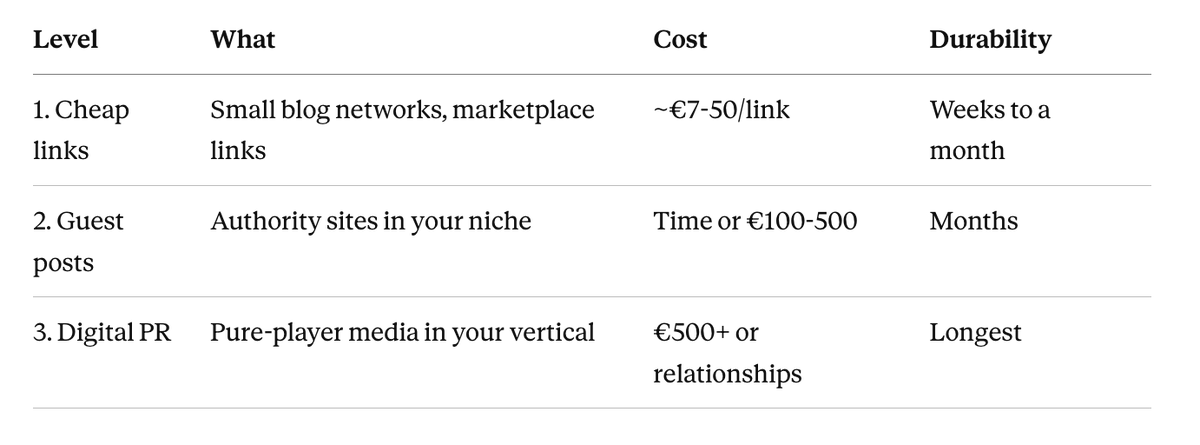 — "Three levels"
Level 1 sounds dirty but it's a lab. LLMs love fresh content, so even a €7 link on a small site can hold your ranking in ChatGPT for a month. Cheap enough to test which queries move.
Level 3: target digital pure players, not legacy press. If you're ranking a Chinese restaurant in Paris, a "what to do in Paris" site beats a national newspaper. Cheaper, more crawlable, no paywall. Paywalled articles are useless here: the crawler hits the subscribe wall after three sentences.
Step 3: ranking exchanges
Writing a "best X" list for someone else takes the same time as writing your own. So trade. You rank them for their target query, they rank you for yours.
We do this constantly. Best SEO tools, best SEO agents, best SEO MCP servers. Each exchange compounds: the more rankings you publish, the more people want in, the more spots you get.
And nobody removes you from an exchanged ranking. They know you'd remove them right back.
Step 4: parasite the platforms LLMs actually read
Reddit is the most-cited domain across AI engines, with YouTube, LinkedIn and Wikipedia right behind. These platforms have their own domain authority. On Reddit it's called karma.
Two rules:
Match the platform to your niche. GitHub if you sell to developers. Instagram and TikTok if you sell cosmetics. Don't copy someone else's channel mix.
Don't burn accounts. Build a real presence, then make 1 post in 4 target a GEO query. Pure spam gets filtered by moderators and by the models.
Step 5: the contributor hack
Media sites need writers. Become one. My co-founder wrote for Journal du Net with an author account and links back to his site. Antoine from our podcast wrote for Les Echos for a year.
You'll never publish "best agency: mine" there. You don't need to. A byline on a high-authority domain, with your name and your company in the signature, feeds the exact entity association LLMs use to answer "who are the best consultants in X".
Step 6: reviews
Pick one platform and concentrate. Splitting reviews across five platforms dilutes all of them.
Local or service business: Google Business Profile, because of Maps. SaaS or ecommerce: Trustpilot, it's what shows up when someone asks "[brand] reviews".
The honest caveats
This is one company's experience plus third-party studies, not a controlled test. Citation volatility in AI engines is measured in weeks, so re-check your queries monthly. And self-first rankings still work in classic Google SERPs sometimes, so if your traffic is mostly Google today, that's a real trade-off before you delete anything.
But the direction is clear. LLMs answer comparative queries with sources that don't have skin in the game. Be in those sources.
Related articles

jev for seo is insane (here's why)
Jev launched on September 15 behind a waitlist. It doesn't chat. It doesn't generate text. You send it state and a typed question, it returns a probability in about 250 milliseconds, for a fraction o…

How We Generated Millions Of Organic Clicks With Programmatic SEO
most SEO looks like this:
Our Entire $35M AI SEO Playbook (and how to copy it)
in 2003 you could publish a blog post and rank on Google in a WEEK