First $1 Roadmap: How I’d Make Money Online If I Was Starting Over (After Generating $30,000,000)

I made my first $1 online in 2014. But the world has changed. Here’s what I would do if I was starting over today.
I made my first $1 writing online in 2014.
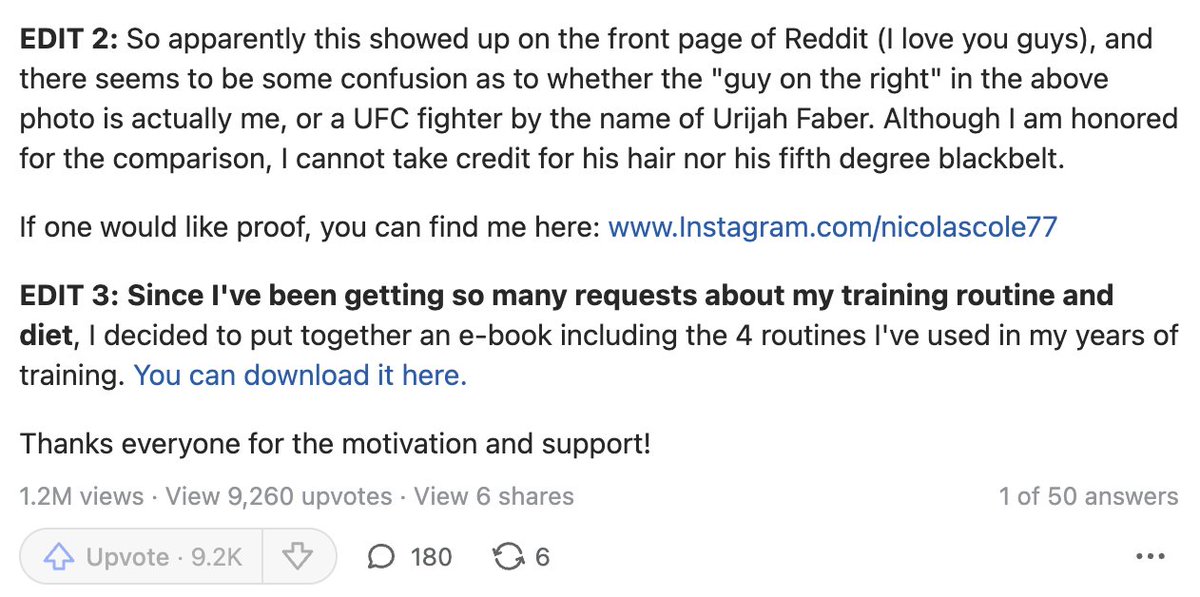
I wrote a viral answer on a little-known website at the time called Quora about my bodybuilding transformation, and how I had gone from weighing less than 100 pounds as a senior in high school to putting on 70 pounds of muscle and becoming a shredded bodybuilder by age 24.
And at the top of the short story I wrote, I put a Before & After image — showing the transformation:

That Quora answer ended up on the front page of Reddit, and accumulated over a million views in just a few days.
And I got probably a hundred emails from guys who said, “I look just like you did, and I want to put on muscle too.”
Which is how I came up with the idea for my very first digital product:
That Quora answer ended up on the front page of Reddit, and accumulated over a million views in just a few days.
And I got probably a hundred emails from guys who said, “I look just like you did, and I want to put on muscle too.”
Which is how I came up with the idea for my very first digital product:
An eBook called Skinny to Shredded.
And I made two of them:
- Skinny to Shredded: Workout Routines
- Skinny to Shredded: Nutrition Guide
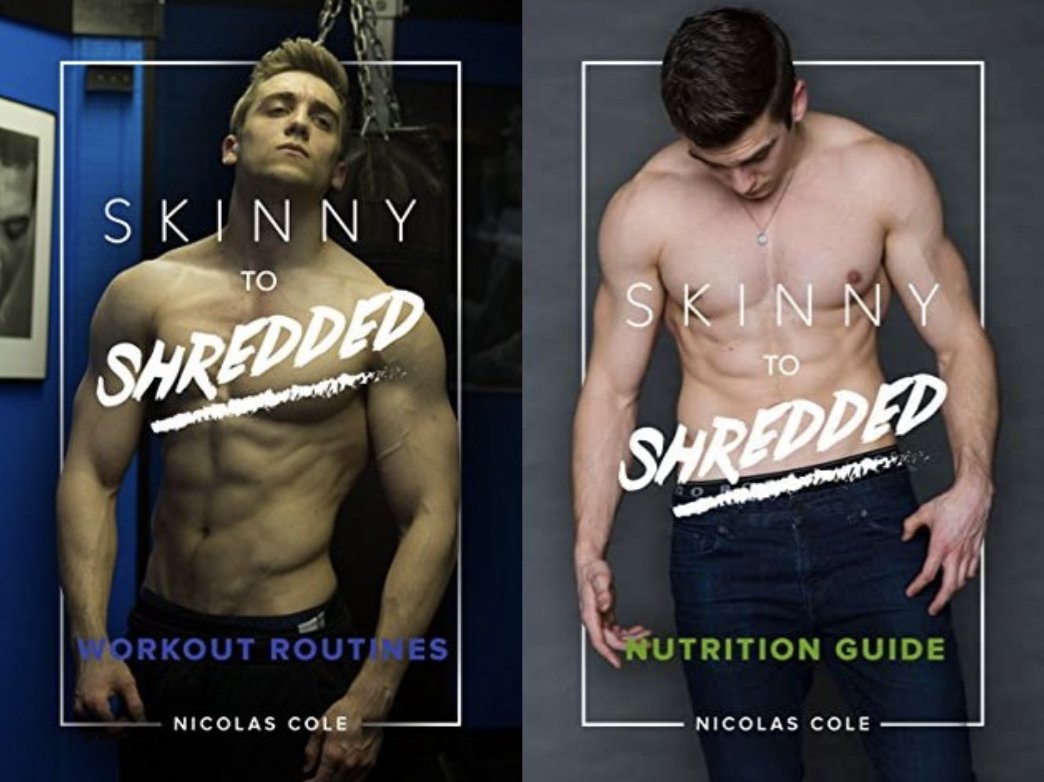
I spent the entire weekend putting them together:
- I bought www.nicolascole.com — which is the same domain I use as my primary website today.
- I built a simple 1-page website using Squarespace.
- I wrote both eBooks in Microsoft Word.
- I used some pictures I’d taken with my bodybuilding friends at the gym, and some I’d taken from trying to become a fitness model
- And I asked a designer at the advertising agency I was working at if she would help me create the covers (and I bought her lunch as a Thank You)
Then, Sunday night, just two days later, I turned my website live, made my eBooks available for sale, and added a link to the products at the bottom of that viral Quora answer.
It’s still there on Quora if you want to take a look.
And I will never forget sitting in our Monday Morning All-Hands meeting.
My phone in my pocket was just buzzing non-stop.
- Stripe notification
- Stripe notification
- Stripe notification
By lunch, I had earned more money selling eBooks than I would make working my full-time job all week!
That simple eBook series is how I made my first $1 online.
And my first $100.
And my first $1,000.
And my first $5,000.
For months thereafter, it just kept selling. Not a ton. But enough to put an extra couple hundred bucks in my pocket each month — which was a lot for me back then.
More importantly, it introduced me to the idea of leverage on the Internet. You can create something once, but continue to sell it forever. Even a decade later, whenever I tell this story, people STILL ask me where they can buy those old eBooks.
That moment of making my first $1 online changed my life, and introduced me to a completely different way of thinking about what it means to provide for yourself in the digital age. The old path of “go to college, get a job, work for 40 years, then retire” isn’t the only path anymore. If anything, it’s dying and no longer a viable path at all. And it’s being replaced by a new path that is more flexible, more lucrative, and most of all, more fun.
(And remember, I was doing all of this back in 2014… before all the incredible tools and platforms we have today!)
If I was starting over today, here’s the full roadmap I would follow to make my first $1 online — and hopefully a lot more.
And for context, since I launched that first digital product way back in 2014, I have generated over $30,000,000 across 8 different business models building digital products and providing services online:
- I have generated over $1,000,000 self-publishing non-fiction books.
- I have generated over $1,000,000 with paid newsletters.
- I have generated over $1,000,000 with SaaS.
- I have generated over $3,000,000 with consulting.
- I have generated over $3,000,000 with low-ticket digital products.
- I have generated over $5,000,000 with cohort-based courses.
- I have generated over $5,000,000 with ghostwriting services.
- And I have generated over $10,000,000 with high-ticket group coaching.
I only share that so you know where my advice is coming from, and to also show you there are lots of different ways to monetize your knowledge online.
So first, let’s walk through the roadmap at a high-level. And then, go through each step — so that by the end of this, you know exactly what to do, why you should do it, and how to make your first $1 online (and hopefully, a lot more money thereafter).
The Roadmap To Your First $1 Online

There are 7 steps to making money online.
None of them are hard. And the roadmap from where you are today to where you want to go is very straightforward.
The hard part is staying committed long enough to see your sacrifices turn into Stripe notifications.
The roadmap goes like this:
- Step 1: Pick a niche. The most effective way to make money on the Internet is to become known for a niche you own — and the smaller, more specific the niche, the more likely you are to become what I like to call “Niche Famous.” You want people to associate you with that niche. Because the more people associate you with a specific niche, the more products and services you can launch within that niche over a prolonged period of time. One of my favorite examples is Ryan Holiday. What’s his niche? Stoicism. He writes articles about Stoicism. He has a newsletter about Stoicism. He has a podcast about Stoicism. He’s written 10 books about Stoicism. And guess what? When he goes to his publisher and says, “I’m ready to write another book,” and they hand him another 7-figure advance, what do you think the topic of the book is going to be? The book is going to be about Stoicism! This is the whole game. You don’t want to become known broadly. You want to become known for a niche you own. And I’m going to walk you through my framework for identifying the perfect, most lucrative niche for you.
- Step 2: Start writing online. The way you validate demand for any product or service you want to monetize inside of a niche is to start writing online. And by the way, if you don’t know what niche or topic you want to commit to, then the answer is to write about anything and everything that is interesting to you and see what “sticks.” What’s resonating with readers? What do they want more of from you? What questions do they have? I usually tell people it takes at least 30 days of writing and publishing every single day to gather enough data to get a sense of which direction you should move next — which is the whole reason why we started Ship 30 for 30. It’s a 30-day writing challenge that holds you accountable and forces you to write and hit publish every day for 30 days. By the end of the month, you have 30 pieces of published content (the foundation of your library), and more importantly, you have 30 data points. Those data points will tell you where there’s customer demand.
- Step 3: Start a newsletter. To sell any product or service, you need emails. To build an email list, you need to write online. And to effectively write online and build a niche audience, you need to commit to a niche. See how each of these steps connect to each other? Think of your email list as the engine of your entire business. The more people you have on your email list, the more money you will make. And I’ll walk you through my strategy for turning social content into weekly newsletters, but the big idea here is that your newsletter should really just be the longer-form version of the same topics you are writing about online.
- Step 4: Create an offer. Once you’ve committed to a niche, started writing online about that niche, and started a weekly newsletter in that niche, now it’s time to make your free readers a paid offer! An offer is just how you solve someone else’s problem. And how you solve someone else’s problem is what dictates your business model. For example, if you solve someone else’s problem with information, maybe your business model is selling eBooks (like I did), or starting a paid newsletter, or launching a course. If you solve someone else’s problem with custom-tailored advice, maybe your business model is selling consulting. If you solve someone else’s problem by doing the work for them, maybe your business model is selling services. You get the idea. And I’ll help you decide which offer and business model is right for you, based on your chosen niche, skills, and goals.
- Step 5: Make your first $1. If you have a product for sale, in a niche, that helps someone solve an urgent, painful, and ideally expensive problem in their life or business, and you write about that same topic on a social platform every single day for 90 days in a row, you will probably make your first $1 online. You might even make your first $1,000 or $10,000 online. I have no idea. I don’t have control over the decisions you make or how consistent you are. But what I do know is that it is very, very, very hard to not-make-money online if you have a helpful product for sale, in a niche, and then you consistently create helpful content in that niche for a prolonged period of time. None of these things are hard. The hard part is not giving up before it happens. (And by the way, putting a product up for sale, or starting to sell a service, is very simple. I’ll walk you through it.)
- Step 6: Gather testimonials. The biggest mistake I made with my first digital product is that I put it up for sale, I made some money, and then I never improved the product and I never collected customer testimonials to use in future marketing. In hindsight, I bet I could have made my first $100,000 online if I had just done those two simple things: make the product better, and use customer testimonials to sell more products. Which is exactly what you should do — and I’ll give you a checklist you can use, once your product is live and selling, to generate even more revenue.
- Step 7: Monetize in more ways! The last step, once you’ve made your first $1 online, is to start stacking different business models on top of each other so you can generate more revenue per customer. For example, if you have a paid newsletter, why can’t you downsell subscribers on specific eBooks? If you sell services, why can’t you upsell your best clients on even more expensive consulting? If you sell courses, why can’t you cross-sell other courses and digital products? I have generated millions of dollars selling individual products and services. But I have generated tens of millions of dollars, selling “other things” to existing customers. This is the whole secret to making money online, and why the hardest part of the journey is starting. Because once you start becoming known for a niche you own, start writing online, start shipping your weekly newsletter, and start making money, momentum begins working in your favor.
So, that’s the roadmap.
Is it simple? Yes.
But is it easy? Absolutely not.
“How to make money online” is literally one of the most popular topics on the Internet. Everyone wants to do it. But the reason not everyone is successful is because they think there’s some secret key on the keyboard that, when you press it, gives you “passive revenue” with no work required.
And that’s just not true.
Making money online, in any niche, selling any type of product or service, takes work.
But once you build the skills, master the fundamentals of writing online, and learn how to monetize in multiple different ways, you can make money forever.
So, I want to set you up for success.
Let’s walk through each step — so you know exactly what to do, why it’s important, and how to do it correctly.
Step 1: Pick a niche.

Your niche should be an industry where you have what I like to call an Information Advantage.
An Information Advantage just means you know more things about this industry than the average person.
For example:
- If you’ve worked as a nurse in a hospital, you have an Information Advantage in healthcare.
- If you played hockey as a kid, you have an Information Advantage in athletics.
- If you are obsessed with Pokémon cards, you have an Information Advantage in collectables.
The easiest way to identify where you have an Information Advantage is to audit these 3 areas of time spent:
- Jobs: Any job you’ve ever had has given you an inside look at that particular industry. Which means you know things (even if they’re simple, fairly basic things) the average person does not — because they’ve never worked a job in that industry before. For example, if you’ve worked in retail, you inherently know more about “working in retail” than someone who has never worked in retail before. This also applies to people close to you who hold jobs of their own. For example, my dad is a spine surgeon. Just by being his son, I have soaked up lots of random knowledge and terminology when it comes to spine surgeries. In a small way, this gives me an Information Advantage.
- Hobbies: Anything you’ve ever gotten interested in, either as a kid or an adult, means you spent a prolonged period of time learning about it. Which means you have an Information Advantage, and know things the average person doesn’t. For example, if you spent your college years teaching yourself music production, then you know more about “music production” than someone who has never taught themselves that skill before. This also applies to people close to you who expose you to hobbies and interests of their own. If your best friend is a pilot and flies planes, you probably don’t even realize how much you’ve learned just by being their friend and listening to them talk about their interest. In a small way, this gives you an Information Advantage.
- Experiences: Anything you have personally experienced means you have an Information Advantage in that particular experience — and the more rare or unique the experience, the more rare and unique the Information Advantage. For example, if you’ve experienced a parent overcoming a sickness, that’s an Information Advantage. Or if you’ve experienced traveling to a certain country, or done something crazy like jumped out of an airplane, those are Information Advantages. You know more about those things than people who have never done those things before.
For example, back in 2016, I was a columnist for Inc Magazine. I wrote a daily column about creativity and business. So when I started ghostwriting and providing writing services to founders and business owners a year later, in 2017, and they would ask me to help them get their own writing in major publications, I could tell them. Because I was already doing that for myself.
I had an Information Advantage.
You should not choose a niche, or pick a topic without some sort of Information Advantage.
This is probably the biggest mistake people make when they decide to start writing and creating content online, with the hopes of one day making money.
They think their niche can be ANYTHING. And it can’t. No one is going to listen to you talk about a topic you know nothing about. The ONLY reason “people follow people” online is because there is an Information-Advantage-trade happening.
- You know things about this topic most other people don’t.
- People follow you to learn those things in a fraction of the time — so they don’t have to go through all the work you had to go through in order to learn the things you know now.
That’s it.
And if that doesn’t convince you to start with a niche where you already have an existing Information Advantage, here’s an even more logical way of thinking about it.
When it comes to making money on the Internet, there are lots of marketing & monetization skills you need to learn.
- You need to learn how to write clearly
- You need to learn how to generate infinite ideas within a niche
- You need to learn how to hook people’s attention
- You need to learn how to retain people’s attention
- You need to learn how to move readers from social platforms over to your email list
- You need to learn how to write compelling emails — compelling enough to keep them subscribed, and ultimately buy something of greater value
- You need to learn how to build a landing page
- You need to learn how to write a landing page
- You need to learn how to process payments on a landing page
- You need to learn about upsells and downsells to increase each customer’s lifetime value
The list goes on and on.
And none of these skills are hard to learn. Each one maybe takes 5 or 10 hours to reach a moderate level of proficiency. That’s nothing. That’s a Saturday morning. That’s a weekend.
But now imagine trying to learn all of these skills, while simultaneously applying them to a niche you know absolutely nothing about. You have no Information Advantage.
Well, if you thought building all those marketing & monetization skills was “a lot of work,” congratulations, because the work just doubled. Now you have to learn all of those things AND start from the very beginning learning about an industry you’ve never worked in, never had a hobby in, and never experienced — but you picked it because it seemed popular, or lucrative, and you thought that was a shortcut to success.
So, here’s a little secret for you: the shortcut is always the longer road in disguise.
And you would get to where you’re trying to go a whole lot faster if you just started with something you already knew a lot about.
Now again, an Information Advantage does not mean you have to have won some huge award, or made millions of dollars. An Information Advantage quite literally just means you know more than someone who hasn’t done that thing before. A silly example I like to use with students inside our AI Writing Skool is: imagine you love reading Thrillers, and you want to start writing online about the best Thrillers to read. You want to start a Thrillers Book Club.
So, what’s your Information Advantage?
Well, it might be something like: “Over the past 10 years, I have read over 500 Thrillers.”
That’s all it has to be.
Your Information Advantage is just context.
It helps the reader understand why they should listen to you.
And you might not realize it, but you look for this signal every single day when you scroll on your preferred social platform. The next time you’re scrolling X or LinkedIn or TikTok or Instagram Reels or YouTube, pay attention to what grabs your attention. It’s almost always a piece of content that does 3 things:
- Speaks directly to a niche interest of yours.
- Promises to help you either solve a problem or help you achieve an outcome.
- And starts with some form of context — meaning the writer or creator tells you their Information Advantage.
Usually something like:
“I’ve been an interior designer for 10 years. So if you want to remodel your kitchen, let me give you a few tips to make it look professional without blowing through your budget.”
This simple “hook” is doing all 3 of those things!
- It’s speaking directly to a niche interest: interior design.
- It’s promising to help achieve a desired outcome: remodel your kitchen without blowing through your budget.
- And it begins with the creator sharing their Information Advantage, which is really just context to why you can trust them: they’ve been an interior designer for 10 years!
So when you “niche down,” all you’re really doing is committing to write and create lots and lots of content about a specific topic in an industry where you have some sort of Information Advantage.
Now, whenever I explain this idea of niching down in an industry where you have an Information Advantage, I always get asked the same 3 questions. And the thing is, they’re not even really questions. They’re more objections to this strategy, phrased as questions. So not only do I want to answer them for you, but I want to help you understand why these objections are incorrect and just clever ways you’ve convinced yourself to avoid taking action.
Question #1: “But Cole?! If I pick a niche, won’t that exclude certain people? Won’t that mean I’ll be limiting my opportunity? I won’t make any money!”
This is, by far, the biggest question and objection people have when it comes to niching down.
First of all, people think that when they pick a niche, that means they “can’t speak to everyone.”
And that’s correct. You can’t speak to everyone. Because when you try to speak to everyone, you end up speaking to no one.
For example, just think about who you follow on social media.
Do you follow one person for “everything?” No, of course not.
- You follow one person for fitness advice.
- And you follow another person for travel recommendations.
- And you follow another person for investment strategies.
- And you follow another person for news and trending topics.
- And you follow another person for memes and pop culture.
It would be impossible for you to speak on “all topics” for “all people.”
Second, it’s not until you commit to a niche for a prolonged period of time that you realize just how deep each niche can go.
For example, I’ve been writing about digital writing and writing on the Internet since 2015. That’s over a decade! And today, after writing thousands and thousands of articles and newsletters and Tweets, and making YouTube videos, and writing books, and recording podcasts, all on the same topic, I am STILL coming up with new ways of explaining concepts to readers.
The deeper you go in a niche, the more you realize how much more there is to say.
But if you haven’t done this work yet, then yes, it’s very easy to think that you can write about 10 different niches and be the best person to listen to in each of them.
We call this blissful ignorance.
Question #2: “But Cole?! What if I have lots of interests, and lots of Information Advantages? Which one should I pick?”
I get it. I have lots of interests and Information Advantages too.
- When I was 17 years old, I was one of the highest-ranked World of Warcraft players in North America. I have an Information Advantage in online gaming.
- When I was in college, I completely changed my physique and became a bodybuilder. I have an Information Advantage in fitness and bodybuilding.
- When I graduated from college, my first job was working as a copywriter at an advertising agency. I have an Information Advantage in advertising, marketing, and how ad agencies work.
- When I quit my job in 2016 to work for myself, I started and scaled a ghostwriting agency to millions of dollars in revenue. I have an Information Advantage in ghostwriting.
I’ve built multiple 7-figure companies. I also love wine and luxury sports cars. I’m a tequila snob. My siblings and I all grew up playing piano and violin, and I played classical piano for 20 years.
All of these are potential “right” answers.
So, here’s the exercise I coach writers through inside our writing programs to help them identify the best Information Advantage for them.
- First, list out every Job, Hobby, and meaningful Experience you’ve ever had. What you’ll find is you have a lot of different Information Advantages to choose from — most of which you probably take for granted.
- Next, looking at that list of 10 or 20 Information Advantages, stack-rank them by knowledge. Out of that entire list, which one do you know the most about? Then which topic second? Which topic third? You should end up with a list that is organized from most-knowledgeable to least-knowledgeable. For example, one of my best friends is a therapist and I have been in therapy for over a decade. I’m a huge proponent of it. So yes, I do have an Information Advantage in this area, but I would hardly consider myself qualified on the topic. So that would probably be near the bottom of my list.
- Lastly, take the top 3–5 Information Advantages you are most knowledgeable about from your list, and start writing about those topics online. You don’t have to commit to a niche yet. But at least this gives you some direction. These are the topics where you possess the most working knowledge. So, write about them, and then out of those 3–5 topics, see which one or two perform the best.
And the way you should measure performance is:
- Which of these topics do readers find most interesting? You can identify this, even in small ways, by looking at views, likes, and comments relative to all other posts. For example, if you write 10 Tweets and 9 of them all get 100 views but 1 of them gets 300 views, that is a 3x difference. That is a data point! A lot of times, people discount these early signals because they think what they’re looking for is a post with a million views. That’s not true. There might be more zeroes, but the logic is the same. Write lots of things. Look for the tiny outliers. Double-down on those. Repeat for a decade.
- Which of these topics do YOU find most interesting? As you write about these 3–5 different topics where you have a strong Information Advantage, I promise, you will very quickly start to realize which ones you enjoy writing about the most and which ones you thought you would enjoy writing about but actually find boring. This is an important part of the learning process.
The final answer to what your “niche should be” is then the result of this exercise, checking these 3 boxes:
- ✅ It’s a topic where you already possess a strong Information Advantage.
- ✅ It’s a topic you see performing well with readers in the form of engagement (even if it’s small).
- ✅ And it’s a topic YOU enjoy writing about — and the more you write about it, the more you realize you have to say.
Whatever topic checks those 3 boxes should be your niche.
And if you want to make money online, then you should commit to that niche for a prolonged period of time.
Because none of the outcomes you desire happen overnight.
Question #3: “But Cole?! I understand all of that… but I want the shortcut. I just want money to rain down from the sky. Can you just tell me what the most lucrative niche is so I can do that?”
Here’s the honest answer:
The most lucrative niche for me is going to be different than the most lucrative niche for you.
That’s because how lucrative a niche is has very little to do with “the niche itself,” and much more to do with the writer or creator who commits to it.
For example, I could tell you that the most lucrative niche in the world right now is advice for Millennial women dealing with postpartum depression. If you write about that topic and launch digital products in that niche, you can crush and probably make loads of money. Why? Because that demographic is chronically online, they love to shop, they have high purchasing power, they tend to control a lot of the purchasing decisions for the household, and they have an urgent and painful problem they desperately want help solving.
OK great, there’s your answer.
The problem is, you aren’t going to go pursue that niche.
Why?
- Because you probably don’t have an Information Advantage in that niche. So now you see the problem. You can’t help people solve a problem you’ve never experienced and know nothing about.
- And because you probably aren’t interested in that topic. So even if you “know” it has the potential to be lucrative, you aren’t going to stay consistent and disciplined and interested long enough to successfully monetize it.
Which is why I tell writers, over and over again:
The best niche is the one you don’t give up on.
Whatever topic you know you will still be interested in 10 years later is the right answer. Because I promise, it doesn’t matter how lucrative you think another niche is… if you don’t have an Information Advantage in it, and you aren’t genuinely interested in continuing to learn about it, you aren’t going to succeed. You’re going to get really excited about it for 2 days and then give up. You’re going to get bored. And when things get hard, or monotonous, you aren’t going push through. And then you’re going to avoid taking accountability for your lack of commitment and blame the niche instead, hoping that if you pick a different niche, an even more seemingly lucrative niche, the problem will magically disappear and THEN money will rain down from the sky.
This is the vicious cycle people stay in for years, sometimes decades.
The problem is never the niche.
The problem is you keep trying to find the shortcut, instead of just committing to a topic you know a lot about and want to help other people become knowledgeable about too.
Step 2: Start writing online.

Once you’ve identified your niche, the easiest way to validate demand for any future product or service is to start writing online.
And there are 5 formats you need to learn how to write if you want to build a niche audience.
Format #1: Short-Form
These are bite-sized pieces of text-based content, like Tweets. But these can also double as scripts or talking points for short-form videos, TikToks, Instagram Reels, YouTube Shorts, etc.

Format #2: Atomic Essays
These are 300-word essays short enough to be written in 30 minutes or less, but long enough that you can start to practice all the fundamental skills of writing online: headlines, formatting, writing rhythms, etc. This is a format we invented for our beginner writing program, Ship 30 for 30, and it has since become an Internet phenomenon. Even people who have never taken Ship 30 write Atomic Essays using our software, Typeshare.
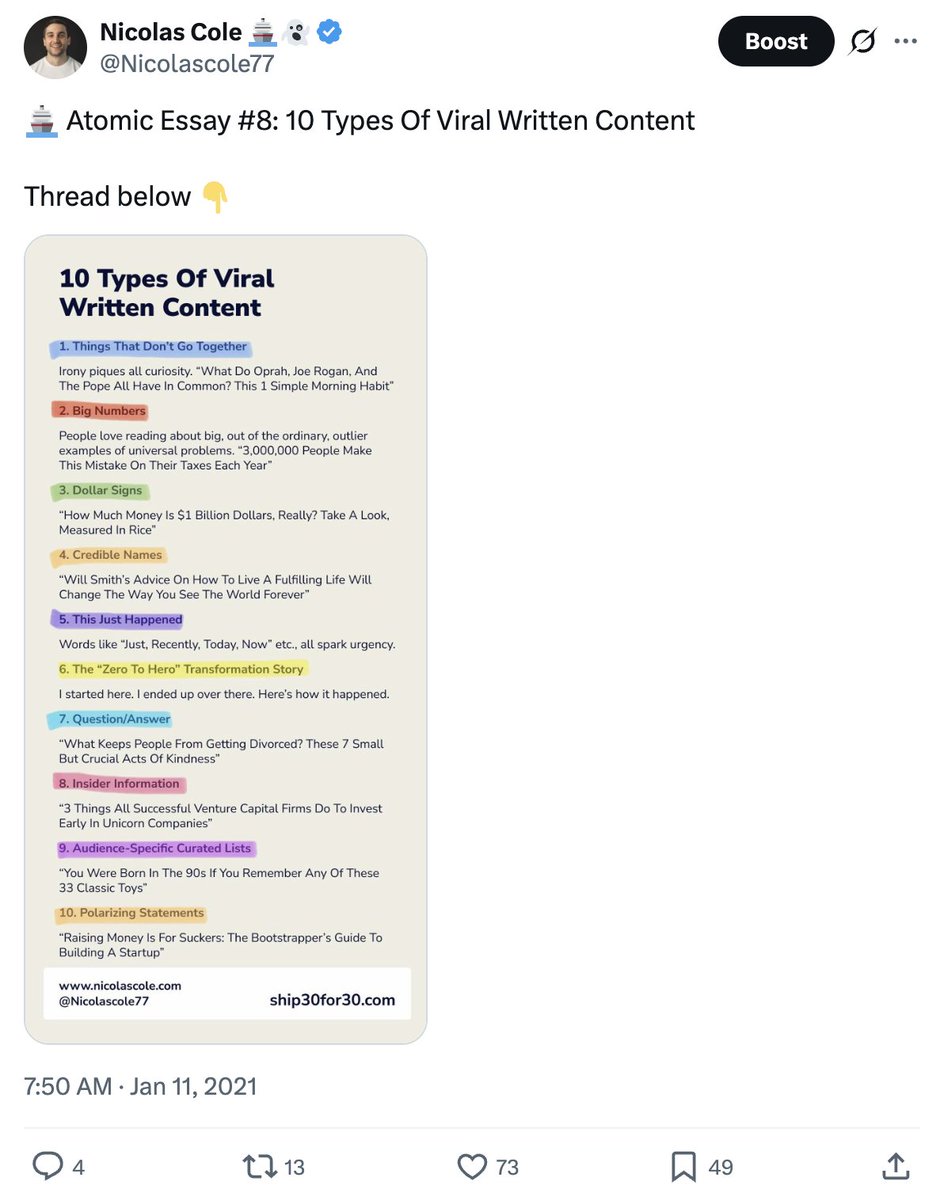
Format #3: LinkedIn Carousels
These are listicles turned into multimedia slideshows that are the highest-performing format on LinkedIn. These Carousels can also double as Carousels on Instagram, or other image-based social platforms like Pinterest.

Format #4: X Articles
These are 800+ word blog posts published as articles on X, but can also be republished across your website, Medium, even your weekly newsletter. Long-form articles can also be the foundation of your entire content strategy, and you can extract dozens of short-form posts from each one.

Format #5: AI Prompts
Lastly, you can get leverage on your writing skills by turning your favorite AI platform into your own personal Writing Assistant — and then turning those prompts into more content/assets for your niche. For example, since my niche is “Digital Writing,” I often share writing, editing, brainstorming, and outlining prompts with my audience.

I train writers & creators on how to write all 5 of these formats inside our AI Writing Skool.
So if you’re brand new to writing online, this is an easy place to start. Because each format has different rules, and each platform has different nuances. I like to think of each format and social platform as a different “sub-language” of Digital Writing — or writing in the digital age.

Now, I know what you’re probably thinking.
“But Cole?! Which platform is the best? How do I go viral? What time of day should I post?”
To which I (kindly) say: you’re asking the wrong questions.
Everyone loves to get fixated on all these little incremental decisions that, in the long run, really don’t matter.
My personal point of view, and the POV I’ve been preaching for over a decade, is that there is no “one perfect platform” and the performance of any individual post is not what’s important. I’ve gone viral more times than I can count, across a wide variety of different platforms. I’ve generated over a billion views on my writing. And I’m telling you, going viral is not what solves your problems, or allows you to build a business and make money online.
My entire thesis for writing in the digital age is that it’s all about the library.
Let me walk you through this:
- The bigger your library of content in a niche, the wider your footprint, the more likely you are to become “Niche Famous.”
- The more you establish yourself as a leading voice in a particular niche, the more people who become interested in that niche become interested in listening to you.
- The more people who follow you, the more you email list grows, the more potential customers you will attract.
- The more customers you attract, in a niche, the more you can sell those customers (not once, but many times over many years).
- The more you successfully monetize a niche, the more excess cash you will be able to reinvest in yourself, your own content, and continuing to expand your footprint in your niche.
Until eventually, you and the niche become synonymous. You have successfully become known for a niche you own.
On top of that, your library of content is yours. You own it. Which means you can do whatever you want with it.
- When a new social platform comes out, you can copy/paste all your highest-performing posts over to that new platform and power-level your niche dominance there too.
- You can turn Tweets into TikToks, TikToks into Instagram Reels, Reels into YouTube Shorts, a bunch of shorts all on the same topic into a YouTube long-form video, etc.
- You can turn articles into newsletters, newsletters into articles.
- You can smash 10 articles or newsletters on the same topic together and self-publish it as a book on Amazon.
- You can turn your book on Amazon into a lead magnet to capture more emails.
- You can expand your book into an online course.
- You can expand your course into a coaching program and curriculum.
The list goes on and on.
In fact, if you want an example, this is what I did with my last book, Writer Career Paths.

I wrote this entire book online. I wrote each chapter as a newsletter, first.
Then, when I was done, I smashed all those newsletters together, did a little light editing, and self-published it on Amazon.
And now that book generates an extra $1,000 per month.
The point is, the most valuable asset you could possibly build for yourself is a library of content, in a niche, over a prolonged period of time.
Because you can re-use all of that content, and double and triple and quadruple monetize all of that content, for decades into the future.
The library matters more than virality.
Step 3: Start a newsletter.

I have been writing online since 2007.
Over the past 20 years, digital distribution and social platforms have changed a lot — the biggest change being from follower-based content to interest-based content.
For example, back in the early 2010s, if you had 10,000 followers and you made a post, that post got shown to a meaningful chunk of your followers. That was the whole point of building an audience on social platforms. More followers meant more distribution.
But then, around 2016, social platforms started to change. Your newsfeed stopped being about who you followed, and started being about topics of interest — showing you posts from people you didn’t follow, but who created content within a niche the algorithm knew you cared about. All of a sudden, followers didn’t matter. What mattered was how well your content performed when the algorithm presented it to groups of people interested in that topic. If people engaged, platforms would distribute your content to wider and wider audiences (causing you to “go viral”), and if your content didn’t perform, then your distribution would fall of a cliff — regardless of whether you had 1,000 followers or a million followers.
Today, followers are an almost meaningless metric.
I have helped over 15,000 people start writing online, and beginners love to think that “more followers” will somehow solve all their problems.
A couple things here:
First of all, everyone starts at zero. When I started writing on Quora back in 2014, right out of college, I didn’t create a new account, “win the lottery,” and get a 5,000-follower head-start. Every single person, who has ever built an audience online, started at 0.
Second, followers are a lagging indicator. You write valuable content in a niche and THEN people follow you. People don’t follow you and THEN you start writing valuable content. You have to build the skill before people will give you their attention.
Third, social platforms are no longer follower-based. They are interest-based. Which means having more followers doesn’t actually give you an advantage. You could have hundreds of thousands of followers and still write content that only gets 1,000 views. I know, because I have over a quarter million followers on X and the majority of my posts reach less than 1% of that audience. Conversely, you could start a brand new account, have 0 followers, and go nuclear viral on your first post if the content is good enough. I just watched it happen. I went on this brand new podcast on YouTube, and the guy’s very first interview, on a brand new channel with 0 subscribers, got 500,000 views in its first week.
Which means the whole point of writing and creating content on social platforms is not really to build an audience on rented, digital land.
The point is to do two things:
- First, just focus on building a library of helpful content in a niche over a prolonged period of time.
- And second, use the distribution social platforms provide to bring your rented audience over to an owned platform, like email.
How do you do that?
By starting a weekly newsletter — and then reminding readers on social platforms, “Hey, by the way, I also write about this same topic, even more in-depth, over here.”
Your newsletter is just the expanded version of your social content.
It’s just “more.”
In Ship 30 for 30, we call this Lean Writing.
Lean Writing is the strategy of expanding short-form content into long-form content, and compressing long-form content into lots of short-form content.
This is how you go from…
- A Viral Tweet
- To an Atomic Essay
- To a LinkedIn Carousel
- To an X article
- To an eBook
- To a paid digital product
- To an online course
- To an entire business
Every single idea or topic you write about in a niche can be expanded or compressed into a wide variety of different content formats.
For example, I recently wrote a long-form newsletter on the 6 Revenue Streams To Become A 6-Figure Fiction Writer. 3,500 words. Lots of examples. Lots of images. It took me almost 10 hours to write, start to finish.

But I could also compress this entire 3,500 newsletter into 280 characters, by just writing a Tweet that lists out the 6 revenue streams to earn 6-figures as a fiction writer:
- Books
- Beta-Reader Community
- Paid Newsletter
- Digital Products
- Affiliate Commissions
- Paid Workshops
So, why would someone read a 3,500 newsletter on the exact same topic if they could just read the 280-character Tweet that gives them all the answers?
One word:
More.
The only difference between short-form and long-form content is More.
- More tips
- More stories
- More lessons
- More reasons
- More mistakes
- More examples
- More explanation
More, more, more.
Your newsletter does not, and should not be about a completely different topic.
It should be about the same topics, in your chosen niche, just More.
Step 4: Create an offer.

Writing and creating content on social platforms is how you get access to unlimited distribution. Each social platform has hundreds of millions, if not billions of users. I promise, no matter what niche you pick, your target readers are there. You just have to stay consistent long enough for them to find you — and for your content to appear in their feed.
Your newsletter is how you retain your most engaged readers, and build a list of potential customers. Anyone who voluntarily moves from a distracting, fleeting social platform over to your email list is essentially raising their hand saying, “I am interested in this topic. I find the content you are creating helpful. And I might even be willing to give you money if you help me solve even more urgent, more painful, more expensive, more valuable problems in my life and/or business.”
Which means your Offer is really just how you solve someone else’s problem, or help them unlock a desirable outcome. And there is no one right answer. In fact, there might be multiple right answers. You could help someone by selling them more advanced information. You could help someone by coaching them 1:1. You could help someone by doing the work for them. Eventually, as you build each of these marketing & monetization skills, you may end up helping them in all of these different ways! That’s the goal.
The magic word here is Congruence.
Where beginners tend to mess up is they think their Social Content needs to be different from their Newsletter, which needs to be different from their Offer.
No, no, no.
Your Social Content is the short-form version of your Newsletter Content.
Your Newsletter Content is the longer-form version of your Social Content.
And your Offer is the even longer, even more valuable version of both your Social Content and your Newsletter Content.
For example, I write about Digital Writing, how to write on the Internet, and all the different ways you can monetize writing in the digital age.
- I write about these topics on social platforms like X, LinkedIn, and Substack, and create videos on these topics on YouTube and Instagram.
- But I also write about these same topics in MORE depth and MORE detail in my Art & Biz of Writing newsletter.
- And then I also write about these same topics, in even MORE detail, with MORE examples, giving writers MORE templates, and MORE AI prompts, with MORE access, answering MORE questions on live sessions and in 5-day sprints, or 2-week bootcamps, or 30-day cohorts inside our AI Writing Skool.
Think of it like a supply chain.
You want to move rented readers from social platforms… over to an owned platform like email… all the way to the end with some sort of paid product, community, or service.
And when it comes to supply chains, Simplicity Is Velocity.
The more congruent each step is to the one before it, the more likely people are to keep moving from Point A to Point B to Point C.
The less congruent each next-step is to the one before it, the less likely people are to keep moving — because they don’t know what to expect next.
What kind of Offer should you create?
Well, there are 9 business models you can choose from — and they all work.
I know, because over the past decade, I have generated over a million dollars in revenue inside each of these different business models:
- Software — We did this with our SaaS platforms Typeshare and Ghostbase. With AI, the average person can now vibe-code a lightweight piece of software and charge a subscription fee for using it. This is the hardest Offer type for the average person to execute, but it’s becoming easier and worth mentioning.
- Self-Publishing — I’ve written 10+ books on Amazon, including the best-seller The Art & Business of Online Writing. You should think of your newsletter as a vehicle for writing book chapters on a weekly basis. And as your pile of newsletters on a topic begins to grow, eventually you will be able to smash them together and self-publish them as a product.
- Digital Products — I have built nearly a dozen different stand-alone digital products at this point, including Category Newsletter Creator, Low-Ticket Launchpad, Substack Starter Kit, and Self-Publishing Studio. A digital product is usually a text & video course on a specific topic, helping your target customer solve a specific problem and/or achieve a specific outcome. The average price point for these types of digital products is between $99 and $350.
- Agency Services — From 2017 to 2021, I built the first ghostwriting agency for founders & executives, scaling to millions of dollars in revenue. Providing a service, or scaling into an agency, just means instead of teaching someone how to solve a problem or achieve an outcome themselves, you are getting paid to do the work for them.
- Paid Newsletters — Our paid newsletter, Write With AI, is one of the biggest education newsletters on Substack. It does over $300,000 in annual recurring revenue, and over $1,000,000 in annual revenue as a vertical within our portfolio of writing businesses. Paid newsletters are where you gate highly specific, technical, or exclusive content behind a paywall, usually charging $9 to $49 per month, depending on the category of content.
- Paid Communities — We run a large community called AI Writing Skool that does over $500,000 per year in annual recurring revenue, and over $1,000,000 per year as a vertical between sprints, bootcamps, and cohorts. A paid community is basically like combining a paid newsletter and a suite of digital products together, and usually costs between $9 and $99 per month, again depending on the category of content.
- 1:1 Coaching/Consulting — In 2023, I built and exited a company called Category Pirates that was another 6-figure paid newsletter on Substack with a multi-7-figure consulting business on the back of it. Coaching or consulting is really just the high-end version of a digital product. Instead of selling people a text & video course for them to go through on their own, coaching usually just means repeating all that same information to someone on a 1:1 call (or set of calls), live. You’re just personalizing it to them.
- Cohort-Based Experiences — I am the co-founder of the largest writing challenge on the Internet, called Ship 30 for 30, that has helped over 15,000 people start writing online and generated millions of dollars in revenue. A cohort-based course usually combines a digital product-style curriculum, with live sessions and community elements that last for a finite amount of time. In the case of Ship 30 for 30, students would participate in the challenge for 30 days.
- Hybrid 1:1 + Group Coaching — This is the model we’ve run for our more advanced program, Premium Ghostwriting Academy, which has has helped over 2,000 students enter the lucrative world of ghostwriting and has generated over $10,000,000 in total revenue. Group coaching is typically in the price range of $5,000 to $10,000 and involves pairing students with coaches to guide them through a constructed curriculum — along with live sessions, community elements, and ongoing education. This is, by far, the most complex Offer type because it involves so many different fulfillment mechanisms.
I share all of this to help you understand that every single business model and offer type can work — and has the potential to scale to millions of dollars in revenue.
Each one just requires different skills, and has different pros and cons.
So, let me give you a quick crash course on how you should make this decision for yourself.
The Right Offer For YOU: Skills x Time Horizon
A lot of times, people choose to pursue a business model or Offer type because it seems lucrative, or easy, or they see someone else succeeding with it and think, “I guess that’s what I should do too!”
But the truth is, these are all bad ways of making this decision.
Every Offer type can be lucrative. Every Offer type can be scaled to millions and millions of dollars in revenue. And I promise, the grass is always greener on the other side of the fence. Every Offer type seems easy when someone else is doing it, and every Offer type seems hard and annoying as soon as you choose to pursue it.
Which means the right way of making this decision comes down to two things:
- Skills: What are you good at? What do you want to get good at? What type of business do you want to run?
- Time Horizon: How fast do you want or need to make money? Do you need money NOW in order to pay rent at the end of the month? Or would you rather make less money now but more money, in a more scalable way, later?
Let’s walk through a few examples so you understand:
Skills
If you really enjoy working with people, and want to continue building skills where you interact with students or customers live, then you should probably pursue an Offer type that involves those elements:
- Cohort-based Courses
- Paid Communities
- 1:1 Coaching/Consulting
Conversely, if you hate interacting with people and just want to write and create content, maybe you shouldn’t pursue a community-oriented Offer type and pick something more asynchronous:
- Digital products
- Paid newsletters
- Self-publishing
- Software
There is no one right answer. But it would be a mistake to pick an Offer type that involves a handful of skills you don’t have, don’t enjoy, and don’t want to do on a consistent basis — even if that Offer type appears to be more lucrative, or you see someone else’s succeeding with it. And the reason is because if it’s not something you inherently enjoy, care about, and want to get better at, you will give up. You will get bored. You will not have the intrinsic motivation to push through moments of frustration.
So, pick an Offer that aligns with your skills.
Not what you see someone else succeeding with online.
Time Horizon
The second variable is your Time Horizon: how long can you wait to make money?
For example, if you need money NOW, you should start with a service. Why? Because services will always generate the most revenue the fastest. Why do services generate the most revenue the fastest, you ask? Because you don’t need 1,000 customers. You don’t need 100 customers. You don’t even need 10 customers. You need 1 client to pay you $3,000 per month. And that is significantly more achievable in a short amount of time relative to all other business models and Offer types.
The problem with services, however, is while they are quick to generate cash, they are also quick to plateau — and require exponentially harder skill sets in order to scale. It’s fairly common for people to go from $0 to $10,000 per month providing services, but much less common to see people do what’s required to scale from $10,000 per month to $50,000 or $100,000 per month and build a million-dollar business.
Conversely, Offer types like paid newsletters, paid communities, software, anything recurring tends to grow much slower in the beginning. Why? Because the less you charge, the more customers you need. And the way you typically attract these customers is by creating content online — and creating content takes time. So these business models tend to be much slower to start. But the trade-off is once they begin to work and build momentum, they can scale significantly easier than services, or 1:1 coaching and consulting.
So a lot of the decision of which business model and Offer type to choose comes down to what skills you have and want to improve, and the time horizon over which you will measure success.
And the answer to which business model and Offer type is right for you entirely depends on where you’re at on the journey. For example, I’ve reached a point where I don’t need to make money NOW. Grinding out an extra $5,000 doesn’t do anything for me anymore. Which means all of my decisions need to be in service of sacrificing money NOW to build something much more scalable in the future. But 10 years ago, when I was first starting out, that was not the right answer for me at that time. 10 years ago, I wanted money NOW. And I was willing to grind in order to make it happen because $5,000 was a lot of money back then. In fact, that was my entire net worth!
So, let me make this decision easy for you.
If you are brand new to making money online, even though all of these business models and Offer types are available and potentially lucrative, I would encourage you to start with these two:
- Digital Products: A $99 — $350 text & video course teaching people how to solve some sort of problem or achieve some sort of outcome in your niche.
- Services: A $3,000 — $5,000 per month recurring service where you do the work for someone else, most likely a business owner of some kind.
These are the two business models and Offer types most likely to generate money NOW.
More importantly, every other business model is really a more advanced version of one of these two Offer types. So I’d recommend doing the beginner versions first, and then look to add the other more advanced and complex monetization models to your business thereafter.
Step 5: Make your first $1.

Here’s a riddle for you:
If you do not have a product or service for sale, how much money can you make?
The answer is $0.
In order to make your first $1 online, you have to have something for sale. It is impossible to generate revenue if you do not have an Offer. Which means, if you want to make money online, your first measure for success is not to build the “perfect product” or become a world-renowned industry expert so that you can one day launch the most innovative service ever created.
Your first measure for success is to have something for sale.
Then, and only then, are you able to generate any revenue at all.
Perfectionism is the enemy of progress.
Inside our writing programs, I preach this idea of Practicing In Public.
Nothing will teach you more about your own writing than doing it in front of other people. And nothing will teach you more about how to improve your product or service than charging money for it. The faster you put yourself in that position, the faster you will learn, the faster you will improve your product or service, the faster you will make money online.
Unfortunately, a lot of times people postpone building products or providing services because they’re afraid of disappointing customers. They’re worried their product won’t be good enough, or their service won’t help someone. But the truth is, even if that were to happen, disappointment is a positive signal. Now you know what to fix! Now you know what to improve so that it doesn’t happen again.
The first digital product you create is going to be your worst one. The first time you provide a service is going to be the worst version of that service. It’s inevitable. But you cannot get to the second version until you provide that first version. And oftentimes, we are much more critical of ourselves than customers are of us. Looking back, my first digital product was horrible. There were so many skills I didn’t have yet, and so many things I would do very differently today. But customers weren’t nearly as critical. In fact, many of them loved it!
The point is, you can’t learn how to write the perfect piece of content, or build the perfect digital product, or provide the perfect service by thinking about it by yourself.
You can only learn how to improve something once it’s in front of someone else.
Then, improvement becomes obvious.
“But Cole?! Shouldn’t I wait until my audience is bigger before I launch my product or service?”
You can — but my advice would be to have something available for sale sooner rather than later.
For a few reasons:
- First, having a paid Offer elevates your perceived value. When you have a digital product, or say you provide a service for a certain type of person, people assume you are established. Because established people have businesses and make money! So having something for sale actually makes it easier to attract your target readers and potential customers, and further positions you as a leader in your chosen niche.
- Second, as your audience grows, you might as well monetize on the way up. Every writer or creator I know wishes they had started monetizing sooner. The reason is because building an audience online takes a lot of effort. So if you’re going to prioritize that much effort into something, you might as well collect revenue along the way. There’s very little to be gained by delaying monetization. You don’t necessarily “make more money” later as a result.
- Third, this thinking implies customers only buy once. And that’s not true. The longer you write within a niche, and the more products or services you provide within that niche, the more repeat customers you will attract.
So the sooner you monetize, and have something for sale, the sooner you will begin to build your recurring or re-occurring base of customers.
Step 6: Gather testimonials.

The moment someone hands you money, the improvement cycle begins.
Without question, this is the biggest mistake I made with my fitness eBooks way back in 2014. I ended up selling thousands of copies of those eBooks to customers all over the world and didn’t once ask for feedback, launch updated versions, or ask for testimonials to use in future marketing.
If I had, I could have easily turned that fitness eBook series into a 6-figure, maybe even a 7-figure business.
So, let’s make sure you don’t make the same mistake.
Once you have a product or service for sale, here are the highest-leverage things you can do to improve that product or service, and generate more revenue.
Improvement Tip #1: Ask for feedback.
If you sell a digital product, you should email every single person who buys and ask them:
- “How did you find me & my product?” This will tell you which of your marketing efforts are working, and which of your social platforms are bringing you customers.
- “Was there anything missing from the product that would be helpful?” This will give you insight into what could be improved.
And as an incentive, you can give every single customer who gives you feedback free access to any future upgrades you make to your product.
The advanced version of this would be to email every single person who buys your product and ask if they would be open to a 30-minute Zoom interview — and you can give them some sort of bonus or additional asset in exchange. I cannot emphasize how valuable these customer interviews are. Customers will literally tell you the answers.
- They will tell you what was confusing.
- They will tell you what was missing.
- They will tell you what they would have paid more for.
- They will tell you what other questions they still have.
- They will tell you why they bought your product in the first place.
Everyone loves to overcomplicate how to build great digital products or provide valuable services. But the truth is, it’s not complicated at all. It’s just tedious.
Talk to every customer. Record the conversations.
Then go back through each call recording and take their exact words — how they phrased their biggest problem, what they found confusing, etc. — and use their words to improve the product and improve the marketing.
If you want to make more money, talk to more customers.
And if you sell a service, you should ask these same questions to every single one of your prospects and clients:
- “How did you find me & my service?” Again, this will tell you which of your marketing efforts are working, and which of your social platforms are bringing you qualified clients.
- “What’s the biggest problem in your business right now?” This will tell you what they care most about, which should be what you anchor the value of your service to. And this will also tell you what other problems you should potentially charge even more money to help them solve, upselling the client on additional services.
- “Is there anything about my process you find confusing, or would like me to change?” The more you can ask clients directly how they would prefer to receive information, communicate, or work with you, the better you will understand how to help them. You will also spot patterns between clients or client types, making it easier for you to anticipate these preferences with clients in the future.
When you ask people how to improve, or what you could do differently to make them happier, they will always tell you.
But a surefire way to make less money is to not ask at all.
Improvement Tip #2: Launch updated versions.
When customers or clients give you feedback, that feedback usually leads to two types of upgrades:
- Feedback to improve the existing offer. As a general rule of thumb, until your product or service is generating at least a million dollars per year, the answer is not to jump around and launch more products or more services. The right next step is to keep improving the product until it’s good enough to become a 7-figure business. This is what I did with my ghostwriting agency, which I scaled to millions of dollars in revenue. And this is what we did with Ship 30 for 30, which crossed a million dollars in revenue in its first year operating as a cohort-based course.
- Feedback to expand the offer into an upsell. Sometimes, customer interviews reveal other problems you can help them solve — either with information in the form of digital products, or additional services. In this case, it’s actually counter-productive to try to solve more and more and more problems within your original product or service. Trying to solve too many “different” problems ends up making that product or service more confusing — not necessarily more valuable. Instead, you’re better off breaking out these problems and monetizing them as separate products or services, otherwise known as “upsells.”
This is why the hardest part of writing and making money online is “starting.” Because once you start writing, and especially once you launch your first product or service, you very quickly realize how much more you have to write about, and how many more products or services you could provide people to monetize over and over again.
Improvement Tip #3: Gather testimonials.
Lastly, while testimonials or case studies are certainly not required in order to launch your first digital product or service (remember, everyone starts at zero), they are incredible assets to have for all your future marketing.
Your goal, for your first 1,000 customers, is to collect 1,000 testimonials.
You should ask every single person who buys something from you:
- “Would you mind sharing a testimonial?”
- “How did this help you?”
- “What problem did you have, and were you able to fix it?”
- “What outcome were you hoping to achieve, and were you able to achieve it?”
Testimonials themselves are valuable. But in all honesty, what is even more valuable is what each testimonial teaches you about your target customer.
Their words will become your marketing copy.
Their stories will become your transformation thesis.
Their fears will give you ideas of helpful content you can create and share.
Nothing will make you more money than talking to your customers.
I repeat:
Nothing will make you more money than talking to your customers.
Step 7: Monetize in more ways!

Once you’ve started writing on social platforms, once you’ve started moving rented readers over to your owned email list, and once you’ve launched some sort of product or service (and made your first $1 online), there’s only one step left.
Do it again, do it more, and do it in more ways!
Volume wins.
The first big idea I want to share here is that there are two ways to scale a business:
- Traffic: Offer more people the same thing.
- Upsells: Or offer more things to the same people.
The goal is obviously to do both.
Traffic means marketing. Once you have a product or service for sale, how much money you make is directly correlated to how much marketing you do and how much better you do it. So, as a beginner, more marketing first means doing more of it: post more times, across more platforms. And then once you’ve maxed out “more,” do it better. How can you make each post perform 2x better? 5x better? 10x better? If you want more insight into this More/Better/New framework, I recommend reading this piece I wrote on 20 Lessons Selling $20M of Online Writing Courses.
Upsells means helping people solve more problems. If you sell digital products, that means creating other “different” digital products helping people solve other “different” problems. And if you sell services, that means offering other “different” services helping clients solve other “different” problems in their business. This is how you extend LTV: the lifetime value of each customer.
From here, you can then add other offer types to monetize in more ways.
The ultimate goal is to become a Full-Stack Writer.
This won’t happen overnight. In fact, it probably won’t even happen in your first year.
But eventually, where you want to end up is with a business that services different customers, at different price points, with different Offer types.
Take a look at our Digital Writing business vertical, for example:
- **The Art & Business of Online Writing:** Our most entry-level offer is actually my book. It’s $9 for the eBook or $19 for the print book, and covers all the fundamental principles of writing in the digital age.
- Write With AI: Next is our paid newsletter on Substack. It costs $20 per month, and provides readers with additional digital writing education as well as exclusive AI prompts. This services a diverse range of customers, and is very price-accessible.
- **AI Writing Skool:** Our next most expensive offer is our paid community on Skool. It costs $99 per month, and includes a lot of the same information we share in our paid newsletter, Write With AI, but also gives students “more”: more AI prompts, more templates, more trainings and mini-courses, and more access to us. Members of AI Writing Skool can come ask questions every Monday, workshop their writing, and jump in the hot seat and get feedback on anything they’d like. They also get free access to our 5-Day writing sprints, and 50%-off any 2-week bootcamps we run.
- Digital Products: Next, we have audience-specific stand-alone digital products people can buy individually, depending on what they’re interested in, what problem they want to solve, or what outcome they’re looking to achieve. These include Category Newsletter Creator, Low-Ticket Launchpad, Substack Starter Kit, Self-Publishing Studio, Decision Journaling, LinkedIn AI, and GhostwriterGPT.
- **Ship 30 for 30:** Lastly, we have our cohort-based writing program. It’s a 30-day writing challenge, and for that month is significantly more hands-on than any of our other offers. Which is why it’s also more expensive.
Each of these Offer types serves a slightly different type of customer, at a different price point, all focused on digital writing education and writing with AI.
And the more ways you monetize, the more “different” types of customers you can help, the more you will extend the average lifetime value of each customer, the more you can reinvest in the creation of new products & services.
Which is how you make money in a niche forever.
Which is why there’s NEVER been a better time to start writing online than today.
Here’s a FREE crash course I wrote to help you:
- Go viral with ease
- Never stare at a Blank Page ever again
- Attract readers & dominate a niche online
In other words, everything you need to start building an audience online.
Related articles

How I Make $20k/Month With Pixar Animations (and how you can too)
Every time I've made the most money in my life it came down to right time, right skill. AI Animations are exactly this to me right now

How to launch a one-person product (without destroying your life)
Over the last 5 years, I’ve helped launch products that went on to make multiple 7 figures in revenue per year.

the whop partner business model explained in 5 minutes...
every online business model is a trade between 3 things.