Grok Bot for Business (Use These Templates Now)

Most people are talking about Grok Bot for recipes, travel, or admin work. Not enough people are talking about using it for business purposes.
We've been using Grok Bot as a team, and it's been a powerful partner for researching, creating, recruiting, and generating revenue.
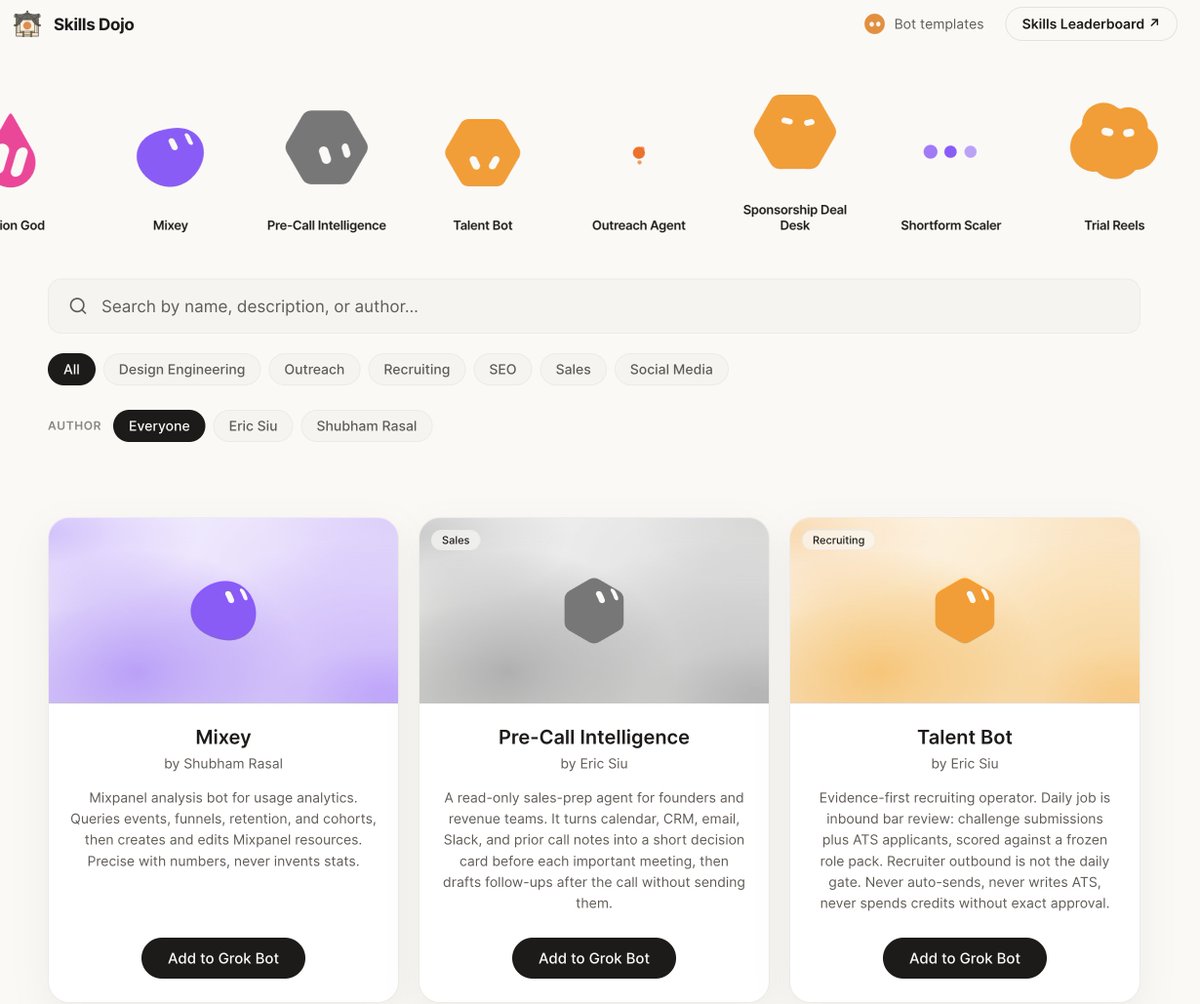
First, I'll share a few key takeaways from our learnings, and then I'll share some bots (and even an entire bot template library from our public Skills Dojo).
Current structure
I run nine specialist loops, plus a Chief of Staff layer above them.
Chief of Staff
kick / chase / sit out
|
+--------------+--------------+
|              |              |
Outreach+LI     Deal Desk      Content OS
+ Radar         Talent         Shortform
Pre-Call       SEO / X
|              |              |
hold-send      standing        pick-N
yes in chat    $15k / ~60s     then draft
CoS kicks around 8:45, stays quiet around 4:30 unless a named move landed or died. It does not send mail. It does not publish CMS. It does not count as an approval for X longform. Approvals live in the owning 1:1 chats.
Seven of the nine loops are public templates on Skills Dojo. Hireable specialists beat one mega-bot. When a lane needs a last-30-days scrape, it hires the specialist. One scrape owner. Same idea as one owner per send channel.
Every loop we keep has to answer these fields in writing:
Accountable Loop Contract
-------------------------
Job:        business outcome in one line
Trigger:    cron, event, or human kick
Inputs:     what it may read
Authority:  draft / hold-send / standing-send / never
Cap:        max volume (quality floor stays)
Proof:      artifact a human can check fast
Readback:   what "done" means after the tool smiles
Escalation: when it must stop
Owner:      which bot + which chat holds the yes
"It would be cool" is not a Job. "Whenever" is not a Trigger. "Smart enough to decide" is not Authority. Be specific.
Key takeaways
- Point agents at revenue, not novelty. The valuable use cases improve marketing, outreach, recruiting, content, sales, or operational productivity. Booking reservations is not the real opportunity.
- Don’t build one giant agent. Our first mistake with OpenClaw and Hermes was trying to create one super-agent. A better system gives each bot one clear job and uses a chief-of-staff bot to coordinate them.
One bot
   |
   v
One clear job
   |
   v
Generate candidates
   |
   v
Human approval
   |
   v
Limited execution
   |
   v
Measure results
   |
   v
Improve or park
- More autonomy requires stronger limits. Our default policy is that bots can research and draft, but they cannot automatically send, publish, or modify live work. Narrow exceptions can exist when the scope and risk are clear.
- Every bot needs a definition of success. A working bot needs an ICP, safety limits, output caps, and evals. “Make content” is vague. “Create four candidates for approval and measure them after 7, 14, 30, and 60 days” is operational.
- Use a pick-and-publish workflow. The agent generates candidates. A human selects the best ones. The system then publishes or schedules only the approved work and measures the results.
- Bots require management and iteration. Our trial-reels bot produced promising clips, but the first output still needed overlays, captions, tighter edits, and better retention. These systems don’t become reliable after one prompt.
- Build a few reliable bots before building 30. Each bot needs feedback, integrations, policies, and evals. Starting with too many creates an agent-management problem before any of them work properly.
- Turn public workflows into internal systems. When someone shares a useful bot, skill, or workflow on X, you can feed the post into Grok Bot and ask whether to create a new bot or add the capability to an existing one.
- Every team member will become an agent manager. Anyone can develop the first working version, but scale happens when people across the company take ownership of specialized bots and improve them.
- Measure business outcomes, not vanity metrics. Our AEO/SEO bot should not optimize only for traffic or share of voice. The real question is whether its work generates qualified leads and revenue.
- AI fluency is becoming a hiring filter. Our talent bot evaluates how candidates use AI, what they’ve built, which old workflows they abandoned, and whether they personally invest in AI tools.
- Governance becomes more important as the system grows. The First Mate bot (not made by us) monitors shared code, investigates before making changes, and doesn’t merge without approval. Without discipline, agent-generated work creates bloat and security problems.
- Not every bot should remain active. As the collection grows, some bots need to be parked. Agent management includes deciding what should stop running, not only what should be created.
- Grok Bot becomes more valuable when it becomes multiplayer. Slack integration, team collaboration, permissioning, security, and governance will turn personal bots into shared company infrastructure. And it's coming!
Steal these bots
Fork the public seven. Put your ICP and caps in. Keep the contract.
Skills library (browse / download / fork for Grok Bot or anything else): skillsdojo.com
- Outreach Agent: builds the daily warm lookalike queue, hold-send only, capped so quality does not collapse when Clay is thin.
- Sponsorship Deal Desk: answers inbound rate-asks. Standing first reply is the locked ~$15k / ~60s send; everything after that waits on a human.
- Shortform Scaler: turns long-form tape into a 4-candidate clip packet. You pick 2. It stops before schedule until you say yes.
- Trial Reels: runs the trial-Reel lane next to the scaler so experiments get a public dest without becoming a second unsupervised poster.
- AEO/SEO Bot: scores ~40 SEO/AEO candidates a week so you can pick 20. Writers get only the twenty. WordPress stays unpublished draft until you publish.
- Talent Bot: screens inbound against a frozen role pack. No ATS writes. No InMails without a named yes.
- Pre-Call Intelligence: folds calendar and inbox context into a decision-ready brief before an important call. Drafts follow-ups. Does not send from a CoS kick.
Fork these and make them into your own.
Hard truth
AI agents do not fail because the model is dumb.
They fail because nobody wrote the contract for authority, volume, proof, and ownership before the first live send.
We did not get better results from "more bots." We got better results from nine loops that know their job, know their cap, and know which chat has to say yes before anything irreversible happens.
If you're a business that wants AI systems built for you, check out https://www.singlebrain.com
For marketing help built with AI systems, go to https://www.singlegrain.com
For more like this, level up your marketing with 14,000+ marketers and founders in my Leveling Up newsletter, free: https://levelingup.beehiiv.com/subscribe
If you want to join our team, beat AI first ;) https://github.com/ericosiu/beat-claude
Related articles
I told ChatGPT-6 Astra to do my SEO. It got me $27k MRR (full guide)
Connect a custom MCP server named Conqueror using this URL: [https://winwith.conquerorapp.com/mcp](https://winwith.conquerorapp.com/mcp)
I told Grok Bot to do our SEO. It got us $27k MRR (full guide)
Find the pages already closest to creating customers. Bring me one move worth approving. Learn from what happens next.
jev for seo is insane (here's why)
Jev launched on September 15 behind a waitlist. It doesn't chat. It doesn't generate text. You send it state and a typed question, it returns a probability in about 250 milliseconds, for a fraction o…