I told Grok Bot to do our SEO. It got us $27k MRR (full guide)

For the last few months, we have been building a software company in stealth.
- The company reached $27k MRR.
- It's doing almost $1k per day.
- It took very little effort, since AI is doing the work

I credit a ridiculous amount of that growth to Grok Bot.
It found search traffic we were ignoring, chose the pages worth fixing, prepared the changes, and returned later to measure what happened.
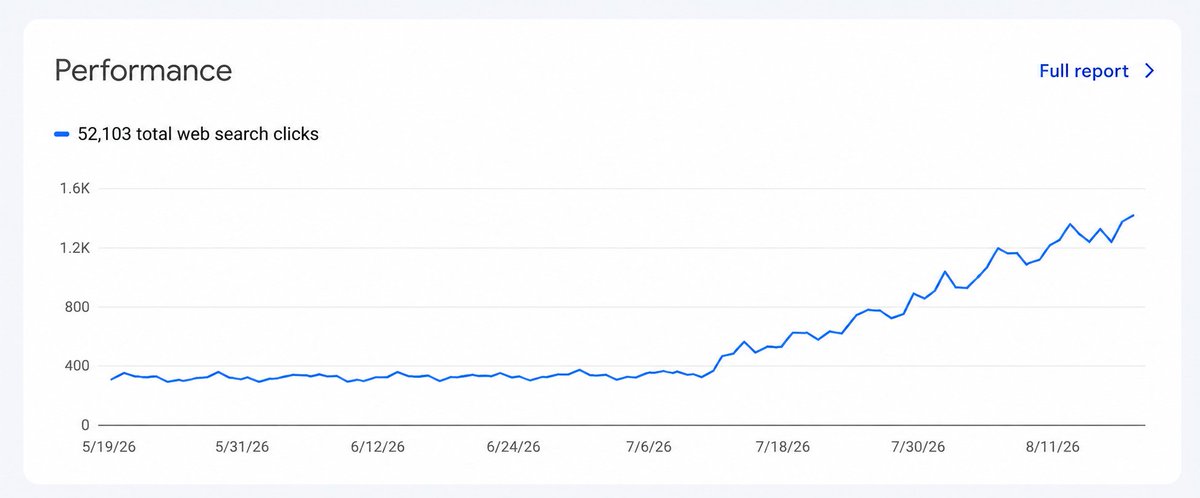
The signal was already visible in Search Console: organic traffic stopped moving sideways and started compounding.
Across those 90 days, Search Console recorded 52,103 clicks. Daily clicks sat around 300 to 350 for nearly two months, then climbed to roughly 1,400.
We did not need another 2,000-word article for the sake of publishing. We needed Grok Bot to find where real demand already existed, decide whether the opportunity was useful, and prepare the smallest change worth testing.
So I gave Grok Bot one recurring job:
> Find the pages already closest to creating customers. Bring me one move worth approving. Learn from what happens next.
That job sounds simple when it has context on:
- GSC
- GA
- Ahrefs-like keyword research (it'll be cheaper than paying for Ahrefs... see soon)
- Best AI models out there for writing, images, etc
- How to edit WordPress pages
All run from my phone, texting Grok Bot (the same I text on WhatsApp)..
Like an employee..
While I could be at the beach/driving/etc.
The Bot has to read live search data, understand the business, reject numbers that look exciting but lead nowhere, inspect the actual WordPress page, prepare a change, and stop before publishing it.
Then it has to come back later and see whether the change helped.
That loop kept finding traffic and turning the right opportunities into revenue. Eventually, the company reached $27k MRR.
This article explains the whole system. The setup, the prompt, the tools, the rules, and the weekly routine are all here.
Keep reading. I'm spilling the full playbook.
I. Most SEO work is very good at looking productive
The usual SEO workflow starts with a vague goal like "get more traffic."
Which is shortsighted...
AI can now be the brain for focusing on growing revenue/leads/etc.
That goal gets translated into activity: more content, more backlinks, more words, more reports.
You end up with a larger report and no idea whether the business is better off.
An impression does not pay you. A ranking does not pay you. Even a click can be worthless if the person had no reason to buy, start a trial, or book a call.
The path is longer:
Search demand → useful page → click → qualified visitor → customer action → revenue
Most tools stop near the beginning of that path.
They tell you which keyword has volume or which page is missing an H2. Then they hand the work back to you, usually inside a dashboard with enough warnings to ruin your morning.
An agent should own the decision that comes next.
It should tell you which opportunity matters, what evidence supports it, what it would change, and what business result that change is supposed to influence.
If it cannot explain the path to a customer, the opportunity moves down the list.
That rule alone removes a surprising amount of SEO theatre.
II. A Bot needs a job, not a prompt
Most people use AI like a smarter search box.
They ask, "How can I improve my SEO?" and receive a polished pile of advice they already knew.
Add internal links. Improve page speed. Publish helpful content. Remember the user.
That's bullshit
Nothing happens because nobody owns the work.
Lately though, AI can own the work, be the brain.
While you orchestrate.
Grok Bot is more useful when you treat it like a new operator who needs a narrow area of responsibility.
The difference is persistence.
The Bot has its own working context, files, browser, terminal, connected tools, and routines. It can return to the same job next week with the record of what happened this week.
But persistence only helps when the job is clear.
"Do SEO" is not a job.
"Own the weekly organic-growth review, find one evidence-backed opportunity on an existing WordPress page, prepare the smallest useful change, and wait for approval" is a job.
That description gives the Bot five things it needs:
- An outcome
- The sources it should trust
- A specific deliverable
- A boundary
- A feedback loop
Paste this into the Bot's description:
You own the weekly organic-growth review for this WordPress business.
Use Conqueror to read live Search Console, keyword, competitor, and page data. Find the existing page with the highest credible revenue upside. Reject vanity traffic and searches with no useful path to a customer.
Return a short decision card with the evidence, the alternatives you rejected, and one proposed before-and-after change.
Never publish, contact anyone, or alter the live site without my approval.
After an approved change goes live, record the baseline and compare the same page after 7 and 28 days. Turn the result into a rule for the next review.
Now the Bot knows what winning looks like and where it has to stop.
III. Work backward from revenue
If your goal is "more traffic," the Bot will find traffic.
And then you'll be traffic-rich and revenue-poor.
That may sound obvious, but it is how people end up ranking for thousands of searches that never create a customer.
Give the Bot the business outcome first.
For us, the scorecard should eventually reach qualified signups, demos or calls booked, and revenue from organic visitors.
Search Console data still matters. It shows where Google sees demand and how your pages meet it.
It just cannot be the final layer.
The Bot should work backward:
- What action creates value for the business?
- Which pages can lead the right visitor toward that action?
- Which of those pages already receive credible search demand?
- Where is the page losing the visitor?
- What is the smallest change that could improve that step?
This turns "SEO" into a chain of decisions rather than a pile of tasks.
It also changes what the Bot prioritizes.
A broad informational keyword with 50,000 searches may look irresistible. A narrower query with 2,000 searches may be far more useful if the person searching has an expensive problem your product solves.
The Bot should understand that difference before it writes a word.
IV. The graph that mattered
Grok Bot began by comparing the last 90 days of Search Console data with the previous period.
It was not looking for the biggest keyword or the longest list of errors. It was looking for pages where demand, search intent, and a path to revenue already overlapped.
Some opportunities looked obvious from the surface.
But what do I know?
I do not want to spend my mornings deciding whether a low CTR means weak packaging, weak intent, or a query Google answers itself. That is Grok Bot's job.
It inspected the search results, rejected attractive query groups that were unlikely to earn useful clicks, and chose the next move itself.
The useful output was not a hundred-item audit. It was a decision card:
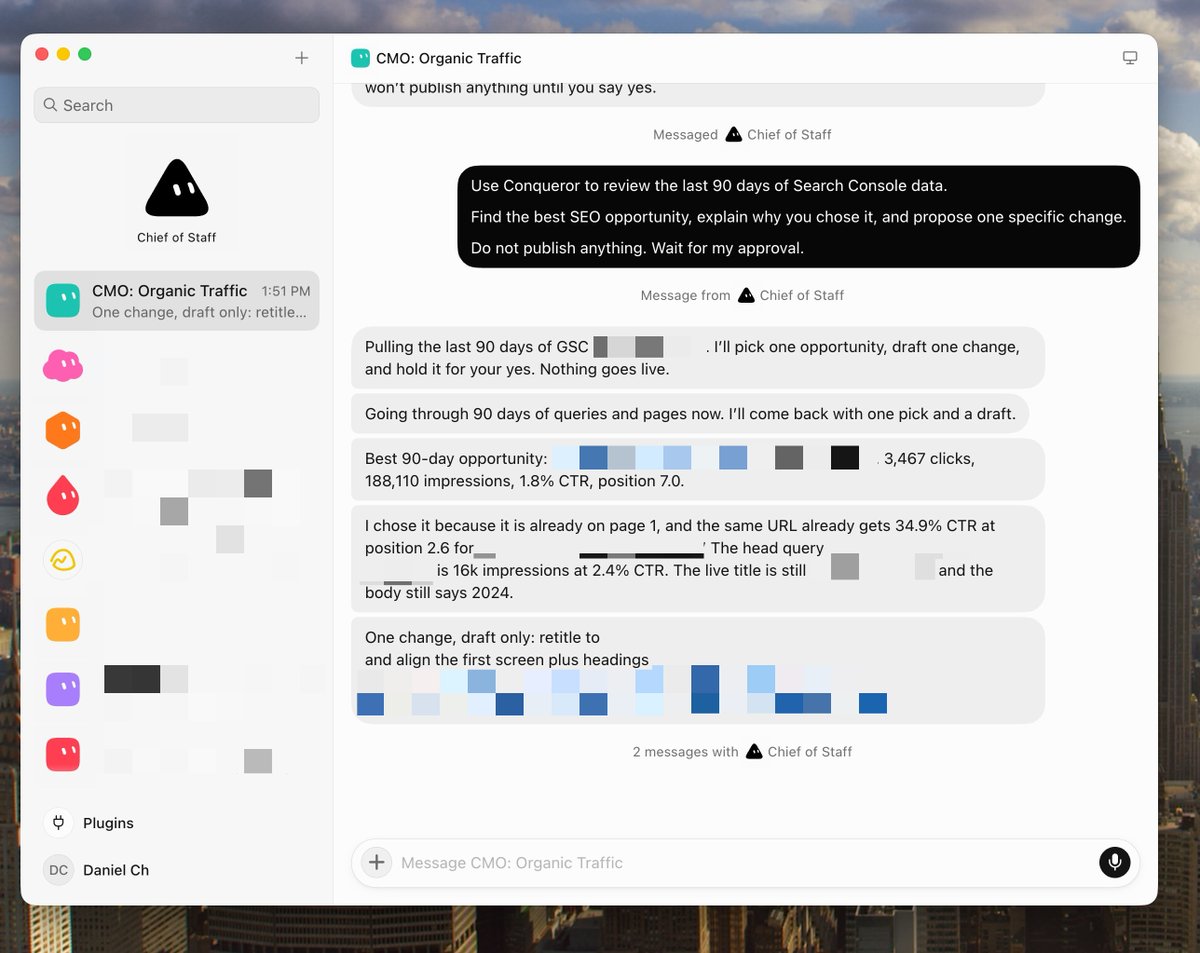
WHY NOW
Real search demand is already visible.
The page is close enough to improve without starting from zero.
WHY THIS PAGE
The search intent matches a problem the product can solve.
There is a clear path from the click to a customer action.
REJECTED
Tempting query groups where Google likely satisfies the search without a click.
NEXT MOVE
Prepare a tighter title and description.
Show the exact diff before touching WordPress.
MEASURE
Page and query-cluster CTR, clicks, and the customer actions that follow.
STATUS
Waiting for approval.
I can understand that in two minutes.
I can also disagree with it without opening six tabs and reconstructing the analysis from scratch.
V. The weekly loop
The system becomes useful when it repeats.
A single good recommendation can be luck. The value appears when the Bot measures what happened and carries that lesson into the next run.
This is what Grok Bot did each week while the company grew.
1. Sense
Read the last 90 days of Search Console data and compare them with the previous period.
Group queries by the page Google already associates with them. Pull clicks, impressions, CTR, and position together so one impressive number cannot hijack the decision.
2. Find near-wins
Look for pages with enough demand to matter, especially those around positions 4 to 15.
They are close enough that a focused improvement may matter, yet far enough from the top that something is probably missing.
3. Reject fake opportunities
Inspect the search results and the intent behind them.
Remove queries that Google answers directly, pages with no credible business path, and topics where a higher CTR would mostly attract the wrong people.
4. Choose one constraint
Pick the page with the best combination of demand, intent, current position, business relevance, and fixability.
The Bot has to explain why this page comes before the others.
5. Prepare the smallest change
Inspect the live title, description, H1, opening, page structure, internal links, and competing results.
Then prepare one focused diff. It may be a search snippet, a missing section, a clearer opening, or better internal links.
6. Stop for review
Nothing goes live yet.
The Bot returns the decision card and waits.
7. Measure and remember
After approval and publication, record the exact change and date.
The 7-day check is an early signal. The 28-day comparison is more useful. If the result improves, save the pattern. If it does not, revise or roll it back and save that lesson too.
This is how Grok Bot stops sounding like every other AI SEO tool after a few cycles.
It begins using your results rather than generic advice.
This is the measurement prompt I use:
@Conqueror
Compare this page against the baseline recorded before the change.
Check the 7-day result for an early signal and the 28-day result for the main decision.
Report:
-
Impressions before and after
-
Clicks before and after
-
CTR before and after
-
Position before and after
-
Relevant signups, demos, calls, or revenue
-
Possible outside factors
-
Keep, revise, or roll back
Save the result as a rule for future organic-growth reviews.
8. Refresh before the page goes stale
A page can win and still decay because the examples, statistics, competitors, or year quietly become old.
For the pages that matter, I use Conqueror to attach an auto-refresh to the keyword and WordPress page.
It has a feature where you set recurring tasks (just like ChatGPT/etc) to refresh the content/pages.
I set mine to every three months.
Each run checks the page again, improves the keyword coverage, opening, headings, structure, and thin sections where needed, then creates a new WordPress draft for me to review. It does not replace the live page.
This is not a fake date change. It is a real maintenance pass, so readers, Google, and AI answer engines such as ChatGPT, Perplexity, and Claude keep encountering a page that is actively maintained.
Copy this and replace the brackets:
@Conqueror
Schedule a content refresh every three months for [PAGE URL], targeting [PRIMARY KEYWORD].
On each refresh:
-
Check the current search results and the page's latest performance
-
Update stale facts, examples, dates, and claims
-
Improve weak keyword coverage, headings, the opening, and thin sections
-
Keep the original topic, voice, verified facts, links, images, and WordPress structure
-
Create a new draft and notify me when it is ready
Do not publish anything without my approval.
9. Run a GEO pass
Search is no longer only ten blue links. I also want the page to be easy for AI products to understand, extract, and cite.
This is the prompt:
@Conqueror
Review whether this page can be understood and cited by AI search products.
Check whether it:
-
Answers the main question directly
-
Makes the company and product entities clear
-
Supports important claims with evidence
-
Uses sections that can stand alone when quoted
-
Covers the follow-up questions a buyer would ask
Prepare one focused GEO improvement as a draft. Do not publish it.
VI. My stack
- Grok Bot through Cursor Teams Premium ($120 per user/month, can be for $60/mo now): owns the job, remembers the context, and runs the routine
- Conqueror ($39/month): gives Grok Bot the SEO research and WordPress tools
- Claude models: that's my choice for writing+revising
- OpenAI's GPT Image 2: creates the images when a page needs them
- DataForSEO: supplies keyword and live search-result data through Conqueror when I use my own key
- Google Search Console: shows queries, impressions, clicks, CTR, and position
- Google Analytics: shows what visitors do after the click
- WordPress: where the approved changes go live
- Stripe: the final scoreboard for whether the traffic reaches MRR
Grok Bot connects to Conqueror through MCP. That gives it keyword and SERP research, rankings, competitor data, backlinks, audits, Search Console data, and the ability to prepare a WordPress change for review.
Grok Bot decides what deserves attention. Conqueror gives it the tools to move from "you should improve this" to an exact change waiting for approval.
Grok Bot does all the work.
SEO keyword research
Grok Bot does not guess which keywords matter. It asks Conqueror for real volume, difficulty, intent, CPC, rankings, competitors, and live search results.
It is the kind of research I would normally expect from an Ahrefs-style tool, except the Bot can call it directly and act on what it finds.
Conqueror costs $39 per month. Starter usage is included.
After that, I bring my own OpenAI and Anthropic keys. We use Claude models for writing and GPT Image 2 for the best image generation we have found.
I like that I can bring my own keys and pay for the AI at provider cost. Conqueror charges for the software; OpenAI and Anthropic charge me directly for what we actually use. I can do the same with DataForSEO for keyword and search-result data.
That is different from my experience with bundled AI tools such as Higgsfield. I can pay around $100 for a subscription while personally using only around $30 to $40 worth of model generation that month. With BYOK, I can see the real usage instead of buying a bundle and hoping I use it.
That avoids putting the Bot behind another research subscription that can quickly run into hundreds each month.
VII. Set it up yourself
The first version is straightforward.
You need:
- Grok Bot
- A Conqueror account ($39 per month after the 7-day free trial)
- A WordPress site
- Google Search Console connected to that site
You do not need your own provider keys on day one because starter usage is included. If you keep running it after that, add your own DataForSEO and AI keys or use Conqueror's managed usage.
1. Create the Bot
Open Grok Bot and choose New → Create new agent.
Name it something boring and specific. Mine is CMO: Organic Traffic.
Put the job description from section II into its profile. Keep permanent rules there, especially the approval boundary.

2. Connect the execution layer
Create a project in Conqueror, then connect your WordPress site and Google Search Console.
Open your CMO: Organic Traffic Bot and send this:
Connect a custom MCP server named Conqueror using this URL:
https://winwith.conquerorapp.com/mcp
Follow the Connect card, complete the sign-in, then open Plugins → Installed and confirm that Conqueror is connected.
Grok Bot can now use Conqueror for search research, WordPress inspection, and reviewable changes.

3. Give it the first safe job
Send this. Mention the connector directly so there is no ambiguity about where the live data should come from:
@Conqueror
Review the last 90 days of Search Console data for my connected WordPress site and compare them with the previous 90 days.
Find up to five existing pages with credible upside. Favor pages with meaningful impressions, average positions around 4 to 15, weak CTR for their position, and a clear path to a customer action.
Reject searches that Google probably answers without a click, have mismatched intent, or would bring visitors unlikely to help the business.
Choose one page. Inspect the live page and current search results. Return a decision card with the evidence, rejected alternatives, one proposed before-and-after change, the metric that should move, and the business action it could influence.
Do not publish or edit the live site.
The first result should be a decision.
If Grok Bot returns an entire finished article, correct it. It started writing before it understood the job.
4. Review the first result
Check the source page, numbers, search intent, rejected options, and proposed diff.
Ask annoying questions. Why this page? Why now? Why should this change affect the metric? What would prove the idea wrong?
Treat it like an employee who is reporting to you.
5. Save the process as a skill
Once one run is reliable, tell Grok Bot:
> Save the process we just used as a skill called "Organic growth review." Include the trusted sources, prioritization rules, decision-card format, measurement windows, failure handling, and the rule that publishing always requires approval.
A skill preserves the method.
The memory file preserves what your business learned from using it.
6. Create the routine
After testing the skill on a second page, give Grok Bot the whole recurring workflow:
Create an Organic growth routine with these rules:
Every Monday at 9:00 AM, run the Organic growth review skill.
Return no more than three opportunities and recommend one. Use current Conqueror and Search Console data. If live data is unavailable, report the failure rather than using old numbers.
For every approved change, save the baseline, exact diff, publication date, and intended business outcome. Recheck it after 7 days and 28 days, then recommend keep, revise, or roll back.
After I approve and publish a change, ask whether I want Conqueror to refresh that keyword and page every three months. If I say yes, schedule the refresh as draft-only.
Never publish or change the live site without my approval.
Grok Bot can now prepare the work while your laptop is closed.
You return to one decision instead of another dashboard.
VIII. The memory file
The useful version of AI memory is not a fake personality with a favorite color.
It is a record of decisions and consequences.
For every approved change, save:
- Page URL and query cluster
- Baseline impressions, clicks, CTR, and position
- The customer action the page should influence
- Why the page was chosen
- The exact before-and-after diff
- Approval and publication date
- 7-day result
- 28-day result
- Keep, revise, or roll back
- Rule learned
The first few entries will feel tedious.
Then they become the reason your Bot can outperform a generic prompt.
It may learn that a certain title pattern earns more clicks on comparison pages. It may learn that definition queries bring traffic but no trials. It may learn that adding a product section too early hurts engagement.
Those examples are only hypotheses until your own numbers support them.
That is why the log matters.
IX. How people ruin this setup
They turn the Bot into a writer
Writing is the easiest part to demonstrate, so it becomes the entire demo.
The hard work happens before the draft: choosing the right page, understanding why it is underperforming, and connecting the change to a customer outcome.
That's why I let Claude write the articles, so that it's another agent. Other people prefer other AIs - Conqueror lets me BYOK so that I pay AI at cost. So I can just plug Kimi/ChatGPT there if I want to - and have them write.
They optimize for search volume
Volume makes screenshots look good.
A smaller query with commercial pain can be worth far more than a broad topic that attracts everyone and converts no one.
They change everything at once
If the title, opening, structure, offer, and internal links all change together, the next measurement teaches you almost nothing.
Smaller changes make the feedback useful.
They let it publish immediately
An agent that can update one page can update one hundred.
Keep the final approval until it has built a long record of correct decisions, clean diffs, and sensible reversals.
They stop at traffic
More clicks feel good.
The business needs qualified visitors who take useful actions. Connect the later parts of the funnel whenever you can, even if the data is imperfect at first.
X. Give the robot the boring 90%
AI can produce more content than you could ever review, but producing more content is rarely the missing piece.
The useful job is much less glamorous:
- Pull the current data
- Compare the pages
- Inspect the search results
- Reject the bad opportunities
- Prepare one diff
- Keep the record
- Return when the measurement window closes
You keep judgment and approval.
Grok Bot carries the context and does the repetition. Conqueror gives it the search and WordPress tools required to finish the work.
That is the system I would build before hiring another person to stare at Search Console.
More SEO activity by itself would not have grown the company.
Grok Bot found the traffic, chose the constraints worth removing, and kept learning from the results. That work helped take the company to $27k MRR.
Give Grok Bot that job.
TLDR;
- Give Grok Bot a revenue outcome, not a vague SEO task
- LET THE ROBOT DO THE BORING 90%
- Connect it to live Search Console, analytics, and conversion data
- Let Conqueror handle the research and prepare the WordPress changes
- Make Grok Bot reject traffic that has no path to a customer
- Approve the changes yourself
- Auto-refresh important pages before the information goes stale
- Check whether winning pages are also easy for AI answer engines to understand and cite
- Measure clicks, signups, demos or calls, and revenue
Up next, leave a comment below if you'd want me to write skills/.md files on how to tap into more powerful workflows that translate ORGANIC TRAFFIC to REVENUE.
Related articles

I told ChatGPT-6 Astra to do my SEO. It got me $27k MRR (full guide)
Connect a custom MCP server named Conqueror using this URL: [https://winwith.conquerorapp.com/mcp](https://winwith.conquerorapp.com/mcp)

Grok Bot for Business (Use These Templates Now)
Most people are talking about Grok Bot for recipes, travel, or admin work. Not enough people are talking about using it for business purposes.

jev for seo is insane (here's why)
Jev launched on September 15 behind a waitlist. It doesn't chat. It doesn't generate text. You send it state and a typed question, it returns a probability in about 250 milliseconds, for a fraction o…