How I Create 60+ Pieces Of Content A Week For My Personal Brand

My team creates close to 60 pieces of content for my personal brand every week.
- 24 native X posts.
- 7 Instagram reels.
- 14+ stories
- 3-4 newsletters.
- 1 YouTube video.
- 1 long-form article.
- 5 LinkedIn posts.
Then we record another 15 ads in one batch.
The goal is simple.
I want my personal brand constantly building authority, reaching new people, staying in front of the people who already know me, and generating qualified lead flow for the business.
The only way to maintain that volume without the content becoming random is to run everything through a system.
Here is exactly how we do it.
1. Friday gives us the data
Friday is metrics day.
Before I decide what I want to talk about next week, I want to know exactly what happened this week.
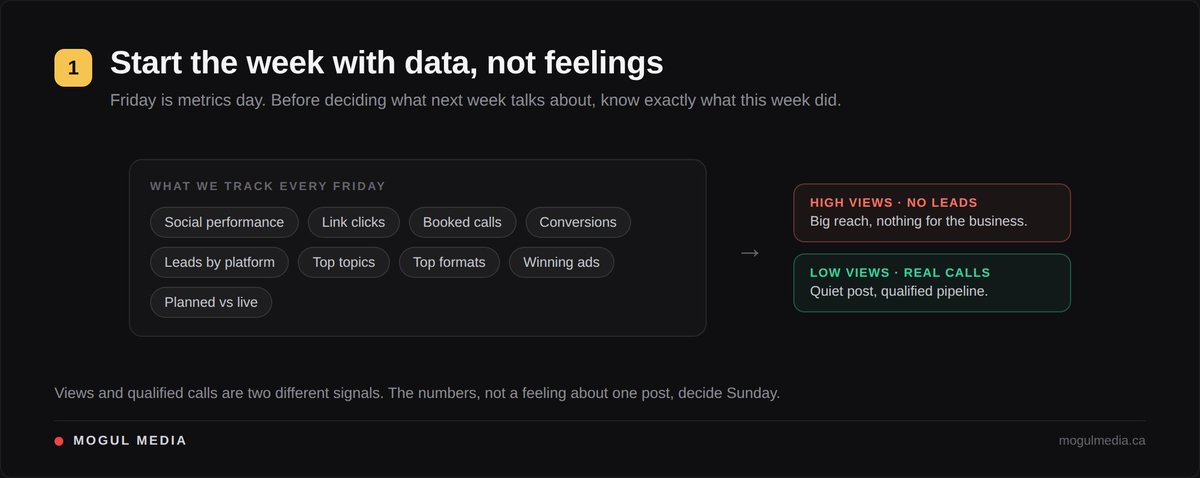
We track:
-
social performance
-
link clicks
-
booked calls
-
conversions
-
which platforms generated leads
-
which topics performed
-
which formats performed
-
which ads won
-
how much content we planned
-
how much content actually went live
This is important because I do not want my content strategy changing based on how I feel about one post.
I want the numbers.
A post can get less engagement and still generate qualified calls.
Another post can get significantly more views and generate nothing for the business.
Those are two completely different signals.
Friday gives me the information I need to make better decisions on Sunday.
2. Sunday decides the entire week
Sunday is my planning day.
I spend around 3 hours going through the data, saved ideas, client conversations, industry conversations, proof, and everything else that happened during the week.
Then I decide what my personal brand should talk about next.
I am looking at:
-
topics that already worked
-
topics worth iterating
-
new pain points we are hearing
-
questions founders keep asking
-
stories from inside the business
-
client wins
-
opinions I want to share
-
conversations happening in our industry
-
new formats we want to test
-
winning ads we can use organically
Then we turn those into the content plan.
By Monday, I do not want the team wondering what we should post.
That decision has already been made.

3. X is the main content engine
We publish around 24 native posts on X every week.
I want different parts of my personal brand showing up throughout the week.
That means we mix:
-
stories
-
technical content
-
conviction
-
proof
-
promotions
-
snipes
-
commentary around key conversations
The story content shows people what is happening behind the business.
The technical content shows what I know.
The conviction content shows how I think.
The proof shows that the strategies actually work.
The promotions give people somewhere to go when they want more help.
I do not want someone following me for three months and only seeing personal-brand tutorials.
They should understand my expertise, my opinions, the businesses we are building, the people we work with, and the results we are generating.
That is how the account builds real authority.

4. We intentionally build proof into the content
Every week I want multiple pieces of content showing real results.
That includes:
-
last week's winning ad posted with context
-
a summary of client wins
-
standalone testimonials
-
client results
-
case studies
I can explain personal-brand strategy every day.
The proof is what backs it up.
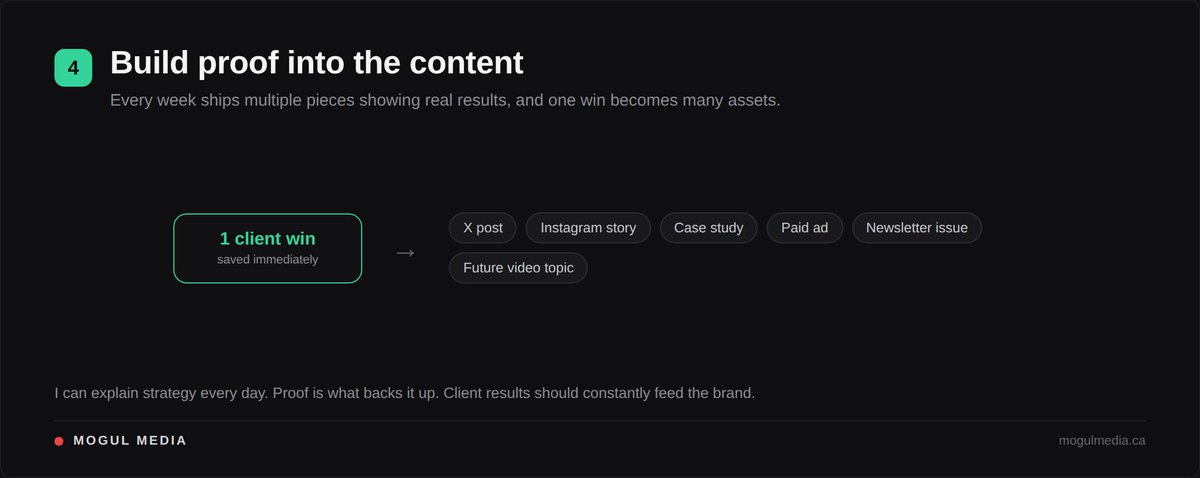
If we get a strong client result, I want that result saved immediately.
That one win can eventually become an X post, an Instagram story, a case study, an ad, a newsletter, or even a future video.
Client results should constantly feed the personal brand.
5. YouTube is where I go deeper
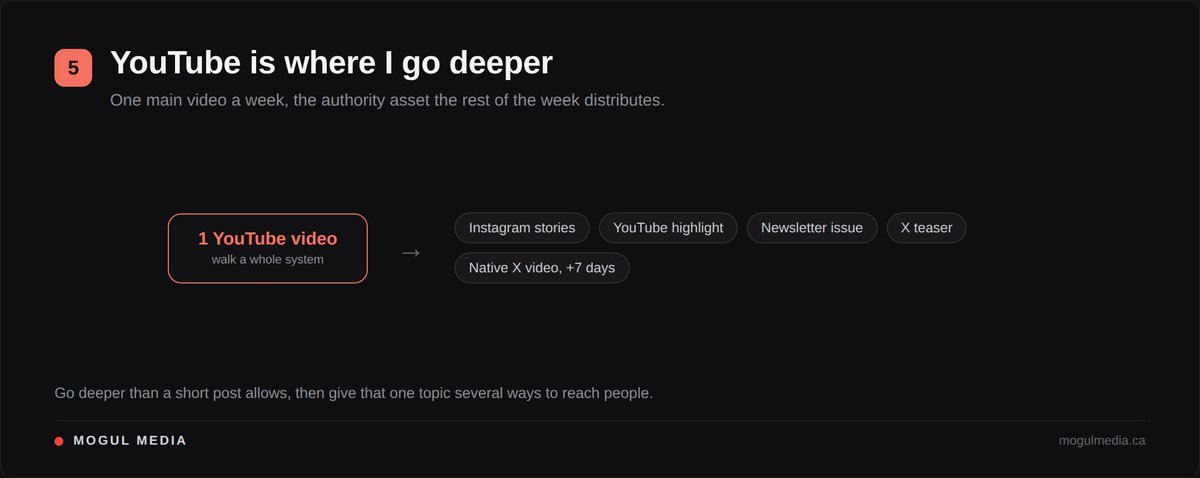
We create one main YouTube video every week.
This gives me room to take one useful topic and actually explain the whole thing.
I can walk through a system.
Break down a strategy.
Show examples.
Explain what we are seeing across founder accounts.
Go much deeper than I can inside a short X post.
That video then gets more distribution throughout the week.
When it goes live, we can:
-
post it to Instagram Stories
-
add it to the YouTube highlight
-
expand on the topic inside the newsletter
-
tease it on X
-
post the full video natively on X seven days later
The video gives us one strong authority asset and multiple ways to distribute it.
6. The article gives us another deep topic
We also create one long-form article.
The article gets its own topic.
I do not want every platform talking about the exact same idea all week.
The article gives us another place to go deep on something useful for founders.
Then we can keep distributing it.
The article gets published.
Around 24 hours later, I can quote it with a doc screenshot.
It can also become one of the week's newsletter issues.
If the topic performs extremely well, it can become a future YouTube video.
Strong ideas keep getting more opportunities to perform.

7. Instagram makes the personal brand more personal
Instagram has a different role.
I want people seeing more of the actual person behind the content.
We post life updates.
Things happening inside the agency.
Habits.
Work.
Travel.
Lessons.
Client wins.
Random moments from the day.
Then we mix that with the more structured content.
Right now we aim for around 7 original reels a week.
We study formats already performing well on Instagram and build our ideas around those formats.
We also run a few promotions through Stories each week.
The AI personal brand playbook.
A case study.
An offer.
This gives Instagram both a relationship-building role and a lead-generation role.

8. The newsletter keeps people in our world
We send around 3-4 newsletters every week.
Somebody might find one of my X posts today and have no reason to work with us yet.
That does not mean I want that relationship to end when they close the app.
The newsletter gives us somewhere to keep sharing useful ideas with them.
A normal week can include:
-
an issue around the YouTube video
-
a case study
-
the weekly article
-
a pure value email
Every email also gives people access to the rest of the ecosystem.
They can read a resource.
Look through a case study.
Download the playbook.
Book a call.
The personal brand gets their attention.
Email lets us keep the relationship going.

9. We use paid ads to learn too
We record around 15 ads in one weekly batch.
There is a very simple way we come up with most of the tests.
We take:
winning angles + new formats
and
new angles + winning formats
Then every ad gets tracked.
We want to know which angle worked.
Which format worked.
Which hook worked.
Which audience responded.
That information is useful outside the ad account too.
If an angle keeps working in paid, there is probably something interesting there for organic content.
If a pain point keeps performing organically, we can test it in an ad.
The paid and organic sides should constantly give each other information.

10. We distribute ideas without blindly copying posts
This is probably one of the biggest reasons we can create so much content.
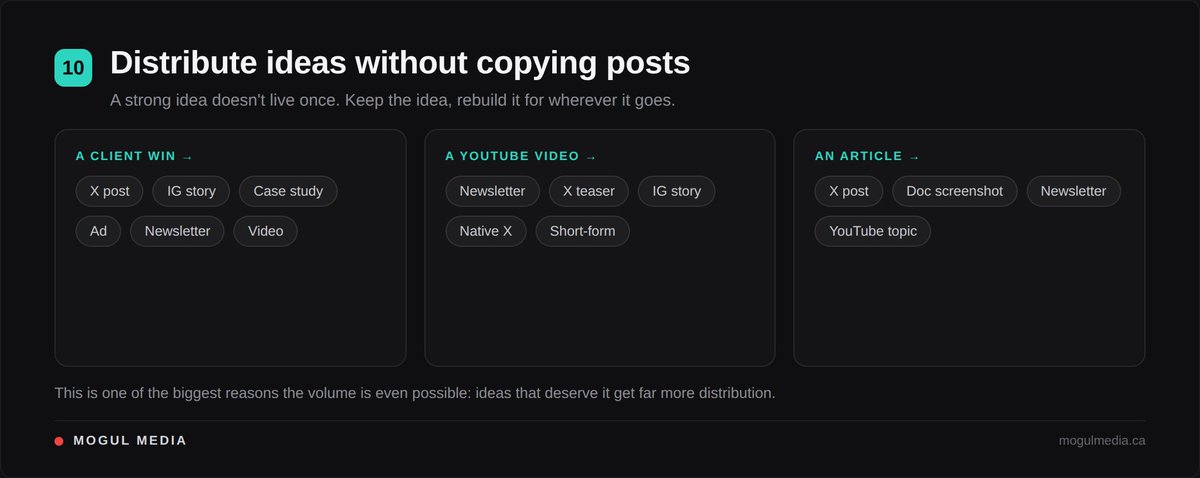
A strong idea does not have to live once.
A client win can become:
-
an X post
-
an Instagram Story
-
a case study
-
an ad
-
a newsletter
-
a future video topic
A YouTube video can become:
-
a newsletter
-
an X teaser
-
an Instagram Story
-
a native X video
-
future short-form ideas
An article can become:
-
an X post
-
a doc screenshot
-
a newsletter
-
a future YouTube topic
We keep the idea.
Then we rebuild it for wherever it is going.
That lets us get significantly more distribution from the ideas that deserve it.
11. We track what actually shipped
There is another metric I care about that has nothing to do with views.
Content planned vs. content published.
If we planned 60 pieces and only 40 actually went live, I need to know.
That tells me something broke operationally.
Maybe approval took too long.
Maybe editing became the bottleneck.
Maybe the briefs were weak.
Maybe we simply planned too much.
That is a completely different issue from publishing everything and seeing weak performance.
I want to know whether we have a content problem or an execution problem.

12. Then the whole system starts again
Friday comes back around.
We update the numbers.
Sunday I review them.
Then I decide:
-
what we should keep doing
-
what we should stop doing
-
which topics deserve another iteration
-
which formats deserve more volume
-
which pain points are resonating
-
which stories people care about
-
which proof is creating conversations
-
which platforms are generating qualified leads
-
what we should test next
Then the next week gets built from that information.
That is the actual system behind the volume.
We are creating close to 60 pieces of content every week for one personal brand.
I want those pieces constantly building my authority, distributing my ideas, showing proof, staying relevant, and generating qualified lead flow.
Every week gives us more data.
That data makes the next week better.
Then we run it again.

Two ways to run this for your own personal brand:
Install the system into your business
Personal Brand HQ is our four-month guided program.
We give you:
→ Our content systems
→ Our AI suite
→ Topic and content workflows
→ Our frameworks
→ A lead strategist
You run the system with our help.
https://pbhq.mogulmedia.ca/?el=xarticle
Have my team run it
You give us around 45 minutes a week.
We handle:
→ Strategy
→ Research
→ Writing
→ Design
→ Performance
Book a call and we'll help you figure out which option fits.
Related articles

How I Make $20k/Month With Pixar Animations (and how you can too)
Every time I've made the most money in my life it came down to right time, right skill. AI Animations are exactly this to me right now
How to launch a one-person product (without destroying your life)
Over the last 5 years, I’ve helped launch products that went on to make multiple 7 figures in revenue per year.
the whop partner business model explained in 5 minutes...
every online business model is a trade between 3 things.