How I Signed 35 Micro-Influencers for $0
You do not need an ad budget to run creator marketing.
You need an offer.
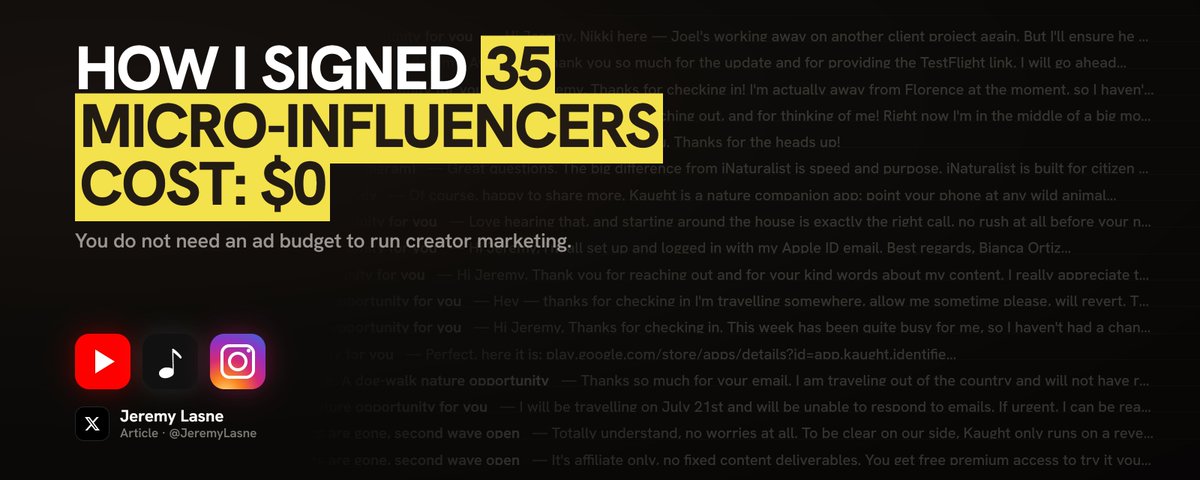
I took my app from 0 to 35 signed creators without paying a cent upfront and without even having it live yet !
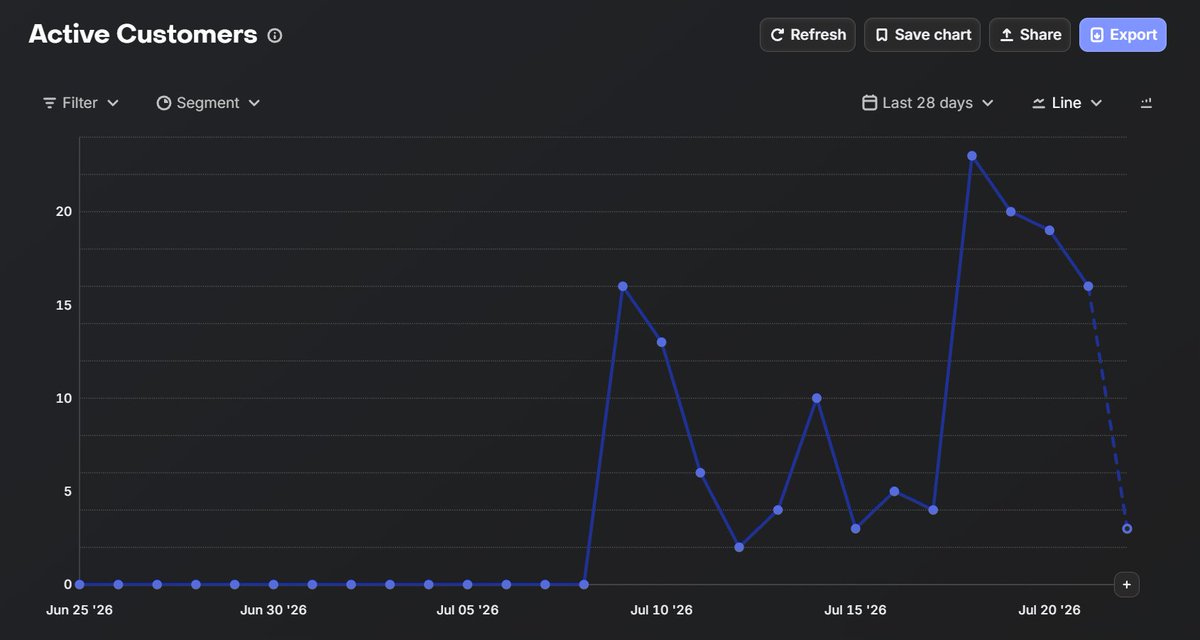 — "Influencers and testers coming in BEFORE it being live"
Just by recruiting micro-influencers onto an affiliate deal instead of a paycheck.
> Micro-influencers have fewer options than the mid-tier creators every funded brand chases, so a real revenue-share offer converts.
The engine has four parts: a decaying commission ladder (40%, then 25%, then 15%) on limited spots to manufacture real FOMO, a clean creator list and a no-cost tracking dashboard
Here is the whole playbook.
TL;DR
You can run micro-influencer marketing with no budget by paying creators in revenue share instead of cash.
How ? Recruit micro-influencers, small and engaged accounts, onto an affiliate deal rather than a flat fee.
Why? They get fewer brand offers than the mid-tier creators every funded app fights over, so a genuine revenue-share deal is found money to them, and it converts.
I used this to take a stealth app from 0 to 35 signed creators for $0 upfront. Four parts make it work: a decaying commission ladder (40%, then 25%, then 15%) on limited spots so the FOMO is real.
Important : a clean dataset of creators who already look for partnerships affiliate deals, so you can run volume without spamming
Important #2 : tracking every creator's conversions in a cheap dashboard wired to RevenueCat, then renewing the ones who convert.
The trade-off versus the flat-fee playbook:
- a flat fee gives asymmetric upside (a viral video costs nothing extra)
- an affiliate gives asymmetric downside protection (a dud costs $0).
The short answer: pay micro-influencers in revenue share, not cash
You can run micro-influencer marketing with no budget by replacing the paycheck with an affiliate deal. Instead of paying a creator upfront to post, you give them a cut of the revenue they drive. No cash leaves your account until they sell, so you can sign creators in volume with zero risk. I took a stealth app from 0 to 35 signed creators this way, for $0 upfront.
The reason it works is who you target. Micro-influencers get far fewer brand offers than the mid-tier creators every funded app is fighting over. A real revenue-share deal is not an insult to them, it is found money. That is the whole edge, and the rest of this playbook is how to run it at volume without embarrassing yourself.
Go micro because fewer options is the edge
The standard advice, the Cal AI creator playbook included, is that the money is in the middle: mid-sized creators, too expensive for clueless brands and too small for giant ones. That holds when you have a budget. With no budget the middle is out of reach, so you go smaller on purpose.
Micro-influencers have fewer options. Fewer brands slide into their DMs, and the ones that do rarely offer anything real. So when you show up with an actual revenue-share deal, you are not competing against ten other offers. You are the offer. That asymmetry is why a $0 program signs at volume where a funded brand would stall.
It also fixes the thing that kills volume outreach: looking desperate. You are not begging a creator to take your money. You are handing them an opportunity most brands never bother to give someone their size. Offer a small paid deal for the ones who insist on cash, and steer everyone else to affiliate. Both are a yes.
Manufacture FOMO with a decaying commission ladder on limited spots
The offer is not a flat 15% forever. It decays. The first cohort of creators earns 40% of the revenue they drive. The next earns 25%. After that it settles at a stable 15%. Each rate has a fixed number of spots.
 — "The FOMO offer"
This does two jobs at once. The 40% tier is a magnet: high enough that early creators say yes fast and become your proof, and it costs you nothing unless they actually sell. And because the top rate genuinely goes away once the spots fill, the scarcity is real. You are not running a fake 24-hour countdown. A creator who stalls actually drops to a lower rate, so 'only a few spots left at 40%' is a true sentence, which is the only kind of urgency that does not burn trust.
Name the spot count out loud. Telling a creator 'only the first cohort gets 40%, and the spots are almost gone' frames the deal as an exclusive opportunity, not a mass DM. The number has to be real, or the scarcity stops working the second two creators compare notes.
Affiliate flips the risk: know the trade-off before you copy it
There is a real tension here worth naming. The flat-fee playbook says never pay per view, always pay a flat rate, because a flat fee gives you asymmetric upside: if the video goes mega-viral, you do not pay a cent more. That is correct, and for a funded app chasing reach it is the right call.
Affiliate is the mirror image. You give up the viral upside, since a huge video pays the creator more when they earn on what they drive, in exchange for asymmetric downside protection: a video that flops costs you exactly $0. The deciding variable is your budget and your stage. Funded and chasing virality, pay flat. Stealth with no budget, run affiliate, sign volume, and let the data find the creators who move revenue. I chose downside protection because at 0 to 35 creators, I could not afford to be wrong thirty times at a flat rate.
Volume only works on a clean list: social tags, email, real intent
Volume without quality is spam, and spam is how you embarrass yourself. So the outreach runs on a dataset, not a vibe. Every creator on my list carries three things: their social handles and tags, a real email, and proof of partnership intent.
 — "An extract of the hundredsssss of email exchnaged"
Partnership intent is the filter that matters. I look for creators who already run affiliate deals on platforms built for it. If someone is already posting partner links, they have told you they will do revenue share, and they know how it works. You skip the entire job of convincing a creator that affiliate is legitimate. You are just a better offer than the one they already took.
A clean list of creators who fit your niche and already partner is what lets you run outreach at volume without looking cheap. The PictureThis style identifier apps prove the niche point: a nature app converts through creators whose audience already cares about the outdoors, not through whoever has the most followers.
Track every creator, renew the ones who convert
An install is not a customer, and a creator with big views is not automatically a creator who sells. AI apps churn hard, so a wave of installs that never reach trial-to-paid is a creator you should not renew. The only way to know is to measure.
I built a simple internal dashboard with an AI coding agent, wired to RevenueCat and the app's own data, so every creator's real conversions sit in one place. It cost nothing to build. That data runs the roster: renew the creators who convert, quietly let the rest lapse, and protect the rate of your best earners so the 40% cohort keeps their number.
The relationship is the retention. I keep each partnership up to date, ask creators what is working, and stay a real person to them, not a payout. A micro-influencer who feels like a partner posts again without being chased. That is the difference between a roster you maintain by hand and one that renews itself.
How to run a $0 creator program this week
-
Build the list first: creators in your niche who already run affiliate or partner links, each with social tags and an email. Intent over follower count.
-
Lead with affiliate, and offer a small paid deal only for the creators who insist on cash. Both are a yes.
-
Set a decaying ladder with real spot counts: 40% for the first cohort, then 25%, then a stable 15%. Say the spot count out loud.
-
Keep the brief light. You recruited them for their voice, so do not script it into an ad.
-
Track conversions in RevenueCat from day one. Renew the creators who sell, cut the ones who do not, protect the rate of your best earners.
-
Stay a real partner: keep deals current and ask what is working, and the roster keeps posting for free.
None of this needs a budget. It needs an offer creators cannot get elsewhere, and a dataset honest enough to tell you who is working.
Sources
- Myself, Jeremy
- Jake, "The Ultimate Guide To Build And Scale Consumer Apps": Cal AI creator marketing.
- tasu.ai 's MCP and articles.
Related articles

How to create AI ads for apps that make $10,000/mo (EASY MODE)
The AI revolution is here, and it has completely changed the way I grow apps.

Scaling an app to $500k/mo (full roadmap for Meta)
"I used to think this problem was caused by the wrong thing."

From 0 to $10K MRR in 2 Weeks
We found an untapped niche inside the AI image & video category, built the app in 3 days, launched it in another 3, and crossed $10K MRR in 2 weeks.