Scaling an app to $500k/mo (full roadmap for Meta)

In April, this account was spending $6,000 a month. In the first 8 days of August it spent $136,000.
We never touched the funnel, the pricing, the positioning or the LTV. Every single thing that changed was creative, and I'm going to give you the whole thing.
| Month | Ad spend |
|---|---|
| April (before us) | $6,000 |
| May (we started the 5th) | $17,000 |
| June | $53,000 |
| July | $392,000 |
| August, first 8 days | $136,000 |
That's $17,000 a day. If it just holds we end the month around $520,000, and it should keep climbing.
That's ad spend, not revenue. Revenue is higher.
Media buying did almost none of this work. One CBO. No targeting stack, no audience ladder. When the unit economics work, creatives are the only lever that moves at this speed.
What the account looked like before us
Their ads were 13 seconds, 18 seconds, 25 seconds. Short, and selling straight into the quiz.
There's a logic to it. The quiz itself takes 10 minutes, so the ad doesn't have to do the selling, it just has to earn the click. For younger audiences it sometimes works.
Here's the trade you're making:
- Short ads buy a higher click-through rate and cost you conversion rate.
- Long ads do the opposite.
You have to test both. What you can't do is run one length and assume the other doesn't work for you.
Length was the visible problem. The bigger one was who the ads were talking to. A 13 second ad selling the value proposition converts someone who already knows this kind of product exists and already wants one. That audience is small. Once you've spent through it there's nowhere left to go.

Before any of this applies to you
This client had a quiz funnel that already worked. They weren't testing pricing or landing pages while we worked. We only did creatives, and creatives alone were enough.
That isn't always true. Below roughly $10k a month, and often below $50k, the funnel and the pricing carry more weight than the creatives do. Above that point it flips.
The public example I use for this prices at $99, $52 for three months, or $22 for one month, with the price per day shown next to each. The ladder is built to push you to the $99.
If you want to test yours, look at:
- The percentage of people buying each tier
- AOV
- Revenue per session
- Profit per session on day 0, then day 30, 60 and 90
Profit per session is the number to beat.
And the rule I'd hold you to: if you're finding winning ads and the account still isn't scaling, either they aren't real winning ads, or the business can't afford the CPA Meta needs. Ideally you can pay $100 on Meta to acquire a customer. If you can, we can scale you easily.
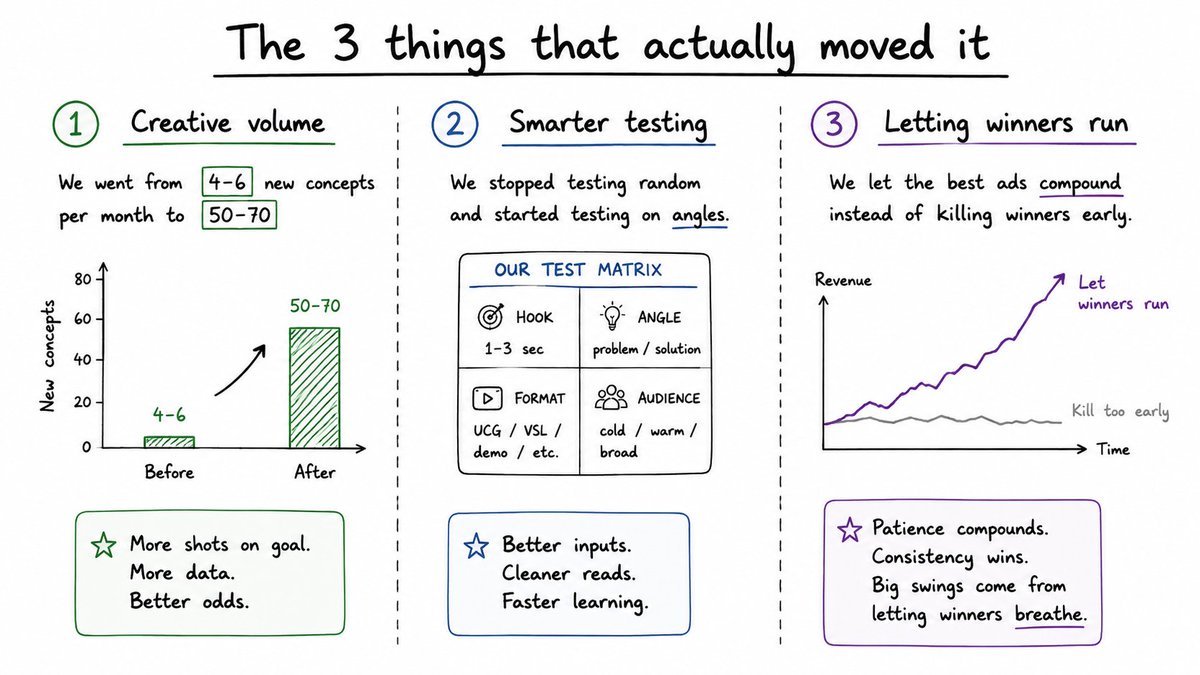
The 3 things that actually moved it
- Concepts written for one specific buyer persona, with real intention behind each one.
- Higher awareness levels. Unaware and problem aware, instead of writing only to solution aware and product aware.
- Hook swaps on strong ads with weak hook rates. Lowest leverage of the three, and by far the lowest effort.
The rest of this is those three in detail.
How we define a buyer persona
We define a persona by the life situation and the relationship to the problem. Demographics don't get you there. If your persona is "moms over 35", nothing you write will resonate, because you've described a census category instead of a person.
Before us this account had a generic idea of who it was talking to. We did the in-depth work: existing creatives, reviews, organic content, comments on Reddit and Quora, with AI research on top of the human research.
Apps end up with a lot of micro personas rather than a few big ones. The overthinker. The stressed student. The overwhelmed mom. The ambitious professional. The self-improvement addict.
Each one gets its own concept, creative style, unique mechanism, CTA and tone.
The reason micro personas work so well on a quiz funnel is that the funnel repeats the trick. The ad picks the person, the quiz asks questions and builds a profile, and the sales page speaks back to that exact profile. The same thing said twice.

Andromeda made creative diversity mandatory
If your ads are similar, they go to a similar audience. That's the whole thing.
So you need diverse formats, different personas, different awareness levels, specific angles, different pain points, different entry points, different unique mechanisms.
You can see it in the spend distribution. In this account the top 10 ads all carry a similar amount of spend. The top ad has about 3 times the spend of the tenth ad, not 10 times. The top ad takes about 10% of the account.
That's what a healthy account looks like now. If one ad is carrying 40% of your spend, that's a single point of failure waiting to fatigue.
Formats follow the audience
Different personas convert on different formats.
- Young audiences. Short form viral formats. Memes, POVs, screenshot memes, fast edits. They're more skeptical and they don't believe a VSL. The catch is you'll struggle to sell anything expensive to them.
- Problem aware and older, 45 plus. Direct response, and a longer VSL usually works very well.
- Older audiences. AI ads work well.
- Young audiences again. Real actors and real creators still beat AI at similar volume. If AI lets you do crazy volume, that's an advantage. This changes every month.
Two strategies sit underneath all of them. Sell the mechanism, which is usually a shorter video that hands people to the quiz. Or sell the mechanism and then sell the app, so they arrive at the quiz mostly sold.
Across our accounts right now, podcast style videos, street interviews, authority figure ads and skit conversations are all working.
Going unaware, the change that unlocked the scale
The old creatives said a version of "this app is a secret weapon for the goal". That's the value proposition, and it converts solution aware and product aware people, which is a slice of a slice.
Most of the audience isn't there. They don't know they need this app or anything like it.
Split them:
- They understand the problem and aren't actively solving it. Problem aware. Start with the problem, then the general solution, then the unique mechanism. Don't lead with the product.
- They're considering or using a different solution. Solution aware. Explain why that solution is the wrong one and go heavy on your mechanism.
- They don't understand the actual problem. Unaware. You need a reframe, and you need to change a belief before you can sell anything.
The opening line that worked best for us was this shape:
> "I used to think this problem was caused by the wrong thing."
That stops people, because they've thought the same thing. And it buys you the next 20 seconds to explain why what they believed is wrong.
Here's what the reframe looks like across categories:
| What they blame | Where the ad points instead |
|---|---|
| Hair loss on genetics and stress | It starts at the scalp |
| Weight on having no willpower | Appetite never switches off when protein is too low |
| Bloating on what they ate today | How slowly things move through, rather than what went in |
| Adult acne on not washing enough | Overcleansing is driving it |
| Low energy on not sleeping enough | Sodium depletion |
Each reframe then hands off to a specific mechanism.
The job of the ad, in order: name the misconception, reconnect it to the real cause, present the mechanism, then present the product as the thing that addresses the real cause.
A big part of your audience looks problem aware and is actually unaware of the root cause. That's the gap almost nobody is advertising into.
How to find the root cause for your product
This is the part you can do this week.
Go to the reviews, the comments, the support tickets, Reddit, anywhere your customers describe the problem in their own words.
Look for sentences where they blame something:
> "I think it's just my age." > > "I've got no willpower." > > "I'm just bad at this." > > "My metabolism is broken."
Every one of those is a diagnosis your customer has made about themselves, and almost all of them are wrong.
Then ask one question: what is actually causing this?
That answer is your unaware angle. Find the root cause your customer can't see and you get to convert an audience your competitors aren't even speaking to.

The map, and the tags that make it measurable
All of this lives in one document we call the creative strategy map.
Persona down the side. Awareness level across. Multiple angles in each cell, and a star on the ones we're prioritising.
Each persona carries its main pain point written the way they'd say it. Things like "I want to be better for her and nobody ever told me how", or "I've optimised everything else about myself except this".
The map is only worth building if you can measure against it, which is where the naming convention comes in.
Every ad we make carries at least 3 tags: the persona, the awareness level and the format. Every script also carries a batch code with the month.
That lets us ask the account questions it otherwise can't answer:
- What percentage of total spend is being taken by the ads we made this month
- Which persona is holding spend and which one never got off the ground
- Whether the winners cluster on one awareness level
- Which format is doing the work
Decide what you want to know at analysis time. Then put those variables in the naming convention before you launch, because you can't add them retroactively.
Podcast ads did most of the work
Out of the top 5 ads by spend in this account, 3 of them were podcast ads.
The first one we made showed decent signals and didn't scale. The obvious move there is to write a new script. We kept the script and changed the execution: better actors, and two men talking instead of a man and a woman.
We re-shot it twice. Those re-shoots held $44,000, $26,000 and $23,000 in spend in the measured window. In August one of them spent $28,000 in about 3 days.
The structure we keep coming back to:
- Two people talking. One explains, one asks the viewer what they think.
- A confession hook in the first second. A specific admission, said flatly.
- Push back. The other person is surprised, or doesn't believe it.
- The objection, said out loud, early.
- Pain with personal stakes.
- The misconception flip.
Two reasons it works this well for us.
The format gives you room to talk about the root cause. A 15 second ad can't carry a reframe. A conversation can.
And it looks like what the audience is already watching on organic. The bar it has to clear is believability. A viewer has to accept it as a real conversation before anything else lands. We shoot ours in our own studio, which is the boring reason we can change the setting and the actors constantly and keep the quality high while we do it. That's how you keep creative diversity up without the ads getting worse.

The hook swap
The lowest effort thing we did all quarter.
Their best performing ad before us had a 25% hook rate. Everything else about it was good.
We took a hook from a different ad that had a 58% hook rate, put it in front of the same footage, and it scaled well past where it had been sitting.
A strong hook, for reference, is above 40%.
This doesn't always work. It costs almost nothing to find out, which is why it's worth doing. And it was the only ad in the account where existing footage was enough, because every other high performer needed new footage with actors.
So if you have an ad that spends well and opens weakly, test a proven hook in front of the footage you already have before you brief a new one.
What a month actually looks like
Month one we wrote 16 scripts, all video. Spend was low, so we went wide on purpose: different personas, different awareness levels, different angles, different formats. 3 of those concepts started performing, and those 3 are what took June to $53,000.
At that script volume you're shipping around 100 ads a month.
Month two, same number of scripts, launched end of June into early July. We doubled down on the winners and added a new buyer persona, targeted at unaware and problem aware. That was the big one.
Month three, same again, launched end of July into August.
The formula has 3 parts and I've never found a fourth:
- More ads
- Better ads
- Diverse ads, so they look different and reach different audiences
Go wide while your spend is low. You're going to make hundreds of ads in a month to find the 3 or 4 that end up carrying most of it, and narrow testing at low spend just means fewer shots at them.
Iterate winners, but only off a hypothesis. "Change something and see" isn't a test.
The bridge
Everything above is what we run at Growthub. Stealth creatives, podcast ads, street interviews. Ads that don't look like ads, mapped to a persona and an awareness level before anyone writes a word, then tagged so we can tell you afterwards which part of the map paid for the scale.
This is a long overview of the creative strategy and not the full method. Every client is a little different.
If you're spending $25k a month or more on Meta and creatives are the thing you suspect is capping you, book a call and I'll go through your account and tell you whether this applies. Link in my bio.
Talk soon, Lorenzo.
Related articles

How to create AI ads for apps that make $10,000/mo (EASY MODE)
The AI revolution is here, and it has completely changed the way I grow apps.

From 0 to $10K MRR in 2 Weeks
We found an untapped niche inside the AI image & video category, built the app in 3 days, launched it in another 3, and crossed $10K MRR in 2 weeks.
How I Signed 35 Micro-Influencers for $0
Micro-influencers have fewer options than the mid-tier creators every funded brand chases, so a real revenue-share offer converts.