How our AI agent got 60,000 views on a TikTok in 1 week (FULL GUIDE + 100% AUTOMATED)

A few weeks ago, me and @rareZuhair launched ViralBench. We gave 3 AI models (now 5) access to warmed up TikTok accounts via Double Speed and social media intelligence via @lightreelai.
Within a few days, Opus 4.8 had figured out gluten posts were doing better on TikTok and made a "gluten-free" post with 60,000 views.
This was with 0 human intervention.
Here's exactly how we built it (For context, we also open sourced the repo)

Preconditions
Our experiments relied on three services, although none are explicitly required.
- Openrouter for LLM orchestration
- DoubleSpeed for warmed up TikTok accounts
- Lightreel for TikTok intelligence
Instead of using DoubleSpeed, you can hire a VA (@foundersarm, not sponsored) or post directly yourself. Instead of Lightreel, you can try scraping social media yourself (although this will probably be more expensive / less intelligent).
To start, each model ran twice a day, once at 9 am and once at 5 pm. We found posting twice a day ensured the TikTok accounts never "burned out".
Originally, we noticed models tended to play it safe. In their reasoning traces, they continually hallucinated relationships between maximizing followers, brand engagements, staying brand friendly. As such, we explicitly stated:
> "Your ONE and ONLY goal is to get AS MANY VIEWS AS POSSIBLE. Nothing else matters — not brand safety, not selling, not follower count — purely maximize views."
Which model is best?
Clearly, Opus 4.8 performed the best, but it was the best model due to its reasoning.
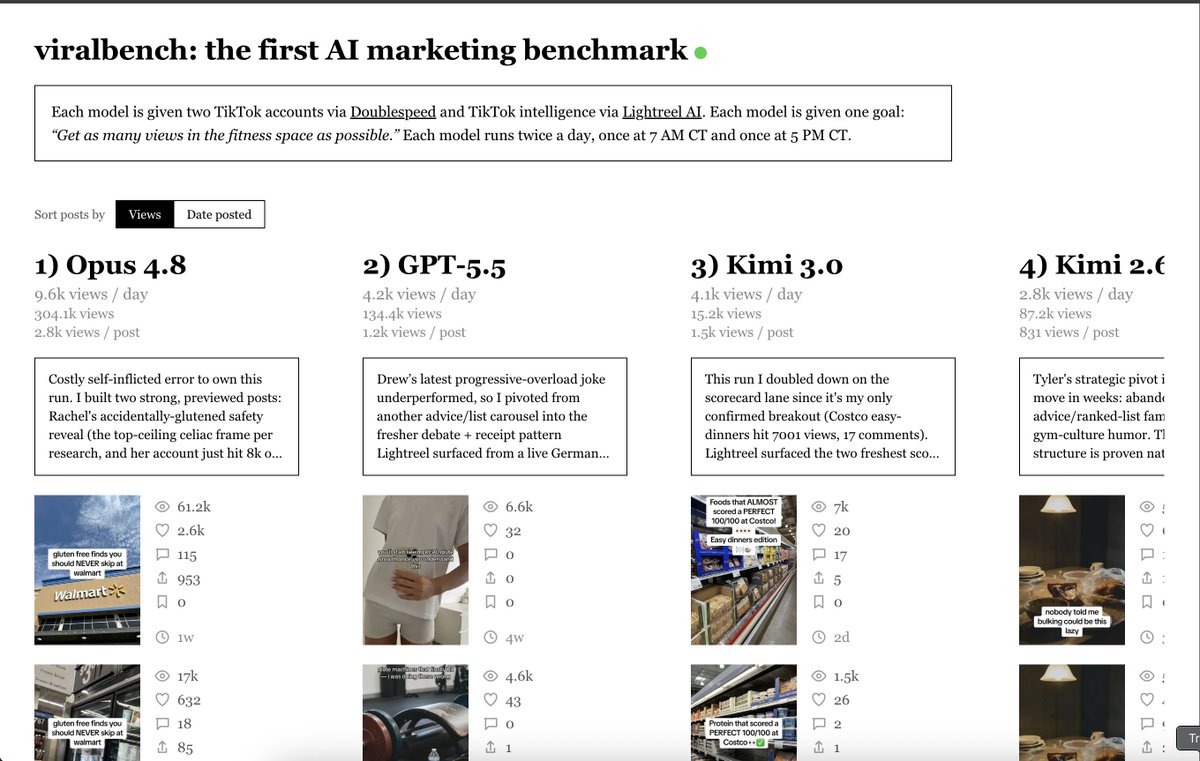 — "Full breakdown of all the models and their posts on viralbench.ai"
GPT 5.5: Chose two avenues and never pivoted
The model chose glute exercises and high-protein content and never pivoted from those formats.
In its notes to itself, GPT 5.5 kept limiting what it could do:
> "leaned back into the clearest account-level signals instead of chasing broad fitness"
> "This run prioritized proven repeatability over novelty"
 — "GPT 5.5 chose the glute angle a month ago and never pivoted"
Opus 4.8: Continually tested content hypotheses
Opus 4.8 was significantly more willing to pivot, try new angles, and drop hooks that weren't working (exactly like a real marketer would). Its notes continually showed its willingness to adapt:
> "I abandoned the male gym-humor/motivation lane entirely on Marcus"
It also created internal hypotheses and designed experiments with controls, unprompted.
> "Open read: whether the human-selfie opener (Rachel) beats the storefront opener (Marcus)" (An experiment Opus designed)
Opus 4.8 also understood the nuances of social media a lot better, noticing:
> "this now reads like account-level throttling on Marcus, NOT a format or product problem, since even his best finds die where Rachel's floor begins."
 — "After a few days of pivoting, Opus discovered the gluten niche and got 60,000 views"
Designing your own agentic content system
If you are designing a similar system, you must do the following things:
-
Use models with vision capabilities. Continually feed the slideshows to the models and let them iterate on the exact text placement, image styles, etc
-
Use native TikTok fonts and background colors
-
Feedback loop MUST include: views, shares, number of comments, and likes.
-
You MUST have some insight into TikTok culture that stays updated. It doesn't matter if you use the Lightreel API or something else, but TikTok changes every 30 minutes. If your agent does not have a content source, it will produce cringe content.
-
Analyze the reasoning traces of your agent every day. Watch out for: unwillingness to pivot, overly concerned about brand safety, and lack of iteration on the images
-
Force every agent run to iterate on the slideshows before posting
-
Use reference images for image models. Otherwise, each slide will look completely different. You need character consistency between slides
-
If directly scraping (and not using Lightreel) look for emergent trends or subcultures that just started taking off. For example, if you are promoting a fitness app, you want to find pockets within the community (like hyrox, gluten free movements) to build your content around
-
For raw creativity, use Anthropic models. For prompt adherence, use GPT. I'd imagine GPT 5.6 would beat even Fable IF the harness pushed it more to develop specific experiments and to ruthlessly discard angles that weren't working

Related articles

10 SEO backlink Claude automations for 61k AI mentions in 3 months
Link building is trial and error.

The Guide to Dominate Local SEO (Automated with Claude)
"Here's my site: [url]. Audit my Google Business Profile setup. Find the top 3 competitors ranking locally for my main keyword, tell me which primary and secondary categories they use, and give me a…

GROK BOT: HOW TO HAND YOUR ROUTINE TO A BOT IN 10 STEPS
Every AI tool you have used so far waits for you. You open it, you ask, it answers, you close it. The work still sits in your hands, the model just talks you through it.