How to become so good at marketing your competition thinks you're cheating

So, you want to become a marketing god. Someone who has the ability to magically manifest money on the internet. Someone with the abilities to get people to beg you to take their money.
Well let me tell you what most people get wrong about learning this magical skill of marketing. They spend years learning marketing backwards.
They begin with Meta ads, landing pages, email sequences, crazy Claude automation, content calendars, hooks, funnels, analytics, and whatever platform happens to be hot that month. Those things matter. But they are delivery systems. Marketing begins much earlier, inside another person's mind.
If you understand what you’re about to read in the next 7 minutes, you will understand what someone wants, why they want it, and what keeps them from acting.
Everything that comes after that is the vehicle that can carry that message to them. You can learn that foundation in one afternoon.
Marketing begins with human desire
Every purchase starts with a gap. Someone has a life they are experiencing now and a life they would rather experience instead. They want to lose weight. They want to earn more money.
They want their partner to look at them the way they used to.
They want more customers, more status, more freedom, less stress, or some proof that they are moving forward. The product sits between those two realities. Marketing makes the gap visible and presents the product as the mechanism that can close it.
This is why good marketing feels personal. The company is describing something the customer has already been thinking about, sometimes for years.
A founder may describe his problem as:
"We need a better content strategy."
But that may not be the desire underneath it.
He may be tired of watching weaker competitors dominate. He may hate having to explain what they do on every demo call. He may worry that the company depends too heavily on referrals. He may want the status that comes with being known as the person who defines his category.
"Content strategy" is the purchase. Being known, trusted, and chosen is the desire.
If you only market the purchase, your message sounds generic. If you speak to the desire, the customer pays attention.
There exists only 3 niches
Most markets can be traced back to one of three broad human desires:
- Health
- Wealth
- Relationships
This is the universal law of marketing.
There exist only 3 niches. Period.
Every human purchase, every niche, every product originates from these 3 niches.

Some products touch several categories at once. But every strong offer eventually promises improvement in one of these areas.
A fitness coach sells health. An investment platform sells wealth. A dating app sells relationships. The connection becomes less obvious when you look at software, fashion, education, entertainment, or business services. Yet the same motivations are still present.
A CRM helps a company make more money.
A luxury watch communicates status, which affects how someone sees themselves and how others see them (Relationships). A productivity app promises more control over time, often so the customer can work less, earn more, or be more present with family (Relationships) or get more done (Wealth).
Customers rarely want the product for its own sake. They want the change they believe the product will create. Nobody wants a “content system” or “marketing strategy”. They want money landing in the bank. That’s it.
Nobody wants a gym membership for access to metal equipment. They want to feel attractive, capable, healthy, or proud when they look in the mirror. The product is the tool. The desire creates the demand.
The brain's oldest filter
Your brain processes an absurd amount of information while you move through the day. You notice cars approaching while crossing the road. You hear your name across a crowded room. You detect anger in someone's voice before you have consciously interpreted their words. The brain must choose what deserves attention because conscious attention is limited.
A simple way to understand this is through survival and thriving. Survival means avoiding pain, danger, loss, exclusion, and uncertainty.
Thriving means gaining resources, status, connection, control, comfort, and opportunity.
These are the two filters the brain uses when exposed to information.
When you cross the road, your brain tells you to look left and right to survive.
When you walk into Starbucks, your buying decision was to get caffeinated so you can win the day and thrive.
If your marketing does not speak directly to the brain’s desire to survive and thrive, your message will get filtered out.
Look at the difference between these 2 messages:
“Our CRM uses advanced LLM systems to accelerate pipeline velocity.”
Or
“Work leads faster and close more of them with our CRM.”

Which of the two will instantly get filtered out by the brain? The first one of course. It’s a bunch of jargon and the brain has to do gymnastics to understand how this will help them. No bueno.
Reading this may feel obvious, but trust me, the large majority of founders I speak to have a message that looks like the first one.
The grunt test
Imagine explaining your offer to a caveman. He does not care about your features, methodology, brand story, credentials, or technology. He wants to know four things:
- What do I get?
- How does it improve my life?
- What pain does it remove?
- Why should I trust you?
A weak message says:
"We developed a cutting edge wood hunting apparatus with industry level precision with a 3 year warranty.”
The caveman hears noise. A clearer version says:
"Hunt your prey faster with a bow that never breaks."

Now the benefit is visible.
Clear marketing does not make the customer perform the translation. It connects the product to an outcome they already want. Run every headline, offer, landing page, and advertisement through the grunt test. Can a stranger grunt in understanding at what you do within a few seconds? Can they see how it helps them?
Can they tell what changes after they buy? If they need to decode the sentence, you have already lost attention.
Your customer is filtering you out
It is estimated that the average person encounters 5,000 to 10,000 advertisements each day.
Your customer sees more messages than they can process. Every app, billboard, notification, email, video, product package, and storefront competes for a small amount of attention.
The brain responds by ignoring almost everything. It does not ask:
"How much work did this company put into its campaign?"
It asks:
"Does this matter to me?"
This is why relevance beats creativity. A beautiful advertisement with no connection to an active desire gets ignored. A plain sentence that names a painful problem can stop someone immediately. Consider these two headlines:
"Unlock the power of next-generation executive content."
And:
"Your competitors are becoming the trusted names in your category while you remain invisible."
The second headline connects to a specific fear. The reader may feel the cost of inaction before they know anything about the service. Attention follows relevance.
Pain, desire, and perceived distance
Three forces affect whether someone buys. The first is the intensity of the current problem. How painful is the situation now? How often does the customer experience it? What is it costing them in money, time, energy, opportunity, or status?
The second is the strength of the desired outcome. How badly do they want the change? Can they picture what life looks like afterward? Does the outcome feel worth the effort and price?
The third is the perceived distance between the two. Does the solution feel believable? Can the customer understand how it works? Do they believe it can work for someone like them? Does the effort feel manageable?
Strong marketing increases the contrast between the customer's current and desired reality. Then it makes the path between them feel credible.
This is where the mechanism matters.
Your product needs a mechanism
A promise tells the customer where you can take them. A mechanism explains how you will get them there. "Grow your business" is a promise. "We interview you once a week, turn your expertise into daily content, distribute it across the channels your customers use, and connect each topic to an offer" is a mechanism.
The mechanism reduces uncertainty. It gives the customer something concrete to evaluate. A strong mechanism should answer:
- Why has the customer's previous approach failed?
- What does this method do differently?
- Why should that difference produce a better result?
- What will the customer need to do?
The mechanism can be a process, system, product feature, business model, ingredient, method, or belief. It does not need a clever name. A name helps people remember it, but clarity matters more.
Positioning connects your mechanism to survival and thriving
Positioning determines what your product means inside the customer's mind. The same service can be positioned in several ways. For example, a content service could promise more posts. It could promise more attention.
It could promise authority in a category. It could promise a shorter sales cycle because prospects arrive already familiar with the founder.
It could promise protection from CAC rising while competitors flood the market. Each position connects to a different desire.
The strongest position depends on what your customer already cares about. You cannot force urgency into a problem they do not feel. You can reveal the consequences of a problem they have underestimated.
For a proven founder, "we help you post more" is weak. The founder does not wake up wanting twelve LinkedIn posts. A stronger position is:
"We make your market understand why you are the obvious person to buy from before the first sales call."
That connects content to trust, acquisition, and revenue. The customer can see why it matters.
The vehicle comes last
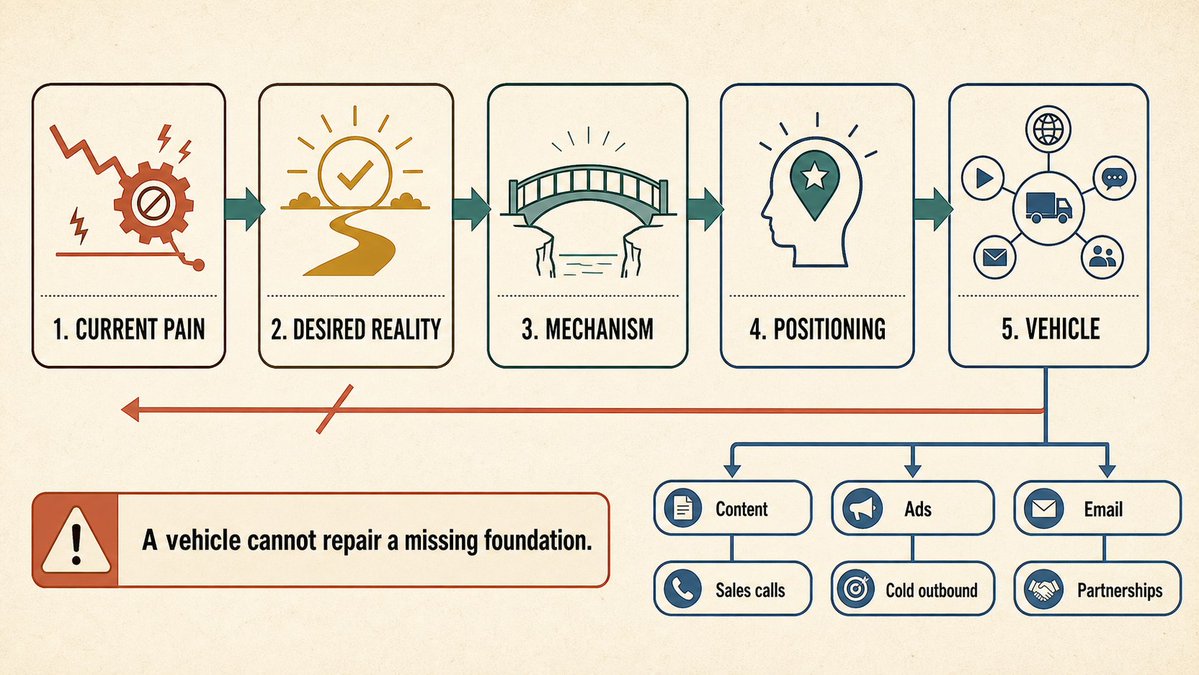
Once you understand the customer, the offer, and the mechanism, you can choose how to deliver the message. These might include:
- Founder-led content
- Meta ads
- YouTube
- Landing pages
- Webinars
- Sales calls
- Cold outbound
- Cold calling
- Affiliate marketing
- Partnerships
- Events
These are vehicles.
A weak message does not become strong because you put it in a LinkedIn post with a proven hook. A confusing offer does not become clear because you build a beautiful landing page. An irrelevant promise does not become desirable because you spend more money advertising it.
The vehicle affects reach, cost, format, and speed. It cannot repair a missing foundation.
This explains why businesses copy successful funnels and still fail. They copied what they could see. They copied the page design, advertisement format, webinar structure, or email sequence. They missed the customer insight underneath it. The visible campaign was built on an invisible understanding of the market.
Learn marketing by studying decisions
You do not need to spend the afternoon memorizing terminology. Choose one product and answer the following questions:
Hour one: the customer
Write down who buys the product. Avoid demographic descriptions unless they affect the purchase. "Male founder, 35 to 50" tells you very little. Describe the moment when the problem becomes urgent. What happened this week that made the customer seek help?
What are they tired of? What do they fear will happen if nothing changes? What would make them feel they had won?
Hour two: the desire
Connect the purchase to health, wealth, relationships, status, security, freedom, or belonging. Keep asking "Why does that matter?" until you reach an emotional outcome. They want content. Why?
To become visible. Why? So prospects recognize them. Why?
So sales conversations begin warm. Why? So the business can grow. Why? Because the business has been plateaued for 2 years. Why? Because they do not have a proper acquisition strategy. Now you have reached the desire.
Hour three: the mechanism
Explain how the product creates the result. Use plain language. List the steps. Identify why previous solutions failed. Show what makes this approach credible. If you cannot explain the mechanism, you may have a promotion problem disguised as an offer problem.
Hour four: the message
Write one sentence for each of these:
- The painful current reality
- The desired future
- The cost of staying where they are
- The mechanism that creates the change
- The proof that makes the claim believable
Then combine the strongest parts into a clear message.
Hour five: the vehicle
Choose where the customer already pays attention. A founder may be reachable through LinkedIn, YouTube, podcasts, industry events, or direct outreach. A local consumer may respond better to search, referrals, or Meta ads. Match the vehicle to the customer's existing behavior.
Do not choose a platform because marketers are talking about it. Choose it because your buyer uses it while thinking about the problem you solve.
The foundation of marketing
Marketing is the work of understanding another person's reality, showing them a more desirable one, and presenting a credible way to move between the two. Everything starts with the customer. What do they want? What are they afraid of losing?
What have they already tried? What would make them believe? How does your product help them survive or thrive?
Once you can answer those questions, content, advertisements, landing pages, and funnels become easier to build. Each one has the same job: carry the right message to the right person at the right moment.
Spend your afternoon studying people before studying platforms. That lesson will outlast every algorithm you learn.
Related articles

How I Make $20k/Month With Pixar Animations (and how you can too)
Every time I've made the most money in my life it came down to right time, right skill. AI Animations are exactly this to me right now
How to launch a one-person product (without destroying your life)
Over the last 5 years, I’ve helped launch products that went on to make multiple 7 figures in revenue per year.

the whop partner business model explained in 5 minutes...
every online business model is a trade between 3 things.