How to break the loop (and never be lazy again)
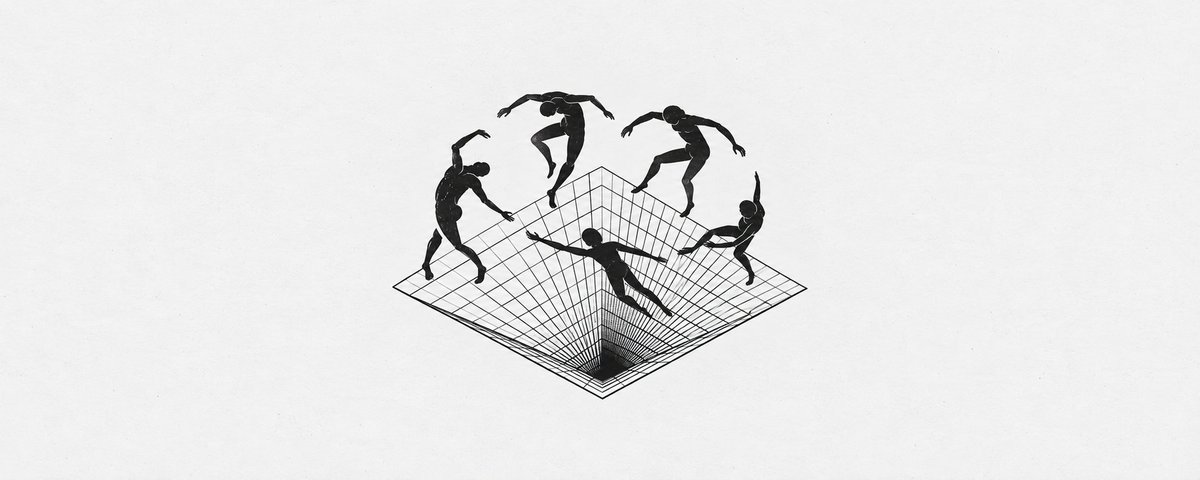
If you're anything like me, you've said “this is the last time” more times than you can count.
Last night, up until 3 AM. Last week, wasted the whole day. Last month, back to the same person, same app, same excuse.
And every time, you meant it.
That's the frustrating part. You weren't lying to yourself. You genuinely wanted to change. So why did you end up doing the exact same thing again?
Because you're probably trying to solve a loop with willpower.
I know because I've done this for years. I'd make a rule. Break the rule. Feel guilty. Make a stricter rule. Break that one too.
Eventually I realized I wasn't fighting laziness. I was fighting something I'd practiced so many times that it had become automatic.
Once you see the loop, you can actually start breaking it.
This is long. It's meant to be read once, slowly, not skimmed.
Let's begin.
I — You're not lazy. You're well-practiced.
Think about the last time you procrastinated. You sit down to work. The task feels difficult. You don't know where to start. You feel that tiny bit of discomfort. Then your hand reaches for your phone. You tell yourself you'll check it for a minute. Forty minutes later, you're scrolling.
What happened?
You didn't suddenly become lazy. You followed a pattern you've repeated hundreds of times.
Difficult task → discomfort → phone → relief.
Do that enough times and your brain gets very good at it. That's why you can feel incredibly motivated at 9 AM and completely useless at midnight.
At 9 AM, you're making a decision. At midnight, you're stepping into a pattern.
This is why simply telling yourself “I'll have more discipline tomorrow” usually doesn't work. You're bringing the same environment, same triggers, same response, and same reward into tomorrow.
Then you're surprised when tomorrow looks like yesterday.
You don't lack discipline. You've just been practicing the wrong response.
II — Every bad habit is solving something
This was the biggest shift for me.
I stopped asking, “Why am I doing this?” and started asking, “What is this doing for me?”
Because almost every habit gives you something. Scrolling gives you stimulation. Procrastination gives you relief. Junk food gives you comfort. Checking messages gives you novelty. Going back to someone gives you familiarity. Avoiding a difficult conversation gives you temporary peace.
The behavior might be terrible for your future. But it is doing something useful right now.
That's why “just stop” is such terrible advice. You remove the behavior, but you haven't removed the reason you wanted it. So the craving is still there, and eventually your brain finds another way to satisfy it.
TRIGGER → FEELING → OLD RESPONSE → IMMEDIATE REWARD
For example:
Deadline → overwhelm → YouTube → relief
Loneliness → discomfort → text them → connection
Boredom → restlessness → Instagram → stimulation
Once you can write your own version of that sentence, you've already done something important.
You've turned “I'm just lazy” into “I know exactly when this starts.”
That's a much easier problem to solve.
III — Find the first domino
Don't study the moment you fail. Study the 30 seconds before you fail.
That's where the useful information is.
Next time you catch yourself doing the thing you promised you'd stop doing, ask: What happened right before this?
Not yesterday. Not your entire personality. Just the few seconds before it happened.
Were you bored? Overwhelmed? Lonely? Tired? Stressed? Avoiding uncertainty? Looking for an escape?
Write it down.
Do this a few times and you'll start seeing your pattern.
Maybe you're not addicted to your phone. Maybe you're addicted to escaping difficult tasks.
Maybe you're not lazy. Maybe you haven't learned how to tolerate being uncomfortable long enough to finish something.
Maybe you don't miss that person. Maybe you miss how you felt when they were around.
Those are completely different problems.
And different problems need different solutions.
IV — There are four levels of awareness
You don't go from “I can't control myself” to “I'm completely in control.”
There are stages.
Level 1: You don't notice. You scroll for three hours and only realize afterward.
Level 2: You notice afterward. You catch yourself and think, “shit. I did it again.”
Still progress. You noticed.
Level 3: You notice during. You're 10 minutes into scrolling and suddenly think, “Wait. I'm doing it again.” Now you can interrupt it.
Level 4: You notice before. You feel the urge, recognize the trigger, and choose what happens next.
That's where the loop starts losing its power.
Most people expect themselves to jump straight to Level 4. Then they fail and conclude, “See? I can't change.”
No.
If you used to notice three hours later and now you notice ten minutes later, you changed.
You're moving the moment of awareness closer to the trigger.
That's the skill.
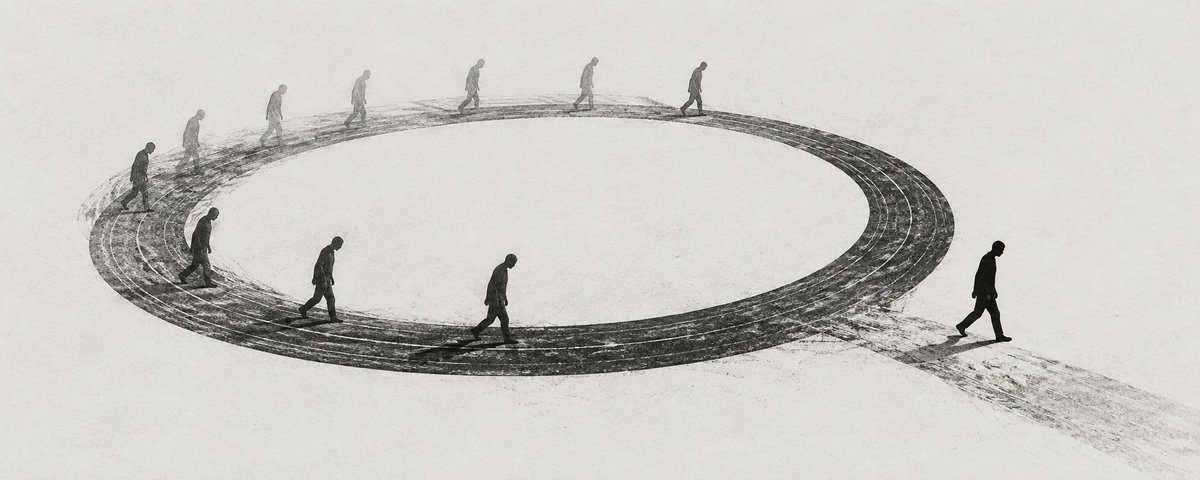
V — Catch it before you fight it
This is where the actual change happens.
You don't need some insane productivity system. You need a tiny interruption.
CATCH → NAME → INTERRUPT → REPLACE
Let's say you're working. The task gets difficult. You feel overwhelmed. Your hand reaches for your phone.
Catch: “I'm about to escape.”
Name: “This is overwhelm.”
Interrupt: Put the phone somewhere you can't reach it.
Replace: Work for five more minutes.
That's it.
You didn't fix your life. You didn't become disciplined. You just broke one loop.
And that counts.
Because the next time the same trigger appears, your brain now has another option.
VI — Make the old habit harder
This is where people overestimate willpower.
If your phone is sitting next to you, unlocked, with every distracting app one tap away, you're going to have to make hundreds of good decisions every day.
Why make yourself fight that battle?
Make the bad behavior annoying.
Delete the app. Log out. Put your phone in another room. Use a website blocker. Don't keep junk food beside your desk. Put your gaming controller in a drawer.
Whatever the habit is, add friction between the trigger and the response.
Then do the opposite for the habit you want.
Want to read? Put the book on your pillow.
Want to work out? Put your clothes beside your bed.
Want to write? Leave the document open.
BAD HABIT = MORE FRICTION
GOOD HABIT = LESS FRICTION
You don't always need more self-control.
Sometimes you just need a better environment.
VII — Replace what the habit was giving you
This is the part that makes or breaks the whole thing.
Don't just remove the behavior. Replace the reward.
If scrolling gives you stimulation, find another source of stimulation. If procrastination gives you relief, create a way to get relief without abandoning the task. If loneliness sends you back to someone you shouldn't return to, find another way to feel connected.
The replacement doesn't have to be perfect. It just has to be better than the old response.
So:
OLD: Stress → scroll → relief
becomes:
NEW: Stress → walk → relief
Or:
OLD: Overwhelm → procrastinate → relief
becomes:
NEW: Overwhelm → five-minute start → progress → relief
You're not trying to become a robot who never feels an urge.
You're teaching yourself:
“When I feel this, I have another move.”
VIII — Decide before you're emotional
Don't wait until the craving arrives to figure out what you'll do.
By then, you're negotiating with yourself. And you're probably going to lose.
Decide beforehand.
IF X HAPPENS → THEN I DO Y
Examples:
If I reach for my phone while working, then I put it in another room.
If I don't feel like going to the gym, then I only commit to the warm-up.
If I want to procrastinate because a task feels overwhelming, then I work on it for five minutes.
If I start overthinking in bed, then I write the thought down and put the phone away.
Don't make the rule vague.
“I'll be more productive” isn't a rule.
“When X happens, I do Y.”
That's a rule your brain can actually use.
IX — Don't turn one mistake into your identity
This might be the most important part.
You're going to slip.
You'll waste the afternoon. You'll scroll again. You'll skip the workout. You'll eat the thing. You'll text the person. Whatever your version is.
The mistake isn't what destroys the habit change.
It's what you tell yourself after the mistake.
You say:
“I've already ruined today.”
So you ruin tomorrow too.
Then Monday.
Then the week.
Then suddenly you're back where you started.
Instead:
SLIP → NOTICE → RESET
That's the entire rule.
Don't wait until tomorrow. Don't wait until Monday. Don't wait until the new month.
The faster you return, the weaker the loop becomes.
If you used to lose a month after one bad day and now you lose an evening, that's progress.
If you used to scroll for three hours and now you catch yourself after 20 minutes, that's progress.
If you used to quit completely and now you restart the next morning, that's progress.
You're measuring the wrong thing if you're only measuring perfection.
Measure recovery time.
X — Your one-day reset
You can start tomorrow.
Morning — find the loop
Pick one loop. Not ten.
Write:
My trigger: ______
What I feel: ______
What I usually do: ______
What I get from it: ______
What I'll do instead: ______
Then finish this:
“If ______ happens, I will ______.”
Make it stupidly specific.
During the day — catch yourself
Set three random alarms.
When one goes off, don't check your notifications.
Ask:
What am I doing? What am I feeling? Am I inside my old loop?
That's it.
You're training awareness.
At night — measure recovery
Write down:
When did I catch the loop?
What triggered it?
How quickly did I recover when I slipped?
Don't judge yourself.
Collect data.
You're not writing a diary.
You're studying the machine.
XI — The whole thing in one page
When you catch yourself repeating the same behavior, run this:
1. FIND THE TRIGGER — What happened immediately before?
2. FIND THE FEELING — What were you trying to escape, change, or get?
3. FIND THE REWARD — What did the behavior give you immediately?
4. ADD FRICTION — How can I make the old response harder?
5. CREATE A REPLACEMENT — What can give me some of the same reward without the same cost?
6. MAKE AN IF–THEN RULE — If X → then Y.
7. PRACTICE THE INTERRUPTION — Catch it earlier each time.
8. RECOVER FAST — Don't turn one mistake into a week.
The loop becomes:
TRIGGER → FEELING → OLD RESPONSE → REWARD
Then you slowly turn it into:
TRIGGER → AWARENESS → PAUSE → NEW RESPONSE → REWARD
And eventually:
TRIGGER → NEW RESPONSE
That's when things start getting easier.
Not because you suddenly became a different person.
Because you stopped giving the old pattern so many repetitions.
XII — You don't need a new life. You need a new response.
Think about how your habits were built.
You didn't decide one day, “I'm going to become this person.”
You repeated small things. Again. Again. Again.
Until they became normal.
That's also how you get out.
One interruption. One better response. One more repetition.
Then another.
And another.
Eventually, the thing that used to happen automatically becomes something you notice.
Then something you can resist.
Then something you don't even want anymore.
That's the part nobody tells you.
Breaking the loop doesn't feel like becoming a new person.
At first, it feels like catching yourself doing the old thing.
Then catching yourself earlier.
Then choosing differently.
Then doing it again.
Until one day you realize:
The thing that used to control you has become a choice again.
That's freedom.
Not never falling back into the old loop.
Being able to leave it when you do.
Related articles

How I Make $20k/Month With Pixar Animations (and how you can too)
Every time I've made the most money in my life it came down to right time, right skill. AI Animations are exactly this to me right now
How to launch a one-person product (without destroying your life)
Over the last 5 years, I’ve helped launch products that went on to make multiple 7 figures in revenue per year.

the whop partner business model explained in 5 minutes...
every online business model is a trade between 3 things.