How to go from 0-50k/month in 42 days (I did this 4 times)

How to Oneshot Apps to $50k/mo (Easy Mode)
If you've been on 𝕏 lately, you've probably seen the same thing I have. Someone builds a random mobile app, posts a screenshot of their revenue a few weeks later, and suddenly it's doing $10k, $50k, sometimes way more per month.
And naturally you start thinking: okay, should I just build an app too?
The answer is probably yes. Not because every mobile app is suddenly free money, but because the annoying part that used to stop most people from even trying has mostly disappeared. You don't need to spend months learning Swift. You don't need to find a technical cofounder. You don't need to pay an agency $30,000 just to see if your idea is any good.
You can build the first version yourself with AI, put it in front of people, and find out pretty quickly whether you've got something.
That's the interesting part to me.
Building isn't really the bottleneck anymore. Knowing what to build and knowing how to get people to care about it is.
So this isn't going to be a coding tutorial. It's more of a playbook for the whole thing: finding an idea, figuring out the feature people will actually care about, building it with Shipper, getting the onboarding and pricing right, finding creators, making content that converts, and then looking at the numbers to figure out what to do next.
Table of Contents
- The Math Behind $50K/Month
- Finding an Idea People Actually Want
- Why Starting Niche Makes Everything Easier
- Borrowing Proven Mechanics
- The One Feature People Need to Remember
- Designing the Viral Video Before the App
- Why Distribution Can't Save a Bad Idea
- Building Your App With Shipper
- How I'd Build the First Version
- Onboarding That Actually Converts
- Pricing and Paywalls
- Finding the Right Creators
- Turning Your Feed Into a Lead List
- Creator Outreach at Scale
- Negotiating Creator Deals
- Making Sponsorships Feel Native
- Organic Content and Meme Pages
- Turning Winning Content Into Paid Ads
- What to Do After a Creator Posts
- Launching the App
- Conversion, Revenue and Retention
- Viral Features vs. Useful Features
- What to Do Once You're Making Money
$50k/month is smaller than it sounds
When people say they want to build a "$50k/month app," it sounds like you're trying to create some enormous company.
You're really trying to make around $1,667 a day.
That's still hard, obviously. But it's a much nicer problem to think about.
You don't need everyone on the internet to know your app. You need a small enough group of people who really want it, a product that turns some of those people into customers, and a way to keep bringing new people in.
I basically think of it as three moving parts.
First, you need something worth building. There has to be an actual reason someone would download this instead of the thousands of other apps already sitting in the App Store.
Then the app has to be good. The promise might get someone through the door, but the product has to actually give them what they came for.
And finally, you need attention. You need some repeatable way of putting the app in front of the kind of person who would use it.
You can be amazing at two of these and still lose because the third one is missing. Great product with no distribution means nobody knows you exist. Great marketing with a forgettable product means you're just paying to send people somewhere they don't care about. And an amazing idea badly executed is still a bad experience.
The goal is getting all three working together.
don't brainstorm apps. look for annoying problems.
I wouldn't open ChatGPT and ask for "50 viral mobile app ideas."
That's probably how you end up making the 400th AI habit tracker.
I'd start much closer to home.
Think about communities you understand unusually well. Sports you play. Hobbies you're obsessed with. Jobs you've had. Things you spend too much money on. Stuff you constantly complain about. Groups of people whose TikTok feed you could basically predict.
Then look for annoying little problems inside those worlds.
This is much easier when you're part of the audience yourself because you don't have to cosplay as your customer. You already know what they care about.
If you lift every day, you know what gym people obsess over.
If you play golf every weekend, you know what golfers complain about.
If you're a university student, you know which parts of university life are unnecessarily painful.
That's where I'd start.
And I wouldn't immediately worry about whether the market is gigantic.
For a first app, I'd actually rather have something very specific.
"AI fitness app" tells me almost nothing.
"An app that watches your Muay Thai bag work and tells you where you're dropping your guard" immediately gives me a picture of the customer, the feature, the marketing, and even the TikTok video.
That's much more useful.
small markets can actually make distribution easier
People hear "niche" and immediately worry that they're limiting themselves.
But at the beginning, being specific is almost a cheat code.
Imagine you're building something for wrestlers.
Now finding customers isn't this giant abstract problem anymore. You know what accounts they follow. You know what videos they watch. You know the vocabulary. You know the memes. You know the athletes they care about. You know exactly which creators you could message.
Compare that with building another generic productivity app.
Who exactly are you marketing that to?
Everyone?
That's usually another way of saying nobody in particular.
You don't need to own the entire fitness market. You can become the app everyone inside one small community knows first, then expand from there.
The best early products often feel almost suspiciously specific.
Someone sees it and thinks:
wait, they literally made this for people like me.
That's a great place to start.
look at what people do, not what they claim they want
Another useful rule is to ignore people's ideal version of themselves.
People say they want to stop scrolling.
Then they scroll for four hours.
People say they want to cook more.
Then they order food again.
People say they want to save money.
Then payday arrives and somehow half of it disappears by Monday.
That gap between what people want themselves to do and what they actually keep doing is full of app ideas.
So don't only ask people, "would you use an app that does X?"
Watch behavior.
What are they already spending time on?
What do they repeatedly struggle with?
What do they keep paying for?
What do they constantly search for?
What are they embarrassed, annoyed, curious or competitive about?
Behavior is usually a much better signal than someone politely telling you your idea sounds cool.
you can also move proven ideas into new markets
You don't always need some completely original mechanic either.
A lot of good products are familiar ideas moved somewhere unexpected.
Take streaks.
Duolingo proved people will protect a meaningless little streak with their life.
So where else could that work?
Gym consistency. Studying. Saving. Running. Reading. Learning piano.
Same mechanic, completely different product.
Or Spotify Wrapped.
People love seeing a pretty summary of themselves, especially if they can share it.
So maybe there's a yearly gym Wrapped. A spending Wrapped. A sleep Wrapped. A dating Wrapped. A productivity Wrapped.
Same psychology.
Or Tinder.
Swiping is basically just an insanely simple way of making lots of decisions.
Could you swipe through workouts? Meals? Clothes? Places to visit? Tasks?
You don't need to reinvent human psychology.
Sometimes you can just notice something people already enjoy doing and apply it somewhere it hasn't been used properly yet.
the app needs one thing people immediately want to try
Before I'd worry about settings pages, profiles, notifications, achievements or any of that stuff, I'd figure out one thing:
what is the feature people are going to show their friends?
Every good consumer app seems to have one.
Take a photo of your food and it tells you the calories.
Upload your face and it gives you a rating.
Upload a sports clip and it breaks down your technique.
Give it your spending and it roasts you.
Whatever.
It should be something I can understand without reading six paragraphs.
More importantly, it should make me curious about my own result.
That's why personalized features work so well.
Seeing someone else's calorie estimate is mildly interesting.
Taking a photo of the pizza sitting in front of you and immediately seeing what it contains is different.
Watching an app analyze somebody else's technique is cool.
Uploading your footage and seeing what you're doing wrong makes you want the app.
That's the feeling you're looking for.
I wouldn't build 15 average features before getting this one right.
I'd rather have one feature people desperately want to try and a very simple app around it.
imagine the ad before you build the product
Here's another thing I'd do differently.
Before building anything, I'd imagine someone promoting it.
Literally picture the TikTok.
What happens in the first five seconds?
What does the creator do?
What appears on their phone?
What makes somebody watching think, "hold on, what app is that?"
If you can't picture that moment, I'd think about the product more before building it.
Because eventually you're going to have to explain this thing to strangers.
And the easiest products to market are the ones that basically demonstrate themselves.
Say you're building an app for runners.
Maybe a creator finishes a run, opens the app, and it instantly tells them exactly where their pace collapsed and what they should change next time.
That's a video.
You barely need a script.
Now imagine the product is "an AI-powered holistic running companion designed to optimize athletic performance."
What does the creator actually show?
No idea.
That's the difference.
You want to be able to turn the product into content without forcing it.
scroll like your future customer
I'd actually use TikTok and Instagram for idea research.
Pick the audience you're thinking about building for and spend 20 minutes pretending to be them.
Not mindless scrolling.
Actually study the feed.
Every time a creator appears, ask yourself:
who watches this person?
what does that audience care about?
what problem keeps appearing in these videos?
could a product naturally fit somewhere inside this content?
You're basically researching the customer and the distribution channel at the same time.
And after doing this for a while, something useful happens.
The algorithm starts doing the research for you.
If you've spent three days watching nothing but running content, suddenly your feed is full of running creators.
Those are potential partners.
Now instead of searching Google for "running influencers," you can literally scroll your feed and find people who already reach your exact customer.
That's a ridiculously useful prospecting tool.
don't assume distribution can rescue anything
People love saying distribution beats product.
I'd phrase it differently.
Distribution multiplies whatever is already there.
If you have something people immediately want, distribution is amazing.
If nobody cares about the thing, getting another million people to see it doesn't magically fix that.
This is why you'll sometimes see a random niche app make serious money from a relatively small creator, while another app gets millions of views and barely converts anyone.
Attention isn't the same as intent.
And views aren't the same as demand.
The nicest situation is when the product itself gives you the marketing angle.
Then you're not constantly inventing crazy advertisements to convince people something boring is interesting.
You're just showing them the interesting thing.
then i'd build it in Shipper
Once I had the idea and knew what the main demo should look like, I'd start building.
This is where Shipper changes the equation quite a bit.
Instead of needing to learn mobile development first, you can describe the app you want and build it through conversation.
I'd start by explaining the customer, what the app does, the main screens I need, and roughly what I want the product to feel like.
Then I'd build from there.
But I definitely wouldn't try to one-shot the entire app.
That's probably the fastest way to make something that feels AI-generated.
I'd work on it the same way I'd work with an actual developer sitting beside me.
Make the home screen.
Look at it.
Change it.
Build the main flow.
Test it.
Something feels weird? Fix it.
The result page looks boring? Redo it.
Navigation is confusing? Simplify it.
Then move onto the next thing.
You might end up giving Shipper hundreds of instructions before you're happy.
That's completely normal.
AI makes the iteration much faster. It doesn't mean you stop caring about the details.
i'd build the outside first, then make the inside work
My first pass would mostly be about getting the product structure right.
Who opens this app?
What do they see?
What's the first thing I want them to do?
Where is the main feature?
What happens after they use it?
How do they get back?
What should the app feel like?
I'd get those screens into Shipper and make the basic experience feel good before adding every backend feature imaginable.
Then I'd spend a huge amount of time on the core feature.
If the whole reason people download the app is because they can upload a video and get feedback, that flow has to be really good.
The upload needs to feel good.
The loading state needs to build anticipation.
The result needs to look impressive.
The feedback needs to actually be useful.
That's where I'd obsess.
After that I'd connect whatever else the product actually needs: accounts, subscriptions, databases, AI models, external APIs, notifications, whatever.
Not before.
There's no prize for having the most complicated stack.
AI doesn't mean ship something bad
There's this weird idea that anything built with AI automatically becomes "AI slop."
I don't really buy that.
Bad products existed long before AI.
AI just makes it possible to make bad products faster.
It also makes it possible to make good products faster.
The difference is how much you care.
If something looks bad, don't accept it.
If a button doesn't work properly, fix it.
If the output isn't useful, keep changing it.
If the onboarding feels generic, redo it.
You still need taste.
You still need judgment.
You still need to know when something isn't good enough.
Shipper removes a lot of the technical work between having the idea and making the change.
It doesn't make the product decisions for you.
And that's actually why I think this is such a big opportunity.
The advantage moves away from "who knows how to write the code?" and closer to "who understands what people want?"
That's a much more interesting game.
onboarding might matter almost as much as the app
Once the actual product works, I'd spend a lot of time on onboarding.
This is one of those things that looks boring until you realize how much money can disappear because you got it wrong. You can have an amazing app, get thousands of downloads, and still make almost nothing because people open it, tap around for 20 seconds, don't really understand why they need it, and leave.
I don't really think of onboarding as "setting up your account."
I think of it as the few minutes you have to take someone from:
"this looked interesting on TikTok"
to:
"okay, I actually want this."
That's a completely different job.
And I'd break that job into a few parts.
First, actually show people what the product does. Don't assume they understood everything from the ad that brought them there. Give them a few quick screens showing the best parts of the app. Keep it visual. If the main feature is analyzing a video, show that happening. If the app generates something, show the output. People should understand what they're about to get before you ask them for money.
Then start making the experience about them. Ask what they're trying to achieve, what they struggle with, how experienced they are, or whatever makes sense for the product. The questions shouldn't just exist because every app has onboarding questions. They should slowly make the user feel like the product is being set up specifically for them.
If you're building a fitness app, for example, you might ask what they're training for, how often they train, where they're currently struggling, and what result they want. Then instead of dumping them onto a generic dashboard, you can tell them you're creating their plan around those answers.
Now they're not waiting to see the app anymore.
They're waiting to see their plan.
That's a much stronger feeling.
make them want the result before showing the paywall
One onboarding trick I really like is letting someone begin the interesting part of the product before asking them to pay.
Say your app analyzes someone's golf swing.
Don't make the flow:
download → answer three questions → paywall.
Let them upload the swing.
Show the video processing.
Maybe show little messages like:
analyzing posture...
checking club path...
comparing impact position...
Then tell them:
your analysis is ready.
And then show the paywall.
Now there's actually something sitting behind it that they want.
The user isn't being asked to pay for some abstract promise anymore. They've already put their own information into the product and they know a personalized result is waiting on the other side.
You can do versions of this with loads of apps.
Upload your meal, then unlock the nutrition breakdown.
Answer the questions, then unlock your personalized plan.
Connect your spending, then unlock your financial analysis.
Upload your face, then unlock your results.
The exact mechanic changes, but the idea is the same.
Build curiosity before you ask for money.
don't make onboarding long just because long onboarding converts
There's obviously a limit here.
You sometimes see apps with 30 or 40 onboarding screens because somebody read that more questions create commitment.
That doesn't mean you should ask users for their childhood address and favorite dinosaur before letting them use a calorie tracker.
Every screen should earn its place.
I basically want enough onboarding that the user understands the product, feels like it's relevant to them, and becomes curious about their result.
Then get out of the way.
If you're unsure what that should look like, don't invent everything yourself.
Download successful apps in your category.
Go through their onboarding slowly.
Screenshot every screen.
Look at what they ask and, more importantly, when they ask it.
When do they show the product?
When do they ask your goal?
When do they show social proof?
When do they ask for notifications?
When do they ask you to create an account?
What happens immediately before the paywall?
You can learn a ridiculous amount just by doing this for 10 good apps.
make the product so obvious someone else can use it without you
There's another test I'd run before sending serious traffic to the app.
Hand your phone to someone who has never seen it before.
Don't explain anything.
Just watch.
If they immediately ask you what they're supposed to do, that's information.
If they press the wrong thing, that's information.
If they can't find the main feature, that's really useful information.
The hard part about designing your own product is that after staring at it for two weeks, everything seems obvious.
You know what every icon means because you chose the icon.
You know where the feature is because you put it there.
Your customer knows none of this.
So find someone non-technical, give them the app, and keep your mouth shut.
Every time you feel the urge to explain something, that's probably something the product should explain instead.
pricing doesn't need to be complicated
Once onboarding is working, I'd keep the first pricing setup very simple.
For a normal consumer subscription app, something around:
$9.99/month
and
$59.99/year
is a perfectly reasonable place to start.
Maybe you put a short free trial on the yearly plan.
That naturally makes annual look more attractive, and annual customers are especially nice early because you're getting much more cash upfront instead of waiting for $10 every month.
But those exact prices aren't sacred.
If there are already successful apps solving a similar problem, look at what they're charging.
They've probably tested this much more than you have.
If five established apps in your category are all around $50 to $70/year, I probably wouldn't randomly decide mine should cost $240/year because some pricing thread on X told me to "charge more."
Start somewhere sensible.
Once you have enough traffic, test it.
Try another yearly price.
Try another monthly price.
Try changing which option gets the trial.
Try changing how the paywall is presented.
Eventually your own numbers matter more than anyone else's advice.
now you actually need people to download it
This is where I'd probably spend most of my time once the product is ready.
Because building an app is only half the job.
Maybe less than half.
You can build something incredible in Shipper, publish it, and still make $0 because nobody knows it exists.
For consumer apps, one of the first channels I'd test is creators.
Not necessarily celebrities.
Actually, probably not celebrities.
I'd much rather find creators whose audiences match the product extremely well.
If I have an app for wrestlers, give me the wrestling creator with 80,000 followers over the lifestyle creator with 2 million.
The smaller creator's audience might be almost entirely potential customers.
The huge creator's audience could be everyone from 13-year-olds watching memes to someone's mom watching recipe videos.
Specific attention is worth a lot.
don't judge creators by follower count
Follower count is probably one of the least useful numbers people obsess over.
I'd care much more about what happens when the creator actually posts.
Look through their recent videos.
How many views do they normally get?
Not their biggest video.
Normally.
If their last ten videos did:
40k
52k
31k
60k
45k
39k
70k
42k
that's interesting.
You can roughly understand what you're buying.
If they did:
1.8m
9k
12k
400k
7k
15k
900k
I'd be much more careful.
Their average might technically look impressive, but their normal post doesn't reliably reach people.
I'd also read the comments.
Do people actually talk to this person?
Do they ask questions?
Do they reference previous videos?
Does it feel like a real community?
Or is every comment basically:
🔥🔥🔥
😍😍
nice bro
Views are nice.
Trust is better.
You're ultimately asking these people to get off Instagram, download something, go through onboarding, and potentially enter their card details.
That's a lot more effort than liking a Reel.
train Instagram to find your creators for you
Instead of manually searching for creators all day, I'd make the algorithm do part of the work.
Create a fresh account for the niche you're targeting.
Then use Instagram exactly like your ideal customer would.
Watch the relevant videos all the way through.
Like them.
Save them.
Follow the good accounts.
Interact naturally.
Ignore unrelated stuff.
Do this for a while and your Explore page and Reels feed basically become a constantly updating database of creators in your niche.
Now prospecting becomes incredibly simple.
Scroll.
Interesting creator.
Open profile.
Check recent views.
Check comments.
Message them.
Keep scrolling.
You're basically telling Instagram:
please keep finding people who already have my customers' attention.
And Instagram is very good at doing exactly that.
outreach is a volume game
At the beginning, I'd send a lot of messages.
Like genuinely a lot.
Not five DMs and then conclude influencer marketing doesn't work.
You might need 100 targeted DMs a day while you're figuring this out.
Some won't open it.
Some will ignore you.
Some will quote a completely insane price.
Some will say yes and then disappear.
Some will agree and make terrible content.
And eventually you'll find a few that work ridiculously well.
That's the game.
Once you've figured out what a good creator looks like, this is also one of the first jobs I'd consider handing off.
Write down your criteria.
Maybe:
- creator is in this niche
- usually gets 25k+ views
- posts regularly
- has real comments
- hasn't promoted five competing apps this week
Then give someone the account and have them prospect every day.
You don't need to personally spend three hours scrolling forever.
You need to build the system first so someone else can eventually run it.
the first DM should barely be a pitch
Don't send creators six paragraphs.
They aren't going to read it.
Their inbox is already full of:
> hey! absolutely LOVE your content and think your authentic voice would align perfectly with our revolutionary brand...
delete.
I'd make it incredibly obvious why I'm messaging.
Something like:
> paid promo? i run an app that analyzes your wrestling footage and shows you exactly what you did wrong. think it'd fit your content really well. interested?
That's basically enough.
You're not trying to close the entire partnership in message one.
You're trying to get:
"yeah, tell me more."
Once you have that, you can actually talk.
move serious conversations away from endless DMs
If someone seems genuinely interesting and there's meaningful money involved, I'd try to get on a quick call.
It's just easier.
You can show them the product.
Explain how you imagine it fitting into their content.
Talk through ideas.
And negotiate without sending 40 messages back and forth over three days.
Also, don't open the call by immediately asking their price.
Talk like a normal person.
Mention something they actually made.
Tell them why you thought their audience made sense.
Show them the product.
Explain the kind of integration you have in mind.
Then talk money.
People negotiate differently when they actually like you and understand what you're trying to do.
always know the CPM you're paying
Even if the creator quotes you one flat number, convert it into CPM in your head.
CPM is just how much you're paying for every thousand views.
If you're paying $300 and realistically expect 100,000 views, you're paying around a $3 CPM.
Now you have something you can compare.
Maybe creator A charges $500 and normally gets 300k views.
Creator B charges $250 and normally gets 30k.
Creator A looks more expensive at first, but could actually be much cheaper attention.
The important word there is realistically.
Don't use their best-performing post ever.
Look at normal performance and be conservative.
If you underestimate views and the video goes viral, great.
If you build the whole deal around the assumption that every post will go viral, you're going to burn money quickly.
i'd rather test multiple posts than bet everything on one
One post is noisy.
Maybe they posted at a bad time.
Maybe the hook sucked.
Maybe their audience didn't understand the integration.
Maybe the video just randomly died.
So where possible, I'd rather test a small batch.
Three videos.
Four videos.
Something that gives you enough information to see whether the creator actually works.
You can also structure deals so there's some alignment around performance.
Maybe there's a guaranteed payment, then more upside if the content performs really well.
Or maybe you agree on a reasonable minimum amount of views across the campaign.
The exact structure isn't the important part.
What matters is that you're not blindly throwing money at follower counts.
You're buying distribution.
Treat it like distribution.
the dream is recurring creators
If someone makes you money, don't immediately move onto the next person.
Book them again.
This sounds obvious, but people constantly forget it.
They treat influencer marketing like collecting Pokémon.
New creator.
New creator.
New creator.
Meanwhile, the creator who made them $4,000 from a $500 campaign hasn't heard from them in two months.
I'd rather have a small group of creators who repeatedly make profitable videos than hundreds of random one-off deals.
It makes the business much more predictable.
You know roughly what happens when they post.
They understand the product better each time.
Their integrations become more natural.
Negotiations become easier.
And you actually build a relationship instead of starting from zero every week.
the best sponsorship barely feels sponsored
Once you've booked someone, don't destroy the thing that made you hire them.
They already know how to make content their audience likes.
That's why you're paying them.
So before deciding what they should post, look through their recent videos.
What formats consistently work?
Maybe they do day-in-the-life content.
Maybe they make tutorials.
Maybe they tell stories.
Maybe everything is comedy.
Maybe they reply to comments.
Maybe their audience loves progress videos.
Whatever already works, put the product inside that.
Don't make them suddenly become a corporate spokesperson.
The app should be something they're using inside the video, not the entire reason the video exists.
That's the difference between:
> today's video is sponsored by this amazing new AI fitness app...
and:
> okay i'm about to train but first look what this thing said about yesterday's session
Then the app appears.
Five seconds.
Result shown.
Back to the video.
That can be much more powerful.
make the creator the interesting part
A simple rule I like is:
the creator is the main character. the product is a tool.
You're borrowing the creator's relationship with their audience.
Don't interrupt it.
If they make routine videos, make the app part of their routine.
If they teach, let the app become one of their tools.
If they make jokes, make the app part of the joke.
If they document progress, let the app help explain the progress.
If they answer comments, let someone ask a question that naturally leads into the product.
You can fit almost any app into existing content if you understand the creator's format.
And that's usually much better than forcing every creator to read the same script.
one winning video is worth way more than one post
Suppose you pay $200 for a creator video and it converts really well.
You haven't just bought one promotion.
You've found an angle.
That's much more valuable.
Now you can ask:
what made this work?
Was it the opening?
Was it the feature they showed?
Was it the creator?
Was it the wording?
Was it the reaction?
Was it the way the result appeared?
Take the same idea and test it again.
Make another version.
Try it with another creator.
Cut it shorter.
Change the first three seconds.
Post it on your own account.
Use it as a reference for future creators.
If you have permission, test it as paid creative.
Good marketing gets much easier when you stop trying to invent something completely new every morning.
Find what works.
Then make variations until it stops working.
niche and meme pages can be ridiculously cheap
Creators aren't the only way to buy attention.
Topic pages and meme pages can work really well too, especially when the product has something funny, surprising, or visual.
Say you make an app for fighters.
There are MMA pages, boxing pages, kickboxing pages, gym pages, fight meme pages, athlete pages.
Some of these pages have incredibly engaged audiences and relatively cheap post prices.
You can take a video that's already working and pay them to repost it.
Sometimes this is dramatically cheaper than paying another creator to make something from scratch.
The same rule applies though.
Don't buy follower counts.
Look at recent reach and engagement.
A 100k page where every post gets 60k views can be far more useful than a million-follower page getting 8k.
organic is where i'd test ideas for free
I'd also post constantly from the brand account.
Not because every company needs to become a media company.
Because organic content gives you cheap feedback.
Show the core feature.
Try different opening lines.
Try screen recordings.
Try reactions.
Try before-and-after.
Try weird use cases.
Try simple demos.
See what gets comments.
See what gets saves.
See what people ask about.
You can even start before the product is finished.
Show the concept and say something like:
> building this right now. comment BETA if you want to try it.
If people start asking for access, that's useful.
If nobody cares after you've tested 20 different ways of showing the idea, that's useful too.
I'd much rather discover that before spending $10,000 on creators.
once something works organically, i'd test paid ads
Paid ads become much more interesting once you already have a library of content.
Instead of sitting down and trying to invent "an advertisement," take the stuff that's already getting attention and test it.
Maybe you have ten creator videos.
Put them into a testing campaign.
Give them some budget.
See what actually produces customers.
Then separate the winners from the losers.
Kill what isn't working.
Make more versions of what is.
This is where creator marketing and paid ads start feeding each other.
Creators give you distribution, but they also give you creative.
Paid ads tell you which creative actually scales.
Then you can take those learnings back to creators.
It becomes a loop.
study ads that companies keep spending money on
You also don't need to invent every advertising angle yourself.
Go into Meta's Ads Library and look at successful apps around your category.
If you're building something for runners, study running apps.
If you're building nutrition software, study calorie trackers.
If you're building focus software, study screen-time apps.
Look for ads that appear to have been running for a while and have multiple variations.
Companies generally don't keep putting serious money behind ads that consistently lose them money.
Then don't just screenshot the ad and copy it.
Break it apart.
Why does the first sentence work?
What problem are they leading with?
How quickly does the product appear?
Do they show the interface?
Is it a testimonial?
Is it funny?
Does it look professionally produced or like somebody filmed it in their bedroom?
Take the underlying structure and apply it to your own app.
Often the best ads are surprisingly simple.
a creator posting isn't the end of the campaign
Once the video goes live, watch it.
Actually watch the numbers.
You should be able to see whether downloads move.
You should see whether trials move.
You should see whether revenue moves.
Read the comments too.
Sometimes the comments tell you more than the dashboard.
People might keep asking the same question.
They might misunderstand the feature.
They might love one part you barely cared about.
They might tell you exactly why they won't download.
Use that.
I'd also have the brand account active in the comments.
Not spamming:
> DOWNLOAD NOW!!! LINK IN BIO!!!
Just being there.
Answer questions.
Make jokes where appropriate.
If someone asks what the app is, tell them.
Now someone watching the video can see your account, click it, watch more demos, and eventually download.
One creator post can turn into several touchpoints instead of one.
launch everything together if you can
When the app is finally ready, I'd try to create a moment around launch rather than quietly publishing it on Tuesday and hoping somebody notices.
If you've already been talking to creators, coordinate some of them.
Post from your own accounts.
Send whatever email list you have.
Push your organic content.
If pre-orders make sense for the app, you can use those too.
The point is concentration.
I'd rather have a lot of attention arrive in one or two days than spread the same amount of attention evenly across a month.
A strong initial spike can also help you move up App Store rankings, which can create another source of downloads on top of the traffic you bought.
And yes, something will probably break.
That's almost part of launching.
An API dies.
Payments do something weird.
A screen works perfectly on your phone and breaks on somebody else's.
A thousand people discover the one edge case you somehow never tested.
Fix it.
Keep moving.
A broken thing during a launch is annoying.
Having nobody care enough to break anything is worse.
once traffic comes in, your dashboard becomes the roadmap
Before you have users, you're mostly making educated guesses.
Once you have hundreds of people downloading the app, you can stop guessing as much.
The numbers start telling you where the problems are.
I'd care about three things especially:
conversion, revenue per download, and retention.
Those three tell you a huge amount about what's actually happening.
conversion tells you where the funnel is leaking
Start at the top.
How many people download?
How many begin onboarding?
How many finish it?
How many reach the paywall?
How many start a trial?
How many actually become customers?
Now find the ugly part.
Maybe loads of people leave halfway through onboarding.
Maybe almost everyone reaches the paywall but nobody starts a trial.
Maybe trials are strong but barely anyone converts after them.
Each one is a different problem.
Don't randomly redesign the app because you feel like "improving conversion."
Find the specific leak.
Then change that part.
Once you have enough traffic, A/B tests become really useful because tiny improvements can compound into a lot of money.
revenue per download keeps marketing grounded
I also want to know roughly how much one download is worth.
If 1,000 downloads eventually generate $2,000, that's around $2 per download.
Now distribution starts becoming a math problem.
If you can reliably buy relevant downloads for less than they're worth, you've got something interesting.
But remember that not all downloads are equal.
A giant meme video might send you thousands of curious people who barely understand the product.
A smaller creator who spends 15 seconds showing exactly what the app does might send far fewer people, but those people could be much more likely to pay.
That's why I'd never judge campaigns on views alone.
Views are the beginning of the funnel.
Revenue is much closer to the thing you actually care about.
retention tells you whether you built a business or a trick
This is the painful one.
Your viral feature might be amazing at getting downloads.
But do people still want the app after they've tried it?
If not, you've built a good acquisition mechanic, not necessarily a good subscription product.
This is why I'd separate the app into two kinds of features.
The exciting features bring people in.
The useful features make them stay.
Maybe the viral part of your fitness app is analyzing someone's physique from a photo.
That's great for TikTok.
But how many times does somebody really need to analyze the same physique?
What keeps them subscribed might be the boring stuff:
progress tracking.
workouts.
nutrition.
weekly reports.
goals.
reminders.
history.
Those features probably won't get 10 million views.
They don't need to.
Their job isn't acquisition.
Their job is making the app useful on a random Wednesday three months later.
That's where retention comes from.
the viral feature and the useful feature don't have to be the same thing
This distinction is really important.
A lot of founders keep trying to make every feature shareable and exciting.
You don't need that.
Have something sexy enough to get attention.
Then have enough everyday value underneath it that people don't immediately cancel.
The flashy part earns the download.
The practical part earns month two.
That's a much healthier way to think about the product.
And if retention is terrible, don't immediately blame pricing or marketing.
Maybe people simply don't need the app after the first experience.
That's a product problem.
Fix the usefulness before pouring more traffic into it.
once you're making money, make the product better
AI lets you get to market incredibly quickly.
That's the advantage.
It doesn't mean the product should stay rough forever.
Once you've proven people want it, start reinvesting.
Maybe you bring in a really good designer.
Maybe you need technical help with something more complicated.
Maybe you rebuild a part that's getting slow.
Maybe you improve animations.
Maybe support needs work.
Maybe users keep requesting the same feature.
This is where you turn something that started as an experiment into a proper product.
Shipper gets you from idea to something real much faster.
Then revenue gives you the ability to keep improving it.
You don't need perfection before your first dollar.
You probably do need increasing quality if you want the first dollar to become $50k/month and eventually much more.
learn how to sell
There's one skill underneath a lot of this that doesn't really have anything to do with apps.
Selling.
You'll use it constantly.
You're selling the idea to creators.
You're negotiating sponsorships.
You're writing hooks.
You're making the App Store page.
You're designing the paywall.
You're explaining the product in a TikTok.
You're convincing someone to stay subscribed.
It's all some version of understanding what another person cares about and communicating why your product matters to them.
And weirdly, AI makes this skill more valuable.
Before, someone could have incredible product taste and be great at marketing but still be blocked because they couldn't build.
Now they can open Shipper and start making the thing themselves.
The technical wall gets smaller.
Taste, sales and distribution become a much bigger part of the advantage.
most of this is just doing enough attempts
There's also no secret number of DMs or videos where everything suddenly works.
You just need enough attempts to find winners.
Send more creator messages.
Make more hooks.
Try more integrations.
Test more onboarding versions.
Talk to more users.
Most things won't be amazing.
That's fine.
You're searching.
Then when something works, stop searching for five minutes and squeeze everything you can out of it.
Creator works?
Book them again.
Hook works?
Make ten variations.
Feature gets shared?
Make it better.
Pricing change lifts conversion?
Keep testing around it.
The compounding comes from repeatedly finding small things that work and stacking them together.
building isn't the scarce part anymore
This is probably the biggest change.
For years, having an app idea and having an app were two completely different things.
There was this giant technical gap in the middle.
Now you can open Shipper and start turning the idea into a product immediately.
That doesn't mean everyone is suddenly going to build successful apps.
Actually, it probably means the opposite.
There's going to be an insane amount of software.
So simply being able to build isn't much of an advantage.
The advantage is knowing what deserves to exist.
Understanding a niche.
Finding an interesting problem.
Having taste.
Knowing what feature will make somebody stop scrolling.
Knowing how to make the product simple.
Knowing how to get creators interested.
Knowing what numbers to look at after launch.
Those things become more valuable when building becomes easier.
if i had to start tomorrow, here's what i'd actually do
I'd pick a niche I understand well enough that I can immediately name ten creators inside it.
Then I'd spend a day or two consuming their content and writing down problems I keep noticing.
I'd choose an idea with one feature that can be demonstrated almost instantly. Before touching the product, I'd know roughly what the TikTok showing it would look like.
Then I'd open Shipper and build the smallest version that delivers that experience properly.
Not 30 features.
Not a giant social network.
The main experience, onboarding, payments, and enough surrounding product that it doesn't feel unfinished.
I'd give it to real people and watch them use it.
Then I'd fix whatever confused them.
After that, I'd start posting content and reaching out to creators every day.
I'd spend small amounts first.
Find out what type of creator converts.
Find out what video format converts.
Find out what feature gets attention.
Find out what the average download is worth.
Then I'd slowly spend more behind whatever keeps working.
And once users start arriving consistently, I'd stop guessing and look at the funnel.
Where do people leave?
Why don't they buy?
Why do they cancel?
What do the people who stay actually use?
Those answers become the next version of the app.
the playbook is basically this
Find a group of people you understand.
Find a problem they actually feel.
Make the solution different enough that people notice it.
Create one feature that can be understood in a few seconds.
Think about how that feature will spread before you build it.
Build the first version in Shipper and keep iterating instead of expecting one prompt to magically produce the final product.
Make the app simple enough that a stranger can figure it out without you explaining anything.
Use onboarding to show the value and make the experience feel personal before asking for money.
Keep pricing simple and let real data tell you what to change.
Find creators who already own the attention of your exact customer.
Ignore vanity follower counts and look at actual reach, engagement and audience fit.
Do a lot of outreach.
Keep the first message short.
Get serious creators into actual conversations.
Know what you're paying for attention.
Make sponsorships feel like normal content instead of commercials.
When something works, reuse it everywhere.
Test niche pages, organic content and paid ads around the same winning ideas.
Then watch conversion, revenue per download and retention.
Use something interesting to bring people in.
Give them something genuinely useful so they stay.
And once the thing starts making money, put some of that money back into making it better.
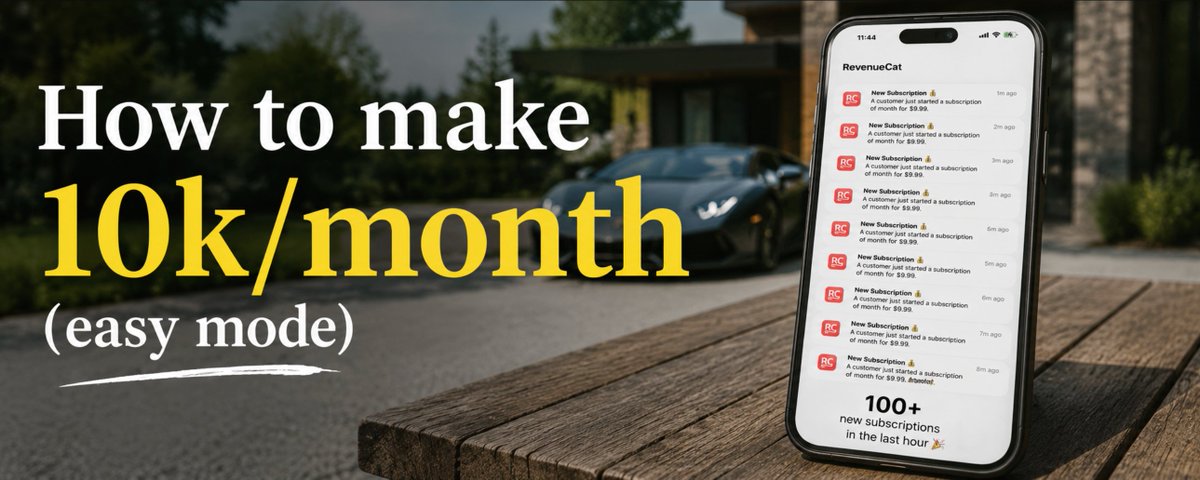
$10K/month is still $10K/month. Nobody is saying it's automatic.
But it's around $333/day.
You don't need the entire internet.
You need a product a specific group of people wants, plus a repeatable way of reaching those people.
And the part that used to stop most people before they even started, actually building the software, is now dramatically easier.
So I'd spend less time waiting for the perfect idea.
Find something interesting.
Open Shipper.
Build the first version.
Show it to people.
Then let what happens next tell you what to do.
Related articles
How to go from 0-10k a month in under 30 days (I've done this 3 times)
"Paid promo for Arc? Hey, I run an app that limits your screen time and unlocks usage once you complete your goals. Love your content and would love to sponsor you. Let me know if you're interested."

The ULTIMATE Organic Marketing Guide For App Founders
I’m going into calorie deficit, fat loss, high protein meals, gym meals, restaurant calories, what I eat in a day, meal prep, macro tracking, cutting, bulking, low calorie snacks and whatever else st…

34 Truths Nobody Tells You About Scaling a Consumer App
I ran marketing and day-to-day operations for Cal AI as we scaled from nothing to $50M ARR in roughly 18 months.