How To Make F*CK You Money With Google Ads [Fast]

Your competitors are spending money to create demand for YOUR product.
Every Meta ad they run, every email blast they send, every TikTok they post generates buyers who don't purchase on the spot. A huge chunk of those buyers do the same thing next: they open Google and search for the product category.
Whoever shows up first wins them.
Right now, that's probably not you. Let me show you how to fix that, and how to do it profitably, because THIS is where the disgusting money on Google gets made.
The demand spillover principle
Say you sell an aluminium frying pan. Your biggest competitor spends $100k/month on Meta and emails a list of a million people every week.
A portion of their audience buys from them directly. Fine. Nothing you can do there.
But a non-zero portion sees the ad, thinks "interesting, but not quite the pan I want", and goes to Google to search "aluminium pan". Another portion forgets the brand name entirely, remembers 5 days later they wanted a pan, and searches the category because the brand name is gone from their head.
Both groups land on the same search results page. Both are ready to buy. Both will click whichever relevant result sits at the top.
Your competitor paid to create that demand. Google is where it gets captured. And the entire first screen of Google is ads now, no organic in sight, so if you're not paying to be there, you don't exist in that moment.
That's the game: everyone else funds the demand, you build the net that catches it.
Why so many brands lose money trying
Because they capture the WRONG demand.
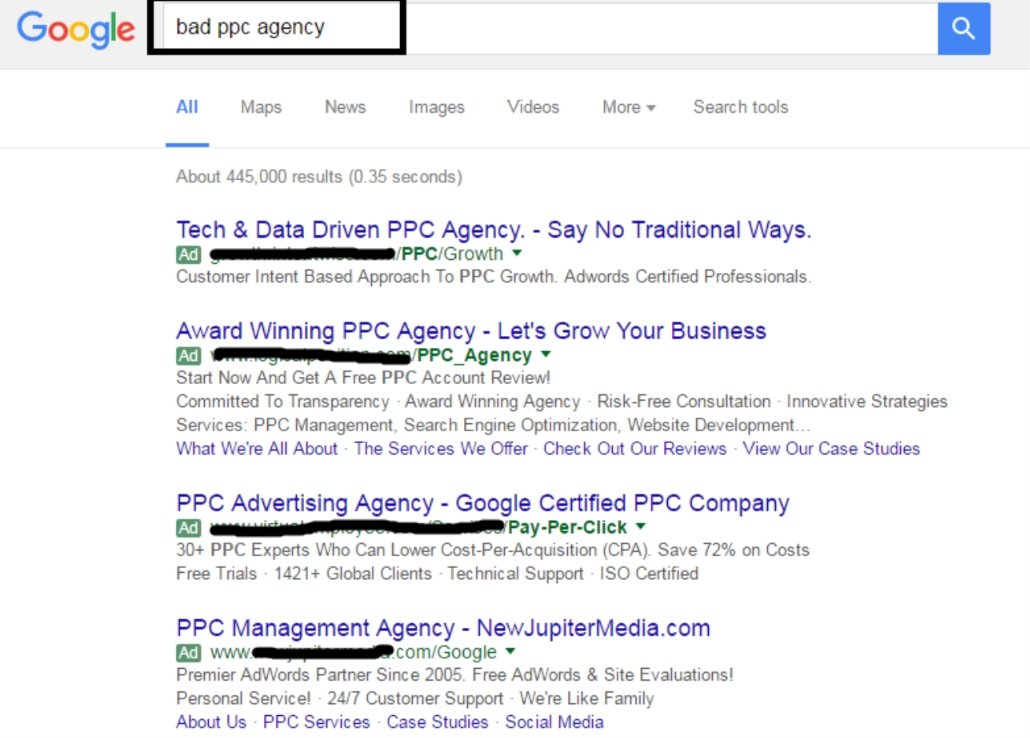 — "(An extreme example of the wrong demand being captured. You’re literally paying to show up on a search looking for bad options in the market)"
(An extreme example of the wrong demand being captured. You’re literally paying to show up on a search looking for bad options in the market)
(An extreme example of the wrong demand being captured. You’re literally paying to show up on a search looking for bad options in the market)
The single biggest failure pattern I see across 100+ audited accounts:
Brands spending nearly all of their Google budget on people searching their own brand name.
Think about what that traffic is. Someone searching your brand already knows you. You already paid to acquire them through a Meta ad, an organic post, a referral. Spending heavily to "convert" them again on Google doesn't grow the business. The ROAS looks incredible on the dashboard, sure. Blended numbers always look incredible when you're re-buying customers you already own.
Meanwhile when you’re trying to acquire new customers, your account shows your ads in mobile game apps, matches your protein powder to creatine searches, and burns budget on placements that will never produce a sale.
The dashboard says the channel works… on branded. Every prospecting and demand gen campaigns says otherwise. That mismatch is why founders conclude "Google doesn't work for us" when the honest sentence is "our structure doesn't work for us."
The 3-campaign system
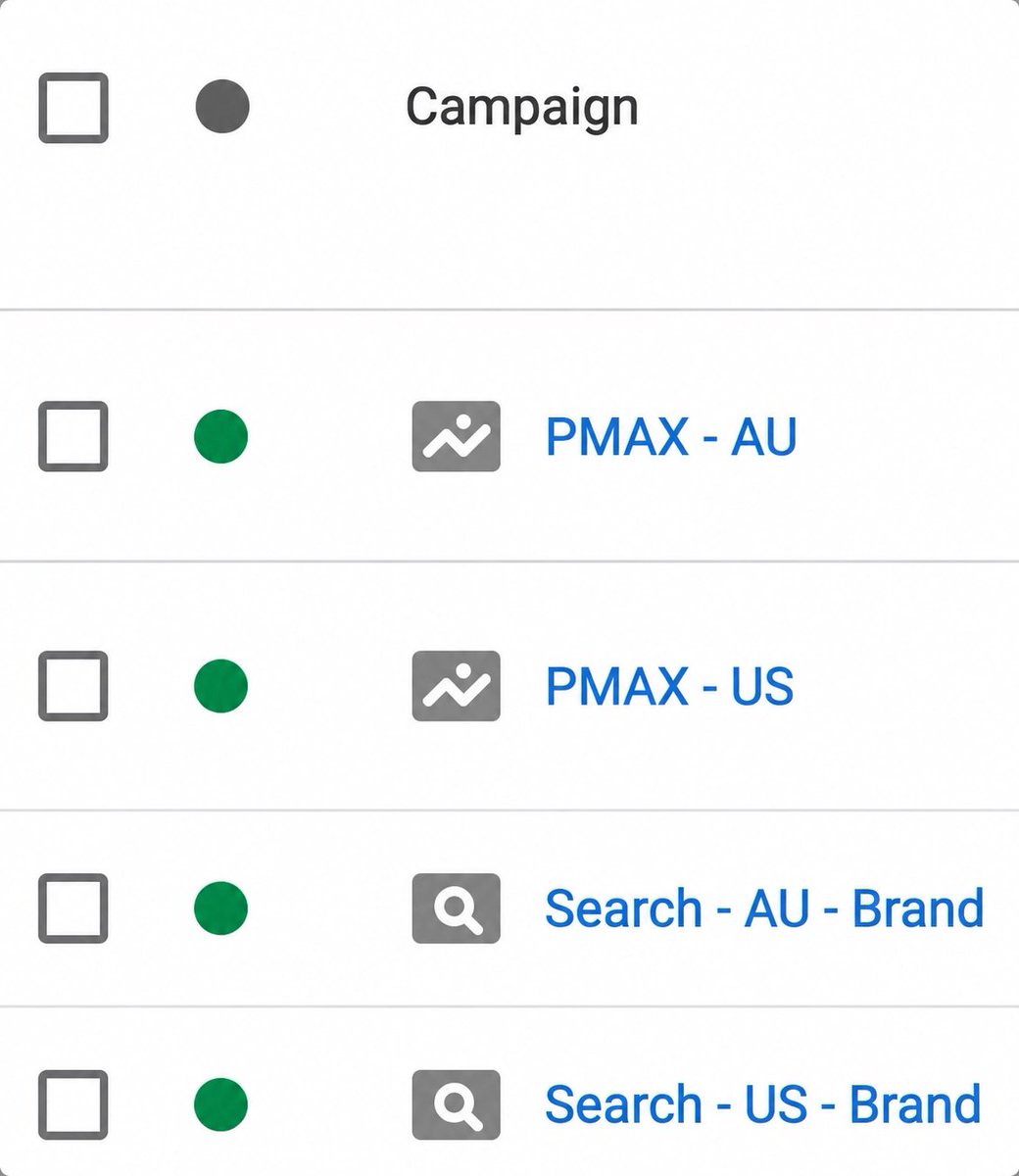
Branded vs non-branded: the split the whole system is built on
You only need 3 campaigns to make real money on Google. Real money meaning incremental new customers, profitably, at scale. This exact structure has carried brands past $100k/month in Google revenue on some of the simplest accounts I've ever opened.
Each campaign has ONE job. The moment their jobs blur together, the system breaks.
Campaign 1: Branded search (the moat)
I said branded traffic is where budgets go to die. That's true when it's unmanaged. Managed correctly, a branded campaign does 3 things no other campaign does:
- it stops competitors bidding on your name and stealing customers you already paid for (this happens far more than founders realise, and yes, it's legal, and yes, it works)
- it feeds Google a clean, concentrated dataset of what your BEST customers look like, which the algorithm uses to find lookalikes for your prospecting campaigns
- it separates your attribution so you finally know what's new revenue and what's recycled revenue

Focus: exact match on your brand name and its misspellings, nothing else. Manual CPC or target impression share so you control every cent. Give it 10-15% of budget maximum. It's a defence mechanism and a data engine. Do not mistake it for a growth channel.
Skip branded shopping for now btw. It needs a script, it complicates your life, and I've seen plenty of accounts pass $100k/month without it.
Campaign 2: Prospecting (the engine)
This is where the vast majority of your budget goes, because this is the campaign that acquires new customers. Everything else supports it.
Ecommerce brands: prospecting shopping, powered by your Google Merchant Center feed. Service businesses: prospecting search on your core keywords in phrase and exact match.

And this is non-branded traffic: category searches from people who’ve never heard of you
The principle that separates winners from losers here is signal concentration.
Google's algorithm behaves like a bloodhound. Give it one clear scent, it finds your buyer with terrifying precision. Give it 40 products and 60 keywords at once, it runs in circles. So: your top 3-5 products only. Or your top 3-5 keywords, 10 at the absolute maximum. Let Google learn deeply on a narrow front, then widen.
Bidding follows a maturity curve, like teaching someone to drive:
- start on Manual CPC, full control, so you learn what a click costs and whether the maths works ($2 clicks converting at 10% on a $50 product means $20 to acquire a customer, probably profitable)
- at 10-15 conversions, hand over to conversion-based bidding (max conversions for search, max conversion value with tROAS for shopping)
- set the tROAS deliberately LOW
That last point is counterintuitive and it's where accounts quietly strangle themselves. A tight tROAS tells Google "only show my ads to near-certain converters", and near-certain converters are people who already know you. In-funnel traffic. Sometimes literally branded traffic wearing a disguise. A low tROAS tells Google "you have room to explore", and exploration is where new customers come from.
And the non-negotiable: build a negative keyword list of your brand name and every misspelling, and apply it to this campaign. Branded traffic NEVER enters your prospecting campaign. This one exclusion is the difference between an account you can read and an account that lies to you.
Campaign 3: PMax remarketing (the closer)
First touch rarely converts. Your prospecting campaign introduces the buyer, they browse, they leave, life happens. The remarketing campaign follows them across YouTube, Gmail, Display, everywhere Google reaches, and finishes what campaign 2 started.
PMax alone is sufficient here for almost every brand under $100k/month on Google.
Two settings make it behave:
- a HIGHER tROAS than your prospecting campaign, which pushes PMax toward high-probability converters, which at a high threshold means your in-funnel warm traffic, exactly who you want it chasing
- that same branded negative keyword list slammed on top, because PMax left alone will attach itself on brand searches and claim credit for revenue that was coming anyway
Set the two tROAS targets relative to each other and the system self-sorts. Low target on prospecting leans it into new customers. High target on PMax leans it into remarketing. Each campaign stays in its lane without you policing it daily.
Why this structure prints
Look at what you've built. A boxer's fight plan, basically.
The jab keeps opponents off you (branded defence). The body work does the accumulating damage nobody notices round by round (prospecting, the unglamorous volume that actually wins fights). The finisher lands when the opening appears (remarketing, closing buyers the moment they're ready).
Take away any one of the 3 and the other 2 degrade. Branded protection without prospecting is a moat around an empty castle. Prospecting without remarketing pays for introductions and never asks for the sale. Remarketing without separation cannibalizes everything and lies about it.
Together, with clean attribution between them, you get the thing nearly no ecommerce brand has: an honest view of exactly what a new customer costs you on Google, and a structure that can absorb more budget when you scale it (15-20% every 2-3 days, no heroics).
That honest view is what F*CK you money is built on. We used this same foundation to help a client add $1M in monthly revenue over BFCM with just $33k in additional spend, ROAS up 3 points. The demand existed the whole time. The structure finally let them take it.
And the "fast" in the title is earned, because nothing here requires a content engine, a viral moment, or a 6-month creative testing cycle. You're capturing demand that already exists with 3 campaigns you already have the assets for. I've watched brands add 6 figures a month in under 60 days from rolling this out.
Scaling: how F*CK you money compounds
The structure above gets you profitable. Scaling logic is what turns profitable into serious.
Rule of thumb we run across every account: increase budgets 15-20% every 2-3 days on campaigns that are hitting their primary KPI. Never more, outside genuine high-demand windows like BFCM. Google's algorithm relearns with every budget change, and violent increases reset the learning you paid for. Rapid, but sustainable. Both words matter.

Green across 7, 14 and 30-day windows before you touch the budget
And you scale against ONE primary KPI per campaign, decided in advance. New customer ROAS for prospecting. Impression share for branded defence. Blended numbers get banned from the conversation, because blended numbers are how accounts drift back into the branded trap while everyone celebrates a dashboard.
The other thing that has to be DIALLED before you pour fuel on this: your Google Merchant Center. Your prospecting shopping campaign targets buyers through your product titles and descriptions. Weak titles mean Google guesses who to show your products to, and Google guessing is you paying for its education. Treat your product feed as targeting. You CANNOT scale with trash GMC listings, and no bidding strategy on earth compensates for them.
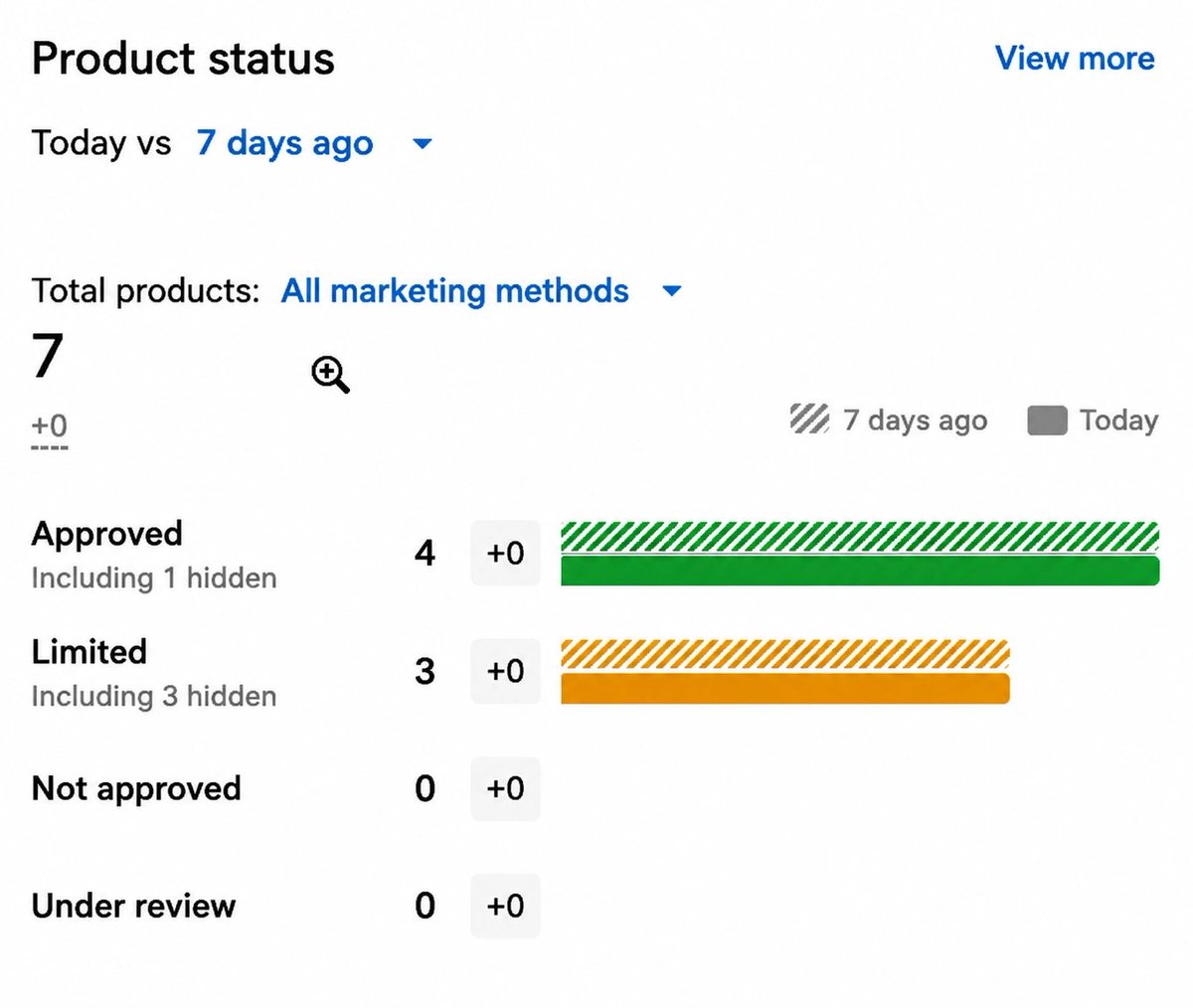
Your feed is your targeting. Titles, images and back-end data decide who Google shows you to
A note on the metrics that tell you the truth
While you're on Manual CPC, 3 numbers run the show: Search Top Impression Share, Search Lost IS (rank), and Search Lost IS (budget).
You don't need to obsess over the mechanics, that's what your operator is for. You need the principle: these metrics tell you WHY you're not showing up. Losing impression share to rank means your bids or relevance are too weak for the auction. Losing it to budget means the demand exists and you're simply not funding the capture. Two completely different problems, two completely different fixes, and brands who never separate them pour money at the wrong one for years.
An account where you know exactly why every impression was won or lost is an account you can scale with intent instead of hope. That knowledge is the real product of this whole structure.
The objection you're thinking
"Meta is our main channel, we'll get to Google later."
Meta proving your product-market fit is EXACTLY the signal that Google is ready for you. Every dollar you spend on Meta increases the search volume for your category. You're already funding the demand side of Google whether you like it or not. The only question is whether you're also on the capture side.
Later is when your competitor sets this up first and your branded CPCs double.
"We tried Google, we'll just increase the budget when we're ready." This one HURTS to hear, because extra budget in a broken structure doesn't acquire new customers. It buys more of whatever the account already buys, which in an unseparated account means more branded clicks, more junk placements, more expensive confirmation of the wrong conclusion. Load hundreds of dollars a day into structural constraints and the constraints win every time. Fix the structure first. Then budget becomes a throttle instead of a bonfire.
The customers are waiting for you. You just need to reach into Google and grab them.
If you want me to find the exact thing in your Google Ads account that's stopping you from making more money, and show you how we'd implement this 3-campaign system for your brand, DM me "GADS" and I'll show you what to fix.
(And if you want us to do it for you, we do guarantee $100k/month in Google Ads revenue in 60 days or we work for free until we hit it)
Max
Related articles

the most valuable google ads masterclass ever created
i've been running google ads for ecom brands for 7 years

How to get AI Overview & AI Mode to recommend your products | A Complete Guide
faq schema, which labels your question-and-answer content so ai can pull it when someone asks a relevant question.

how to STEAL your competitors customers with google ads
i built an AI workflow that does in 20 minutes what a $5,000 google ads audit takes 2 weeks to deliver.