How To Master GTM Engineering (FULL COURSE)

GTM engineering emerged around 2024, when companies started looking for alternatives to growing revenue through headcount.
Job postings for the role grew 205% year over year.
Vercel pays $252k. OpenAI pays $250k. Ramp pays $184k.
The median sits around $127.5k.
Average requested experience is 4.11 years, so a 2-year old title means almost NOBODY gets disqualified on tenure.
This is the full course on the discipline, built from running 10 million+ emails and 700k+ cold calls across 100+ B2B companies, producing 30k+ leads and $70M+ in pipeline.
What the role actually is:

RevOps manages and optimizes existing tools. SDRs execute outreach manually.
A GTM engineer builds the systems that REPLACE both of them
The work itself:
- Data enrichment pipelines that turn a company name into a qualified, contactable record
- Lead scoring models that decide which accounts get expensive effort
- CRM integrations and reply routing
- Automated outbound sequences with the personalization layer built in
- Signal detection, meaning watching for hiring, funding, and product changes across a market
- Reporting that shows which segments and angles actually produce pipeline
What the output looks like when it works.
At Verkada, the team automated roughly 80% of SDR workflows, taking reps to 80-100 meetings booked per month.
At Gorgias, a GTM engineer built dynamic content generation wired into an email API and produced a 70% lift in conversion rates.
The same team built a script analysing Gong calls to extract why customers migrated, then fed that language back into outbound.
At Ramp it runs as a Growth Platform squad shipping internal prospecting tools and AI outreach flows on 2 week sprints.
The common thread across all of them is where the function reports.
It sits under growth, on a product cadence.
Why companies are hiring for this instead of more reps.
3 more SDRs runs north of $200k a year before commission, plus management, plus ramp time, plus the churn.
One engineer who automates 80% of that workflow is a faster decision than most people expect,
and that comparison is what sets your compensation ceiling.
The technical foundation:
You need enough to build systems, not enough to ship a product.
SQL.
Querying and manipulating data is the base skill.
Every enrichment pipeline, scoring model, and report starts here.
Python or JavaScript.
For scripting, API work, and anything the no-code tools cannot reach.
API integration.
The job is connecting systems that were never designed to talk to each other.
Authentication, rate limits, pagination, and error handling.
Automation platforms.
n8n, Make, or Clay.
These handle the routing between steps and cover most workflows without code.
An agent for the reasoning layer.
Claude Code or equivalent, for qualification, classification, and anything requiring judgment at volume.
What you do not need.
Front-end skills, deployment pipelines, or anything resembling a software engineering interview.
The bar is whether you can build a working pipeline and keep it running.
How long this takes to learn.
SQL to a useful level is weeks.
Enough Python to hit an API and parse a response is weeks. The automation platforms are days.
The part that takes longer is knowing what to build, which is the commercial half below and the reason most technical people stall in this role.
The commercial foundation:
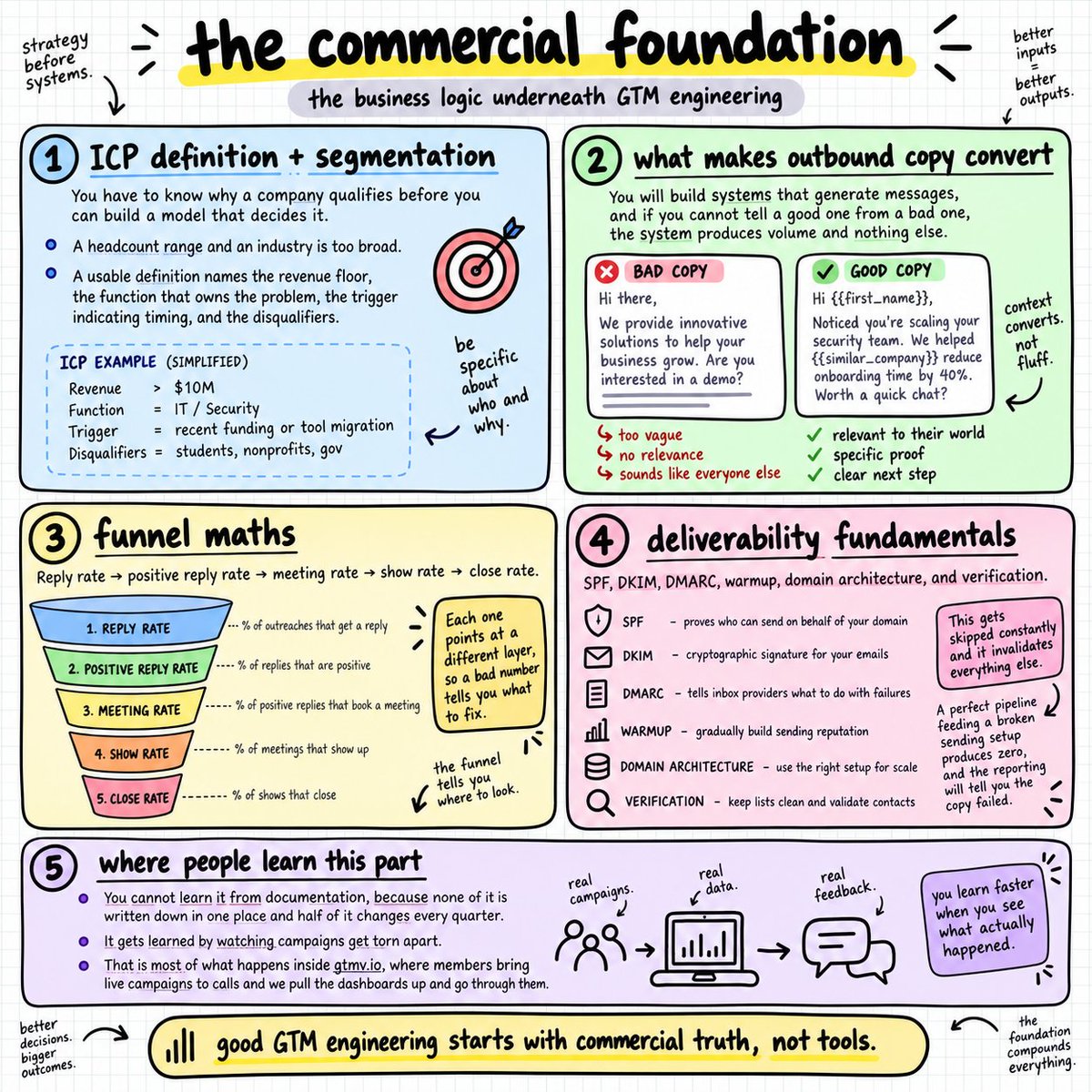
This is what separates a GTM engineer from an automation contractor.
ICP definition and segmentation.
You have to know why a company qualifies before you can build a model that decides it.
A headcount range and an industry is too broad.
A usable definition names the revenue floor, the function that owns the problem, the trigger indicating timing, and the disqualifiers.
What makes outbound copy convert.
You will build systems that generate messages, and if you cannot tell a good one from a bad one, the system produces volume and nothing else.
Funnel maths.
Reply rate to positive reply rate to meeting rate to show rate to close rate.
Each one points at a different layer, so a bad number tells you what to fix.
Deliverability fundamentals.
SPF, DKIM, DMARC, warmup, domain architecture, and verification.
This gets skipped constantly and it invalidates everything else.
A perfect pipeline feeding a broken sending setup produces zero, and the reporting will tell you the copy failed.
Where people learn this part.
You cannot learn it from documentation, because none of it is written down in one place and half of it changes every quarter.
It gets learned by watching campaigns get torn apart.
That is most of what happens inside gtmu.io, where members bring live campaigns to the calls and we pull the dashboards up and go through them.
The core systems, and how to build each one:
System 1: the enrichment pipeline.
Input a company name or domain, output a qualified contactable record.
The order carries more weight than the tools.
- Source the raw list broad, since every filter you stack at the source removes accounts you would have qualified
- Scrape each company's site, meaning the homepage, about, services, and careers pages
- Run an AI summary column describing what the business actually does
- Score against the ICP with the disqualifiers written in
- Cut everything below your threshold
- Only then run the email waterfall
Raw scraping runs 50 to 60% ICP fit.
This process runs around 90 to 95%.
Enriching before qualifying burns credits on companies you were always going to drop, which on a broad pull is roughly half the file.
System 2: the scoring model.
Score on things that indicate timing, not just fit.
- Recent funding
- Hiring for the function you sell into
- A new executive in the relevant seat
- Technology on their stack that pairs with your offer
- Headcount or location growth
An account carrying 3 of those is worth several times the effort of one carrying none.
Re-score on a cycle, since a funding round from 14 months ago tells you nothing about this quarter's budget.
System 3: reply routing.
Reply detection fires a webhook the moment a message lands.
The lead pushes into the CRM automatically.
Positive replies route to a dedicated channel with a named owner.
The same reply volume produces zero closes or eight closes depending on how fast a human responds.
Track time-to-first-response weekly, because it degrades quietly as volume grows and the close rate follows it down.
System 4: signal detection.
Watch a defined market for a specific trigger and output the accounts that fired it.
Sources worth building against:
> ATS job feeds from Greenhouse, Lever and Ashby, SEC filings including Form D, funding announcements, executive job changes, and ad library activity.
Run it on a schedule, so the signals arrive before anyone asks.
System 5: the reporting layer.
Reply rate, interested rate, meeting rate, and pipeline value, all split by segment and persona.
The aggregate reply rate is the least useful number in any campaign, because 1 or 2 segments carry almost everything and the average hides which.
Build these in order.
Get the enrichment pipeline producing clean records before you build the scoring model.
Get the scoring accurate before you wire the routing.
Building all 5 at once means that when the output is wrong you CANNOT tell which layer produced it.
We drop the Claude Code and Clay builds behind these into gtmu.io weekly,
as the same workflows we ship internally, so members clone them instead of building from a blank page.
How to write prompts that hold at volume:

Most GTM engineering failures happen at the prompt and not at the pipeline.
Write the disqualifiers with the same care as the criteria.
Without a definition of what your ICP is not, the model starts inventing reasons a company qualifies.
Replace vague categories with specific tests.
> "Headcount above 2,000 or a procurement department mentioned on the site" works.
Require a written reason on every verdict.
That reason is what you read in bulk afterwards to find out where the definition is wrong.
Forbid invention explicitly.
A model asked to find a signal will find one whether it exists or not.
Instruct it to return none, and to return no site data when a page is unreachable.
Test on 50 records before running at volume.
Include 10 you would definitely take, 10 you would definitely decline, and 30 you are unsure about.
Check the verdicts against your own judgment.
How to fix a prompt by symptom:
- It keeps companies you would drop, so the disqualifiers are too vague
- It drops companies you would take, so one criterion is too narrow and reading 20 rejection reasons will show you which
- The reasons are generic, so it is not reading the source deeply enough and needs an instruction to cite a specific page
- The scores cluster around one number, so the bands are not differentiated enough
Run the cheap model first.
A small model sorts the obvious misses at cents per thousand records.
The frontier model reads and scores what survives.
Pointing a frontier model at 50,000 raw records is a bill you did not need to pay.
Building the portfolio:
A working system beats a CV in this discipline, because the whole role is proving you can build things.
3 projects that demonstrate range:
1. A scraper plus qualification pipeline that turns a public source into a scored list.
Shows you can source, enrich, and apply judgment at volume.
2. A reply routing workflow that classifies inbound and pushes it into a CRM.
Shows you understand where revenue actually leaks.
3. A signal detector that watches a market for a trigger and outputs the accounts.
Shows you can build something that runs on its own.
Then send them UNSOLICITED.
Pick a company, build the pipeline you would run for them, and send the output to whoever owns growth with one line on what it would produce at their volume.
Document each build publicly as you go.
The audience for that content is the exact person who hires for this role.
Where to look for the role:
- Companies with GTM engineering already reporting into growth, since the mandate is broader
- Series B and later, where the TAM justifies systems
- Compound businesses with multiple products and buyer types, since complexity creates the need
- Any company publicly hiring SDRs at volume, which signals a scaling problem you can solve differently
Position on outcomes.
Meetings booked per rep, pipeline generated, hours removed from the sales team.
Ask what their SDR team currently costs and what it produces.
Those 2 numbers are your entire pitch.
The career ladder, and where the money is:

Stage 1.
SDR or RevOps, learning what produces pipeline before you automate it.
Stage 2.
First systems built, meaning SQL, Python, an automation platform, and one working pipeline.
Stage 3.
Junior GTM engineer around the $127.5k median, replacing manual work.
Stage 4.
Senior, at $180k to $250k+.
Stage 5.
Reporting into growth, where the mandate widens and you own plays instead of tickets.
Stage 6.
Variable compensation tied to pipeline, so the systems you build pay you directly.
Stage 7.
Consulting.
One system built well is worth more to a company than a quarter of your salary, and the pricing reflects that.
Stage 8.
Your own agency, running the same systems across many clients.
The compounding asset is your library.
Every enrichment pipeline, scoring model, and routing workflow you build once gets rebuilt for the next company in a fraction of the time.
After a few years you are selling assembly instead of construction, and the price stays the same.
Price project work on what the system produces over a year and not on the days it takes you to build.
A pipeline generating 30 meetings a month is worth a multiple of a week of your time, and the client is comparing it to a hire.
Expect the first role to pay less than the work is worth.
The portfolio you build inside it is what prices the second one.
The fastest way through all of this:
Everything above is learnable alone.
BUT, it takes considerably longer alone.
The bottleneck is not information.
It is that you build something, it produces nothing, and you have no way to tell which of the 6 layers caused it.
That is the problem gtmu.io exists to solve. (Our GTM and outbound community)
What runs inside it:
- 3 live coaching calls every week. Wednesday on Clay and Claude Code builds, Thursday on GTM strategy, Friday on campaign and copy reviews
- The full course library covering infrastructure, list building, copy, deliverability, and sales process, with new modules monthly
- 200+ cold email scripts pulled from campaigns we have actually run for clients
- 30+ editable Clay workbook templates you can clone into your own workspace
- Weekly Claude Code and Clay workflow drops, meaning the same builds we ship internally
- Software discounts on Ocean.io, ScaledMail, EmailBison, Prospeo and Sending.ac
- Direct DM access to me and the other coaches
- etc
What the calls actually look like.
Members bring live campaigns and we tear them apart on the call.
One member found out his client had been paying an agency $1,000/mo for 10 months.
We pulled the dashboard up live: 0.22% reply rate, and 763 mailboxes sitting at 600 sends a day against a 2,100 capacity.
Another brought a recruitment offer that was not landing.
The problem turned out to be his list rather than his copy, since 50 to 70% of it was his own competitors.
Another inherited 50-60 domains from a previous vendor and we audited the whole thing live.
That is a normal week in there.
Why that format works for this specific discipline.
You learn deliverability diagnosis by watching someone read a dashboard and say which of the 6 layers is broken and why.
Between the coaches running it:
-
11+ years in GTM
-
10,000,000+ emails sent
-
30,000+ leads generated
-
and $70M in pipeline.
If you want to learn this properly, gtmu.io is where I would start.
VOLUME NEGATES LUCK.
- Christian
Related articles

How I Make $20k/Month With Pixar Animations (and how you can too)
Every time I've made the most money in my life it came down to right time, right skill. AI Animations are exactly this to me right now

How to launch a one-person product (without destroying your life)
Over the last 5 years, I’ve helped launch products that went on to make multiple 7 figures in revenue per year.

the whop partner business model explained in 5 minutes...
every online business model is a trade between 3 things.