How to Stop Doomscrolling for Content Research With Claude

If you run a marketing agency and want to actually know what's going viral on TikTok and Instagram in every one of your clients' niches, without:
- scrolling natively on both apps for hours every week
- 40+ browser tabs open trying to remember what you saved last Tuesday
- guessing which video's actually worth scripting off versus which one just looked cool
then you're going to LOVE what I'm about to share with you.
This is about social media content research, specifically: how a marketing agency figures out what's actually working on TikTok, Instagram Reels, and YouTube Shorts for every single client, without a person doing the scrolling by hand.
What's inside
- Why scrolling TikTok and Instagram never turns into anything usable - the actual mental model
- How to set up content research agents in Claude, Codex, or Cursor etc.
- Exactly what type of client results you can expect, based on agencies we've worked with
- "Plug-and-play" prompts to give to your AI agent
- Frequently asked questions & objections, answered
- What happens if you skip a step
Why scrolling TikTok and Instagram never turns into anything usable
I have a friend who runs a marketing agency for clients in the beverage industry like Heineken, Hennessy, & Fireball.
For most of last year, finding out what was actually working for any one client on TikTok or Instagram meant opening both apps and scrolling - one client at a time, whenever someone remembered to.
Saving TikTok & Reels with no system around it is NOT research.
It's a video sitting in a swipe-file next to a hundred other files - indistinguishable from all of them.
The moment someone needs it, three weeks later, mid-script, it's already gone. Not deleted. Just unfindable, which for a working strategist is the same thing.
Picture the actual moment this breaks.
> A client call is in an hour. Someone remembers a great TikTok they saw a few weeks back, so they scroll: > > - their camera roll > > - their Instagram saves > > - the group chat where someone once dropped a link > > Nothing. > > The reference is GONE… > > The call is in fifty minutes…
And somewhere underneath the panic is the same quiet fear every agency PRAYS to avoid on call:
> "what am I paying you for?"
So you see, it's not about scrolling enough on the feed.
It's that nothing gets tagged, nothing gets ranked, and nothing survives the gap between finding a good TikTok or IG Reel and needing it again for a script.
Everything below is built to fix exactly that gap in your social media content research... not to make the scrolling faster.
What this actually costs, per week
Most agencies lose somewhere between 1 and 3 hours per client per week scrolling TikTok and Instagram for content ideas that never get organized.
Run that across a real roster.
- Five clients, call it 10 hours a week, conservatively.
- Fifteen clients, and it's a full working day gone before anyone's written a single script.
But none of those hours are wasted on nothing altogether...
The scrolling genuinely DOES surface real videos on real platforms. What eats the time is that none of it survives long enough to get used.
The belief that keeps agencies stuck on the old version
> "My research process works fine, I just need more time."
Most content strategists genuinely believe this.
It's wrong in a specific way: more hours scrolling TikTok and Instagram with no retrieval system just produces more unfindable saved videos.
Give that same strategist twice the hours and watch what actually happens.
Twice as much saved to the swipe file... twice as much time spent on brainrot videos that slipped in their feed, and none of it gets any easier to find later - the pile just gets bigger, and the search inside it gets slower, not faster.
Brother... your problem is not needing more time for research.
It's needing a place for that research to live.
Think about it.
Your lack of structure is CREATING the need for more time spent researching.
Structure looks like this:
- Watching every client's niche across TikTok, Instagram, and YouTube Shorts…
- Weighing every outlier video against what's actually normal for that platform, niche, and creator…
- Packaging the winners into a brief a scriptwriter, editor and client can open and use…
In that order.
Every time.
And once you give Claude your client's content, competitors and their real site, this engine runs itself.
All it takes is one message to Claude Code, connected to Virlo- then your content research agent is watching, on schedule, whether you remember to check in on it or not.
(prompts down below)
How often should you run this in your agency?
Daily for a fast-moving niche. Weekly for a slow one.
The client's own niche sets the pace, not a settings menu - for example:
- A fast-moving consumer niche needs watching TikTok and Instagram closer to daily for virality
- A slower, more established client's niche can get checked weekly, focusing outliers, not viral videos.
Think about the actual difference between two real client types.
- A supplement brand riding UGC trend cycles that turn over in days: needs eyes on TikTok constantly. Miss three days and the reference that mattered has already been used by five other creators.
- A regional home-services client, the kind whose content pillars barely shift month to month: gets by fine on a weekly cadence. Checking daily just produces the same handful of videos over and over, dressed up as new data.
The niche decides the depth... not the tool.
Get this wrong in either direction and it costs something:
- Too shallow, and the fast-moving client's window closes before anyone notices.
- Too deep on a slow client, and someone's spending review time on data that's stayed exactly the same.
Save this part for the next time someone on your team asks:
> "how often should we even be checking this client's niche on TikTok?"
The real answer is always about how fast that specific client's world actually moves.
How to set up a Content Research Agent in Claude
This is the actual niche research and competitor research system, the thing that's supposed to feed your content calendar, broken into three prompts.
Each one useless without the one before it.
First: watching a niche continuously across TikTok, Instagram Reels, and YouTube Shorts, instead of doomscrolling on three apps and hoping to catch something.
Setting this up means telling Claude Code exactly what to watch for.
The client's real name and their real named competitors matter here - say your client is in DTC ecom:
- "Bloom Nutrition" as a search term surfaces what that specific audience is watching on TikTok this week.
- "Supplement brand" surfaces an average of the whole category, which tells nobody anything.
Grab an API key at dev.virlo.ai before you paste this in. Claude Code needs it to actually talk to Virlo.
Prompt:
I want to set up a persistent research agent that watches a
specific client's niche across TikTok, Instagram Reels, and
YouTube Shorts.

Goal:
- automatically surface viral short-form videos and outlier
  content in this client's niche every day, without me
  opening any of the three apps myself
- wake up to fresh content ideas without prompting anything

Process:
- read the Virlo API documentation
- create a standing agent using the client's real brand name
  and real named competitors as search keywords, never a
  category label
- confirm the agent is active and show me the next scheduled
  run date

Tool:
- Virlo
- Virlo API docs: dev.virlo.ai/docs

Knowledge:
- never use a category label as a keyword ("supplement
  brand") - use the client's actual name and their real
  named competitors instead
- this niche moves fast, so check daily

Client's real name:
[INSERT CLIENT NAME]

Client's real named competitors:
[INSERT 2-4 REAL COMPETITOR NAMES]

Platforms: TikTok, Instagram Reels, YouTube Shorts
One message, the client's real details filled in. This is the whole first step of your social media content research, done once and left running.
Second: having an agent that finds outliers for you.
(An outlier simply means a video that outperforms a creator's average view count.)
Prompt:
Don't rank what this agent finds by raw view count.

Goal:
- know which videos, across all three platforms, are genuine outliers,
  not just the ones with the biggest numbers
- avoid wasting a script on a video that only looks impressive

Process:
- pull the latest results from the agent
- weigh every video against what's normal for its own
  platform and that specific creator's own following
- rank on that, never on raw views, and never compare a
  TikTok's view count directly to a YouTube Short's

Tool:
- Virlo

Knowledge:
- a video's raw view count means nothing on its own - a
  40,000-view TikTok is unremarkable, a 40,000-view YouTube
  Short is a real outlier
- always weigh a video against its own platform's normal and
  its own creator's own following, never across platforms
Third, and this is the part most setups skip entirely: turning a ranked folder of outliers into an actual winning script, proven by winners.
Virlo tags well over 80 signals on every single video: the exact hook, the tone it's delivered in, whether it's sponsored, what it's actually selling, how it's shot, and dozens more most agencies never think to check for.
Your agent reads all of that.
Ask it to (with this prompt), and it goes all the way to drafting the actual script, beat by beat, modeled on whichever real outlier is winning in that niche right now.
Prompt:
Turn whatever ranks highest into an actual script, not just
a brief.

Goal:
- stop handing over forty TikTok and Instagram links in no
  particular order
- get a beat-by-beat script modeled on a real, currently
  winning outlier, ready to hand to whoever's filming

Process:
- take the top-ranked results from across TikTok, Instagram
  Reels, and YouTube Shorts
- group them by how each one opens: a question, a bold
  claim, or a before-and-after
- group them by how they're shot: talking to camera, a
  screen recording, or b-roll with no one on camera
- group them by the story they're telling: a pain point,
  a transformation, or social proof
- pick the best-fitting outlier for this client and write a
  beat-by-beat script modeled on its real opening, pacing,
  and structure, adapted to this client's product

Tool:
- Virlo

Knowledge:
- a script needs the real hook and structure behind it, not
  just a link to a video that performed well
- group by how it opens, how it's shot, and what story it
  tells, don't just list results in the order they were found
- adapt the winning structure to the client, never copy it
  word for word
A script or brief organized this way gives a client all the context they need.
> The single highest-leverage move in this whole system: > > Stop researching client by client, session by session. Start watching each client's niche continuously across TikTok, Instagram, and YouTube Shorts instead.
Everything above compounds in that order for a reason.
- Watching without weighing just produces more raw material nobody has time to sort.
- Weighing without packaging produces a ranked list that still needs a full afternoon before anyone can script off it.
- Packaging is what makes the other two worth doing, and it literally only works because the two steps before it already did the sorting.
Watch → weigh → package.
Break the order and the whole thing collapses back into a pile.
Bookmark this article if you're setting this up for more than one client. The three prompts above are the same three, every time. Only the client's name and competitors change.
📌 Key takeaway: three prompts, told once each to Virlo through Claude Code, replace the entire manual TikTok-and-Instagram research cycle: watch, weigh, package.
Why this reads as an employee, not another dashboard
Easy to hear all that and assume it's one more tab to add to the rotation, on top of TikTok and Instagram themselves. Another login. Another thing to remember to open.
- A dashboard waits for someone to open it. You're plugging it into an agent that watches whether anyone opens it or not.
- A dashboard shows raw numbers and leaves the judgment call to whoever's looking. Your agent makes judgment call before a human ever sees the result.
- A dashboard is a place data sits. This is closer to a employee who never stops watching one specific client's corner of TikTok and Instagram, and only speaks up when it's actually worth mentioning.
This is what Virlo actually is, underneath the name
On the surface:
- A content marketing agent that stands watch on a niche across TikTok, Instagram Reels, and YouTube Shorts.
- A weighing system that ranks every video against real outliers in that niche.
- A packaging layer that hands the results to Claude Code already sorted hooks, format, and angles.
📌 Key takeaway: Virlo is the watching-weighing-packaging layer underneath, built specifically for TikTok, Instagram Reels, and YouTube Shorts. Claude Code is what talks to it in plain English.
Here's what this looks like on a real account
Same agency as the opening. Matt's.
Manually calculating average TikTok views per creator, client by client, every week. "Frankly it was just a cumbersome process."
He stood up exactly this system across TikTok and Instagram. Tagged and ranked the results, then packaged them into a weekly drop his team calls the Monday Drop, since it lands the same day every week without anyone having to ask for it.
Every client gets one. Same format, every Monday, whether anyone remembers to check in on it or not.
One client video off it did 11 million-plus views on TikTok in 28 days.
Repeatable enough that he's since packaged the whole workflow and resold it to brands who were never even his clients.
Different domain, same three steps underneath.
Embedded post:
Author: jaffa (@dsqjaffa) Post ID: 2037339134537130052 Source: https://x.com/dsqjaffa/status/2037339134537130052 Posted: 2026-03-27T01:21:16.000Z Reply to: none
Text:
> 11,000,000 views in under a month. > > here's how: @TheMattBerman built a viral content agent for his clients on OpenClaw > > (steal the EXACT setup - thread below)
Media:
- video: /media/posts/how-to-stop-doomscrolling-for-content-research-with-claude/2.mp4
📌 Key takeaway: one weekend, one client, one repeatable system. Everything after that was the same three steps running through Virlo, not a new invention per client.
Set this up for one client today
Grab an API key at dev.virlo.ai first. Connect Claude Code to it. Then send this, brackets filled in with the real client:
Prompt:
Set up a standing watch on [client]'s niche across TikTok,
Instagram Reels, and YouTube Shorts.

Goal:
- replace the weekly manual scroll for this one client
  entirely
- wake up every [daily/weekly] to a ranked, tagged brief

Process:
- use [client]'s real name and real named competitors as
  search keywords, never a category label
- check [daily/weekly] depending on how fast this niche
  actually moves
- rank everything by comparing to real outliers in this
  niche, never by raw views, and never across platforms
- group the results by hook type and content format before
  handing them to me

Tool:
- Virlo
- Virlo API docs: dev.virlo.ai/docs

Client's real name: [INSERT CLIENT NAME]
Client's real named competitors: [INSERT 2-4 COMPETITORS]
Platforms: TikTok, Instagram Reels, YouTube Shorts
Cadence: [daily/weekly]
That's the client's real name and real competitors, which platforms to watch, how often the niche moves, ranked against platform and creator norms.
Once that's running clean for one client, the exact same message stands up the next one.
Same structure, new client, new competitors.
📌Key takeaway: one message to Claude Code, connected to Virlo, covers TikTok, Instagram Reels, and YouTube Shorts at once.
This scales past one client fast
- One real agency owner, managing accounts across Meta: "I must be handling 40-50 accounts... I can barely keep up with the campaigns that I launched 3-4 weeks ago."
- Another agency, ten client accounts, roughly $400,000 a month in combined spend: "our reporting process was destroying our margin and our team's weekends."
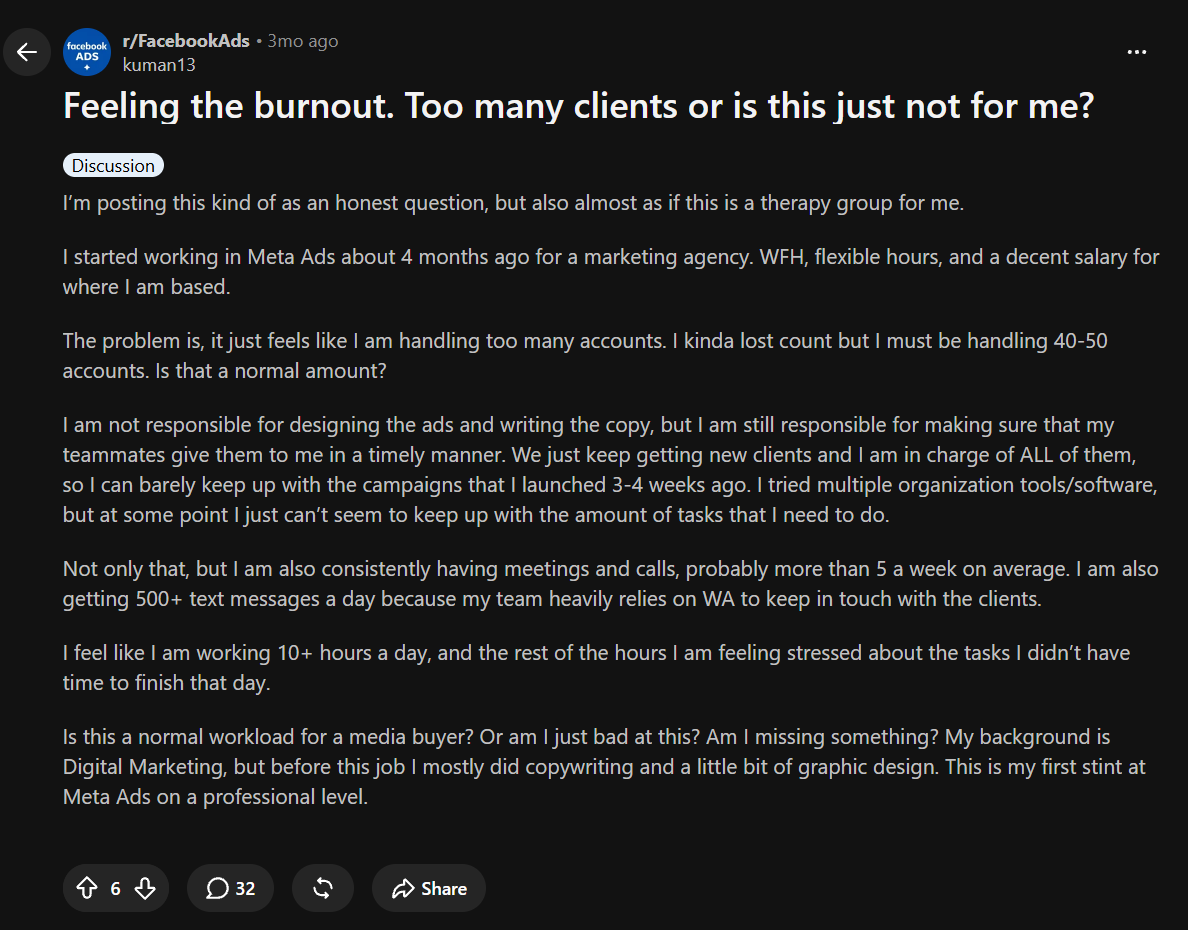
Same shape, different scale.
The more clients an agency wins across TikTok and Instagram, the more this exact gap widens, not shrinks. Growth should make an agency stronger. Instead it quietly makes the research problem worse, one new client at a time.
The fix stays exactly as easy as the roster grows. Same three steps, repeated once per client, whether that's three accounts or thirty.
Matt's own agency proves the second half of that.
He built the watch, the weighing, and the packaging once, for one client, on TikTok.
Then he stood up the exact same three steps for every client after that.
The 11-million-view result came out of client one... everything after that came from repeating the same three steps, client after client.
FAQs
"Will my team actually use this, or default back to scrolling TikTok themselves in a month?"
Fair question. Most tools die at exactly this point.
The difference here is there's nothing new to learn. The output is still a brief. Someone still opens it and scripts off it. What changed is only where the brief came from.
"Does this actually work per-client, or is it one setup for the whole agency?"
Per-client, every time. Each watch runs on that one client's real name, real competitors, real niche, across whichever of TikTok, Instagram, and YouTube Shorts actually matters for them.
A 3-client shop and a 30-client shop run the exact same mechanism, just repeated.
"We already have a research process. Why change it?"
Depends what that process actually produces. A folder of saved TikToks nobody can find in three weeks is a habit that feels like a process.
"I'm not an agency, does any of this apply to me?"
Same mechanism, smaller version.
An in-house marketing team runs this exact setup on one brand's TikTok and Instagram instead of many clients. A solo creator runs it on their own niche. The three steps don't change. Only the number of times you repeat them does.
"How is this different from just checking TikTok's own trending tab?"
A trending tab shows what's trending everywhere, for everyone, on one platform. It has no idea who this specific client is, who their actual competitors are, what's happening on Instagram or YouTube Shorts at the same time, or what's already been used in a script three months ago.
This watches one client's actual niche across all three platforms, weighs it against that client's own baseline, and remembers what's already been shown. A trending tab can't do any of that.
What happens if you skip a step
Skip the watching, and there's nothing new to weigh. Skip the weighing, and the brief gets built off whichever TikTok happened to have the biggest number, which is usually the wrong one. Skip the packaging, and the brief is back to being forty links again, just tagged this time instead of untagged.
Each step only earns its keep if the one before it actually ran.
What we learned building this
- Retrieval is the real bottleneck.
- One agent watching TikTok, Instagram, and YouTube Shorts for one client beats one person scrolling all three by hand.
- The brief writes itself once the data's already organized.
- The system compounds. Every client added is the same three steps again, not a new problem.
That's the whole difference between a pile of saved TikToks and a system worth reselling.
Four things to keep in front of you
- The niche decides the depth. Not the tool.
- Rank by what's normal for that platform and creator. Never raw views, never across platforms.
- A brief sorted by hook and format is usable. A pile of links is just a pile.
- The same three steps repeat per client. Everything you know at client one still applies at client twenty.
The system is here. The data exists, across TikTok, Instagram Reels, and YouTube Shorts. The only question left is whether you set it up for your first client this week, or keep scrolling until the next one signs.
→ Grab an API key and connect Claude Code: dev.virlo.ai
Related articles

How We Get 100M Views/Month (and how you can copy us)
This is how you should really pick your next video

How to Run AI Slideshows Profitably on TikTok
the algorithm re-serves a slideshow to people who scrolled past it.

We got 75M+ views in 6 months. This is how we run social with Muse, GrokBot now (Step by step tips)
Part of that is luck. Most of it is a content marketing system we built with [Helena](https://www.hirehelena.com), our favorite AI marketer.