How we scaled Cal AI to $50M ARR with influencers

I ran marketing and day-to-day operations at Cal AI as we built the company from zero to $50M ARR in 18 months.
A large part of our early success while scaling was thanks to the influencer marketing program I built from scratch.
Today I’m giving you a peek behind the curtain on:
- How to find and evaluate profitable influencers
- What and how to pay them
- What to put in the brief
- How to judge the results they produce
- And what needs to happen before you spend a dime more on influencers
> PLUS links to a bunch more articles and threads I've written on this subject so you can run this same playbook to scale your own consumer app.
This is the exact insight and processes I'd want in front of me before signing my first influencer deal.
> Bookmark this for later, and let's jump in.
1. Make sure your app gives creators something worth showing
Cal AI had a simple demonstration: point your camera at a meal and get a nutritional breakdown.
You could understand the value by watching someone use it 3-5 seconds
That mattered because it solved a painful problem people were already familiar with.
People wanted to track what they ate, and manually logging food was tedious and annoying.
The creator could connect a visible reduction in effort to an outcome their audience already wanted.
So before you sign anyone, answer these questions:
> What does the customer want badly enough to pay for?
> What can a creator show that makes your app's value obvious?
> What content does your ideal customer already watch?
> Are there enough relevant creators to keep testing after the first few deals?
And that last question gets overlooked constantly
The fitness niche gave us a large supply of creators, content formats that were proven for virality, and audiences already interested in improving their health and fitness.
If your entire niche has a handful of relevant creators and most are unavailable or unaffordable, you will always have distribution issues.
You also need to understand what you're paying for.
- UGC is best used as a testing ground
- Paid ads give you predictable distribution on winning formats and concepts
- Influencer partnerships give you access to a relationship someone has already built with an audience
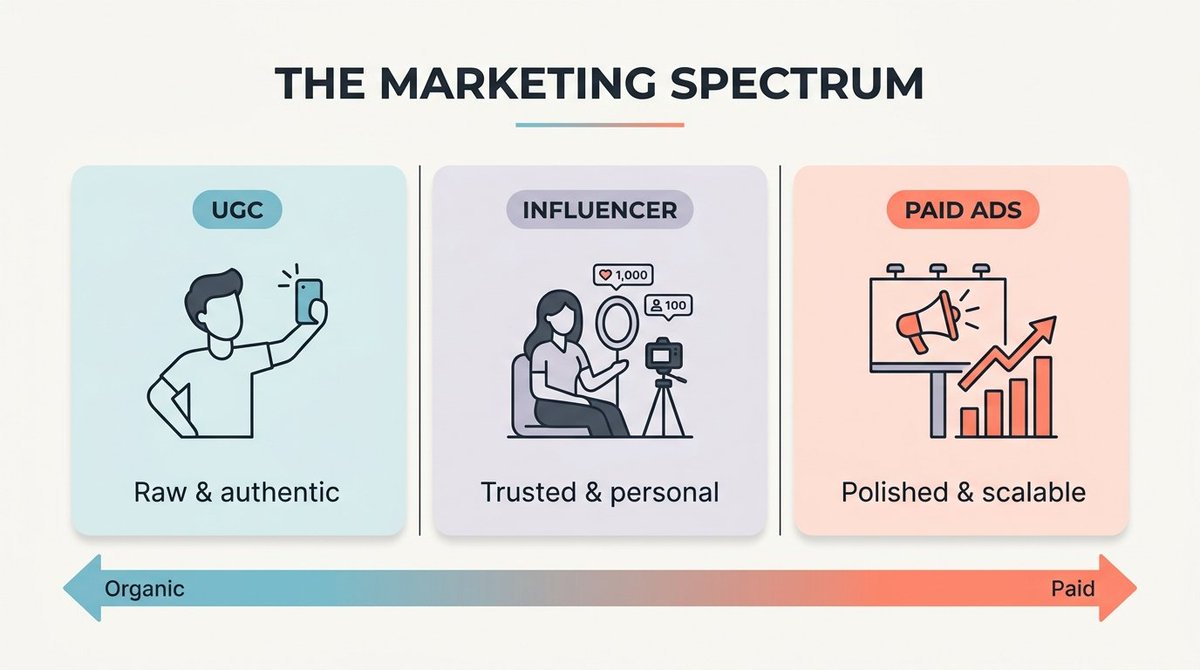
There can be overlap, but that trust relationship is the reason to pay an influencer premium.
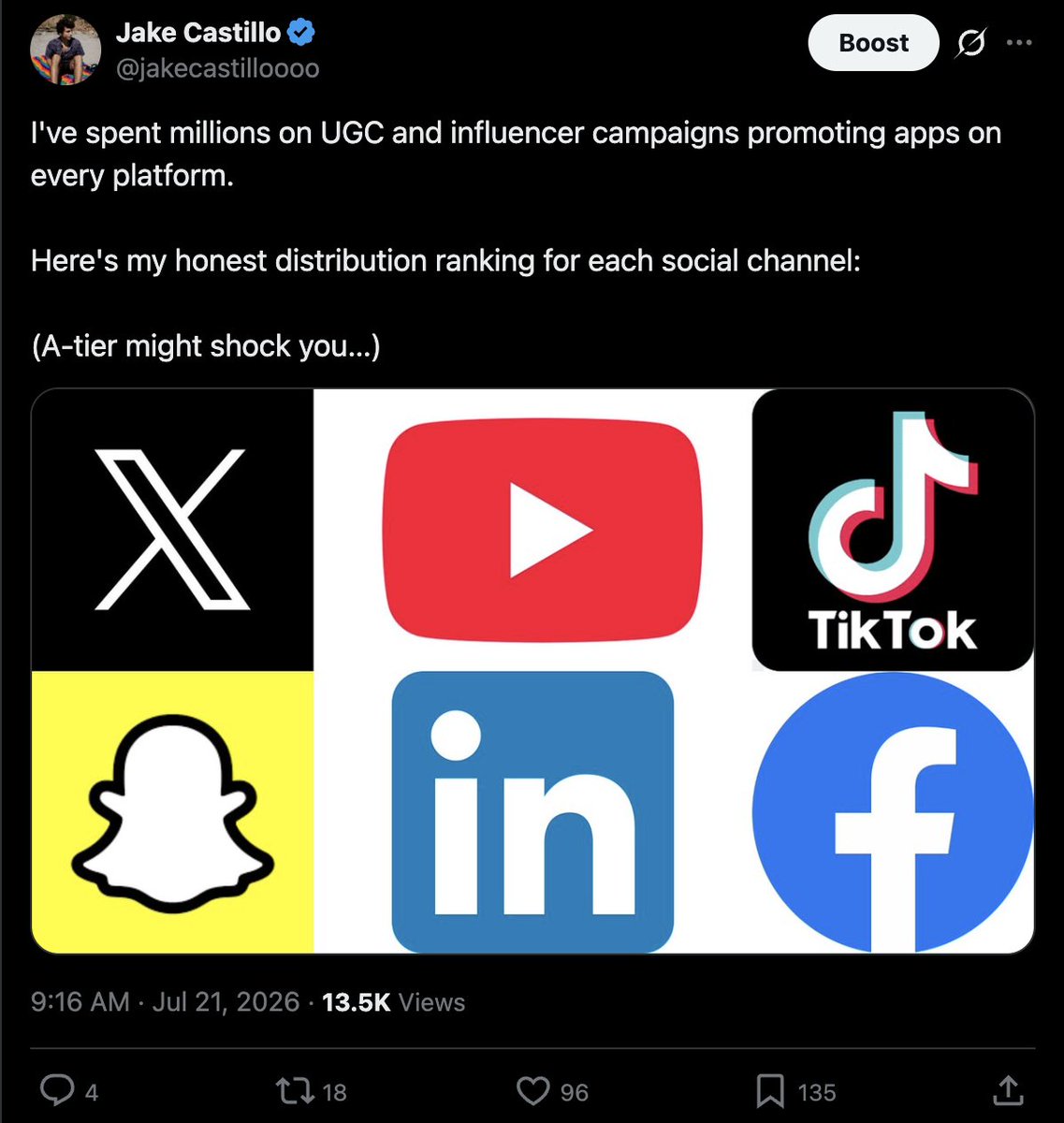
You can check out a breakdown of each social platform in terms of best bang-for-your-buck when trying to find influencers to partner with
(check out the thread HERE).
> If nobody trusts the creator's recommendations, even a mega viral video might not convert.
And if the product is confusing or people haven’t already proven they will pay for it, signing more creators makes that problem just more expensive.
Now after you have a creator to partner with, run through your app funnel as if you just discovered it from a video:
- Does the store page promise the same thing as the organic or paid piece of content?
- Does onboarding reinforce why you wanted it?
- Does the offer make sense by the time you're asked to pay?
You don't need a perfect app to begin testing.
> You need a clear promise, a useful product that solves a real problem people will pay for, and a path from interest to purchase that holds together all the way to your paywall.
2. Read the comments before you fall in love with the creator
We once paid a mukbang creator to promote Cal AI.
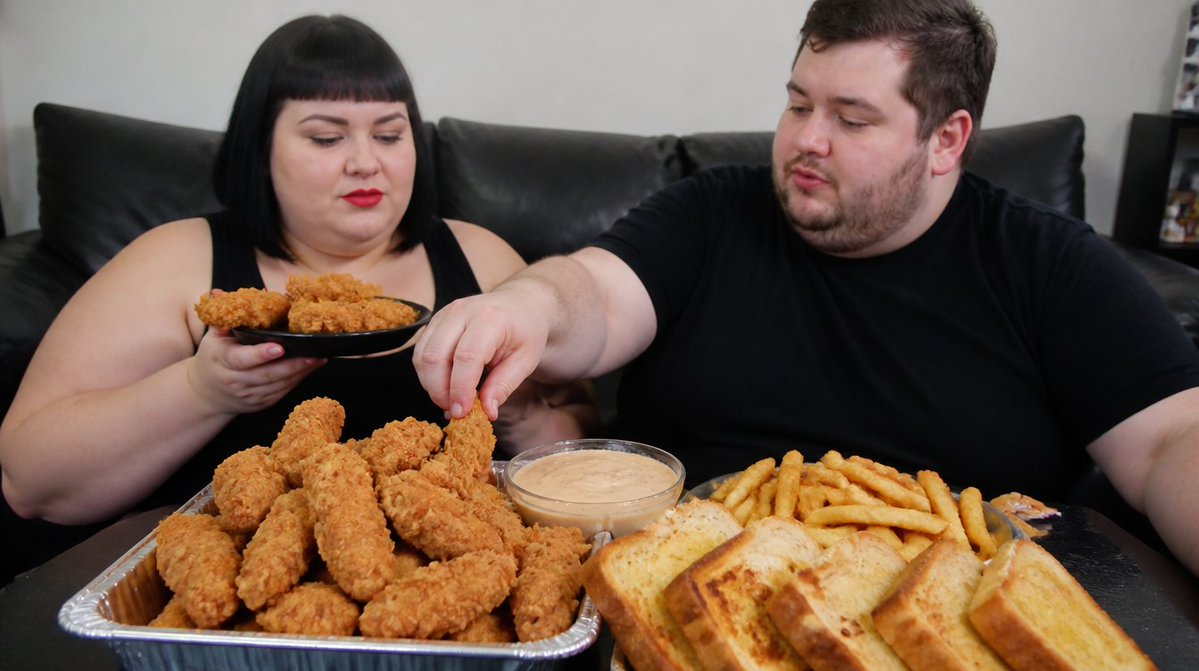
On paper, the connection looked obvious (putting a calorie tracking app in front of an audience who watches people eat for a living).
Aaaand it barely converted.
The audience was there to watch someone eat enormous amounts of food, that didn't mean they wanted help tracking their own meals.
We made a similar mistake with UFC fighters.
The fighter's relationship with weight management didn't tell us enough about what their audience wanted to buy.
Most of the people watching UFC are at the sports bar chugging beers and slamming wings or doing the same thing from their couch at home.
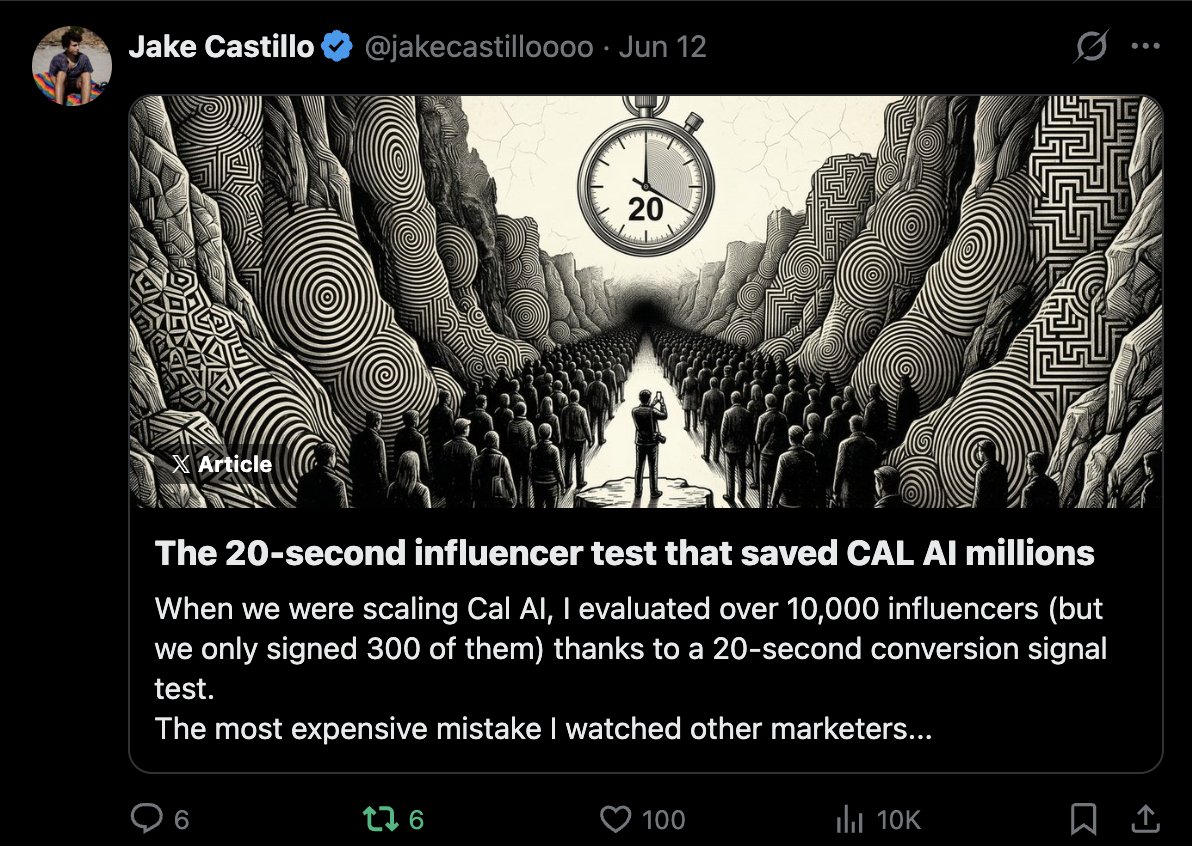
> Which led to the creation of the 20-second influencer litmus test which involves 3 main questions:
- What do their normal views per video look like?
Look for their baseline views across their most recent 20-25 posts, and throw out any outlier viral videos.
One viral video tells you what's possible, while the rest of the account gives you a better starting point for what to expect.
- What’s happening in their comment section?
Look for questions, conversations, and people responding to what the creator actually said.
- Does the audience ask for advice?
- Do they talk to each other?
- Do they seem invested in this person's life?
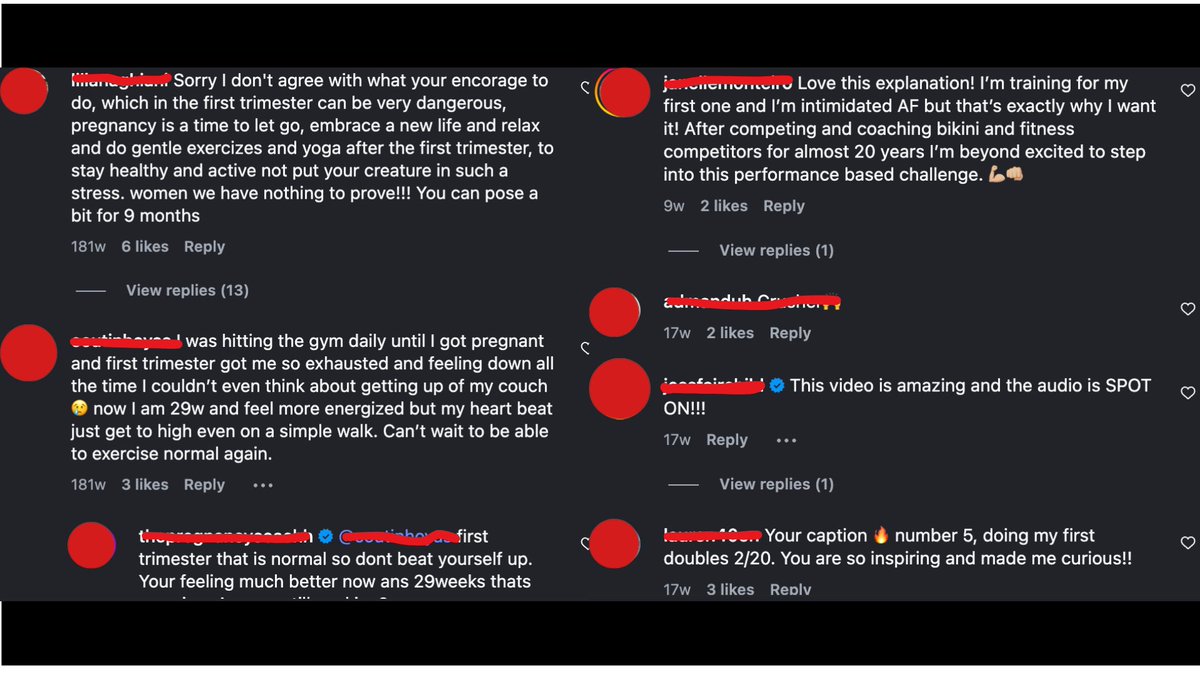
A wall of fire emojis or “YAS QUEEN SLAY” gives you much less to work with.
- Does the creator feel like someone their audience knows and you’d want to be friends with?
Watch how they speak to the camera and how people respond.
You're looking for the kind of familiarity that makes a recommendation carry weight and not feel like an ad.
This 20-second test helps you decide who deserves a closer look, but it doesn't replace checking the economics before you send real money on partnership.
And leave room to be surprised…
> One of our best performers was a TikTok dancer who hadn't previously made fitness content or talked to the camera EVER.
The Cal AI integration gave her audience a chance to hear from someone they'd followed for years but hadn’t actually gotten to know on a personal level.
Use your first 20-second screen to build a shortlist, then write down:
- Why this audience might want your product
- Which existing format could naturally integrate it (for us, what I eat in a day videos became our bread and butter)
- What audience behavior supports your reasoning
- What result would make the partnership worth repeating
If you can't explain the audience fit without mentioning the creator's follower count, keep looking.
If you want a full breakdown of the 20-second influencer test in more detail, you can read this article I wrote on X few months back.
3. Calculate your price before you ask for theirs
A creator's rate tells you what they want to charge.
You still have to work out what the deal is worth to your app.
At Cal AI, we priced around expected views.
> Pull the creator's last 20-25 videos, set aside the extraordinary viral outlier, and take the median as your starting point.
Then account for what you're actually buying: how many posts, in what format, on which platforms.
Here's a hypothetical deal (these are example numbers, not Cal AI results).
- A creator wants $1,000 for four posts.
- You estimate 50,000 views per post.
That gives you 200,000 expected total views and a $5 expected cost per thousand views:
$1,000 ÷ 200,000 × 1,000 = $5 CPM
Those are total views, including repeat exposure.
You haven't bought 200,000 unique potential customers.
Now connect the price to paying users
- If the campaign produces 100 additional paying customers, the creator fee alone works out to $10 per customer.
- If it produces 25, you're at $40 per customer.
One of those is manageable and the other is the fastest way to kill your app, since most annual app plans are around the $30/yr mark.
That's why cheap views can still be an expensive acquisition.
> Before you negotiate, work backward from what a customer is worth after your costs, refunds, and the fees that apply to your business.
Then consider how long you're willing and able to wait to recover the spend.
If you're early and don't know those numbers yet, treat the first deals as a capped learning budget.
A spreadsheet assumption isn't proof that you can afford to scale.
Write down your fee ceiling before opening the conversation.
You should know the deliverables, expected views, what performance would justify the price, and how much you can lose if the test fails.
There's another cost people forget: their own time.
Our early creator deals were around $400 a month...
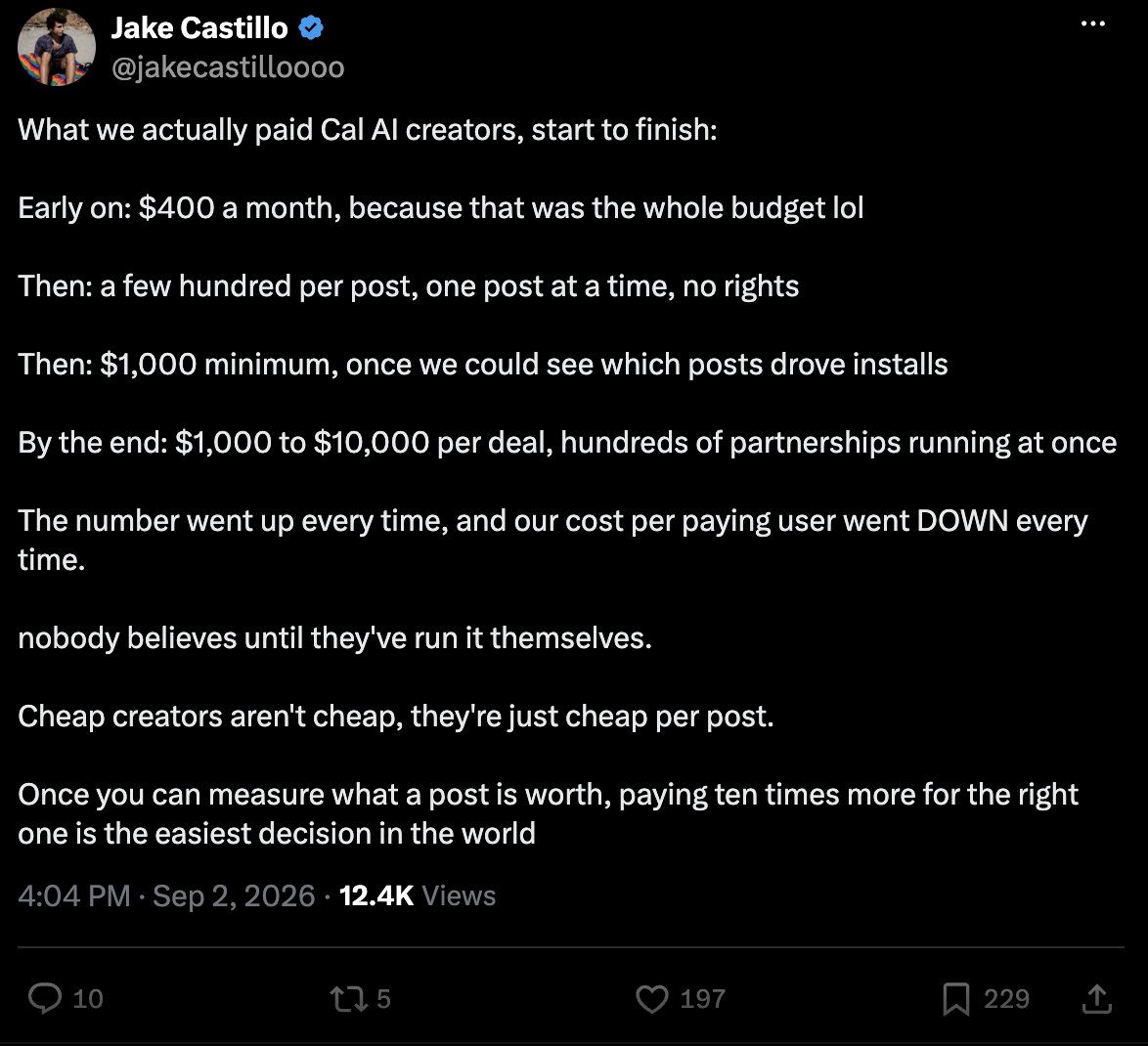
Later, we moved toward larger commitments because managing a small creator getting you 30,000 views per post takes the same work as managing an influencer who gets 500,000 views per post.
4. Use flat fees to keep the upside
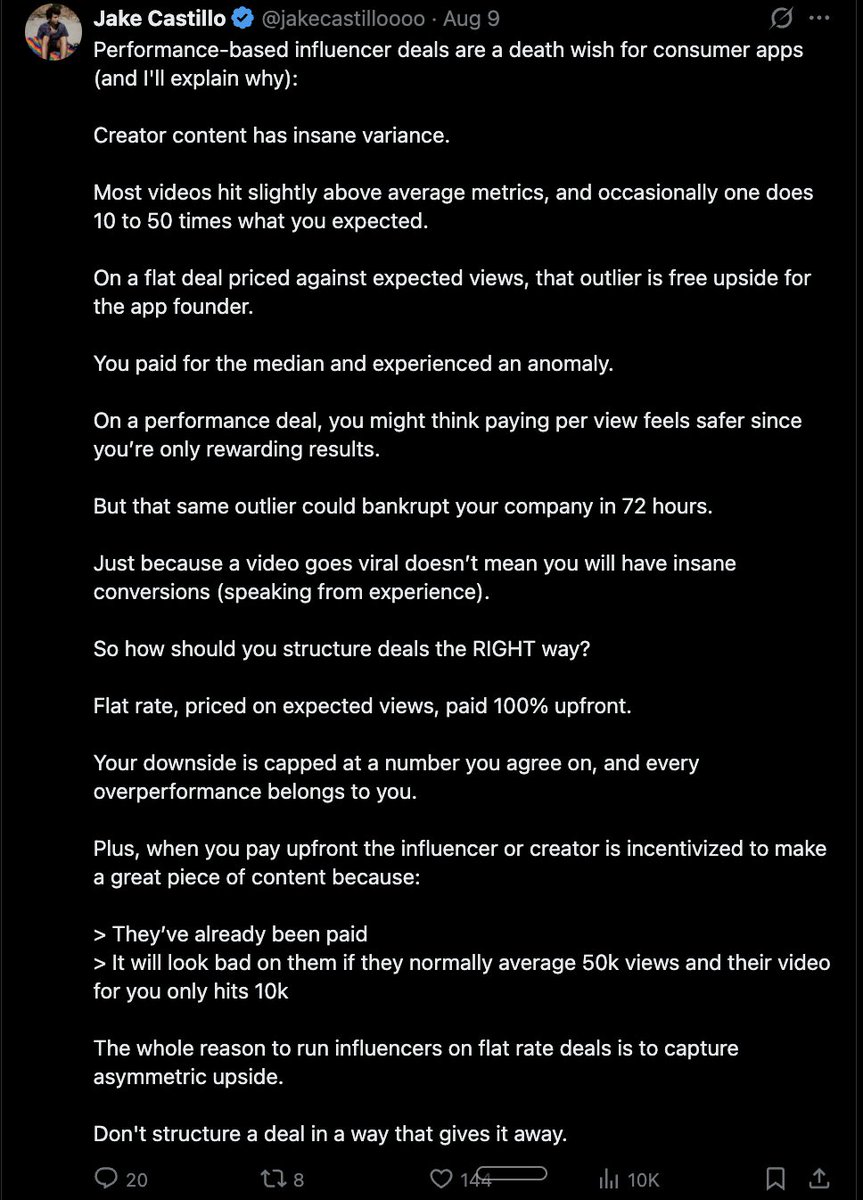
My preference (and yours should be too) is a flat fee, priced on expected views.
If the video performs far beyond expectations, the fee stays the same.
That's a meaningful advantage of any deal you sign.
Take the hypothetical $1,000 package above.
- At 200,000 views, the creator fee works out to $5 CPM.
- At 2 million views, it works out to $0.50 CPM.
A deal charging $5 for every thousand views would cost $10,000 with that second outcome.
Of course, the flat-fee deal can also underperform and you’d still owe the agreed amount.
You're accepting that uncertainty in exchange for keeping the upside when a video goes mega viral.
We also paid creators 100% upfront and that’s cheat code for great influencer relationships.
Creators had often dealt with brands that made them do the work and then left them chasing payments or just completely ghosted them.
Paying promptly helped us build trust, close faster, and negotiate better terms.
It also meant cash left our account before we knew what the campaign would produce.
So budget for the actual commitments you're making, don't assume next week's sales will cover every deal you sign today.
Before paying, get the commercial details clear:
- The number and type of posts
- Platforms and posting windows
- Fee and payment schedule
- What content reviews entail and how it works
- Whether any content reuse or paid-ad use is included
Creative freedom works better when nobody is guessing about the deliverables.
And an organic posting agreement shouldn't leave you assuming you can use the creator's video everywhere else.
5. Give them a two-minute brief
Our briefs at Cal AI were short enough to read in a couple of minutes.
The product, the most important moments and shots to show, the things they couldn't claim, and the deliverables.
Then we let the creator do their job.
That was an adjustment for me coming from consulting, where making everything polished and detailed could feel like the work itself.
But a creator doesn't need a presentation explaining your entire company.
They need to understand the angle well enough to make something their audience will watch.
For Cal AI, the useful connection was between the outcome people wanted and how much easier a photo made tracking their food.
Here's a template you can adapt:
- The Product: What does the app do in one sentence?
- Audience problem: What frustrating part of the viewer's life does it help with?
- Angle: Which desired outcome or problem should this video explore?
- Demonstration: What should the viewer see the product do?
- Boundaries: Which claims must the creator avoid, and what sponsorship disclosure should appear?
- Deliverables: What is being posted, where, and when?
For a photo-based food tracker, the demonstration could be a creator photographing a meal and showing the resulting breakdown during content about their routine.
The creator chooses how to introduce that moment, how to speak, and how to make it fit their usual format.
Give them something useful to communicate and room to communicate it well.
If every line has to sound exactly how you would say it, you've removed much of the value you hired them for.
Compare the finished integration with their normal content.
Does it still feel like the same person talking to the same audience?
That's the standard.
6. Decide how you'll judge the test before it goes live
One underwhelming post can make a founder abandon a promising channel.
One viral and profitable post can make them ignore the next ten flops.
> We used a simple rule for new niches: test three to five times with different creators and angles.
If there was a sign of life, we kept investigating and testing.
If every attempt didn’t convert we moved on.
The point was to give an idea a fair test without letting our attachment to it consume the budget.
Pick your limit before the results start messing with your judgment.
For each test, write a short note:
- Hypothesis: Why might this audience buy?
- Execution: Which creator, format, and angle are we testing?
- Spend: What is the commitment of cash we are comfortable losing in a worst case scenario?
- Observation window: When will we have enough information to judge it?
- Decision: What would justify running it back, changing strategy, or stopping all together?
A sign of life needs context:
- People asking where to download the app is encouraging.
- Downloads are more useful.
- Paying customers at workable economics are obviously the strongest signal.
Don't let one layer substitute for the next.
And give the funnel time to produce the outcome you're measuring.
If users enter a free trial, judging their paid conversion immediately will tell you very little.
A useful test also gives you a next question.
- Maybe the audience engaged but the product demonstration was unclear.
- Maybe installs arrived and onboarding lost them.
- Maybe the video reached the wrong people entirely.
Those observations lead to different decisions.
Record what you changed on the next attempt so you can learn something beyond whether the view count went up.
7. Follow the customer all the way to payment
When a video goes live, start by comparing it with the creator's normal performance.
If it falls far below their usual range, inspect the integration.
- Was the hook weak?
- Did the creator suddenly sound like they were reading a brand statement?
- Did the product interrupt the reason people watch them?
One post can vary for plenty of reasons, but a weak integration is worth checking before you decide the audience is useless.
Then follow the customer through the rest of the funnel.
- Views with little interest in the app: inspect audience fit, the demonstration, and whether the reason to try it was clear.
- Interest without downloads:*look at what happens between the content and the app store page. Does the promise still make sense when someone gets there?
- Downloads without enough people reaching the offer: inspect onboarding. Are you reinforcing the value or asking for effort before the user understands why?
- People reaching the offer without paying: inspect the offer, price, value, and the maturity of any trial cohort.
If the creator sells an easier way to track meals, the store page, onboarding, and paywall should keep developing that same idea.
Every new promise or unrelated feature gives the user something else to process and chance to get confused and bounce.
Go through the entire journey in one sitting: Watch the video, open the listing, install, complete onboarding, and reach the offer.
You'll notice disconnects that are easy to miss when each screen is reviewed separately.
Also know, influencer attribution gets harder as the program grows.
Early on, you may see a post go live and downloads spike.
With many creators posting and other marketing channels running, those individual spikes become harder to separate.
Keep the post log, compare patterns, and watch aggregate spending and customer economics.
Be honest about how confidently you can assign an outcome to a particular creator.
Don't let the search for perfect attribution consume the hours that should go into better tests.
But don't use imperfect attribution as an excuse to ignore whether the overall program pays for itself.
8. Build a system that gets the next post live
When I joined Cal AI, we had two or three influencers and a lot of manual work around each relationship.
Contracts, follow-ups, posting dates, checking performance, etc etc
I rebuilt the process into an automated pipeline, so by the end, we were signing around ten new influencers a week and managing hundreds of partnerships with a small team.
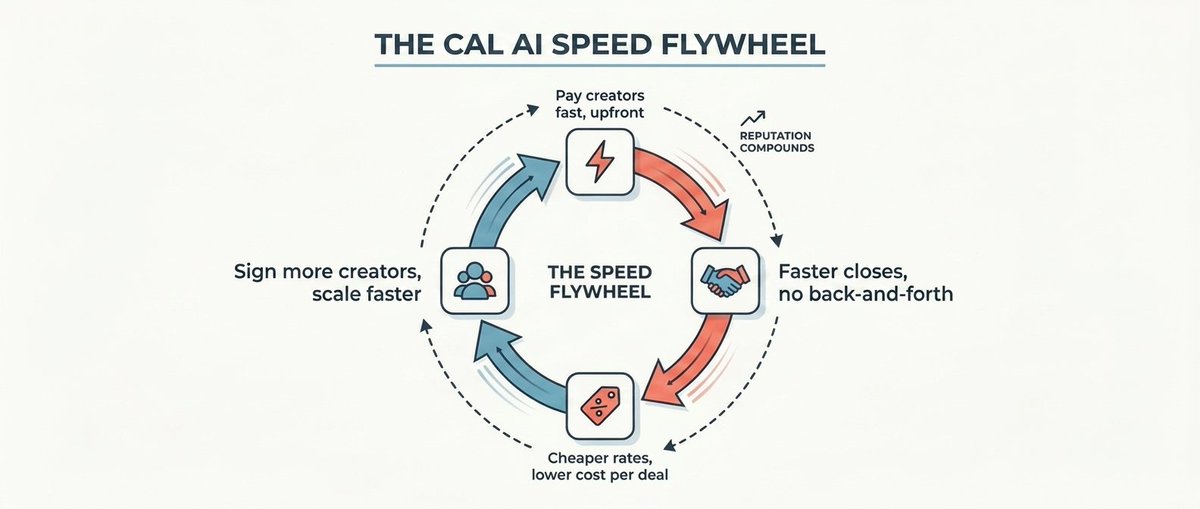
The process looked like this:
- Outreach
- Conversation/call
- Agreed deal
- Contract
- Tracker
- Posting reminder
- Performance review
- Renewal
A yes should trigger the next step without three people asking who owns it.
A signed agreement should appear in the tracker with the right deliverables and dates.
A post coming due should trigger a reminder.
A completed campaign should produce a renewal decision.
You can start with a simple shared sheet. Give each creator one record containing:
- Owner and current status
- Agreed fee and payment status
- Deliverables and due dates
- Expected and observed views
- Renewal date and decision
Automate the repetitive handoffs as volume grows.
Keep judgment focused on audience fit, creative quality, pricing, and where the next dollar should go.
9. Repeat what works until the evidence changes
When a creator and concept worked, we ran it again.
We also looked for creators with similar audiences and formats so we could test the same underlying idea elsewhere.
You don't need a completely new strategy every time something succeeds.
Before moving on, understand the win.
- Was the audience already looking for this solution?
- Did the demonstration make the value unusually clear?
- Did the creator explain a problem in language their viewers recognized?
Carry that insight into the next brief.
Let the next creator deliver it in their own voice.
> Your renewal decisions should account for the commercial evidence, the reliability of delivery, and how much effort the relationship takes to manage.
But overall, the daily work remains pretty simple to describe:
- Find more suitable creators
- Get good content live
- Learn from it
- Repeat the combinations that earn another test.
The difficulty is doing that consistently without letting busywork take over.
Start with a test you can afford to learn from
You don't need 300 partnerships to start.
You need a clear reason someone would buy your app, a shortlist of creators whose audiences might care, and a deal structure you understand.
Before you send the first offer, you should have:
- An audience-fit hypothesis
- An expected-view estimate and fee ceiling
- A brief the creator can actually use
- A spending limit and observation window
- A way to follow the results through to paying customers
- A rule for what happens next
That's enough to start learning.
Open your niche, find the first few creators worth a closer look, and read their comments.
The first useful decision is right there
- Jake
Related articles
How to Start a 6 Figure Faceless YouTube Channel (Full Breakdown)
I've helped over 400 people start profitable faceless youtube channels. i've ran over 50 channels myself. Generated over $4 MILLION by age 25. Worked with youtubers that have 10 million+ subscribers,…
$5T opportunity: AI Roll Ups
You are a sourcing analyst for a holding company buying [industry] firms in [region]. Using the attached list of licensed firms, identify businesses that likely match these criteria: 5 to 50 employee…
How to Make $300K with AI avatars in 90 days
I’ve made more than $300K selling digital products through YouTube and managing AI avatars.