i created a Grok Bot workflow and earned (full guide)

i'm going to show you one cash lane on Grok Bot: demand-first info products.
not "ask AI for a PDF."
the bot listens where people are stuck, scores the pain, builds a landing + checkout before you write anything, then you only ship the product if there's real intent.
one bot per job. approvals on money and publish. math below is illustrative so you can size the machine - not a promise.
what's inside
-
the loop in plain words
-
stack (Grok Bot, Whop, landing, tracker)
-
four lanes on the roster + what stays human
-
standing rules + copy-paste prompts
-
listen → score → pre-sell → write → distribute → fulfill
-
daily/weekly cadence
-
7-day sprint
-
failure modes + quality bar
-
example unit math
-
paste pack to start today
the mistake i keep seeing
people treat the agent like a notes app.
prompt → paste → 40-page PDF → nobody buys.
usually one of three things broke:
-
no demand proof (topic felt smart, nobody was stuck)
-
no distribution (asset with zero pipes)
-
slop (generic advice, no constraints, no artifacts)
this workflow is built to kill those early.
the loop

hard rule: if the landing doesn't show intent (clicks, checkout starts, "is this out yet?"), you do not write the product.
product type: one narrow info product (guide, pack, templates, checklist + scripts).
payment: one-time checkout (Whop or equivalent).
traffic: communities + X where the pain already shows up.
stack
required:
-
Grok Bot
-
Whop for checkout (CLI helps if you want the bot creating products/links)
-
a landing you can deploy fast (Framer, Carrd, custom, or bot-built static)
-
file delivery on Whop (PDF, zip, whatever you can support)
-
one tracker (sheet or tiny dashboard): candidates, status, spend, revenue
optional:
-
Apify-style scrapes for public data (cap the spend at the provider)
-
email capture later - v1 can go straight to checkout
print/mail vendors are for other cash lanes. you don't need them for info products.
keep burn small on purpose:
-
hard caps on tools
-
no ads until organic winners exist
-
one product book - don't mix spend across experiments
example sizing only:

one bot, one job
don't build a god-agent that also refunds people and tweets as you.
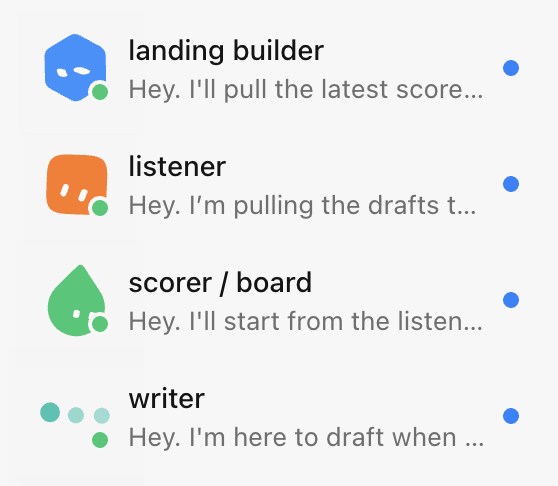
listener - daily pulls stuck posts. saves exact wording. no cleanup.
scorer / board - running board; promotes a topic to candidate only when it repeats and scores.
landing builder - pre-sell page + checkout link. no fake testimonials. no invented proof.
writer - only after intent. narrow product from the board + your constraints.
you still do:
-
pick lanes you can actually teach
-
approve candidates
-
post and reply from your accounts (auto-post gets banned)
-
refunds, price changes, payouts
-
final quality gate
one agent, one outcome. handoffs are fine. role titles that mean nothing are not.
standing law (paste once)
You run ONE business: demand-first info products.

Hard rules:
- Public sources only unless I give credentials.
- Never invent testimonials, revenue, user counts, or screenshots.
- Never refund, change prices, move money, or raise spend caps.
- If a spend cap is hit, stop and tell me.
- Social posting/replies from my accounts = draft only. I publish.
- Exact buyer language is sacred. Do not "professionalize" pain quotes.
- A topic becomes a candidate only if it repeats across the week AND
  I could plausibly teach it. If I can't, say so and skip.
- Build landing + checkout BEFORE writing the product.
- If landing intent is weak, kill the topic. Do not write anyway
  to justify sunk cost.
- Keep this book's files, products, and metrics separate from any other project.
- For the first 3 ships, stop before publish and show me everything.
when rules conflict, approval wins.
step 1 - pick a lane you can sell without cosplay
good:
-
a job people already pay to fix
-
recurring confusion (tools, workflows, distribution, shipping agents)
-
buyers who care about time and money
bad:
-
pure hype with no steps
-
medical / legal / finance promises you won't stand behind
-
topics where you have zero judgment
one sentence:
> > I help [who] get [outcome] without [common waste], using [concrete artifacts].
if you can't fill that, stop. the bot can't invent authority for you.
step 2 - demand surfaces
pick 3-7 places. depth beats tourism.
types:
-
X search / lists around a tool or job-to-be-done
-
forums where people post failures
-
discords where beginners get stuck (listen-only is fine at first)
for each surface write down:
-
name / url
-
what "stuck" looks like
-
posting norms so you don't spam and die
step 3 - daily listen
Every day, scan the last 24h in these surfaces: [LIST].

Pull posts/comments where someone is stuck on something SPECIFIC
and losing money or time.

For each item capture:
- surface + link
- date
- exact quote (no rewriting)
- what they already tried (if said)
- whether they mention paying for something that failed
- rough urgency (low/med/high) with evidence from wording

Output a table. No strategy essay.
Drop jokes, news, and vague motivation posts
step 4 - weekly scoreboard
Update the running board from this week's captures.

Group near-identical pains into topics.

A topic becomes CANDIDATE only if:
1) it appeared multiple days this week (not one viral rant)
2) wording shows money/time loss
3) a digital info product can solve a first win in <7 days of work
4) I can teach it (flag if doubtful)

Score candidates 0-10 on:
- repeat frequency
- urgency
- willingness to pay signals
- narrowness (can we title it in one line?)
- competition spam level (high spam = need sharper angle)

For top 3 candidates give:
- topic name
- buyer language headline options (3)
- who it's for / not for
- product shape (checklist, templates, short guide, pack)
- suggested price band (one-time)
- why it might still fail
kill when:
-
one loud post, no repeats
-
entertainment argument only
-
needs credentials you don't have
-
only works as ongoing private consulting
-
you wouldn't put your name on it
step 5 - landing before the product
For candidate #[N], build a landing page. Product body does NOT exist yet.

Requirements:
- H1 = problem in their words
- 5-8 bullets of what's inside (specific artifacts, not vibes)
- who it's for
- who it's NOT for
- plain-English what happens after purchase
- checkout section with THIS link: [WHOP_CHECKOUT_URL]
- zero testimonials
- zero "join thousands"
- zero fake logos
- mobile-first, fast

Deploy and give me the live URL.
Also give me 10 distribution openers that point to this URL
without sounding like a bot.
intent you actually track:
-
checkout starts
-
"take my money" replies
-
email asks
-
repeated clicks from in-market threads
no intent after a real distribution push → kill.
cheap lesson. expensive lesson is writing 12k words first.
step 6 - paid shell on Whop
manual or bot + CLI:
-
name = outcome + audience constraint
-
one-time plan
-
checkout link
-
delivery empty until write is done
-
internal SKU tied to candidate id
Install/auth Whop CLI if needed.
Create one product + one-time plan for [NAME] at $[PRICE].
Create checkout link.
Return ids + url as bullets.
Do not touch other products.
step 7 - write like an operator
only after intent.
Write the v1 product for [CANDIDATE].

Constraints:
- promise ONLY what the landing promised
- length: short enough to finish in one sitting (aim lean)
- structure every section as: goal → steps → template/example → failure mode
- include copy-paste prompts/checklists where useful
- no generic "mindset" chapters
- no invented case studies
- mark assumptions clearly

Deliver:
1) final manuscript outline
2) full draft
3) 1-page quickstart
4) filename + version
human gate: read it once out loud. cut anything you couldn't defend on a call.
step 8 - distribution (this is the money part)
most AI product posts skip this. don't.

step 9 - when someone pays
When a payment hits:
- deliver file immediately
- send a short confirmation: what they got, how to start in 10 minutes, how to reply for support
- log: date, SKU, source pipe if known, issues
- if request is outside scope, answer with boundary + what v2 could include
- never promise refunds unless I say so
honest "not for you" on the landing keeps support sane.
step 10 - weekly read-out
Weekly review for the info-product book:

- candidates created / killed / shipped
- landing unique visitors (if available)
- checkout starts / sales / refunds
- top source pipe
- $ spend (tools) vs $ gross
- one thing to change next week
- which product gets another distribution week vs sunsetting
double down on winners. more distribution beats more PDFs.
cadence

failure modes
-
shipping without repeats → random content
-
writing before landing → sunk-cost novels
-
fake social proof → trust death
-
too broad ("complete guide to AI") → no convert
-
topic you can't teach → refunds + reputation hit
-
autoposting → bans
-
no caps → silent tool bill
-
new product every day → zero compounding
-
soft CTA only → clout, no checkout
-
skipping "not for you" → bad-fit buyers, noisy support
quality bar before you sell
-
title names the job-to-be-done
-
outcomes match landing bullets exactly
-
at least one copy-paste asset (prompt, script, checklist, template)
-
one worked example with real constraints
-
failure modes section
-
time-to-first-win under one sitting if you can
-
you can defend every claim without theater
if you wouldn't charge a friend this price, don't ship.
example math (worksheet)

put your real P and C in after week one.
what "done" looks like
not when the bot writes pretty.
done when:
-
demand hits a board on a schedule
-
weak ideas die cheap
-
strong ideas get a live checkout fast
-
distribution is a muscle, not a mood
-
money and files move without chaos
-
you can open a second candidate without inventing a new business identity
that's a workflow. everything else is cosplay.
limits (be adult about it)
-
shared cloud computer is not a security boundary - treat logins like production
-
social send stays manual until you've watched the drafts
-
no invented metrics in public posts about this lane
-
spend caps live at the provider, not only in the prompt
-
first three ships: Require Approval before anything irreversible
expansion rule
one lane stable before the next.
specific profile. specific actions. visible board.
get the first lane running today: standing law → five surfaces → one listen run → nothing else until the table has real stuck quotes.
if you build agent workflows and care about distribution more than fairy dust - follow @thekuchh.
Related articles

The One-Person Company Blueprint: How to Run an Entire Business Using Grok Bot Alone
A traditional company has an org chart. Sales sits in one box, marketing in another, operations somewhere else, each staffed by a person who owns that function and nothing else. The org chart exists…

How We Generated Millions Of Organic Clicks With Programmatic SEO
most SEO looks like this:
I told ChatGPT-6 Astra to do my SEO. It got me $27k MRR (full guide)
Connect a custom MCP server named Conqueror using this URL: [https://winwith.conquerorapp.com/mcp](https://winwith.conquerorapp.com/mcp)