I've generated 8 billion views. Here's how to go viral.

most people in this space think they know how virality works. The problem is most of them are wrong.
i've generated over 8 billion views across 60+ industries.
my agency puts out between 650 and 800 million views every single month. and i can tell you with certainty virality is not random, it's engineered.
what most people get wrong
most creators think virality is about content quality.
write better scripts. hire better editors. post more often. find the right niche.
It's true but not how people make it out to be.
Obviously you're content isn't going to perform if it's straight up trash so it needs to actually be good.
But for a lot of them it's not the actual problem.
The real problem is the distribution:
For example, a 10,000-view clip relies on the creator's existing audience.

it reaches the people who already follow them and not many beyond that.
a 10,000,000-view clip relies on human psychology and algorithmic triggers and it doesn't care who the creator is.
it engineers a response.
the algorithm rewards watch behaviour.
specifically, it watches three signals:
does the viewer start watching
do they keep watching
do they watch again.
quality has a small effect on those three signals directly.
what drives them is mechanical.
here's what the data actually shows.
the 3 mechanics that separate 10k views from 10M views
the competence gap in the hook
a 10,000-view hook says: "here are 3 tips to grow your instagram."
a 10,000,000-view hook does something different.
it attacks a specific mistake the viewer is already making, or destroys something they believed was true.
it creates an immediate need in the viewer's brain to know the answer before they can move on.
"you've been posting reels wrong and here's the proof" compared to "here's how to post better reels."
the first one creates a competence gap.
the viewer thinks wait, am i the one doing this wrong?
that question makes scrolling past psychologically difficult.
the hook's only job is to create a gap that can only be closed by watching the rest of the clip. not to summarize. not to explain. to open a gap.
information density and visual pacing
a 10M-view video has zero dead air. not reduced dead air. zero.
every 3 to 5 seconds, there's a visual reset
the other half of this is progressive disclosure. instead of showing a completed diagram, you build it live on screen.
instead of stating a list, you reveal it item by item. the viewer always feels like the next piece of value is 3 seconds away. that feeling is what kills scroll impulse.
the perfect loop
this is the one almost nobody talks about, and it might be the most important of the three.
the algorithm's primary distribution metric is average watch time as a percentage of video length.
a 100% watch time means the viewer watched the whole thing.
above 100% means they watched it more than once.
the algorithm interprets that as "this video is so good people can't stop watching" and pushes it to cold audiences at scale.
the final sentence of the clip has to bleed back into the first sentence of the hook.
the viewer finishes the video and the brain doesn't register a stopping point.
it loops before the person consciously decides to. the watch time counter keeps climbing.
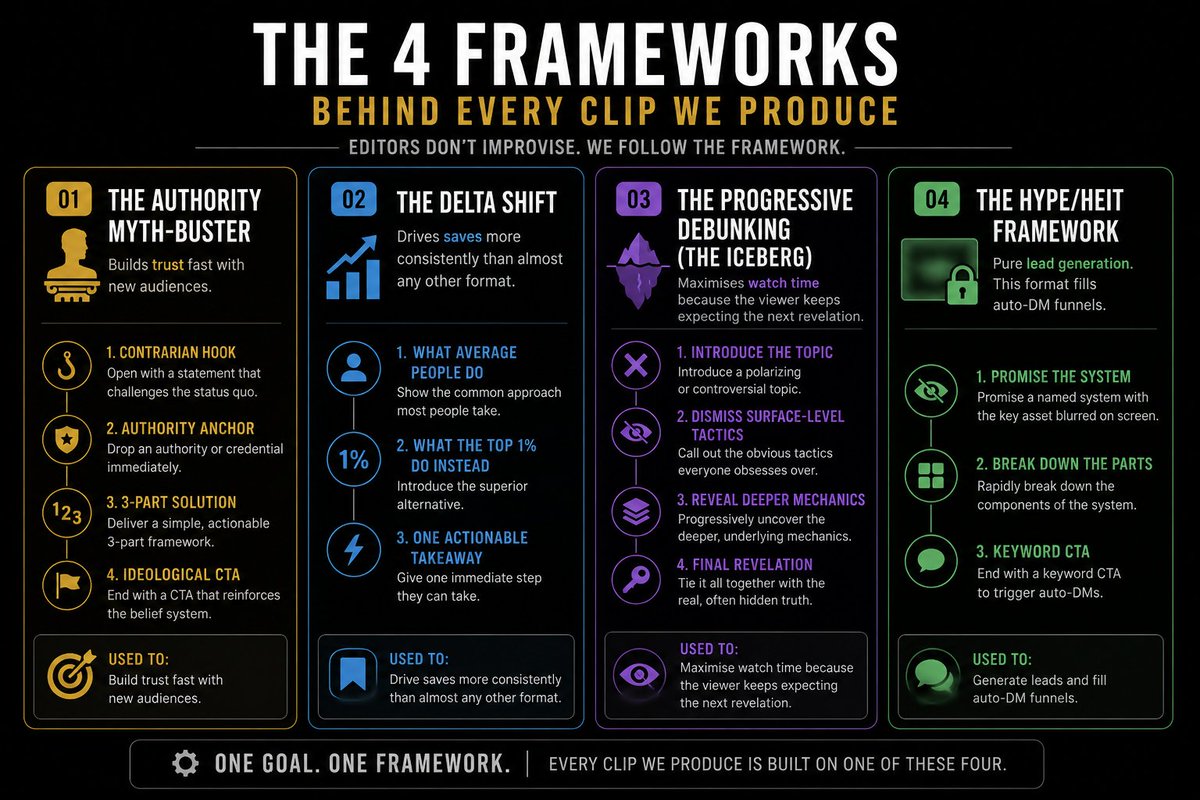
the four frameworks we actually use
every clip we produce is built on one of four internal frameworks depending on the goal. editors don't improvise.
the authority myth-buster — opens with a contrarian hook, drops an authority anchor immediately, delivers a 3-part solution, ends with an ideological cta. used to build trust fast with new audiences.
the delta shift — shows what the average person does first, then introduces what the top 1% does instead, then gives one immediately actionable takeaway. drives saves more consistently than almost any other format.
the progressive debunking (the iceberg) — introduces a polarizing topic, dismisses the surface-level tactics everyone obsesses over, and progressively reveals the deeper mechanics underneath. maximises watch time because the viewer keeps expecting the next revelation.
the HYPE/HEIT framework — promises a named system with the key asset deliberately blurred on screen, rapidly breaks down the parts, and ends with a keyword cta. pure lead generation. this is the format that fills auto-DM funnels.
the frameworks are the skeleton.
On top of that, we're constantly analyzing what's exploding in real time across every niche, reverse-engineering the mechanism behind it, and rebuilding it as a new format for our clients.
By the time something looks like a trend, we've already moved past the format that created it.
the distribution layer
the clip is only half the machine.
We run over 40 pages across instagram, tiktok, and youtube for a single creator at full scale.
Main page.
Secondary pages.
Fan pages.
Clipping pages.
distribution channels that all feed attention back to the main brand.
the numbers we generate come from combining a high-volume content machine with a proven offer.
These are the basics of scaling organically and if there's one thing I want you to take away it's:
EVERYTHING IS IN THE DATA
Related articles

How to Run AI Slideshows Profitably on TikTok
the algorithm re-serves a slideshow to people who scrolled past it.
We got 75M+ views in 6 months. This is how we run social with Muse, GrokBot now (Step by step tips)
Part of that is luck. Most of it is a content marketing system we built with [Helena](https://www.hirehelena.com), our favorite AI marketer.
