I vibecoded a B2C app and exited for $375,000 in 6 months (full guide)

I went from idea to $375,000 in 6 months. No team, no coding ability. What I'm about to break down will change how you build forever
It was a web app btw. No Xcode, no Apple's 30% cut, no App Store rejections.
Built nights and weekends around a 9-9 consulting job a year out of university.
Six months later it was acquired. And the money wasn't the only thing that changed. The exit gave me the freedom to be a full-time founder and the permission to bet on things I'd been wanting to build for years.
I moved to Korea. I joined Jenni AI to work with one of the greatest founders of our generation.
Before this, I was doing what most readers of this are probably doing. Trading hours for a salary. Working on someone else's roadmap. Moving shapes on powerpoints.
None of that changes without the wire.
Here's what I actually figured out:
→ Making content is the best way to get acquired for the highest possible multiple. It's also a full learnable skill (I'd never posted a TikTok in my life).
→ Building has never been easier. AI has obliterated the technical moat.
→ This means the moat moved. Distribution is where the asymmetry lives now.
→ Most founders are still optimising the part that no longer matters.
→ One non-technical person, with a laptop and a system, can now do what used to require a team and a year.
I'm proof of point 5. I can't code. I built, scaled with UGC, and sold inside six months. If I can do this, you can do this.
This window is open but it won't stay open forever. The CPMs will rise. The viral formats will get exhausted faster. Right now, almost none of that has happened. The people who move in the next twelve months will own this category.
Here's exactly how I did it, and what I'd do if I were starting again today.
Build a distribution engine acquirers actually buy
Acquirers don't buy your app. They buy attention they couldn't build themselves.
MyFitnessPal buying Cal AI. Quizlet buying Coconote and Answers AI.
All 3 have one thing in common - their moat was distribution, not product.


Here's how to build that moat:
- Start with a format, not with a problem
Traditional startup product ideation goes something like: find a painful problem. Validate it. Build the app. Then figure out marketing.
That sequence is backwards and that logic is dead.
Your viral potential determines your ceiling. If you build a great app but have no way of marketing it, you'll be stuck at $0 for a long, long time. A mediocre app with outstanding distribution will always beat an outstanding app with mediocre distribution
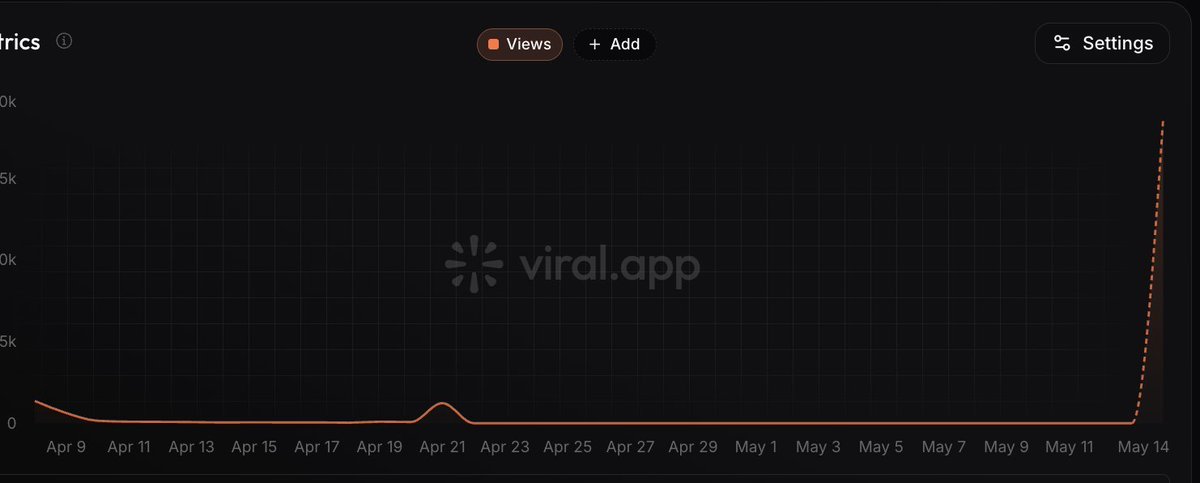
And when you get the format right, the impact is incredibly powerful. Even for a $1m MRR business, a viral video can massively move the needle:
Pick the format first. Then build the minimum app the format requires.
What makes a format worth picking:
Three criteria. All three matter.
→ Viral. It's working right now on TikTok. Not "could work." Currently going off.
→ Scalable. You can produce 50+ variations of it without it getting stale. One-hit formats are lottery tickets.
→ Sustainable. It's already survived at least one fatigue cycle. Look for formats that hit, dipped, and came back.
A key bit of advice: scroll TikTok, not Reels. Reels are about two weeks behind TikTok. By the time a format hits Reels, the early-mover advantage is gone.
Two places to find the format
Path A: study apps already winning.
Find apps in any category making real revenue, then study their winning content. Halo AI's "prank" format is an amazing example - they built a signature format with tight unit economics, aggressively scaled it, turned it into a brand. UMax with face rating. The pattern: format + niche + unit economics that facilitate scale = winning formula.
Path B: steal from ecom / info.
This is the one I see very few people talking about. Dropshippers, course sellers and ecom brands have often cracked viral formats but their products are often terrible with low LTV and no recurring revenue. The format has product-market-fit, but the product doesn't.
Take the format. Build an app whose product actually delivers what the format promises. You take a proven content engine and replace a weak product (with bad economics) with a more valuable one.
The hardest part of going viral is figuring out what goes viral! If someone has already done that work, copy the homework and apply it where the economics and retention are better.
Once you've picked the format, the app essentially designs itself. Work backwards.


If the format is a "reveal" (scan → score), the app needs to do the scan and the reveal well. Nothing else has to be excellent. Don't build features that don't appear in the format in your MVP.
Use Cursor / Claude Code. Starting with a super user friendly builder that doesn't give you granular control will become a pain later. Two weeks max from choosing your format to getting your MVP live. If it takes longer, you're overbuilding.
One catch (I'll talk more about this later):
A format that drives downloads to a one-and-done app is a churn machine. You'll get views, you'll get installs, then you'll lose them in two weeks.
The best formats sell products people return to. Daily, weekly, habitually. This is the difference between a viral spike and a real business - as the subsequent success of UGC for Jenni has proven
Plus, as I'll show later, churn is what determined my acquisition multiple.
That starts here. You'll have plenty of formats to choose from, so pick one that funnels to a product people use on a regular basis.
- Make content yourself before anything else
Don't use agents. Don't use AI influencers. Don't automate. Don't hire creators. For your first 100 videos, you make every single video yourself.
I'd never posted a single TikTok before I started CiteSure. Not one. The skill that got me acquired didn't exist for me 8 months before the wire. If you're worried you're not a creator - neither was I! Content is a learnable skill, it just takes practice.
And hey, this might be a skill you've got some talent for without knowing. My first ever TikTok got 200k views, much to my own (pleasant) surprise!
You won't know until you try.
3 reasons why you should do it yourself:
→ There's a lot of sauce out there on growth strategies, but they're all dependent on you knowing what good looks like. How will you know what makes a good creator when you can't judge their content? How will you know what content to automate?
→ It's free. If you get it wrong for a month with Meta ads, you'll pay thousands of dollars. Making content yourself costs you nothing except time and time is what this early stage of the game is supposed to consume.
→ Understanding content and building "viral sense" is a skill that compounds. I know this because it's why I was acquired!
What this looks like in practice:
→ Post 3x daily across multiple accounts TikTok, Reels, and Shorts
→ Monitor your ability to predict which posts will do well before posting them
→ Focus on the trending view average, not just seeking random viral hits
- The production system


I made every post myself, total spend under $100, for six months. The output: 30M views, a peak of $132k ARR, and $375k
Here's the system that made it work.
50 hook clips. A maximum of 3 uses per demo. Constant re-filming of the demos to ensure uniqueness. Total cost of the hook clips: under $100, sourced from Fiverr or Upwork at <$2 per video, with the bulk of reaction clips filmed by friends and family for free.
There's a widespread misconception I see often which is that if you have 10 hooks and 10 demos, you have 100 unique videos. This is wrong.
TikTok's anti-duplication detection is incredibly powerful (thanks in part to something called perceptual hashing) - if you use a demo 10 times over, your reach will get throttled and your videos shadowbanned.
3 other operational rules:
→ Batch film. Filming is the bottleneck, so unlock it on a single day. I spent 16 hours every Sunday filming demos and stitching things together so that through the week I only had to click post during my posting windows. If you don't batch, the production time will begin to consume your life.
→ Your content strategy should be a portfolio. 50% of your posts should be proven formats with reliable view bases. 25% should be the iterations of those formats - material changes that bet on a changing variable causing a big view uplift. 25% should be moonshots, format experiments. Most accounts only do the first 50%. That works until the format dies and you have nothing to replace it. Uh oh.
→ Post 3x per day per account maximum. Any more than that causes a material decrease in view average, particularly on TikTok. Spread posts out throughout the day and ramp up to this volume gently.
Content strategy: how to know WHAT to post
Knowing what to post comes down to viral sense. This is the ability to know the difference between a good video and a great video, between a good creator and a bad creator. Strong viral sense = better content = better chance at going viral
To train your viral sense, spend 30 mins per day scrolling inside your niche, 30 mins outside (prescribed doomscrolling). Inside your niche teaches you formats. Outside your niche teaches you what culture is doing and is how you find innovative, new content winners.
Viral sense is a skill that keeps compounding and scales easily - as the transition from CiteSure marketing -> Jenni marketing shows:
Why organic crushes paid on margins
Paid attention dies the moment you stop spending. Organic doesn't.
The net profit margin on the app was over 80%, with total marketing spend under $100. When Jenni ran their due diligence, they saw an app generating recurring revenue at near-zero customer acquisition cost.
Something that still surprises me: CiteSure has grown strongly since the acquisition I haven't posted a new video in almost a year. The old content is still gaining views, still driving signups, still generating MRR
With paid, the moment you stop spending, the engine dies. With organic UGC, the misconception is that a video's lifespan is 24 hours - no virality in 24 hours = video is cooked. The reality is that the videos are an asset that continue to generate views perpetually and can even go viral weeks + months later.
At the time the acquisition happened, I hadn't managed a single creator or automated a single post. I had made every post myself using an internal system and that system + viral sense skill was what got acquired
- Retention determines your multiple
Get ready for some numbers (sorry).


→ You have an app with $100k MRR (congrats) but 50% churn (boo).
→ Your top of funnel system breaks
→ In 1 month, you have $50k MRR. In 3 months, $12.5k MRR and in 6 months, $1.5k MRR.
Shock, acquirers don't like this - they don't view this revenue as truly recurring, so pay a lower multiple on your MRR
High churn is also just annoying from a Founder perspective. In that example, you'd need to be acquiring $50k MRR worth of new customers just to keep MRR stable with 0% growth
Having an amazing top of funnel but terrible churn is like filling a leaky bucket. Patch the leaks and your life will be a lot happier
Tips for reducing churn:
→ Make a good product (duh)
→ Even if your product is a vitamin, make it feel like a painkiller. Use your content and copy to make the problem feel big and your app's solution feel truly necessary
→ Show VALUE in the cancellation flow. Yes, friction and framing matter but lots of your customers are churning because they never actually saw the value of your app. Use this moment to educate them
→ Incentives. Whether on web or mobile, you should have offers within your flow that strongly incentivise people to stay
All of those tips are underpinned by you understanding your customer's psychology and behaviour. If you understand what they actually want, you'll be much better placed to build for them
- The actual acquisition
Ultimately, you want to be shooting for a strategic acquisition, particularly if your app is new - multiples will be much higher.
For me, the DM from the buyer arrived when my app was less than 2 months old. I didn't know it at the time, but every single video I'd posted had put my app in front of potential acquirers and ultimately one of them came through.
That strategic synergy can be niche (EdTech and EdTech) or it can be a company looking to enhance their distribution (i.e. acquiring the content engine / skills)
How to actually find acquirers:
Marketplaces. Great for volume and speed, but lots of platforms like Acquire based their prices on TTM (trailing twelve months' revenue). If you've only existed for 6 months, this is going to be low. Newer platforms like Marc Lou's TrustMRR help to disrupt this, but you'll still want to optimize the type of buyer. Other marketplaces include Flippa and Microns for smaller deals
Brokers. Individuals and firms in the space who can provide a more tailored service, like Empire Flippers. Their value is in their network and they take a % of the sale
Outbound. Determine your ideal acquirer profile, make a list, and research them. Send each of them a message based on cold outreach principles and try to close
Inbound. This is the best of the 4 if you can make it happen. No broker fees, likely to be strategic, and gives you the leverage. The beauty of being a viral / content-led app is that you inherently facilitate this. Your content and reach gets your app in front of more eyes, increasing the chances of those eyes belonging to potential acquirers.

This is EXACTLY how my app was acquired. The Jenni team reached out to one of the accounts I was running for a content partnership, thinking it was a creator account. That moved into an acquisition discussion and the rest is history:
Some fun facts:
→ The Jenni team genuinely thought the profile I was running was a real creator because of the way I stitched clips - no sense it was worse than a real creator
→ Part of the conversation was me + David speaking to each other fully in 3rd person!
TLDR: if you want to get acquired for the best possible multiple, you need to be making viral content - that's how you'll get inbound acquirers
One last thing
Most of what I've just written is uncomfortable to do. Making 500 posts yourself sucks. Filming demos for 16 hours on a Sunday sucks. Getting fewer than 1,000 views for the first month sucks. The temptation to use AI, automate something, skip the boring part is incredibly strong.
Don't.
The friction and discomfort you're feeling is the asset getting built and you pushing yourself. There's simply no way of achieving big things and becoming a great founder without doing the work. Once you build the operator skill, you have it forever - across this app, your next app, every future hire, and every future role.
My wire was 9 months ago now. CiteSure is still growing. Jenni is at $1M MRR. The skill I built in those six months funded the freedom to bet on what I wanted next, and continues to compound across everything I do.
You don't need a team. You don't need investors. You don't need to know how to code. You don't need to have made a single TikTok before. You need a format, a phone, a Sunday, and the willingness to keep going for longer than is comfortable.
If you take one thing from this guide: the best version of this play ends in an acquisition.
Owning an app feels like wealth. Owning an exit is wealth.
The window is open. The tools are sitting right there. The buyer is already watching.
Make the first post.
(And follow my account - something cool is coming soon)
Disclaimer: absolutely nothing in this post is sponsored or paid for :)
Related articles

The ULTIMATE Organic Marketing Guide For App Founders
I’m going into calorie deficit, fat loss, high protein meals, gym meals, restaurant calories, what I eat in a day, meal prep, macro tracking, cutting, bulking, low calorie snacks and whatever else st…

4 Steps To Writing Viral Hooks
The fastest way is to identify direct competitors and reuse their hooks as a base.
I studied 60 apps that generated 10B+ views. 7 patterns separate the winners from the ones that die.
Over the last 18 months I've analyzed every consumer app growth case study I could find. 60 apps and 10 billion+ combined views. Revenue ranging from $0 to $4M ARR.