Launch and Scale Generational Creator Programs (FULL GUIDE)

I will show you everything there is to scaling generational creator programs in this article
By the time you have finished reading, you will know how to scale an app or product to $1M MRR, generate insane conversions and dominate social media.
let's get into it ↓↓↓
1) What is clipping?
What is clipping and why is everyone talking about it?
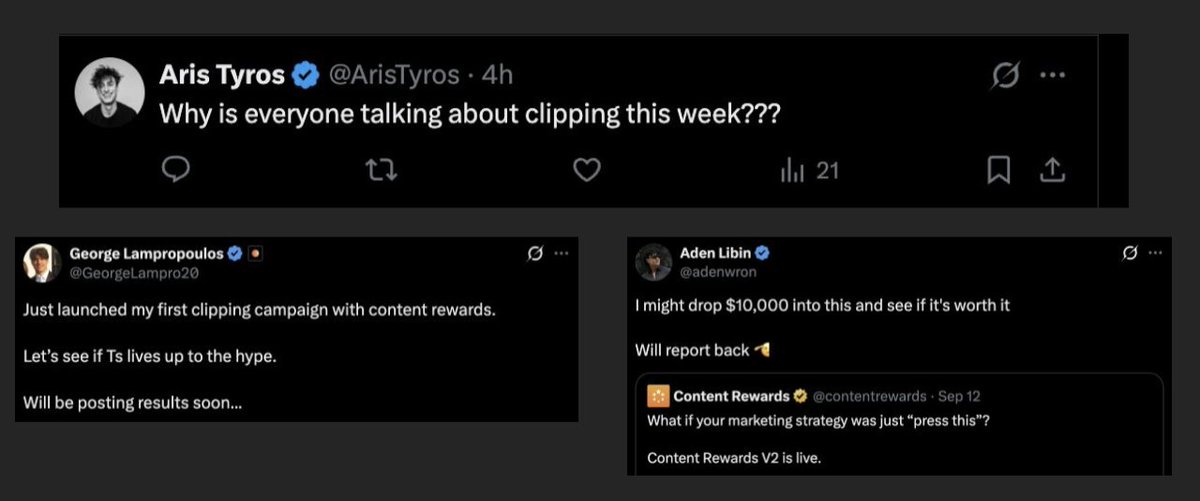
Clipping is essentially where creators take your content, or make their own original content and post it on social media for a certain RPM ($ per 1K views).
This can come in all sorts of forms like:
- Reposting (creators post videos you give them)
- UGC (creators make UGC content showing their face, can be different formats like memes, talking head, etc.)
- Meme Videos (creators post clips related to your product with a funny caption)
- TikTok Slideshows (Creators make a full slideshow w/ different images + text and post it to TikTok)
This is only the start, there are a ton of styles you can experiment with and it all depends on what works best for your product.
2) Why is clipping so good?
Now that you understand what clipping actually is, I'm going to explain why it beats every other marketing method.
Meta Ads
A lot of brands start with Meta ads due to how much they have been hyped up on platforms like X, LinkedIn etc.
But they are genuinely one of the WORST choices for marketing, here's why:
- EVERYONE skips ads. If you see a post on Facebook with a sponsored label are you even going to bother reading it?
- INSANE CPMs, Meta averages a CPM of $11.54 and when you compare that to the CPMs you get with clipping (<$1) it's pretty bad
- As soon as you stop paying, people stop seeing your ad, with clipping the videos stay up and keep generating views for months
- It keeps getting more expensive, Meta CPMs rose 47% between 2023 and 2025, it's going to keep increasing
 — "Meta CPMs are skyrocketing"
Influencer Deals
This is basically where you pay someone with a large following a flat fee to do a sponsored post about your product.
In some cases this can generate quite a lot of views for your product, but there are still a lot of drawbacks.
- Some influencers charge CRAZY prices, in a lot of cases this results in a bad ROI due to how much you're paying.
- If the post flops you don't get your money back. You pay the flat fee upfront with no refunds.
- You're paying for one post and hoping it converts with the influencer's audience, if it doesn't convert with their following your money gets wasted.
- The audience will know it's paid. Nearly all platforms require the influencer to disclose the sponsorship.
This is only the start, there are loads of methods I could go over but these are the most common choices for marketing.
There's also:
- Google Ads
- YouTube pre-roll
- SEO
- Email & SMS
- Affiliate Programs
- Podcast sponsorships
- Agency retainers
We even tested a billboard by spending $10,000 to see the results compared to clipping.
Full experiment here:
Embedded post:
Author: Content Rewards (@contentrewards) Post ID: 2042662823767990350 Source: https://x.com/contentrewards/status/2042662823767990350 Posted: 2026-04-10T17:55:42.000Z Reply to: none
Text:
> Physical billboards are dead. > > We spent $10,000 to prove it. > > Experiment #1
Media:
- video: /media/posts/launch-and-scale-generational-creator-programs-full-guide/1.mp4
3) Finding your format
Before you even start spending, you need to find a banger format that is highly scalable.
Here's how you do it:
- If you are trying to market your gym app, go to TikTok and search "gym app". Then check the videos & slideshows for it.
- Look for posts that are generating big numbers consistently. If the same format generates 1M+ views multiple times, it's a good sign.
- Take the full structure from each post. Literally every detail from the hook all the way to the CTA.
- Engage with everything you find, because the algorithm will show you more of the content you want to see.
You can search up different keywords related to your app on TikTok & Instagram as well, it helps you find even more banger formats.
There are some accounts killing it right now:
 — "Slideshow account for eating healthy"
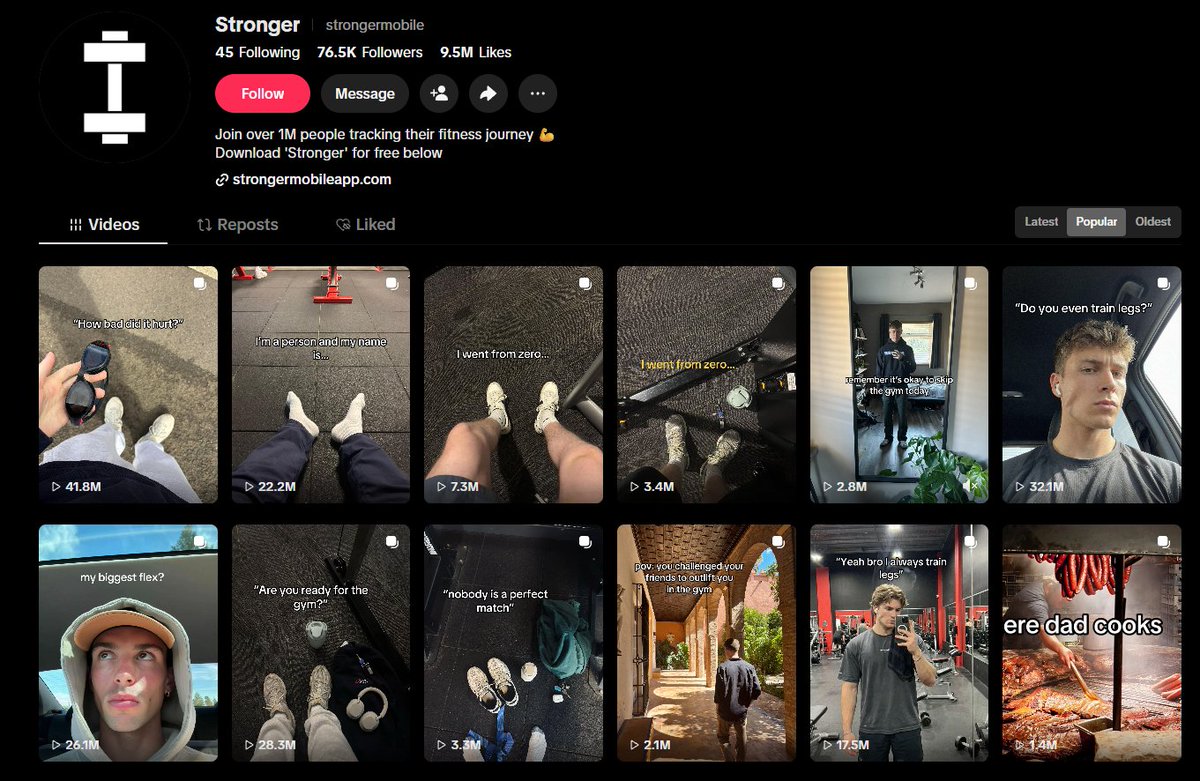 — "Slideshow account for a gym app called Stronger"
 — "Slideshow account for a women's safety brand"
I made a Notion where I dived deeper into some of these formats & gave some extra tips which you can access **here.**
4) The brief
This is one of the most important parts of your clipping campaign, so listen carefully.
The brief is the first thing a creator reads when they join your campaign. If it's not good enough the content produced will be low quality and your campaign won't reach its full potential.
Here's how it should look:
4.1) Creator Agreement
Before clippers start setting up accounts and other stuff for the campaign, you should get them to sign a creator agreement
You can make one with Tally and embed it within your brief in Notion
It can include things like:
- Your rights for using the content
- Minimum time for keeping content up on their pages
- Confidentiality for certain bits of information
- A non-compete so they don't create for competitors
4.2) Account setup guide
This will basically tell your creators how to set up their accounts so so they look authentic and real for viewers.
If your campaign is for your car app, you would want the account to look something like this.
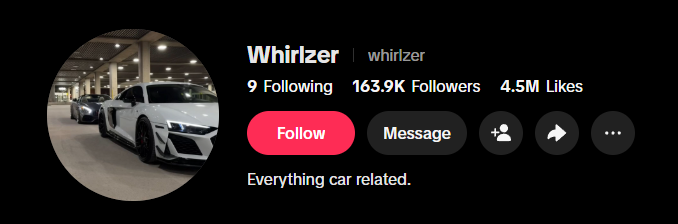 — "Car account on TikTok"
You can also ask the creator to link your app in their bio, it's completely up to you
4.3) Video Guides
It's always a good idea to include video guides in your campaign brief, these videos can go over things like
- How they can download and setup your app
- All the features in your app
- How to setup an account properly
- How to make content
- How to submit to the campaign & withdraw earnings
The more detail you go into, the more your creators will understand what to do and the content they make will be much better & go viral more often.
4.4) Content bank
You've already found your viral formats, now it's time to give your creators access to them
Make a Notion full of formats you found, with examples, music, structure and more
 — "Example Content Bank"
Your creators will use the viral formats and upload them at scale, generating you millions of views.
Make sure you keep updating this with trending formats, or it won't be as effective.
4.5) Content rules
This should be a section that tells creators what they can and can't do.
For example, creators aren't allowed to:
- Post more than 2 times a day
- Spam the same formats
- Present the app in a negative way
Keeping your creators in check will result in content that actually gets approved most of the time.
5) Launching your campaign on Content Rewards
Your brief is done and you're ready to launch your campaign.
There are two ways you can do this.
Launching with an agency
There are currently 1500+ active agencies on Content Rewards and they all have their own creators and systems.
Launching with an agency comes with lots of benefits, you get access to all their creators, they can make the brief for you, they will research content formats and make sure your campaign is successful.
Most of these agencies have already recruited thousands of creators who are ready to clip for your campaign, so you don't need to worry about finding creators.
Book a call here and we'll connect you with the best agency for your product:
https://cal.com/team/content-rewards/discovery-call
Self-fulfill
If you'd rather run everything yourself without an agency, you can self-fulfill.
Read about this in the next section.
6) How to self-fulfill a successful campaign
If you want to launch with an agency, you can skip to the next section.
But if you want to self-fulfill your own campaign, read this section for all the sauce.
6.1) How to find creators
When you run everything by yourself, the first step is to find creators. After launching your campaign, it goes to the Discover page of Content Rewards where creators will see it and join from there.
But you need to push harder if you want thousands of creators.
Here are the best methods to get them:
- Reddit (There are thousands of freelancing subreddits with people looking for simple jobs, recruit people from those subreddits and funnel them into a Discord server)
 — "Different Subreddits"
- Discord Affiliate (Pay people to funnel creators into your server, for example $10 per 30 invites)
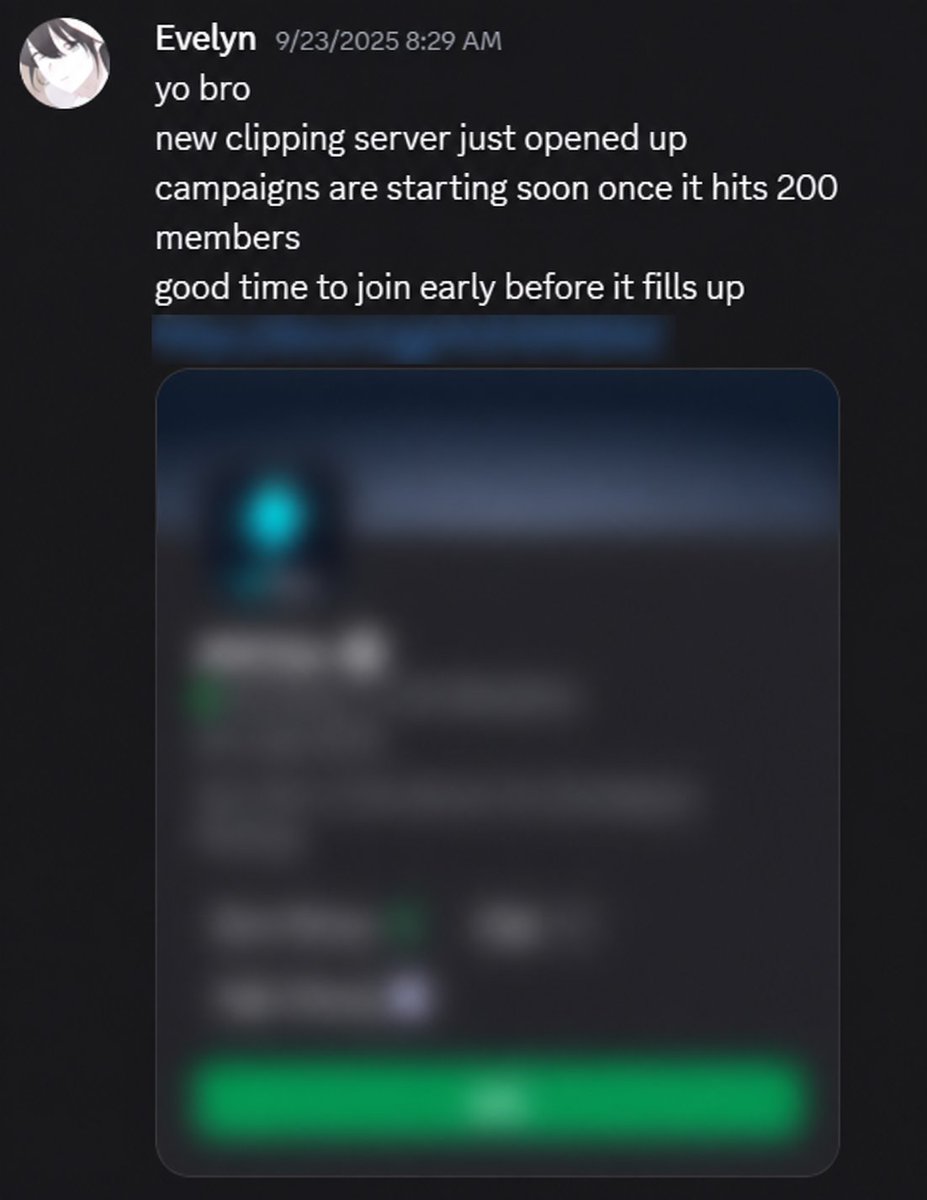 — "Affiliate DMs"
- Social Media DMs (Use tools to mass DM creators on TikTok, X, Instagram and more)
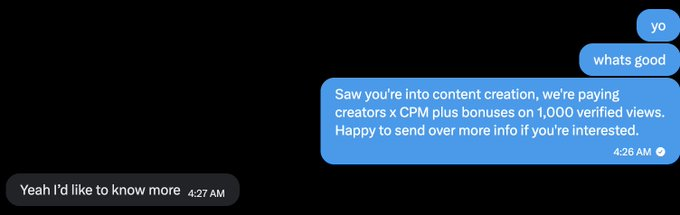 — "X outreach"
- Recruitment Posts (Post on platforms like X, TikTok and Instagram with something like "looking for creators" and funnel them to your Discord server)
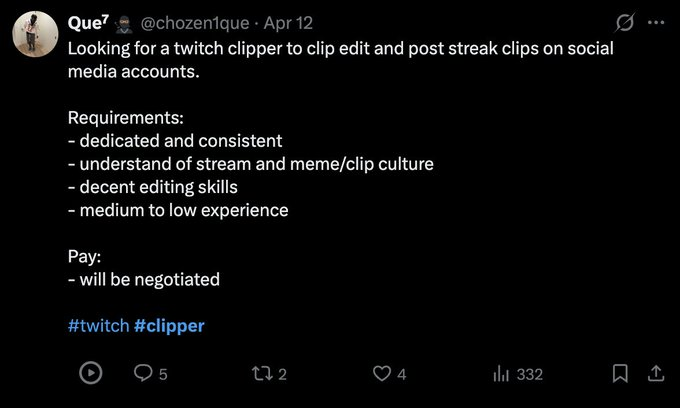 — "Recruitment Posts"
6.2) How to train new creators
Now you have a decent number of creators ready to post, you need to train them in the basics of clipping.
There are multiple ways to do this
The first thing I would do is record multiple video tutorials walking them through the basics like warming up, editing and posting.
 — "Content Rewards Academy"
I would also do daily or weekly live calls, where accounts get reviewed and clippers learn the latest meta for content.
 — "Content Rewards Live Calls"
And I would also make a mentorship system, where clippers can get mentored by experienced coaches.
6.3) Setting up your Discord properly
A good Discord makes onboarding easy for new creators, has a good amount of value for new creators and isn't too hard to navigate
Here are some important channels you need to have
- Start here (A channel that basically explains where everything is in the server and where to start from, this is the first channel new creators see)
- Campaigns (This channel will basically include all your active campaigns)
- Links (Includes your Whop link and any other important links you have)
- Academy + Calls (Includes all your video tutorials and a place where you can host live calls)
- Support (Clippers can open a ticket for mentoring or any sort of help they need)
- Chat, payouts and leaderboard (Clippers can talk to each other, flex payouts and try to climb the public leaderboard)
6.4) Reviewing submissions
Reviewing submissions is really important and you need to plan ahead for this.
You already made a brief with rules earlier, now is the time to use it.
Watch each video to the end and make sure it meets all the requirements you set. If it's fine you can approve it, if something isn't right you should reject it.
Always include a rejection reason for when you reject, this is so that the creator knows what to change.
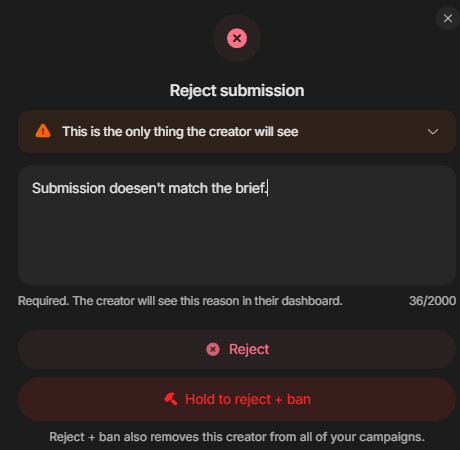
6.5) How to handle fraud and botting
Botting is where a clipper buys fake views or manipulates the view count so they can earn more money.
Luckily Content Rewards has advanced systems in place to detect this, all you need to do is set a policy for people who try to game the system.
When you are reviewing a submission, there is a small tab that says Bot Score. If the Bot Score is high, it's most likely that the view count has been manipulated.
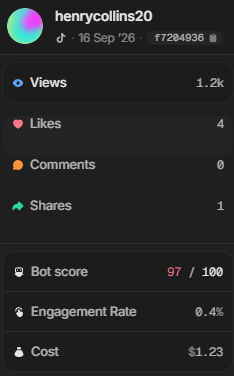
In my opinion the best move is to always ban botters, because if they bot once they are probably going to bot again.
6.6) How to keep creators active
A lot of creators give up after a few posts. This can be because they don't have motivation to continue or they aren't seeing any results.
There are a few ways you can keep them active:
- Weekly giveaways for active clippers, people will clip because they have an extra incentive to do so.
- Rewards for the top clippers on the leaderboard, more clippers will try to climb the leaderboard so they can reach the prizes.
- Bonuses after a certain amount of submissions or a certain amount of views, clippers will keep working so they can hit the bonuses.
- Keep updating the content bank, more formats will help the creators keep posting.
6.7) The team you actually need
Hiring people for certain roles is genuinely a game changer and will make your campaign 10x more successful.
Here are some of the roles that you should hire for:
- Campaign Manager (A campaign manager will manage the campaign for you and ensure it's successful. Someone who has gone viral multiple times before and generated thousands of dollars clipping would be a perfect fit for this role)
- Reviewers (You can hire reviewers who will accept and reject submissions for you, this role is pretty simple so anyone with basic clipping knowledge can do it)
- Coaches (These should be people who have generated millions of views on platforms like YouTube, TikTok, Instagram and more)
- Server Moderators (These people ban scammers, and keep the server clean of spam / unwanted stuff)
7) Setting your rates
A lot of brands mess up here, and making a mistake with these rates can impact your whole campaign
These are the three numbers you need to set
Your CPM
This is basically what you pay per 1000 views. Most campaigns do something from $0.50 to $2
But it can be as low as $0.05, it totally depends on the content.
 — "This campaign has a CPM of only $0.05!"
A general rule of thumb is, the lower the production barrier for your content is, the lower the CPM should be.
But if the videos are hard to make, the CPM should be higher.
The cap
This is basically the max amount on what any video can earn, and it's one of the most important numbers in any campaign.
Once a creator hits the cap, the views keep coming but you stop paying for the video.
I've seen a case where the cap was set at $750 and the RPM was set at $1.50. A clip reached 28.7 million views and got capped very early. Without the cap it would've cost $43,016 but the brand only paid $750 and got 28.2M views of free reach

The minimum view requirement (MVR)
This is basically the minimum views a post needs before it earns anything, usually set somewhere between 500 and 2000 views.
This filters out low quality submissions automatically, if a video can't reach the MVR you don't pay for it at all.
8) Demographic Requirements
This is super important if you want your campaign to convert, so listen up.
Views aren't all worth the same.
10 million views from a Tier 3 audience is worth less than 500,000 views from a Tier 1 audience.
Because people from Tier 3 countries often don't have the money to buy your product.
That's why it's so important to set a demographic requirement.
These are the requirements you should set:
Tier 1 audience percentage
The most common setting for this is 40%, that means at least 40% of the views come from countries like the UK, US, Canada, etc.
If the creator has most of the views coming from countries like India, you should reject.
Gender split
This only matters for certain products. For example, if the campaign is for a women's product, you should require a 40%+ female audience.
Blocking countries
You can choose to block videos that have views from certain countries entirely, I've seen a campaign that blocked anything with more than a 10% Philippines audience.
9) Funding & Topups
Most brands are funding their campaign completely wrong.
They start with one huge topup and they have no backup if the campaign flops.
The best way to fund your campaign is to start small and keep topping up
A GLP-1 app started their campaign with $4,000 and topped up five times over the next four months
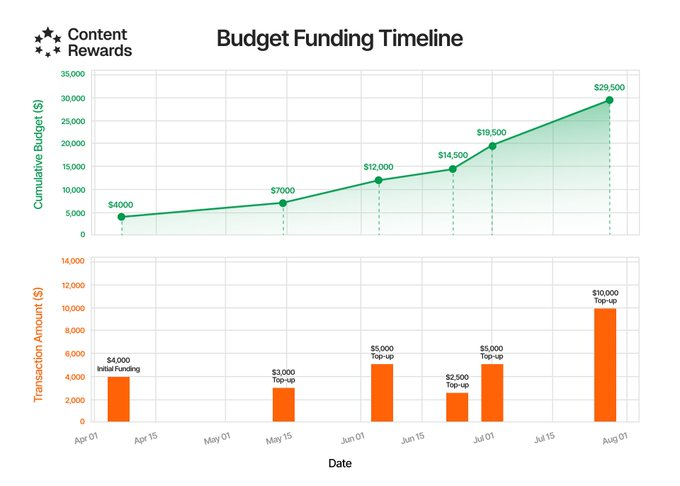
By the end, they'd funded $29,500 in total.
And their biggest topup came last after four months of testing, not first.
An agency called Reachify ran this campaign, you can read the full case study here:
Embedded post:
Author: Adam (@adamtwtz) Post ID: 2097073557868056925 Source: https://x.com/adamtwtz/status/2097073557868056925 Posted: 2026-09-07T21:24:32.000Z Reply to: none
Text:
> https://x.com/i/article/2097060822207909888
Why this works better
After the first campaign ends, you can tweak anything that didn't go well or needs improving. If creators got confused because of a certain part in the brief, you can change it or if creators weren't happy with the content rules you can also change it.
You can test out new things until you find the perfect combination, then you can topup a big amount.
10) Reading the signals
Once your campaign is live, the numbers tell you exactly what to fix. You just need to know how to read them.
Not getting many submissions?
This means your CPM is too low. Creators look at the rate and decide if it's worth it, if it's too much effort and your CPM just isn't high enough your submission volume will probably be low.
All you have to do is increase the CPM a bit to fix this.
Content quality is bad?
This means your creators don't know what good content should look like. And it isn't a creator problem, it's actually a training problem. Make video tutorials and host more live calls and it should be fixed.
Getting views but no conversions?
In this scenario there are two things to look at.
Your format -> the content might be good but you aren't plugging your product in correctly, test different formats until one generates better results.
Your CTA -> If people are watching but aren't clicking, your CTA is probably bad. Change it up and test different types until one works.
11) Conclusion
This article was a full guide to scaling your first creator program.
It was created based on the most successful campaigns and how they ran everything.
If you follow this correctly you are guaranteed to generate millions of views for your product with clipping.
DM me if you have any questions. I will answer all messages :)
Related articles

How I Make $20k/Month With Pixar Animations (and how you can too)
Every time I've made the most money in my life it came down to right time, right skill. AI Animations are exactly this to me right now
How to launch a one-person product (without destroying your life)
Over the last 5 years, I’ve helped launch products that went on to make multiple 7 figures in revenue per year.
the whop partner business model explained in 5 minutes...
every online business model is a trade between 3 things.