Mars men's full meta ads playbook (4,512 ads)

Mars Men has 4,512 ads live on Meta right now, on a Facebook page that only exists since December 2023.
Their most duplicated ad has been copied 306 times and has been running for 341 days. And every single one of their top 15 creatives has been duplicated more than 100 times.
The founder of a $100M pet brand brought them up on a podcast without being asked: "there's a brand called Mars Men who have an unbelievable journey. Smashed it."
Most brands look at that and conclude Mars Men found one great testosterone ad and threw money at it.
They did something stranger.
Mars Men barely sends anyone to its product page. The traffic goes through quizzes, pre-sell pages and "10 reasons" listicles, and those listicles are cloned for every type of guy they sell to and for every publisher they borrow trust from.
The ads are the part you see in the feed. The machine underneath is the part worth stealing, and I'm going to take the whole thing apart.
P&G Did This With Detergent
Walk down the laundry aisle in any American supermarket and you'll see Tide, Gain and Cheer sitting next to each other.
They all come from Procter & Gamble.
The shopper thinks they're choosing between brands. P&G already won the moment they walked into the aisle, because every box on that shelf is theirs, and each box is built for a slightly different buyer.
One product fighting for one spot on the shelf is a bet.
One product in ten different boxes is a system.
Mars Men does the same thing on Meta. One supplement, one checkout, and dozens of different boxes in front of it: a quiz for one guy, a blue-collar listicle for another, a page that looks like it came from a publisher he already reads.
Everything below is how they built it.
Layer One: The Product Page Gets Almost No Traffic
Here's the decision that shapes the whole account, and it's made before a single ad goes live.
The standard move is to send cold traffic straight to the product page. Nice images, reviews, a buy button. It works on people who already want the thing, and a cold guy scrolling past a testosterone ad at 11pm does not want the thing yet.
Mars Men put something in between.
TrendTrack shows 155 active ads pointing at one pre-sell page, /pages/boost-fb, and 120 more at a quiz, /pages/quiz-v6-eg. Their starter kit product page gets 26.
So the page most brands spend weeks designing is the page they send the least traffic to.
The quiz and the pre-sell page do the selling. The product page only has to take the order.
Here's the most duplicated ad in the account, and it's one of the many that never lands on the product page:
Layer Two: One Listicle for Every Type of Guy
The listicle is where it gets interesting.
Most brands build one "10 reasons" page and send everyone there. A 58-year-old guy running a plumbing company and a 34-year-old guy who lives in the gym read the same page, and it speaks to neither of them properly.
Mars Men clones it.
TrendTrack shows /pages/10-reason-handyman with 39 active ads, /pages/10-reason-modern-man with 53, and /pages/10-reason-peak-years with 55. Same product, same ten-reasons shape, a different guy on the other side of each page.
The ads match the page. One of their hooks: "He's 39, runs an HVAC crew. He takes three energy drinks before lunch." That guy lands on a page written for him.
And they run the same trick on angles, too. There's a listicle for cortisol, one for weight loss, and one built for the GLP-1 crowd, /pages/10-reasons-glp, with 41 active ads.
Here's their "which one are you" ad, which sorts the viewer into a persona in the first three seconds:
Layer Three: They Borrow Trust From Publishers
This is the layer that surprised me the most.
When you search TrendTrack for every advertiser pointing at mengotomars.com, you get 40 pages. Mars Men is one of them. Next to it are publisher pages like Bustle, The Dodo, New York Post, Thrillist and Rolling Stone.
The landing pages match those names. /pages/10-reason-thrillist has 37 active ads, /pages/10-reason-nyp has 32, /pages/10-reason-dodo has 29, and /pages/10-reason-chronicle has 110.
I'll be precise here, because it matters: I haven't pulled a single Mars Men ad from one of those publisher pages. What TrendTrack shows is the URL search returning those pages and the landing pages named after them.
But the logic is clear either way.
A guy who doesn't trust a supplement brand he's never heard of will read an article that feels like it came from a publisher he already scrolls past every day. The brand borrows the trust the publisher spent years building.
Here's their static built on the "modern environment" angle, the kind of message that reads like an article before it reads like an ad:
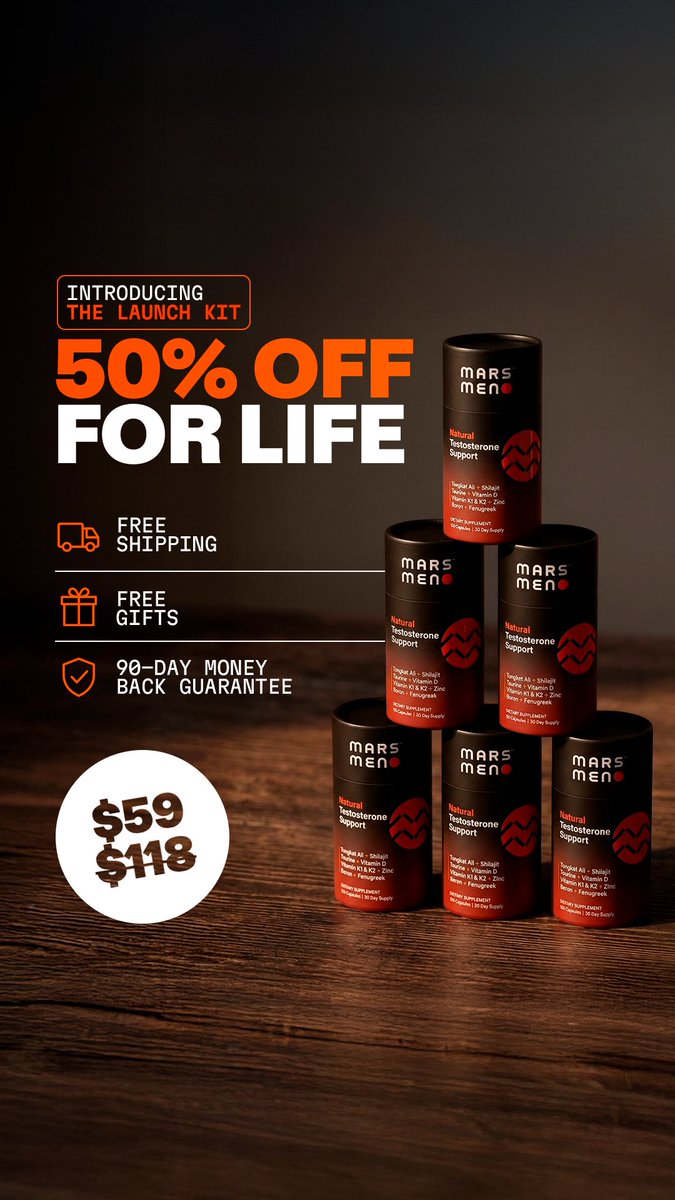
Layer Four: They Duplicate the Winner Instead of Replacing It
Most brands treat a winning ad like something with an expiry date.
It works for a few weeks, CPA creeps up, someone on the team says it's fatigued, and they go looking for the next winner from scratch.
Mars Men does the opposite. When something works, they copy it and push the copies out.
Their top ad opens on a story: "A random guy in a restaurant bathroom changed my entire perspective on testosterone." It has 306 duplicates and has been running for 341 days.
The second one, "I almost started testosterone injections until I found this", has 279 duplicates and 341 days.
The one running longest, "The problem with Marsmen? It works too well. Here are five downsides nobody's talking about", is at 426 days.
All 15 of their top creatives have 100+ duplicates.
That's the part people miss about volume. A lot of it is the same winning idea going into more placements, more ad sets and more containers, while the team keeps testing new ones next to it.
Here's the reverse-downsides ad, still live after 426 days:
Layer Five: They Picked an Enemy the Buyer Already Fears
Every strong account has an enemy. Mars Men picked TRT.
It's a smart choice, because the buyer is already scared of it. He's heard about the injections, he knows it's a commitment for life, and he doesn't want to shut his own body down.
So the ads say it for him.
"My doctor told me TRT was my only option but I wasn't ready to shut down my body's natural testosterone for life."
"I quit TRT, started Marsmen. Got leaner than I ever did on injections."
And the one with the number in the hook: "my testosterone went from 298 to 847 without a single injection here's what i did." That ad has 303 duplicates and has been running for 375 days.
They even built a landing page around the fear itself, /pages/trt-nervous, with 27 active ads.
The enemy does two jobs at once. It explains why the guy hasn't fixed this yet, and it makes the natural option feel like the safe one.
Here's the 298 to 847 ad:
Layer Six: A Person Next to the Brand
The brand page isn't the only face running the ads.
TrendTrack shows a page called Benjamin Smith, with 1,217 likes and 255 live ads, pointing at the same quiz and the same starter kit.
A page with a person's name on it reads like a guy sharing what worked for him. A brand page reads like a brand selling something. Same ad, different messenger, and a different reaction in the feed.
They do the same with authority inside the creative. One of their ads opens with "I won a world natural bodybuilding title. I ran multiple hundred mile races, never touched TRT. Here's what I actually use." It has 111 duplicates and 117 days live.
Here it is:
Layer Seven: The Retention Is Built Into the Box
This is the layer you can't see in the ad library, and the Wuffes co-founder is the one who pointed it out.
His words: "They do something so cool with the packaging... inside it they have a 90-day checklist. So you're supposed to take it every single day... It comes free with a health app." The app pushes you into the gym and sends recipes.
Think about what that does to the second order.
A supplement you take and forget about gets judged on how you feel in two weeks. A supplement that comes with a 90-day checklist and a gym habit gets judged on how you feel after three months of training and eating better.
The product gets credit for the whole lifestyle change.
Their product page claims 4,130 reviews and a 12-week triple-blind study. I haven't verified either, but it tells you how much they lean on proof at the bottom of the funnel.
And it closes the loop on the ads: a guy who actually changes becomes the next "I quit TRT" or "298 to 847" story.
Here's the "I quit TRT" ad:
The Objection Every Brand Owner Raises Here
"They have a huge budget. I spend $50k a month."
Fair. And mostly irrelevant.
Strip the Mars Men machine down and there are four mechanics you can copy on a fraction of the spend:
Put a page between the ad and the product. A quiz, a pre-sell page or a listicle. Let that page do the convincing so the product page only has to take the order.
Clone the page for each buyer. Take your best listicle and rewrite it for your two or three strongest personas. Same product, same shape, a different person reading it.
Duplicate winners before you replace them. When an ad works, copy it into new ad sets and new containers, and keep testing new concepts next to it.
Pick one enemy your buyer already fears. For Mars Men it's TRT. For a skincare brand it might be a procedure, for a pet brand a vet bill. Name it, and make your product the safer path.
A brand at $50k a month can run all four. The version at $50k looks different from the version at 4,512 ads, and the mechanics are identical.
The Second Objection: This Takes a Lot of Volume
Yes, it does.
Mars Men is running 4,512 live ads, and their best ones have been live for close to a year. That didn't happen in a month.
But look at where the volume actually comes from. A big part of it is duplication of ideas that already won, and new landing pages for the same idea. That's a lot cheaper than inventing 4,000 new concepts.
The Wuffes founder said the same thing about his own account: last year they didn't test enough, and "if you don't have enough volume, you just get crushed so quickly."
The brands that stop at five ads a month usually have a good enough strategy. What they're missing is the volume to let it work.
What This Actually Costs
The Mars Men account is hard to copy because the ads sit on top of quizzes, persona listicles, borrowed trust, duplication and retention, all running at the same time.
Copying the ads gets you ads.
For a brand spending $50k to $500k a month, the realistic version is narrower and still demanding. One enemy. Two or three personas, each with its own listicle. A quiz or pre-sell page in front of the product. New concepts every week, and every winner duplicated into new containers. A weekly review of what scaled and what died.
Run that for 90 days before you judge it.
Most brands run it for two weeks, see one bad week, and go back to sending everyone to the product page.
The playbook is sitting in the ad library for anyone to read. The constraint was never the information.
Related articles

How I scaled two apps to $240,000/yr with paid ads
My first app made $20,000 in a single month after I did this one thing:

the $1,000,000 "youtube + bing + google" opportunity
every ecom brand owner i talk to says the same thing.