Run a team of AI Employees
You Are a Manager of Agents Now
Ryan Carson has been a founder for 25 years. His last company, Treehouse, grew to 110 full-time employees and taught a million people to code.
His current company has one employee. Him.
It ships 22 to 25 pull requests a day. Sometimes 40. Revenue is on track to 4x this month, and he is about to hire his first people.
The company is Untangle, an AI divorce agent for family law firms. He does more than half the work from his phone.
Here is his system.
The job title everyone just inherited
Ryan's framing: you are a manager of agents now.
Founder, IC, VC, college student, stay-at-home parent. Same role going forward.
The counterintuitive part is what that does to your skill set. Most people assumed being technical was going away. Ryan says the opposite happened to him: he is more technical now than at any point in his life.
You have to understand what Postgres is. Production versus dev. Migrations.
You learn all of it by managing the work.
His analogy from the episode: robot carpenters still need a carpenter. You know where the nail goes and how to make the cut. That is why you can manage them.
Being a very good engineering manager is now one of the most valuable skills you can teach yourself.
Step 01: Move your work to the cloud

Local development has a hard ceiling. You set up your database, your auth, your dev server, all on your Mac. Then you want to do two things at once.
Now you need git worktrees, or a second copy of your entire codebase in another directory.
Three things at once? Five? Ten? The whole approach falls apart.
How cloud agents solve it:
Click a button. A virtual machine spins up in the cloud with your dev environment already inside it.
Open a browser, click new session, get a fresh VM. Do it again. And again.
You can create as many as you want, and the code never collides.
Ryan runs at least 5 cloud agents at once. Often 10.
His words: "If you are working locally, I honestly think you are a caveman."
The one exception: heavy front-end work. A brand new feature with a lot of UI. Spin up a local agent, do the light wireframing, then move it to the cloud and let a cloud agent take over.
He uses Devin, built by Cognition, and calls it one of the best software factories in the industry. Not cheap. Good.
Security rule that comes with this: keep your production write keys in 1Password and out of agent hands. Production writing is dangerous and your agents will eventually do something bad. Set it up so the agent asks you for the key, then you paste it into the session and you both know exactly what is happening.
Step 02: Build a cadence before the volume breaks you
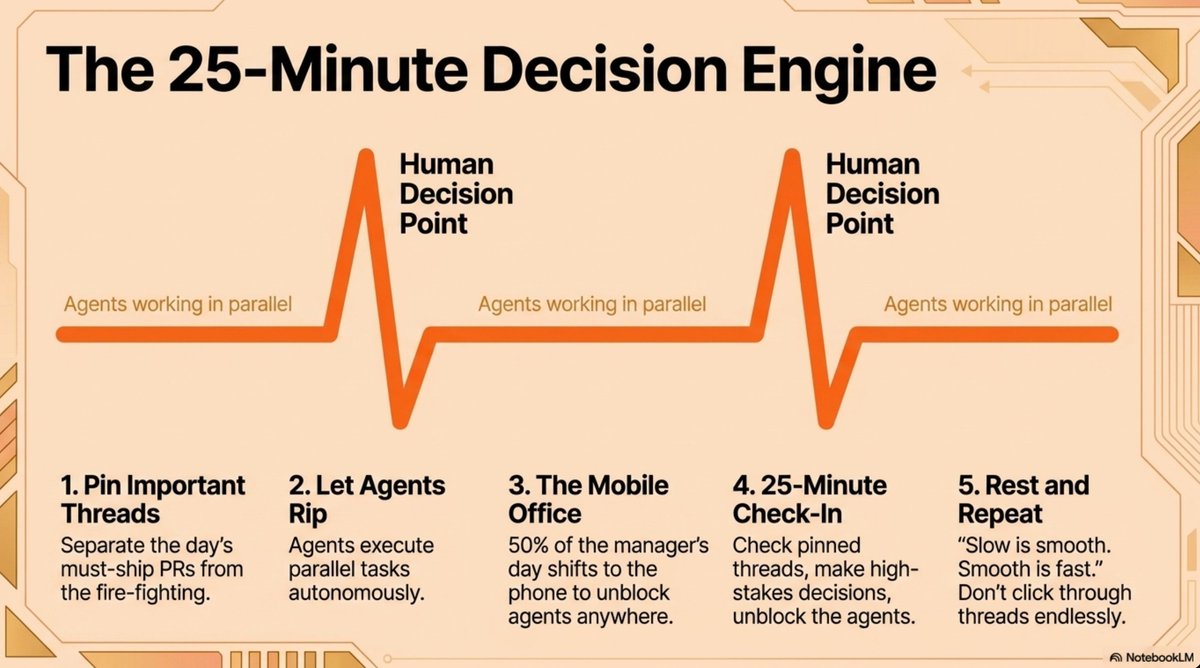
Fifty times the output means fifty times the decisions.
The old world gave you two or three high stakes decisions a day. An important meeting, a couple of calls, and the work happened over the next two weeks.
The new world hands you 10 to 20 before lunch.
Ryan's system:
Sort your agent threads into two buckets. The big important things shipping today, and everything else.
Pin the important ones. Let the rest run and get back to them.
Check your pinned threads on a timer, roughly every 25 minutes. The gap is the point. It is the only thing keeping you from clicking through threads until you are wiped out.
Write the day's must-ship items down on paper. Ryan uses an analog to-do list (UG Monk) for exactly this, because 10 of the day's PRs will be fires and fires are very good at eating your attention.
Slow is smooth. Smooth is fast.
The honest part: Ryan says you will work more, not less. He compares it to a back muscle you never had to exercise before. It turns out to be the most important one you have.
Step 03: Turn recurring checks into automations

Anything you would normally handle in a weekly meeting or a daily review becomes an automation.
The instruction is simple. Start a session and tell your agent to run this task every X days.
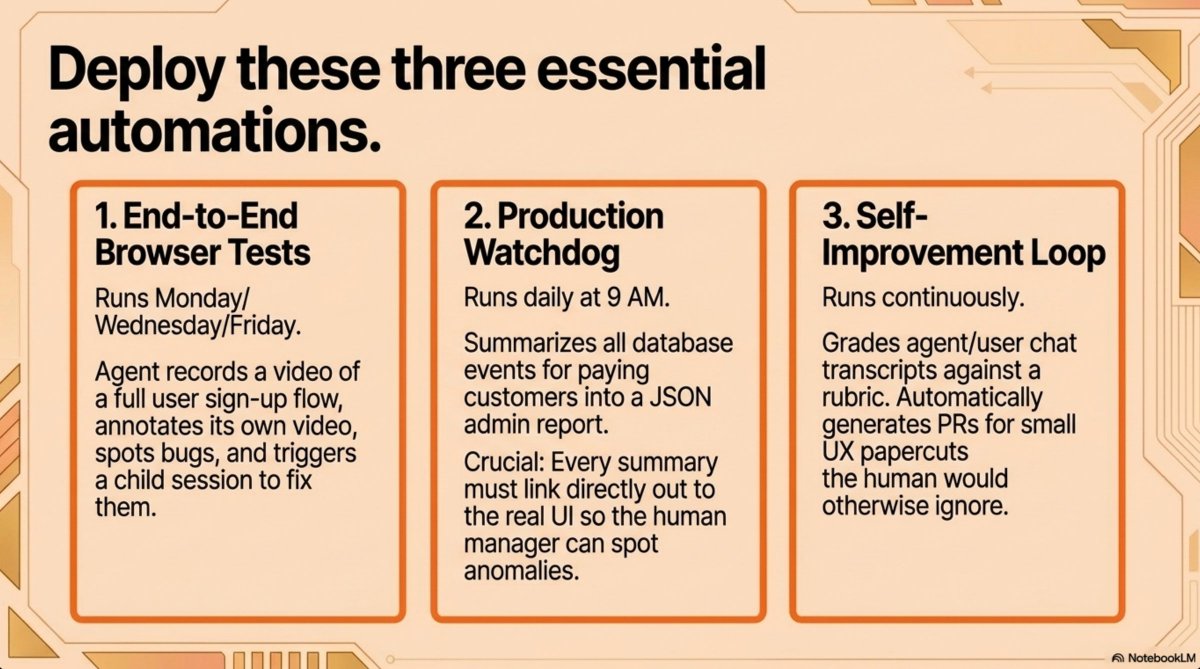
Automation 1: End-to-end signup test
A browser agent signs up for Untangle, creates a case, onboards a client, and walks through discovery. Basic user testing, fully automated.
It runs Monday, Wednesday, Friday. Three times a week, because it costs roughly $60 in tokens each run.
The browser testing loop is the interesting part: the agent records a video of the session, annotates it, watches its own video, and fixes the bugs it spots.
When a test fails, it triggers a child session to fix it.
Automation 2: Production watchdog
Every day at 9am, an automation reads every event in the database for paying customers and summarizes it into a JSON file that lands in the admin panel.
Ryan reads it with coffee. It works like a chief of staff walking in and telling you what your customers actually did yesterday.
Critical detail: each item links out to the real UI, so he can click through and watch what the customer was doing.
That is where the value lives. A human spots "that's weird" in about a second, and several times that click has revealed a user experience the agent built that was different from what he assumed.
Automation 3: The self-improvement loop
Untangle has an agent named Grace, a paralegal. She talks to attorneys, paralegals, and clients going through a divorce.
Every day, an automation reads those conversations and grades them against a rubric. Anything scoring below the bar kicks off a child session to fix it.
Ryan ships about three of these fixes a day.
Most of them are small UX paper cuts he either would never have found or would have skipped. The agent already found it, already opened the PR. He just ships it.
The pattern underneath all three:
Automation → detection → triage → child session → PR → your review
Then answer the question that kills most automations: how will you know when it fires? Ask your agent. It will suggest posting to Slack, connecting an MCP, whatever fits. Build that part too, or your automation is running in a room with nobody in it.
One thing to keep for yourself: using your own app. Ryan still clicks through the entire product himself on a regular schedule. There is no substitute yet, and there won't be for a while.
Step 04: Get your token bill under control

Ryan spent about $20,000 on tokens last month. His own verdict: too much, not viable.
His estimate for where real engineering work settles: around $5,000 per employee per month.
Past that number, you need model routing.
How routing works in practice:
Use the right model for the right task. His reinforcement loops run on a cheap fine-tuned coding model Cognition built specifically for this, which runs roughly $5 a session.
Same idea for parent and child sessions. Run one premium model thread as the manager, have it spin up child sessions on a cheaper model, and keep the expensive model for the thinking.
The structural argument:
If your entire engineering motion lives inside a frontier lab's product, you are betting on a company that is not incentivized to make your costs reasonable in the long run.
Independent agent labs compete on giving you the best result for the lowest price. That is their whole business. They will do the hard routing work for you.
When to switch:
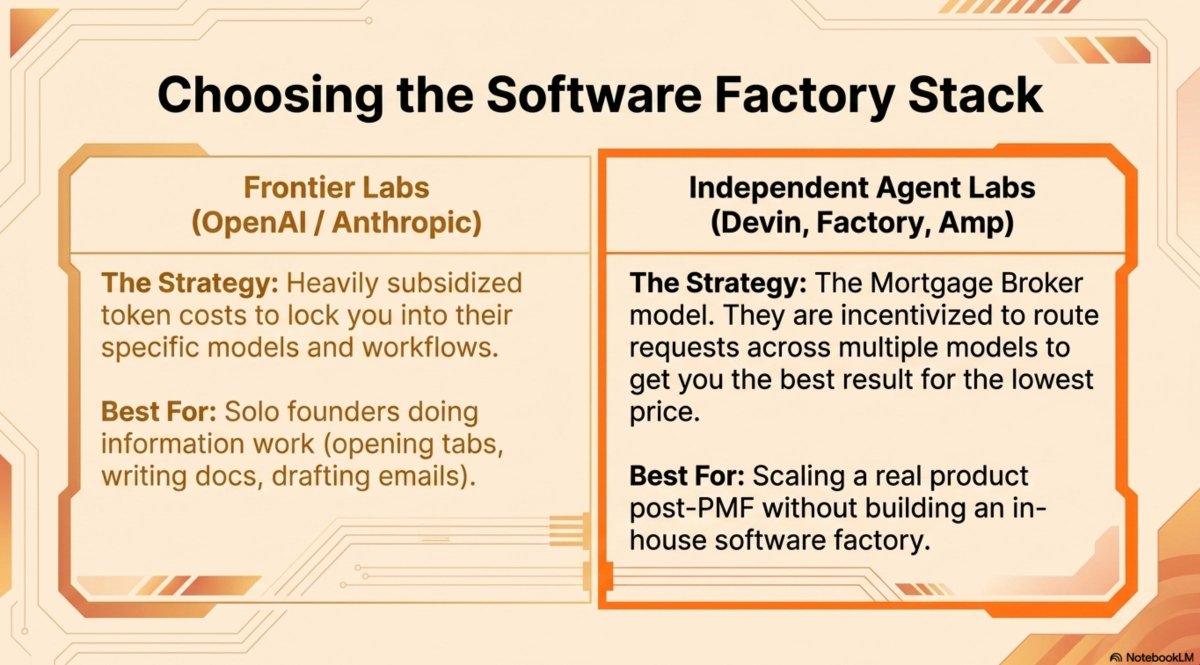
One person building something for yourself? A $200 a month frontier lab plan is fine.
Real product, product market fit, hiring people? You need a software factory, and it should sit on an independent lab. Ramp built Inspect in-house because they hit the size where you have to. You probably have not.
Ryan still uses Codex daily for information work: opening browser tabs, creating docs, checking email. The tokens are heavily subsidized and the Mac app is beautiful. He just refuses to build the company's software factory on it.
Step 05: Share what you're learning in public
Ryan's third takeaway has nothing to do with tooling.
Twenty years of writing on X still pays him dividends. The algorithm rewards articles. The relationships compound.
He was on this show because of a relationship built entirely over X.
It does not have to be polished. You know more than you think.
Greg's example: Sahil Bloom worked in private equity, started writing about finance topics during COVID, and wrote them like Wikipedia articles built for Twitter. He was learning in public, saying "here's the thing I'm learning."
Over a million followers. A New York Times bestselling book. Companies. A fund.
If you don't know something, say you don't know. Then go ask an agent.
The checklist
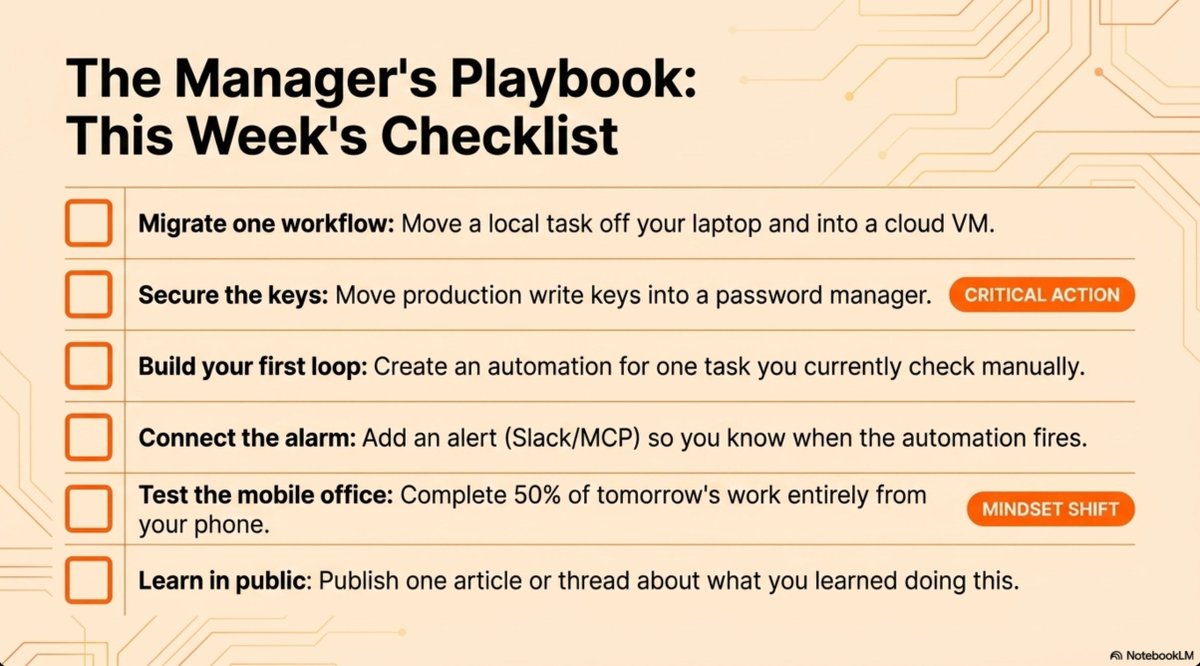
- Move one workflow off your laptop and into a cloud VM this week
- Get your prod write keys into a password manager and out of agent reach
- Pin your two or three most important threads, check them every 25 minutes
- Write the day's must-ship items on paper
- Build one automation that watches something you currently check manually
- Add the alert so you know when it fires
- Do 50% of one day's work from your phone
- Publish one article about what you learned doing it
The part nobody says out loud
The agents are going to write your code, review your code, and ship your code.
Your job is deciding. All day, at a pace you have never worked at, half of it from a screen the size of your hand.
Ryan expects all of this to change again in three to six months.
Which means the only durable skill is getting your reps in now.
Related articles

Stop stacking apps. Build a personal control plane for life, ventures, and work
Most ambitious people do not fail from laziness. The usual failure is a flat system.

Full Guide: How to start a profitable one-person business (in 2026)
*"It is possible now to start a one-person company that would be worth more than $1 billion."*

How We Generated Millions Of Organic Clicks With Programmatic SEO
most SEO looks like this: