The Language Arbitrage: Dubbing Viral Videos Into Markets Nobody Else Has Touched

$6,400 last month. One voice clone. Zero original ideas.
A video that pulled 4M views in English has probably never been seen by the 500M+ people who speak Spanish, Portuguese, or Hindi. Nobody dubbed it. The hook already worked once. It just never crossed the language line.
That's the whole business: find a video that's already proven, move it into a market that hasn't seen it, publish before anyone else does.
Why This Works
Virality is language-locked, not idea-locked. A hook that stopped the scroll in English stops the scroll just as hard in Portuguese, if it arrives first.
The algorithm treats a dubbed video as new content in that market. You're not competing with the original. You're not even competing with anyone, because nobody else made the trip yet.
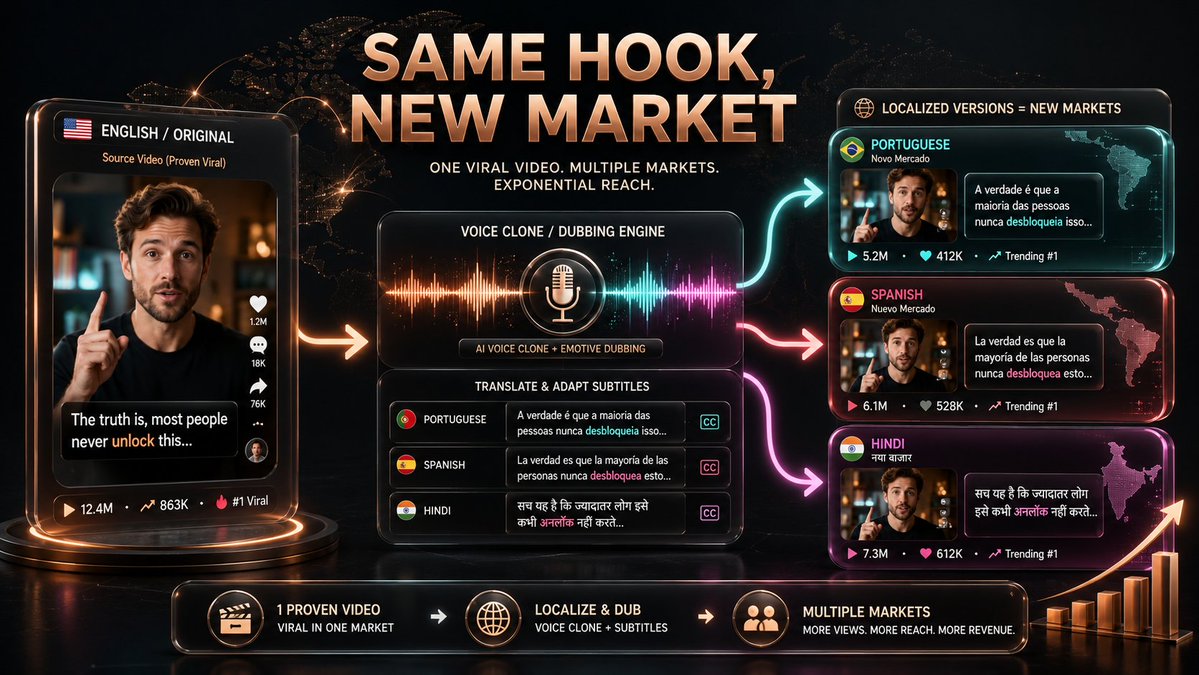

The Stack
Research → ElevenLabs Dubbing → CapCut → Make → Views
find the gap / clone and dub / polish and caption / publish and track
Three tools. The research decides everything before any of them open.
Step 1 - Find the Gap
Track outlier videos the same way you'd scout any viral format: log anything pulling 10x a channel's own average into a sheet, daily, in whatever source language you're pulling from.
For each outlier, run the on-screen hook through Claude for a literal translation, then search that exact phrase on the target platform, in the target language. You don't need to speak it. You need the search bar.
Match the platform to the language, not the country: Douyin and Xiaohongshu for Chinese-speaking audiences, YouTube Shorts and Instagram Reels for Brazil and the rest of Latin America, ShareChat and Moj for Hindi.
Zero close matches in the first 20 results means the gap is real.
Worked example: a fitness-transformation video pulled 2.1M views on a US TikTok account that averages 180k. Score: 12. The same hook, translated and searched on Brazilian TikTok, returned nothing within 3 scrolls. That's a market, not a coincidence.
Step 2 - Clone and Dub
ElevenLabs Dubbing Studio takes the source video, transcribes it, translates it, clones a voice that matches the original's tone, and lip-syncs the result. One upload, one language selection, one export.
Step 3 - Polish in CapCut
Add native captions in the target language, trim any pacing the dub made awkward, and adjust the hook text on screen so it reads instantly in the new language.
Step 4 - Publish and Track
Make posts the dub to the target platform, tags it by source video and language, and pulls the view count back after 48 hours. Whatever crosses 10x its market's baseline gets a second and third language added next.
10 to 15 dubs a week, split across 2 to 3 target languages, is the pace behind the numbers below. One outlier found, three languages dubbed, is 3 shots on goal from one piece of research.
How You Make Money
Platform payouts in the new market - the dubbed video earns exactly like an original would, in a market with less competition for the same attention.
Localization-as-a-service - creators who already went viral once want the same hit in 3 more languages. You charge per language, they keep 100% of the original market.
A multi-language channel network - one source library, five language channels, all running from the same research.
The Numbers
Assumes 10 to 15 dubs a week once the pipeline is running.
Month 1: $400-900
Month 2: $1,200-2,200
Month 3: $2,500-4,000
Month 6: $6,000-9,000
The Cost
ElevenLabs (Dubbing): $22-99/month
CapCut Pro: about $15/month
Make Core: $9/month
Total: under $130/month in. A market with zero competition out.
The Bottom Line
Most people are still trying to make a video nobody's seen before.
This runs on the opposite bet: find one the world already loved, and be the first to say it in a language nobody translated it into yet.
Comment "DUB" and I'll send the exact ElevenLabs settings and the Make scenario.

Prompts
> Translate and dub this video into Brazilian Portuguese.
> Match the original speaker's pacing and tone. Keep the
> voice warm and casual, not corporate.
> Preserve any jokes or hooks in the first 3 seconds, even
> if the literal translation doesn't land the same way.
Related articles


How I Semi-Automated 650k+ Views on Instagram In 30 Days With Fable 5
I made an entirely new Instagram and TikTok account last month and ran them both up to 650,000+ impressions in less than 30 days. I did this with a really unique combination of clipping, Fable 5, Pos…

$31,211/month selling testosterone to Clavicular's fans. 6 Claude prompts replaced a $5K/month team
4%, generate 3 variants of that hook and add to queue.