the full AI meta ads creative blueprint (fable 5 + meta API + higgsfield MCP)

this is the internal document we use to run creative production across every client account. i'm publishing the full workflow because the value is in execution, not secrecy. reading this without implementing it produces nothing. implementing it changes your output speed by 10x.
four stages. each one feeds the next. every tool in the stack has a specific job at a specific stage. nothing overlaps.
here's the full blueprint.
stage 1: research and angle discovery (opus 4.8 + meta MCP + cowork)
the creative production process starts with research, never with ideation. ideation without data produces the most average version of an ad for your category. research with data produces angles your competitors haven't found yet.
tool: opus 4.8 in cowork mode with the meta MCP connected.
cowork gives opus 4.8 the ability to browse, search, and pull structured data from external sources while maintaining full session context. the meta MCP gives it read access to the live ad account: campaign structure, creative performance, audience signals, cost metrics.
the research session runs three passes:
pass 1: account performance analysis
pull performance data for all active creatives in this account
over the last 14 days.

for each creative, extract:
- hook category (from naming convention: AUTH, CONT, PAIN,
  PROOF, MECH)
- format type (SELF, HEAD, STAT, UGC, SPLIT, NATIVE)
- CTR, thumbstop rate, CPL, ROAS, frequency
- daily trend (improving, stable, declining)

aggregate and report:
1. which hook categories produce the lowest cost per qualified lead
2. which format types produce the highest thumbstop
3. which creatives are showing fatigue signals
4. which buying triggers have never been tested
pass 2: competitive landscape scan
search the meta ad library for [competitors and category
keywords].

for each competitor with ads running 30+ days:
- categorize by format type and hook category
- identify the buying trigger underneath each ad
- flag angle gaps: buying triggers nobody in the category
  is currently testing

then search negative reviews for the top 5 competitors:
- extract specific complaints, group by theme
- rank themes by frequency

output the competitive gap analysis and the pain themes.
pass 3: angle brief generation
cross-reference three datasets:
1. account performance (which triggers work, which don't)
2. competitive research (gap angles + pain themes)
3. ICP deep extraction (buying triggers from offer engineering)

generate a prioritized angle brief:
- top 20 angles ranked by priority score
- for each angle: the buying trigger, the recommended format
  type, the awareness stage, and a 1-line hook direction
- flag which angles are untested, which are filling competitive
  gaps, and which are tapping pain themes from reviews
the output from stage 1 is the angle brief. every creative produced in stages 2 and 3 is built from this brief. no creative gets produced from imagination.
stage 2: asset production (higgsfield MCP)
the angle brief specifies what to produce. the higgsfield MCP specifies how to produce it.
tool: higgsfield MCP connected to claude, routing to seedance 2.0 (video) and chatgpt images 2.0 (statics).
the production workflow for each creative in the batch:
for video creatives:
step 1: start with a real image. the founder, the product, the office, a client result. upload it as the reference.
step 2: use chatgpt images 2.0 through higgsfield to enhance the reference: clean background, adjust lighting, add text overlay if the angle needs one. the real photo stays underneath.
step 3: feed the enhanced stills into seedance 2.0 as reference images. generate the video: 15-second format, synced audio, camera direction specified (dolly in, truck left, handheld follow).
step 1: use chatgpt images 2.0 to create 2-3 enhanced still
frames from this real photo:
- frame 1: hero shot with subject in focus
- frame 2: lifestyle context
- frame 3: result visualization

step 2: use seedance 2.0 to turn these enhanced stills into
a 15-second video ad.

use enhanced stills as @image reference inputs.
script: [paste from the angle brief]
camera: [specify based on format type]
aspect ratio: 9:16 for stories, 1:1 for feed
resolution: 1080p
audio: narration synced to the visual
for static creatives:
using chatgpt images 2.0 through higgsfield, create:
- the visual layout matching the assigned native format
  (iMessage thread, apple notes, google search results,
  before/after comparison, etc.)
- text content matching the hook and angle from the brief
- brand colors: [specify hex codes]
- resolution: 4K
- aspect ratio: 1:1 for feed, 9:16 for stories
for AI UGC creatives:
using seedance 2.0 through higgsfield:
- generate a UGC-style video with character consistency
- script: [from the angle brief]
- setting: [match the ICP's environment: home office,
  kitchen, car, gym]
- aesthetic: native phone-camera feel, slightly shaky,
  natural lighting
- audio: narration synced to lip movement
- duration: 30-60 seconds
- aspect ratio: 9:16
production speed: a full 20-creative batch takes 5-8 hours through this pipeline. the equivalent human production pipeline takes 8-13 days. the speed advantage compounds every 2-week refresh cycle.
if you want the exact higgsfield MCP setup commands and the full production prompt library, DM me "META" and i'll send the documentation.
stage 3: copy and hook refinement (meta MCP context)
the creatives from stage 2 have scripts. stage 3 refines those scripts against what the algorithm is currently rewarding in the account.
tool: sonnet 5 with meta MCP connected, using the account performance data from stage 1.
review the scripts for all 20 creatives in this batch.

for each script, cross-reference against the account
performance data and refine:

1. does the hook match the hook categories producing the
   lowest CPL in the account? if not, rewrite to align.

2. does the awareness stage match where the best-performing
   creatives are currently targeting? if a mismatch, adjust.

3. anti-slop audit: flag any lines that sound generic,
   corporate, hedged, or AI-generated. rewrite with
   specificity and conviction.

4. read each script out loud. flag anything that sounds
   like recitation instead of conversation. rewrite.

5. verify the CTA matches the offer structure from the
   briefing document.

output the refined scripts alongside the originals for
comparison.
the refinement pass takes 1-2 hours. the output is the final creative batch ready for launch.
stage 4: launch, monitoring, and iteration (fable 5)
the final creative batch from stage 3 gets loaded into the account. fable 5 takes over from here.
tool: fable 5 as the media buying and performance monitoring layer.
launch protocol:
- upload all creatives into the testing campaign (ABO, broad targeting)
- naming convention applied to every creative: [HOOK]-[FORMAT]-[AWARENESS]-[BATCH#]-[VARIANT#]
- 72-hour hands-off period. no changes, no adjustments, no panic-checking.
monitoring cadence (automated by fable 5):
- every 4 hours during peak spend windows: fatigue signal check across all active creatives
- daily: performance aggregation by hook category, format type, and awareness stage
- day 5-7: first evaluation. identify the top performers and the clear losers.
- top performers: move to the scaling campaign with 20% budget increases every 2-3 days
- clear losers: pause and add to the "tested/failed" log for the next angle brief
- middle performers: leave running through day 14 before final evaluation
iteration protocol (automated by fable 5):
when a winning creative starts showing fatigue signals, fable 5 triggers the format rotation: same buying trigger, different format type. the replacement comes from the backup creative library (minimum 10 ready-to-deploy creatives, refreshed every 14 days).
fable 5 logs every decision with full metric context in a timestamped decision log. the log gets reviewed by the human auditor each monday morning.
the feedback loop:
fable 5's performance data from this batch feeds directly back into stage 1 of the next cycle. which hook categories performed. which format types won. which buying triggers showed promise. which awareness stages produced the highest lead quality.
the intelligence compounds cycle over cycle. each 2-week batch is informed by every batch that came before it. the account doesn't reset. it learns.
the full stack, mapped
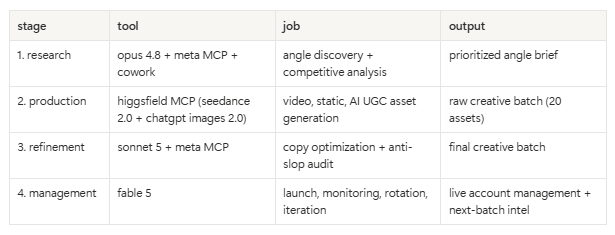
four stages. four tools. each one does one job. the output of each stage feeds the input of the next. the cycle repeats every 2 weeks.
if you want us to audit your service business and show you how we'd implement this exact 4-stage creative blueprint on your meta ads account, DM me "META" and we'll map the full stack.
($10M+ generated for service-based businesses through meta ads funnels, fully done-for-you)
zack
Related articles

how i automated my entire meta ads management with claude (the exact system)
claude wired into the ad account through the autoady MCP

how i write KILLER ad copy with sonnet 5 + meta MCP
most people write ad copy by staring at a blank screen and guessing what might work.
how i cook $100M+ meta ads offers with sonnet 5
the number one variable in your meta ads account is not the creative. it's not the targeting. it's not the budget.