The AI Listing Glow-Up Factory: $12,900 a Month Staging Real Estate and Airbnb Homes.
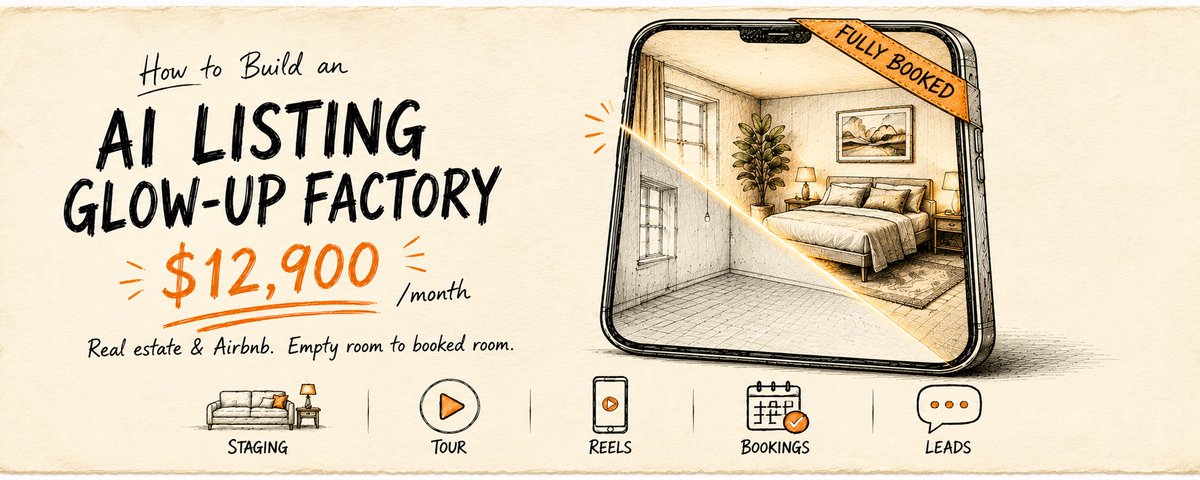
Most short-term-rental listings look dead, and a dead listing bleeds bookings every week it sits. Fixing the look now costs about a dollar a room, and hosts pay hundreds to have it done for them.
$12,900 a month. Six tools. Directed about eleven hours a week.
That is the modeled ceiling for one operator running a full book of short-term-rental hosts and a few agents. Every one of them already knows their photos are the reason bookings stall, and none of them want to reshoot.
Who pays it: the Airbnb host whose beach condo has looked the same since 2021, the couple running three cabins off one calendar, the agent with a stale listing that will not move. Every US market has a stack of them, and every one is one better photo away from a booking they are currently losing.
The money, up front
You scroll for the number, so here it is before the how-to. The per-unit rates that build the ceiling:
And what a single job clears, built from those rates:
That is one listing. The $12,900 is a full book of them, and the honest floor further down is how long that book takes to fill.
Why hosts are the buyer that comes to you
Most AI-money niches make you build a case for why anyone should care. This one hands the host proof before you say a word. You take one bare or badly lit room from their listing, run it through staging, and send back the same room warm, furnished, and shot like a magazine. The before-and-after does the selling. A host looking at their own space transformed is already sold, and all that is left is the price.
The economics land instantly because the host already understands them. Airbnb's own data shows about 85 percent of hosts who pay for professional photos cover that cost with a single night's booking. So a $300 job that lifts the listing to the top of search pays for itself before the week is out, and every booking after that is upside. The host is not buying pretty pictures. They are buying the difference between a calendar that fills and one that sits empty at 40 percent occupancy.
Agents are the secondary buyer, and they buy for the same math on a bigger number. A staged listing sells faster and closer to asking, and a virtually staged photo runs about a dollar to produce against a $39 median market rate. But hosts are where the volume lives, because there are more of them, they turn over their look every season, and they book you again the next time they add a property.
What the factory actually sells
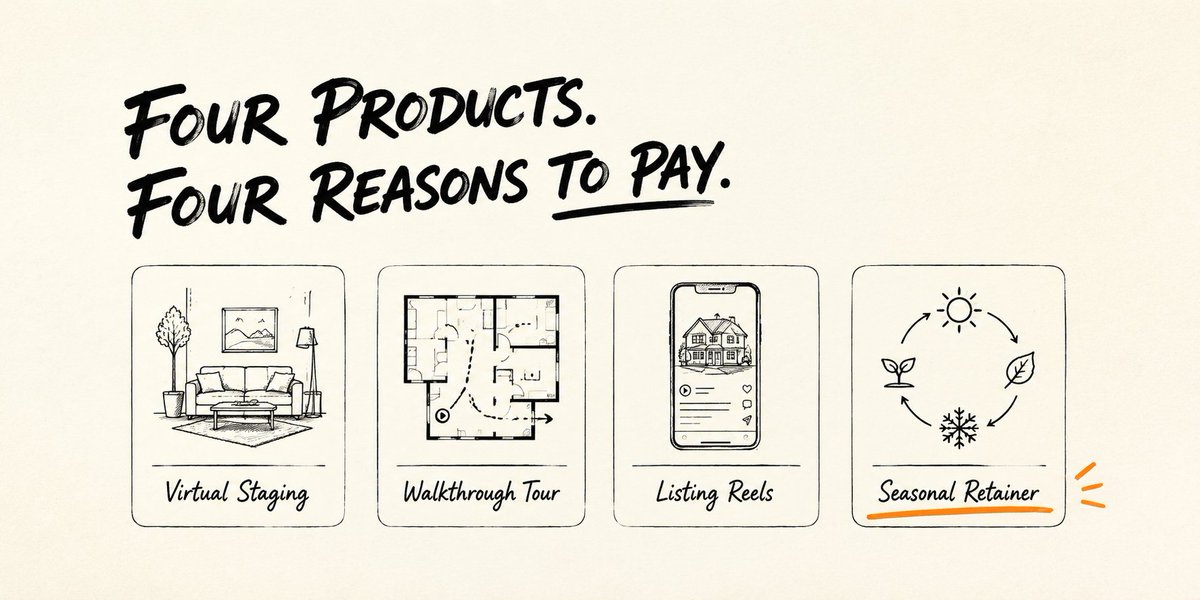
Four products, one pipeline. Each fixes a different weak spot in a listing, and they stack onto the same client.
Virtual staging. The core product and the one that opens every door. You take an empty, cluttered, or dated room and return it furnished and styled, photoreal, keeping the actual walls, windows, and layout. Sold per image. Hosts order it for empty units and dead rooms; agents order it for vacant listings. This is the visual that gets you the DM.
AI walkthrough tours. A moving video tour of the space, cut from the host's photos and clips plus generated motion, so a guest can feel the flow of the place before they book. Listings with video hold attention longer and convert better. Sold per listing.
Short listing reels. Fifteen to thirty second vertical cuts for the host's Instagram and TikTok, built to make someone in another city save the place and book a trip. This is where a listing stops being a page and starts being marketing that travels.
The seasonal-refresh retainer. The bundle that turns a one-time job into recurring revenue. You restage the same properties for each season, swap the reels, refresh the tour, and invoice monthly. A summer patio, a fall throw blanket, holiday styling, a spring reset. This is the actual business. One-off staging is a treadmill; a retainer is revenue you can plan, and the only version that reaches the ceiling above.
The pipeline
Six tools, wired together once. Claude writes the listing copy, the staging brief, and the reel script. REimagineHome does the virtual staging, furnishing empty rooms while holding the architecture. Kling AI turns stills into a moving walkthrough. ElevenLabs adds a warm voice when a tour or reel wants narration, often skipped. CapCut or Creatomate cuts the reel, burns captions, and lays the music. Make schedules delivery and sends the host their weekly proof. Your recurring job sits at the two ends: choose what to feature, sign off on the cut.

Step 1: Claude writes the copy and the staging brief
The image sells the host, but the copy sells the guest, and most listing text reads like a rental agreement. Claude fixes both the listing description and the staging direction in one pass, so the room you stage and the words that describe it match.
Short-term-rental listing-copy prompt:
Then the staging brief, which is where most operators get sloppy and produce rooms that look fake. The brief locks the style and, more importantly, names the architectural features that must survive the staging untouched.
Virtual-staging brief prompt:
That last block is not boilerplate. It is what keeps the staging legal and keeps the host out of trouble, which the ethics section gets into.
Step 2: REimagineHome does the staging
REimagineHome and the current staging tools take an empty or dated room and furnish it photoreal while holding the walls, windows, and floor in place. You feed the photo plus the brief from step one, generate a few variations, and keep the one that reads as a room a real person could book and walk into. The AI cost to produce a staged image runs about a dollar. The market pays a median near $39, and you charge $30 to $50. That gap is the whole first product.
The discipline that separates a good operator from one who gets a host delisted: stage the room the property actually has. Furnish the empty bedroom, warm up the dead living room, fix the lighting. Do not paint over a water stain, do not add a second window, do not conjure a view the balcony cannot see. A guest who books off a fantasy photo and arrives to a smaller, darker, viewless room leaves a one-star review and a refund request, and the host blames you. Stage honestly and the before-and-after still stops the scroll, because most listings are empty, cluttered, or lit like a crime scene, and merely fixing that is a transformation.
Generate three variations per room, keep the strongest, and always deliver alongside the original so the host sees the honest before.
Step 3: Kling AI builds the walkthrough
Kling AI turns the still photos into a moving tour, so a guest scrolling at midnight can feel the flow from the door to the balcony instead of guessing from six flat frames. Write it as a shot list with one clear motion per clip, not a vibe. Slow, real-estate-smooth camera moves read as premium; fast or jerky moves read as cheap.
Kling walkthrough shot-list and motion prompt:
Generate each shot, drop the ones where a wall bends or a doorway melts, and stitch the keepers under the copy and music in step five.
Step 4: voice, when the tour needs it
Most reels autoplay muted, so voice is optional. But a full walkthrough tour or a deal-driven reel often lands harder spoken, and ElevenLabs gives you one warm, reusable voice per client. When narration earns its place, direct the read instead of pasting the line flat:
Keep one voice per host so their whole feed sounds like the same place.
Step 5: the cut, captions, and music
CapCut or Creatomate assembles the reel. The walkthrough clips plus the strongest staged stills, captions burned in for the sound-off crowd, a licensed music bed, and a pace that never lets a shot sit long enough to lose the scroll. CapCut is free for manual work; Creatomate runs on an API so Make can fire it.
Reel hook and caption prompt:
On muted autoplay the on-screen text is the reel, so Claude writes it with the same voice as the listing copy from step one.
Step 6: Make schedules and sends the proof
Make ties the tools together and takes delivery off your plate. A scenario posts approved reels to the host's accounts on a calendar, logs the numbers, and sends the one message that keeps a retainer alive.
That Friday text is the whole retainer. A host renews when they can see the reels moving saves and taps, and forgets what they pay for the moment you go quiet.
What it actually costs
The fixed floor is cheap, because the heavy work runs on tools you pay per use or a small flat fee. Verified 2026 rates:
Everything else is metered. Claude writes copy and briefs for pennies. Kling charges per second of generated video, your real variable cost on the walkthroughs, a few dollars to low double digits per listing depending on how many shots you generate and retry. Staging itself lands near a dollar per image against what you charge. A single walkthrough at $300 covers the whole monthly stack many times over. The margin is not the story, though. The cost that actually matters is the hours you spend getting hosts on a call, which the honest floor covers straight.
Real 2026 rates, per unit:
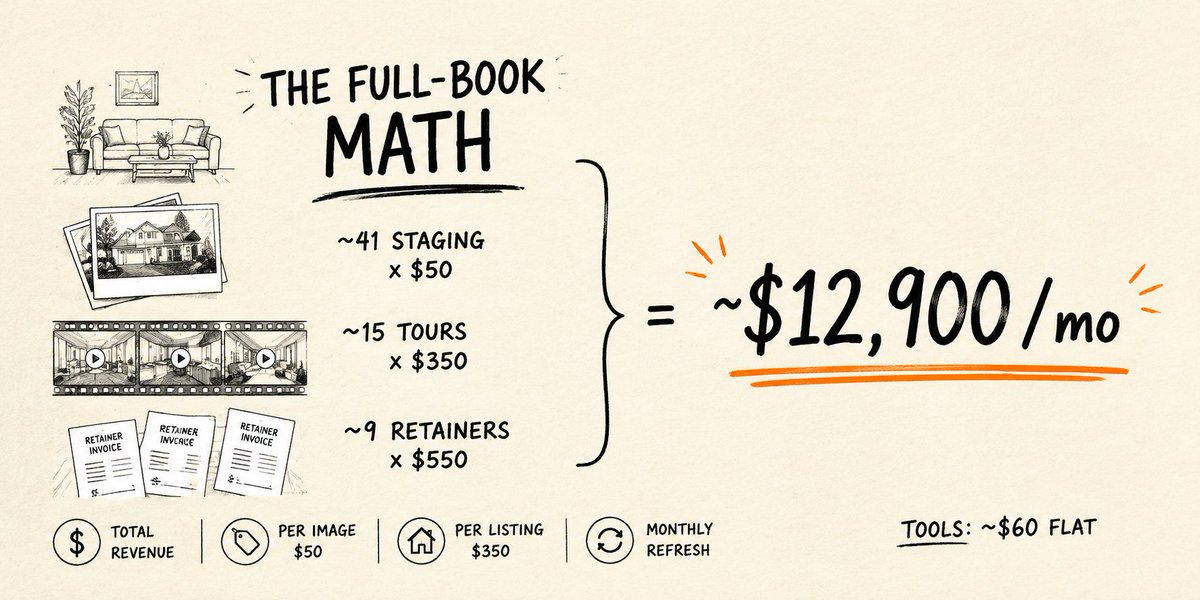
Now model the book. The ceiling is a stack, not a single big client:
An operator running a full book of staging, tours, and seasonal retainers clears about $12,900. That is where a filled book lands, not where you open. The number that decides whether you get there is how many hosts you can get to say yes and stay.
The honest floor
Staging a room and cutting a tour is the easy part, and every course selling this niche pretends the whole thing is that easy. The pipeline is a weekend to learn and your before-and-afters look sharp by the second week. That is not the business.
The business is landing hosts and keeping them. That is sales, to owners who get pitched by every photographer, cleaner, and co-host in their market. Most say no. The ones who say yes churn if the listing does not fill, because a host watches their occupancy calendar, not a chart of saves. So the whole game is proving the glow-up put heads in beds, then restaging next season before they think to leave.
What does a typical operator actually clear? For the first stretch, close to nothing, while they build the first two or three clients and learn to price staging, tours, and retainers separately. A realistic ramp for someone doing outreach consistently is one to three retained hosts in the first couple of months, maybe $600 to $2,300, climbing as they collect before-and-afters that close the next host on sight. The full book is a year-one grind for operators who treat this as a sales job with a staging tool attached.
The move that opens more DMs than any cold pitch: a free worst-room glow-up. Scroll a host's listing, find the emptiest or ugliest photo, stage that one room for nothing, and send it back unasked with the honest before beside it. That single image does what a paragraph cannot, because the host is looking at their own space fixed. It costs you a few minutes of generation and converts better than anything else you do.
The legal line that protects you both
This part is a selling point, not fine print. Virtually staged and AI-enhanced photos have to be disclosed. MLS rules and most real-estate boards require staged or altered images to be labeled as virtually staged, and Airbnb expects listing photos to accurately represent the actual space. You must not add features the property does not have, must not remove real defects to hide them, and must not misrepresent the size, layout, or view.
Run it clean and this becomes your pitch. You stage the real room, label it honestly, and the guest arrives to the place they booked, so the host gets five-star reviews instead of refund fights and delisting risk. Tell hosts that upfront. The operators who quietly fake a view get their clients burned once and lose the account; the ones who disclose and stage honestly become the person a host trusts with every property they own. That trust is the moat, and it compounds with every listing they hand you.
The outreach that opens doors
The free glow-up is the pitch. The frame that turns it into a call:
Hosts do not buy a year. They buy one refresh, watch the calendar, and the retainer sells itself.
The build
Once it is built, the factory runs itself and you steer it. You pick the room and the season, approve the cut, and Make posts it every Friday with a proof text while you go stage the next listing. A real ceiling above, about $12,900 a month on a full book, and an unglamorous floor below, where the staging is easy and landing hosts is the work. The operators who win treat the before-and-after as the product and a fuller calendar as the promise they keep honestly. And a host with a full calendar tells the next host, so a book that took months to fill starts referring itself.
Comment STAGE and I will send the glow-up kit: the staging brief prompt, the host-outreach template, and the free-worst-room DM script, free.
Prompts
You are writing the hook, on-screen text, and caption for a
short-term-rental listing reel.

Property: beach condo in Gulf Shores, sleeps 6, partial gulf view,
walkable to the pier. Reel is 20 seconds, vertical, muted autoplay.

Give me:
- 3 scroll-stopping first-line hooks, each under 8 words, that make
  someone in a cold city want a warm trip. No "you won't believe".
- 5 on-screen text lines timed to a 20-second reel, each under 6
  words, ending on a reason to book now. Mark the second each appears.
- A caption under 200 characters: one craving line, one line of what
  and where, a soft booking CTA, and 5 hashtags (2 travel, 3 local
  Gulf Shores).

Tone: warm, aspirational, local. One emoji max. Make them feel the stay.
Claude  ->  REimagineHome  ->  Kling AI  ->  ElevenLabs  ->  CapCut/Creatomate  ->  Make
copy    ->  staging        ->  flythrough  ->  voice        ->  cut                ->  publish
Product                       Market rate       You charge
-------                       -----------       ----------
Virtual staging (per image)   $16 to $75        $30 to $50
  median per room             ~$39              AI cost ~$1
AI walkthrough / tour video   $100 to $500      per listing
Independent photo/video shoot $100 to $500      up to $800 large homes
Short listing reels           package/retainer  monthly refresh
Read this warm and unhurried, like a friend describing a place they
love, not a real-estate ad. Slight smile in the voice. Slow down on
the last line and drop the volume a touch so it settles.

"Two blocks from the pier. Coffee on the balcony. This one books
out by June."

Settings: Stability 0.45, Similarity 0.80, Style 0.30, Speaker boost on.
Generate a sequence of vertical (9:16) walkthrough clips for a
short-term-rental listing tour. Each clip 4 to 6 seconds, smooth
real-estate camera motion, no people, natural light, photoreal.

Shot 1: slow push-in through the front door into an open living
room, warm afternoon light, camera glides forward at eye level.
Shot 2: gentle pan left across the kitchen counter to the window.
Shot 3: slow dolly down a short hallway toward the open bedroom door.
Shot 4: rise slightly and drift out onto the balcony toward the view.
Shot 5: slow push-in on the made bed, linen texture, soft lamp light.

Motion: steady, gimbal-smooth, gentle easing in and out. No fast
cuts, no shake, no warping of walls or furniture. Keep every room
consistent with the reference stills. Loop-friendly ending.
Trigger: Schedule (Tue / Thu, 10am local)

1.  Pull the next approved reel and caption from Drive
2.  Post to the host's Instagram Reels, cross-post to TikTok
3.  Log the post link and time into the client tracking sheet
4.  Every Monday, pull last week's saves, views, and profile taps
5.  Friday text to the host: "2 reels live, top one did X saves,
    booking page taps up Y"
6.  Telegram confirmation to you when the week's posts are done
~41 staging images x ~$50               =  $2,050
~15 walkthrough videos x ~$350          =  $5,250
~9 reel + refresh retainers x ~$550     =  $4,950
Setup / onboarding fees, a few new      =  ~$650 that month
-------------------------------------------------------------
Modeled monthly ceiling                 ~ $12,900
Tool cost                               ~ $60 flat + light generation
You are a copywriter for short-term-rental listings that convert.

Property: a 2-bedroom beach condo in Gulf Shores, Alabama, 4th floor,
balcony with a partial gulf view, walkable to the pier, sleeps 6.
Guest: couples and small families booking a 3 to 5 night summer stay.

Write:
- A listing title under 50 characters that names the single best
  feature and reads well in search.
- A 90-word description: one sensory opening line about waking up
  there, then the layout, then the 3 things within a 5-minute walk.
  Concrete, no "cozy" or "nestled", no exclamation marks.
- 6 short bullet highlights guests scan for (view, beds, parking,
  distance to beach, kitchen, one surprise perk).
- A one-line house rule note that sounds welcoming, not strict.

Tone: warm, specific, trustworthy. Sell the stay, not the building.
Service                      What the market pays
-------                      --------------------
Virtual staging (per image)  $30 to $50   (AI cost ~$1)
AI walkthrough tour          $100 to $500 per listing
Monthly seasonal refresh     $300 to $1,500 retainer
REimagineHome (staging)   ~$29/month and up
CapCut Pro                ~$10/month
ElevenLabs Creator        ~$22/month   (only if you use voice)
Make Core                 ~$10/month
-----------------------
Fixed floor               ~$49 to $71/month
A tired 2-bedroom cabin, dated photos, one weekend of work.

12 staged images x $40         =  $480
1 walkthrough tour             =  $300
3 listing reels (starter pack) =  $180
----------------------------------------
Revenue on one listing          ~$960
Tool + AI cost                  ~$19
Time                            ~4 hours
COLD DM (after you send the free worst-room glow-up):

"Hey [name], booked a place near yours last month and love your spot.
Ran your [worst room] through a quick glow-up, no charge, attached,
original on the left so you can see it's the real room. If you like
it, I stage the whole listing and keep it fresh each season.
Worth a 10-minute call this week?"

DISCOVERY CALL, 4 questions:
1. What's your occupancy running right now, and what would you want it at?
2. When were these photos last updated?
3. Which room do guests complain about or skip past?
4. If a refreshed listing pulled 4 extra booked nights a month, what's
   that worth to you?

CLOSE: "Full listing staged and disclosed, a walkthrough tour, and a
seasonal refresh with reels, posted for you, plus a weekly numbers
text. Retainer's $550 a month, one-time $300 setup. Start with the
first refresh so you see the calendar move before you commit?"
You are writing a virtual-staging brief for a photo editor.

Room: primary bedroom, currently empty, one south window with real
afternoon light, wide-plank oak floor, one exposed brick wall,
sloped ceiling on the left side, a door to a small ensuite.

Target style: warm coastal-modern. Linen bedding in oat and soft
blue, a low wood bed frame, one woven bench, a single large plant,
warm lamp lighting, one framed print. Nothing loud.

MUST KEEP EXACTLY, do not alter or hide:
- the real window and the direction of its light
- the exposed brick wall
- the sloped ceiling line
- the oak floor color and plank direction
- the ensuite door position

Do NOT add windows, doors, square footage, or a view the room
does not have. Furnish the real room. Do not invent architecture.
Related articles

HOW TO BUILD AN AI INFLUENCER AND MAKE $5000 A MONTH
For a long time, being an influencer was a highly exclusive niche for real humans.

Our Fake Company Went Viral on X. Here’s How.
We’ve raised $6M to turn sad employees into happy ones. One pizza at a time. Led by http://Atomik.vc

How to Run AI Slideshows Profitably on TikTok
the algorithm re-serves a slideshow to people who scrolled past it.