The Marketing Engineer Clearly Explained

The most valuable marketer changes every time the technology changes.

Traditional marketing made people care. Don Draper, print, radio, psychology.
Digital marketing acquired customers through channels you could measure. Websites, email, SEO, Google, Facebook ads, landing pages, pixels.
Growth hacking pulled marketing into the product. Activation, referrals, onboarding, retention, pricing. Dave McClure's framework was the symbol of that era.
Marketing engineering is the fourth era.
It uses AI agents, data, code, and taste to build a marketing system that keeps learning.
The job:
A marketing engineer turns market signal into pipeline using AI agents, data, code, and taste.
Over the next 18 to 24 months this becomes a 250K, 500K, and million dollar job. Some people call it a forward deployed marketer. Others call it an AI growth operator. The label keeps moving. The work stays the same.
Every company wants more leads, faster experiments, sharper positioning, and a live read on its customers. They want that from a smaller team every week.
Whoever walks in and builds it gets to name their price.
The problem this fixes

Most companies already own the pieces. Dashboards, call recordings, content calendars, CRM, a stack of SaaS tools.
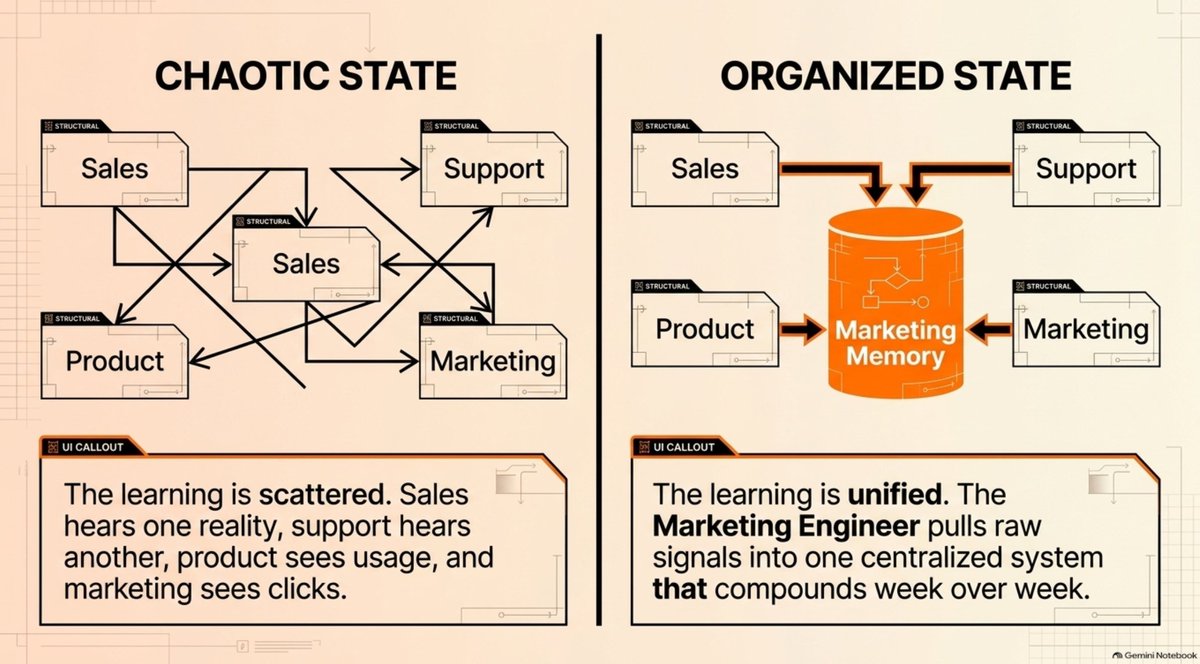
The learning sits in separate rooms.
Sales hears one version of the market. Support hears another. Product sees usage. Marketing sees clicks. The founder remembers the one customer call that hit hard that week.
Then everyone walks into the growth meeting with a different version of reality.
Build the growth repo

Create a GitHub repo, or a structured folder. Call it Growth OS. It holds the company's marketing memory.
The folders:
- Customer truth: sales call notes, support tickets, churn notes, interviews, product feedback
- Content engine: founder voice guide, winning hooks, scripts, notes on what performed
- Outbound engine: ICP, account research, trigger events, approved angles, banned language
- Creative testing: ad angles, landing page tests, hooks, offers, results
- Agents: the job spec for every AI worker you run
Then the prompt changes.
Weak prompt: write me 10 LinkedIn posts.
Repo prompt: read the customer truth file, read the founder voice file, read the last five posts that drove qualified replies, then draft five posts about the pains buyers raised this week.
Same model. Different context. Different output.
The tool stack

GrokBot: the layer that lives close to the internet, connected to the X ecosystem. Give it lanes. One bot watches competitors and reports what changed. One watches customer language across X and Reddit. One watches creators for formats worth testing. One watches ads and landing pages.
Claude and Codex: build the repo, generate landing pages, write scripts, ship small internal tools.
Hermes style workflows: scheduled runs with memory and approval. Every Monday, build the market brief. Every Friday, review the experiments. Every time fresh sales calls land, pull the objections and update the positioning file.
Creative models: ads, thumbnails, mockups, video concepts. FAL AI and Higgsfield sit here.
Local AI: private customer transcripts, regulated notes, pricing plans, and anything a company would feel weird sending to a cloud tool.
The tools keep changing. The workflow is the thing to learn.
Write the agent job spec

Beginner SEO: ask an AI to write a blog post about a keyword.
Marketing engineer SEO: check Google Search Console → pull keyword data from Ahrefs or SEMrush → check the CMS for existing coverage → rank opportunities by volume and buyer intent → study what already ranks → add the founder's point of view → draft the post → write the meta title → suggest internal links → send it for approval.
Write every agent spec the way you would write a job description:
- The data source
- The run schedule
- The filters
- The expected output, and what good looks like
- The approval step
- The metric that matters
- Where it writes the result, so the system gets smarter
A competitor engager agent, as an example: every weekday morning, check these 20 LinkedIn accounts, pull the people who commented on new posts, enrich them, drop bad fit leads, draft 10 messages tied to the exact post each person engaged with, write the file for approval.
Metric: positive replies from qualified accounts.
Messages sent is activity. Qualified replies is signal.
Train agents the way you train a new hire. Small tasks, watch the work, correct the mistakes, add every correction to memory, expand the scope as trust grows.
Every correction compounds.
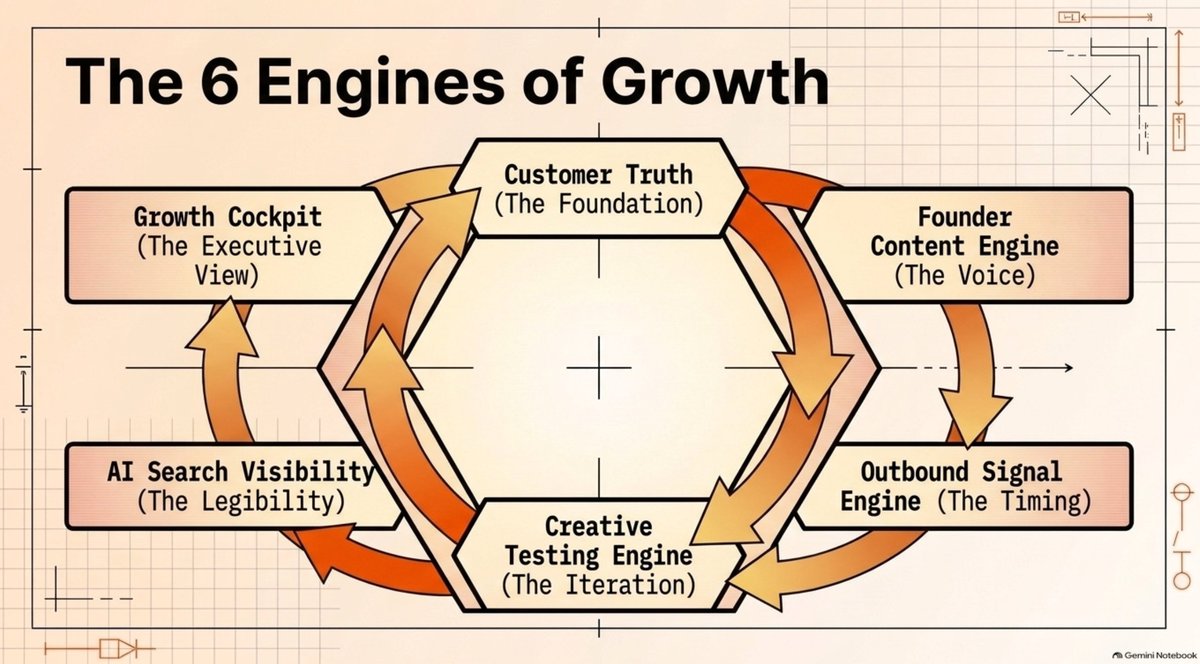
The 6 systems to build
Picture a vertical SaaS company selling to commercial HVAC contractors. Technicians, service calls, maintenance contracts, dispatch. Real budgets, messy workflows, specific language.
Sharp angle: stop losing replacement revenue after every service call. Dull angle: run your HVAC business better.
1. Customer truth. A file called whatthemarketistellingus.md, updated every morning or every week. It reads sales calls, support tickets, churn notes, CRM notes, Stripe movement, and social data. Demand quotes, snippets, ticket links, and event counts.

A good memo reads like this: five sales calls this week mentioned emergency dispatch, and the calls that converted all talked about missed follow-up quotes after the tech left.
2. Founder content engine. Record the founder talking to customers. Pull from podcasts. Extract the strongest ideas, then watch which hooks hold attention.
One HVAC insight becomes five assets:
- A founder post about the hidden revenue leak in service businesses
- A short video on why contractors lose money after the first visit
- A landing page line: every completed job should create the next quote
- A cold email angle
- A calculator that estimates the lost revenue
3. Outbound signal engine. Good outbound starts with timing. Who just raised money, who is hiring for the exact problem you solve, who posted publicly about the pain, and who fits the ICP with a reason to care this week.
For HVAC: contractors hiring dispatchers, opening new locations, collecting bad reviews. You sell painkillers when the timing hurts.

4. Creative testing engine. Take one offer. Spin up 20 hooks and 10 ad angles. Record the results. Repeat. Creative becomes a learning system.
5. AI search visibility. Over a billion people now ask ChatGPT, plus Google AI overviews, Gemini, Perplexity, and Claude. Make the company legible to those systems and get cited.

6. Growth cockpit. A weekly view of what changed and what to do about it. For HVAC it might read: the lost replacement revenue angle drove fewer clicks than the dispatch angle, and twice as many demo requests from owners with more than 20 techs.
That is the memo an executive wants to wake up to.
4 ways to get paid
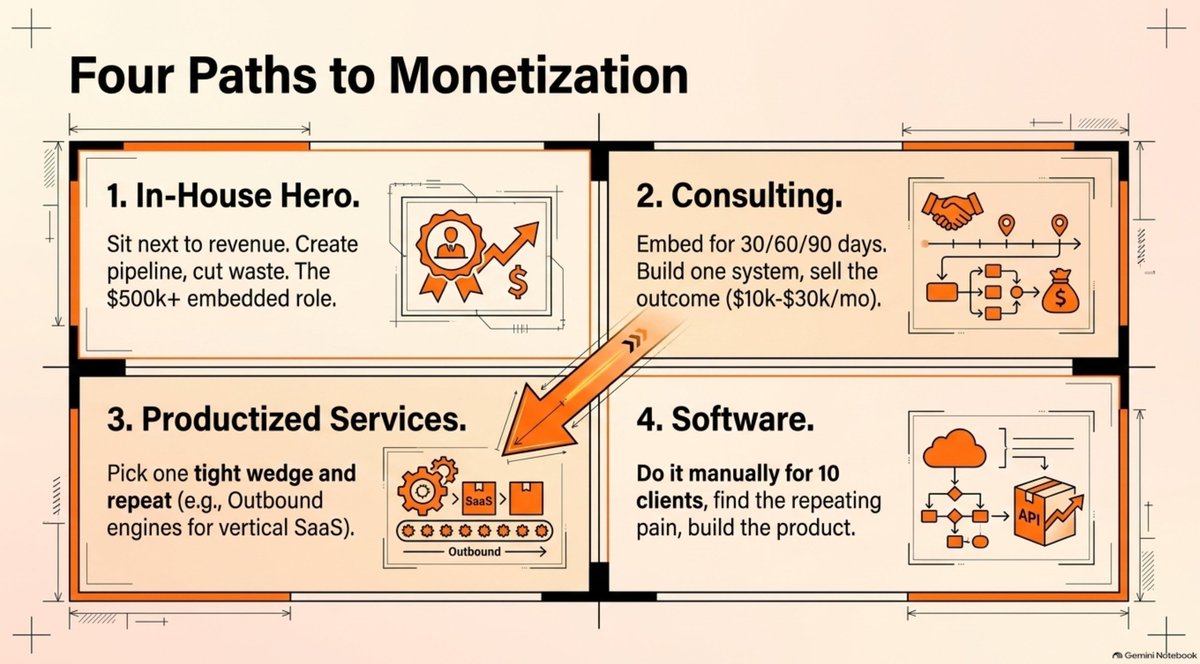
1. Become the person inside the company. This work sits directly next to revenue: pipeline created, conversion lifted, wasted spend cut. That is how someone becomes a $500,000 hire.
2. Consulting. Embed with a founder-led company for 30, 60, or 90 days. Build one growth system. Sell the outcome. $5,000, $10,000, or $30,000 a month, depending on the build.
3. Productized services. Pick one wedge and repeat it. Outbound signal engines for vertical SaaS. Founder content engines for B2B CEOs. Customer truth repos for seed stage startups. The tighter the wedge, the easier it is to sell, deliver, and repeat.
4. Software. Build the same system by hand for five or ten companies. Find the pain that repeats. Then turn it into product. Services first keeps you honest about what people actually want.
These stack: consult to learn → productize what repeats → ship the software.
The 30 day plan

Week 1: Audit. Pick one real company. Study the website, the offer, the ICP, the founder's content, the sales calls, the support tickets. Output a market map: who the customer is, what pain they describe, what words they use, what they buy instead, where the funnel leaks, and what you would test first.
Week 2: Growth repo. Create it, add the folders, write your first "what is the market telling us" file. Any tool works here. The workflow carries the weight.
Week 3: First machine. Pick one system and build it. One working system beats five half-built ones.
Week 4: Results. Did replies improve? Did meetings get booked? Did conversion lift? Did the founder sound sharper?
By day 30 you should hold a case study that reads like this: I audited the company's growth, built a customer truth repo, surfaced one high-intent pain they had missed, turned it into an outbound signal engine, shipped 75 targeted messages, earned nine warm replies, and booked three calls.
That is how you get hired, how you get clients, and how you become credible.
Start tomorrow morning
Keep version one painfully simple.
Build the Growth OS folder with five files. Four of them: customer truth, founder voice, experiments, agent jobs. [UNCLEAR: the fifth file]
Paste in 20 real customer notes or call summaries.
Give the agent one job: tell me what changed, show me the receipts, suggest one marketing test that creates pipeline this week.
Then build the one thing it suggests.
The part that stays yours

The best marketing engineers read as part marketer, part product person, part rev ops, part data analyst, part creator, part engineer. They talk to a customer, write the positioning, wire the automation, build the landing page, read the conversion, and point the outbound agent at the right accounts.
AI is about to make average marketing cheap. Taste matters more than it ever has.
Agents become a commodity. Your judgment about where to point them is the moat.
Most teams are still running the growth hacker playbook. The window is open right now.
Checkout the full episode
Spotify: https://open.spotify.com/episode/6df054sPp06slLWRw6wY0P?si=dc9e24d1dbe84063
Related articles

Mars men's full meta ads playbook (4,512 ads)
Mars Men has 4,512 ads live on Meta right now, on a Facebook page that only exists since December 2023.
How to Start a 6 Figure Faceless YouTube Channel (Full Breakdown)
I've helped over 400 people start profitable faceless youtube channels. i've ran over 50 channels myself. Generated over $4 MILLION by age 25. Worked with youtubers that have 10 million+ subscribers,…

10 UGC Hooks That Always Work (App Marketing)
your app doesn't need 100 new content ideas.