THE POLYMATH: How to Turn Multiple Interests Into One Body of Knowledge

there always comes this moment in a conversation. when they’ve told me everything they possibly could about themselves and finally ask:
‘so... what do you do?’
my mind begins to circle around many different responses:
‘I am a bohemian creator who admires great works of art and wakes up at dusk to smoke cigarettes and write prose in the rays of the rising sun?’
or... ‘a semi-pro boxer who gets bloodthirsty at the smell of leather and the sound of a heavy bag?’
maybe ‘a seeker of forbidden knowledge, descending into deep rabbit holes in the dead of the night to understand how reality ACTUALLY works?’
how tf am I going to explain it to anyone?
so it always ends up on an answer like:
‘I’m a secret CIA agent.’
‘I do crack on behalf of pablo escobar.’
‘I’m an undercover hitman’
gotta keep it mysterious.
jokes aside, in today’s world, people have this preconception that they have to close themselves in a specific frame to achieve success in life.
you’re either a gym bro with a greek physique yet nothing in his head.
an artist or scholar with a very rich inner world and the body of a third grader.
or a hustler with a full bag and an empty soul.
on the outside, each of these paths seems incomplete. but what if I told you one does not exclude the other? what if you could mix all three into one person?
true enlightenment comes the moment you realize that you don’t have to choose. and you simply start letting one branch of your life feed another.
you do science in an artistic way and art in a scientific way.
you put sports into business and business into sports.
you realize that everything you do in life connects to every other thing, so you neither neglect nor abandon anything.
as always, my lab is buried in material.
plato’s republic. vitruvius’ de architectura. isaacson’s biography of leonardo da vinci. a print of the vitruvian man is lying next to the bag with my headgear and hand wraps from yesterday’s sparring session, all overlooked by the marble statue of alexander the great.
we’re going to dig through all of it to find one answer: what makes a universal man?
the plan is as follows:
first, we’ll trace the idea from the greek gymnasium through rome to the renaissance, and find out how the three circles of body, mind and spirit interconnect with each other.
secondly, we’ll analyze how some of the greatest men in history (leonardo, musashi & a modern-day billionaire) lived in all three circles at once.
until at last, you will receive my universal man playbook: 5 daily practices you can start applying today.
let’s get into it.
I. THE ANATOMY OF A UNIVERSAL MAN
first off, let’s take a look at what it even means to be a ‘polymath’.
from greek poly (many) + manthanein (to learn), it literally means to study many things.
the ‘many’, however, does not mean solely different subjects. it’s about the many parts of the man himself.
in the old traditions of the east it was believed there are three ways to achieve mastery:
the way of the fakir. work on the body. master of his body, but not of his emotions or his mind.
the way of the monk. work on the heart. master of his emotions, but not of his body or his mind.
the way of the yogi. work on the mind. master of his mind, but not of his body or his emotions.
each of them had to leave the world to walk his path… and each came back only a third of a man.
it wasn’t until george gurdjieff, a greek-armenian mystic, brought to the west what he called the fourth way. one that requires you to retreat neither into the desert nor into a monastery.
you walk it in your ordinary life, at your ordinary work, and work on all three at once: mind, body & spirit.
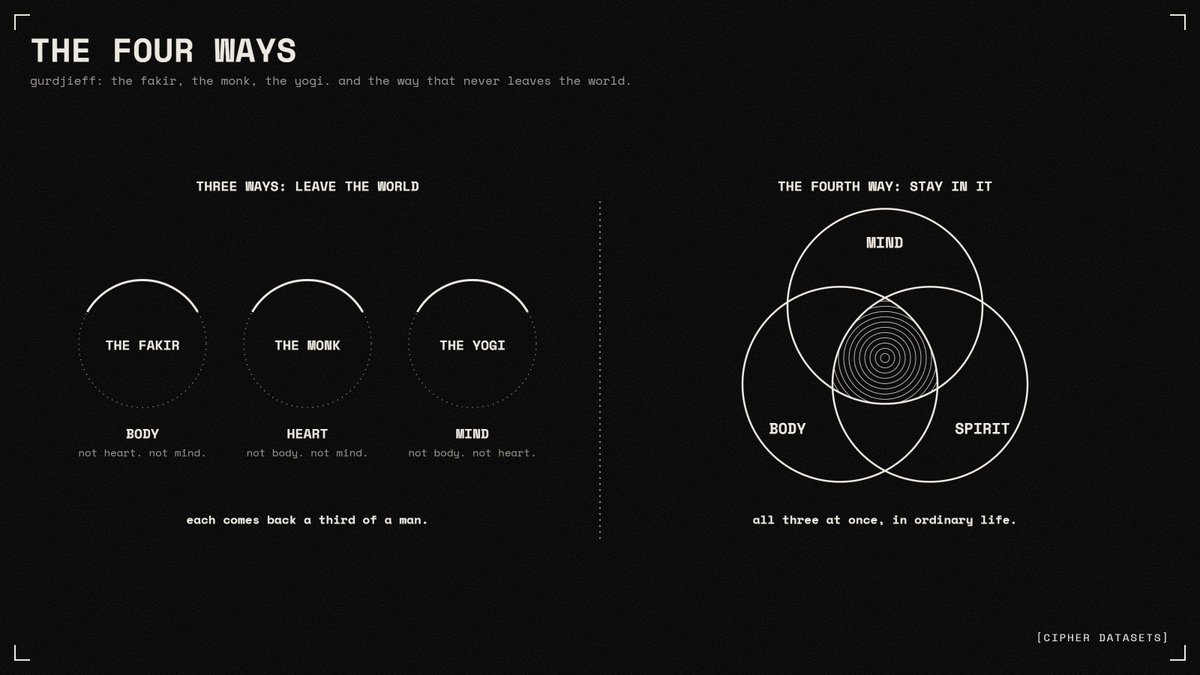
in its original understanding, a polymath is not a man who simply knows many things, but a man who develops every part of himself simultaneously and creates a sort of feedback loop, where mastering one part automatically strengthens the others.
but the idea itself is far older than gurdjieff. to find its roots, we have to go back 2,500 years.
ANCIENT GREECE: THE FIRST UNIVERSAL SCHOOL
ancient greece established the tradition of training a man in multiple fields more than any other culture before it.
pathei mathos, wrote aeschylus. learning through suffering.
every boy of school age had to train the mind, the body and the spirit simultaneously.
mousike, the arts of the muses: poetry, music, letters. gymnastike, the training of the body: running, wrestling, boxing. and philosophy was taught in the very same building where they had their wrestling lessons (the gymnasium), the very same day. plato’s own academy was a gymnasium.
for the greeks, knowledge was something that had to be earned on all levels. socrates himself, as xenophon records, said that ‘it is a disgrace to grow old through sheer carelessness before seeing what manner of man you may become by developing your bodily strength and beauty to their highest limit.’
this philosophy was best encapsulated in plato’s republic.
in book III, socrates says that the mere athlete with time ‘becomes too much of a savage’, whilst the mere musician ‘is melted and softened beyond what is good for him.’ because both trainings, he argues, ‘have in view chiefly the improvement of the soul.’
then, plato distinguishes three different parts of the soul:
appetite (body). reason (mind). thumos (spirit).
according to socrates, justice in a man is each part doing its own work in harmony. one part ruling alone is not strength. it is sickness.
VITRUVIAN MAN: THE CRAFT OF BEING EVERYTHING AT ONCE
this philosophy of the greeks spread throughout the ancient world and influenced many other civilizations.
it survived, above all, in the works of a man named vitruvius.
now, who the hell was vitruvius? well, he was a roman architect, some three centuries after the times of plato and socrates, a military engineer under julius caesar and later augustus.
but the reason I bring him up is because he was far from the idea of an architect you may have.
in today’s world, architects have separated the drawing from the building, the building from the thinking, and their job pretty much limits itself to sketching the blueprint.
back then, an architect had to be a draughtsman, mathematician, astronomer, musician and physician at once.
he wrote de architectura as a manual for every architect, in which he laid down the principles of the craft for the generations to come.
> ‘let him be educated, skilful with the pencil, instructed in geometry, know much history, have followed the philosophers with attention, understand music, have some knowledge of medicine, know the opinions of the jurists, and be acquainted with astronomy.’
quite a lot to demand from a single architect, but as he put it, hands without theory ‘have never been able to reach a position of authority.’
it is in this very book that he describes a man with outstretched arms and legs fitting perfectly into a circle and a square. almost 1,500 years later, leonardo would draw him. the vitruvian man.
and if you look deeper, it applies to something far bigger than this specific craft.
> ‘all studies have a common bond of union and intercourse with one another... a liberal education forms, as it were, a single body made up of these members.’

when you see it this way, it applies to an architect as much as to a painter, a scientist, a businessman, and any other man who wishes to achieve mastery in his field.
RENAISSANCE: THE BLOOM OF THE UNIVERSAL MAN
this book of vitruvius then gathered dust for centuries in medieval monasteries. a few copies survived thanks to charlemagne’s scribes, but it became pretty much forgotten.
this was until the year 1416, when a man named poggio bracciolini found it in the old abbey of st. gall and popularized it across florentine society as the blueprint of what a man could be.
one of the first renaissance men who ever laid his hand on it was none other than leon battista alberti, commonly perceived as the archetype and first ever uomo universale (universal man).
why him and not da vinci?
you see, alberti did not just read vitruvius. he answered him. he wrote his own ten books on architecture, then treatises on painting, on sculpture, on the family.
he designed churches from florence to mantua. he learned music without a teacher and professionals admired his compositions.
and with his feet together he could jump over a man’s head, threw a coin so high in the cathedral it rang against the vault, and ‘the wildest horses trembled under him.’
his creed: ‘men can do all things if they will.’
this later inspired the men who came after him, like leonardo and michelangelo.
a direct contrast to medieval times, in which a man had to be either a farmer, a monk or a soldier, and stayed one until death.
it’s safe to say that renaissance florence produced the biggest leap of human evolution up to that point.
nearly every breakthrough humanity has made since comes from this renaissance school of thought. connecting different branches of knowledge to create a whole.
the printing press: a goldsmith’s metalwork, a wine press and ink chemistry.
the aircraft: physics, the anatomy of birds, engineering, and two bicycle mechanics who understood balance.
the iphone: computing, glass and design, all by a man who once sat in on a calligraphy class.
II. CASE STUDIES
now let’s take a look at the men who actually did it.
how does a man ACTUALLY become universal?
LEONARDO DA VINCI: THE MAN WITHOUT LETTERS
a man that needs no introduction.
painter of the most famous face on earth, and by many considered the greatest mind who ever lived.
extraordinary painter, engineer, botanist, anatomist and astronomer in one.
but ever wondered how he did it? was he born rich, schooled by the best, or supernaturally talented in any way?
from the sources that we have, no.
leonardo was born a bastard, with no family name, no university, no education whatsoever beyond an abacus school. he barely knew latin, the language of every serious book of his time, and called himself omo sanza lettere. a man without letters.
his secret was that, above all, he was immensely curious.
he observed and studied a ridiculously wide range of things: water, birds, muscles, light, rocks, the tongue of the woodpecker. and then saw what they all had in common.
he painted the locks of hair the way he drew the eddies of water.
he drew the branching of veins the way he drew the branching of trees and rivers.
he figured out how the valve of the heart closes by watching how water swirls into eddies.
the line the internet loves to credit him with, ‘study the science of art. study the art of science.’, appears nowhere in his notebooks.
but this one does: ‘those who fall in love with practice without science are like a pilot who goes into a ship without rudder or compass and never has any certainty where he is going.’
MIYAMOTO MUSASHI: THE SCHOLAR SAMURAI
musashi went down in history as the greatest samurai who ever lived.
over 60 duels. not a single loss. undefeated across a lifetime.
his first duel at 13. the boy schooled a grown swordsman.
at 28 he was challenged by sasaki kojiro, the most famous swordsman in the country. the story goes: he arrives deliberately late, and kills him with one stroke... of a wooden sword he carved from an oar on the boat.
he designed his own style of fighting with two blades at once, niten ichi-ryu.
but beneath all of it, musashi mastered the art of applying one principle to all things.
in his last years, he withdrew into a cave and wrote the book of five rings, finishing it weeks before his death. a manual still studied by executives and traders 400 years later.
the title comes from the five elements: earth, water, fire, wind, void. one scroll for each, and the void is where they all become one.
in there he lays down the rules of his life: ‘know the ways of all professions.’ and: ‘when I apply the principle of strategy to the ways of different arts and crafts, I no longer have need for a teacher in any domain.’
he carved wooden statues. he forged sword guards. he practiced zen.
his ink paintings still hang in museums. shrike on a withered branch. wild geese among reeds.
his principle: ‘from one thing, know ten thousand things.’
ALEX BOUZARI: THE MODERN RENAISSANCE MAN
if you think that the universal man died with the renaissance and now it’s history, you’re wrong, and alex bouzari is the greatest example of that.
born in paris to iranian parents, he is the 65-year-old founder of DDN, one of the biggest data storage companies in the world, the one that feeds nvidia’s ai supercomputers.
but aside from his work, he also designs his own suits and dresses like a regency duke. popped collars, crocodile shoes, a shirtmaker he once shared with karl lagerfeld.
but he does not simply buy the clothes.
he draws them by hand, and a trusted network of artisans turns his sketches into the finished pieces.
he furnished his home in las vegas in art deco, piece by piece.
he also has an apartment in paris where he designed everything himself, down to the marbled carpets.
yes, you heard right. a man worth around $2 billion, whose machines keep nvidia’s ai running, still picks his own carpets.
he tried to buy a shipyard in norway and is currently building a 1.3-gigawatt data centre in texas, the size of a small city.
he brings the same eye for design to his work, and that is exactly the reason why his company leads the market.
as he himself puts it: ‘I just love to design.’
III. THE UNIVERSAL MAN PLAYBOOK: 5 PRACTICES TO CONNECT EVERYTHING YOU DO
after going through 2,500 years of history and some of the greatest universal minds who lived within this time, it’s time to draw conclusions.
you can become the universal man. but it all comes down to awareness and daily practice.
1. HAVE AT LEAST ONE DISCIPLINE PER CIRCLE.
if you’re still reading this, chances are you have multiple interests and you’re looking for a way to make sense of them.
maybe you’re mainly a sports person, maybe you’re a business mind, or a creative one that likes to paint, write or sing.
the main thing that should stick in your head from this piece is that you don’t have to choose, but also, you shouldn’t limit yourself to one.
as we already established, there are 3 levels of the man: body, mind and spirit.
ideally, you would want to pick at least one discipline per circle and wire it into your daily routine.
for the body, that would be any kind of sport.
competitive sports always tower above solo training like the gym or running, because they train the body and the mind in a way that non-competitive training never will.
but anything is fine. just make sure you are actively working on your body.
for the mind, this is any kind of activity that develops your general knowledge: reading books, watching films or even video games, so long as they are not mindless grinding like league of legends or cs:go.
and for the spirit: any kind of creative work. art, writing, painting, singing.
have at least one of each in your daily routine and you will soon develop in a way unreachable to a normal person.

2. MASTER ONE THING BEFORE YOU MOVE TO THE NEXT.
this does not mean you have to first look like a greek god before you touch a book.
or read the whole western canon before you touch a dumbbell.
it means that in every branch, you want to lock in the fundamentals before you jump to another thing.
if you are training boxing, you want to drill the fundamentals first: footwork, the jab, keeping your hands up, before you get to the flashy combinations. because sooner or later, the basics will catch up with you.
similarly, if you are a writer, you want to learn to write one clean sentence before you attempt a novel.
master one thing to the bone, and it teaches you what mastery feels like. then that feeling transfers to everything else you touch.
‘from one thing, know ten thousand things.’
3. FIND THE COMMON BOND.
as leonardo’s notebooks show, everything connects to everything else.
how you do fitness is how you do business.
how you treat your girl is how you treat your coworkers.
the discipline from one thing transfers to every other thing you touch.
the key is to spot these patterns, become aware of them and deliberately carry them across.
progressive overload in the gym is compound interest in money is daily pages in writing. same law, three languages.
the footwork you drill in boxing is the patience you need in a negotiation. the rhythm you feel in music is the rhythm of good copywriting.
vitruvius called it the common bond. all studies, one body.
so in everything you learn, practice and fail at, ask yourself: where else is this true?
chances are, from one weakness you can trace multiple other weaknesses in your life.
those are the ones you want to fix first. kill the root, and the branches die with it.
4. FEED THE OTHER CIRCLE.
modern society at its core resembles a factory. one man, one function.
we have this tendency to close ourselves in narrow frames and call it focus.
you’re either a hustler, a creator or an athlete, and it becomes your identity, out of which you don’t step for the rest of your life.
what I’m going to propose is the opposite.
whatever side you tend to lean towards, try to deliberately lean to the other.
this does not mean abandoning your natural interests and drives, but using them as a tool to identify other branches which you need to develop AS WELL.
if you have a tendency to live in your head, try to spend an hour a day in your body. hit the bag. run until it hurts.
if you live in your body, pick up the book you keep postponing. or a brush.
if you live in the numbers, make something that no one will pay you for.
the part of you that you neglect does not disappear. it runs you from the basement.
5. CARRY THE NOTEBOOK.
this one may seem trivial, but it is something of the highest importance.
leonardo observed the world for HOURS and noted it all down. water, birds, faces in the street, the tongue of the woodpecker. thousands of pages, and all in one place. anatomy next to grocery lists.
what a notebook does is it forces your brain to actively observe and structure your observations into something that can be used.
this applies to things as simple as tracking your lifts in the gym,
catching your thoughts as they arise on a long walk,
or writing down annotations and lines from the books you read.
so the next time someone asks you ‘so... what do you do?’
you won’t have to pick one.
everything.
-Cipher.
there are three planes of existance: mind, body and spirit.
all require equal mastery, but of the three, the mind is the engine for the other two.
if you want to go deeper into conditioning your mental patterns, i can help you with that also.
Mental Game Playbook is my personal framework for aligning every part of your mind with the reality you want to create.
built on real stories. structured into something you can actually apply.
5 cognitions of your mind. 5 plays you can simply mimic in your own game.
learn more → mentalgameplaybook.com
Related articles

How I Make $20k/Month With Pixar Animations (and how you can too)
Every time I've made the most money in my life it came down to right time, right skill. AI Animations are exactly this to me right now
How to launch a one-person product (without destroying your life)
Over the last 5 years, I’ve helped launch products that went on to make multiple 7 figures in revenue per year.

the whop partner business model explained in 5 minutes...
every online business model is a trade between 3 things.