They made $40 million on Polymarket arb because prices didn't add up to a dollar

Every prediction market runs on one rule so simple nobody bothers to check it.
The prices of all the outcomes are supposed to add up to exactly one dollar.
They don't. Not always.
And every time they drift off a dollar, there is free money sitting on the screen for whoever is fast enough to grab it.
This is NOT a theory.
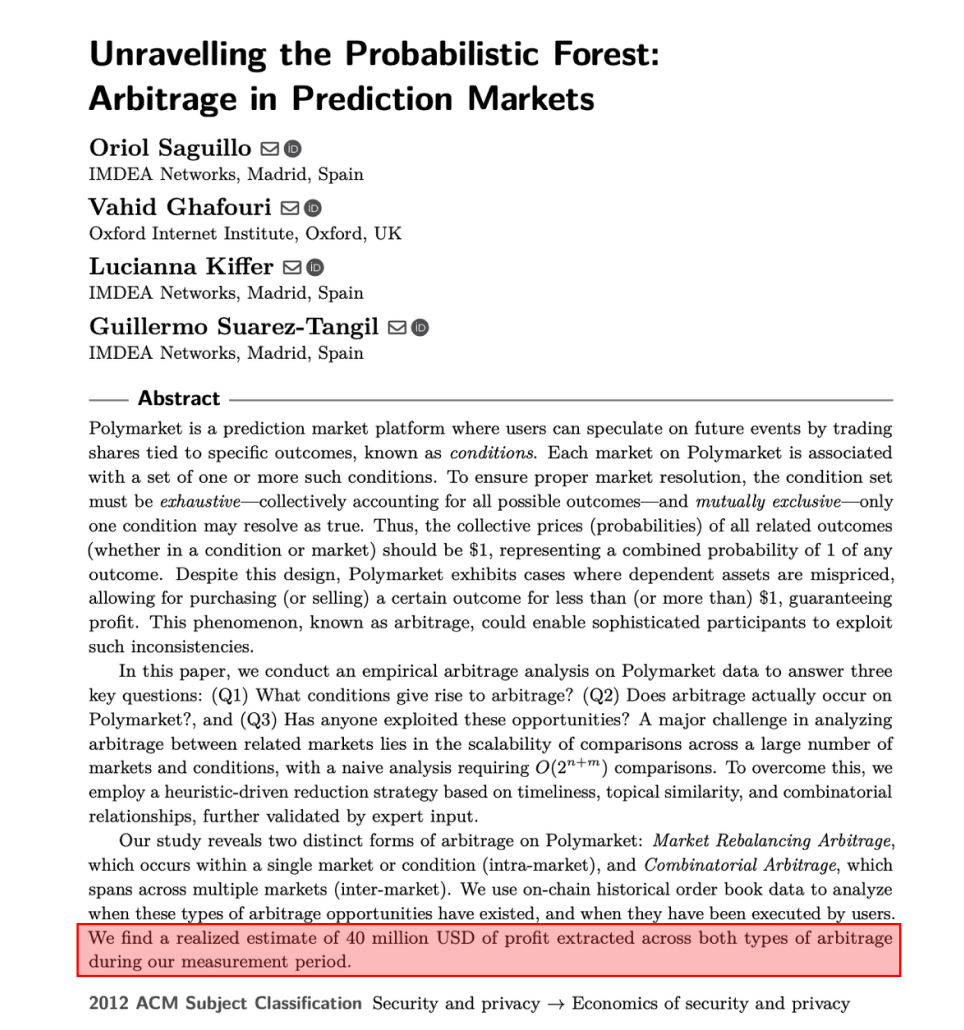
In a year of Polymarket data, researchers measured roughly $40 million in real, realized arbitrage profit, extracted by people who did nothing but notice that the numbers didn't sum right.
There is a second game on the exact same screen that does not care about the future at all.
It only cares whether the prices are internally consistent with each other.
When they are not, you can build a basket that pays out no matter what happens.
This article is about that second game, grounded in a 2025 study from IMDEA Networks and Oxford that mapped it across a full year of Polymarket.
Real data, real on-chain profits and a structure you can learn to see.
This paper helped me a lot when i was doing my first steps towards building an arb bot: https://arxiv.org/pdf/2508.03474
Now it's finally sitting at 6 figs clean PnL so let me help you too.

This article will give you EVERYTHING you need to start making first money on Polymarket arb.
Hope you're ready.
One rule every market must obey
Start with what a price on Polymarket actually is.
When a YES token trades at 67 cents, the market is saying that outcome has about a 67 percent chance.
The price is the probability. That is the whole design.

Now add the second half of the design. Every market is built so its outcomes are exhaustive and mutually exclusive. Exhaustive means the listed outcomes cover everything that can happen. Mutually exclusive means exactly one of them can end up true.
A three-way election market: Democrat, Republican, third party.
One and only one resolves to a dollar. The rest go to zero.
Put those two facts together and you get the rule the entire system leans on. If exactly one outcome will pay a dollar, then the prices of all the outcomes must add up to a dollar.
Not roughly. Exactly.
A 60-cent YES, a 35-cent YES, and a 5-cent YES sum to a dollar, and that is the market being honest with itself.
The moment that sum is not a dollar, the market is contradicting its own rules. And a market that contradicts itself is not a risk. It is a payout.
Embedded post:
Author: Oracle Boar (@bored2boar) Post ID: 2083307638134128950 Source: https://x.com/bored2boar/status/2083307638134128950 Posted: 2026-07-31T21:43:41.000Z Reply to: none
Text:
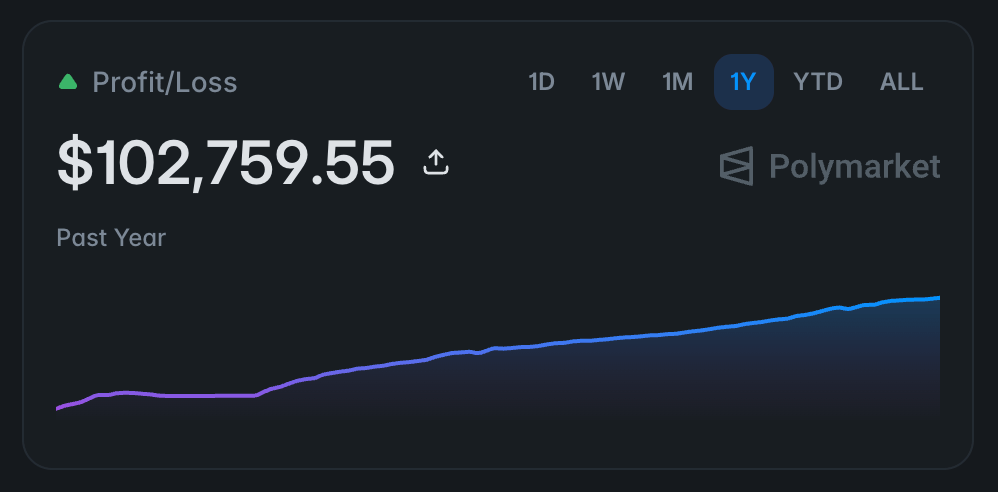
> 🚨 MY PUBLIC ARB BOT HIT $100K PNL TODAY
>
> The best part? You've seen the whole process live.
>
> Remember when i started a few months ago?
>
> Remember those daily negative PnLs?
>
> Well, it was worth it.
>
> Public wallet: [https://polymarket.com/@0x951bd740ef681d05891ca35440232488271d433]
>
> Full guide on how to set it up below.
>
>  https://twitter.com/bored2boar/status/2079175201476984941
Media:
Quoted: https://x.com/bored2boar/status/2079175201476984941
Retail asks: which outcome is going to win?
An arbitrageur asks: do these prices even add up, and if they don't, how do I buy the gap?
One question needs you to predict the world.
The other just needs you to do arithmetic the crowd skipped.
Market rebalancing arbitrage
The simplest version lives inside a single market, and the paper calls it Market Rebalancing Arbitrage.
Take a market with several mutually exclusive outcomes. Add up the price of every YES token. Two things can go wrong, and both pay you.
If the YES prices add up to less than a dollar, buy one share of every outcome.
You have now covered every possible result. One of them is guaranteed to resolve to a dollar, and you paid less than a dollar for the whole set. The profit is locked the instant you buy, and it equals one minus the sum.
Now check the exact scheme:

Three outcomes priced at 0.46, 0.33 and 0.15 sum to 0.94, so the full basket costs 94 cents and pays back a dollar. Six cents of risk-free profit per basket, times size.
If the YES prices add up to more than a dollar, you flip it. The outcomes are collectively overpriced, which means the NO side is cheap.
You buy the NO positions, or you lock a dollar to mint the full set of shares and immediately sell the overpriced YES tokens. Either way you pocket the sum minus one.
That is the entire mechanism. The profit is always the distance between the sum of the prices and a clean dollar:
> profit per basket = | (sum of all YES prices) − 1 |
No opinion about the election. No view on the teams.
You are being paid because the order book let the prices drift off their only mathematical anchor, and you snapped them back.
Combinatorial arbitrage
The bigger money, and the harder game, is between two different markets that are secretly about the same thing. The paper calls this Combinatorial Arbitrage.
Here is the shape. Polymarket often lists an event twice, from two angles.
One market: "Who wins the state?" Another market: "What is the winning margin?"
These look like separate markets with separate order books and separate prices. But they are logically welded together. If "Candidate wins by more than 2 points" resolves YES, then "Candidate wins" must also resolve YES.
It cannot be otherwise.
This scheme shows this dependency as a graph, the way the researchers modeled it: outcomes in one market forced to agree with outcomes in the other.
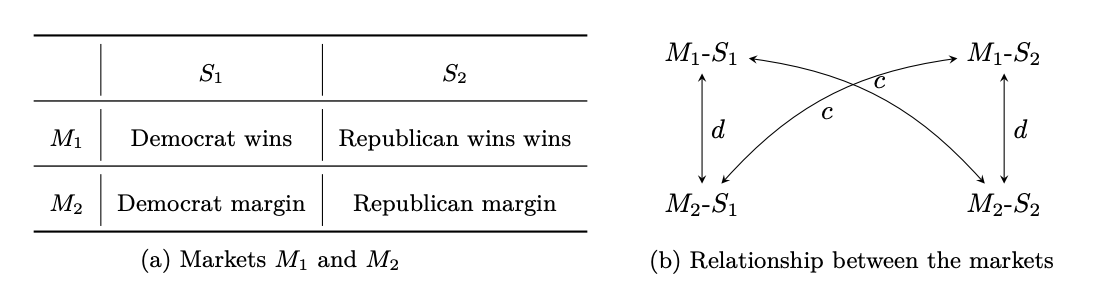
Because the two markets share a hidden truth, their prices are constrained. The probability of the narrow outcome can never logically exceed the probability of the broad outcome that contains it.
When the order books drift and that constraint breaks, you can buy a bundle across both markets that is guaranteed to win on at least one leg for less than the guaranteed payout. Same principle as before, one dollar of certainty for less than a dollar, except now the certainty is spread across two markets that most traders never think to compare.
This is where the real inefficiency lives, because almost nobody is watching two order books at once and doing the logic between them. Retail looks at one market in isolation. The edge is in the relationship the platform never draws for you.
Search problem
If this is free money, why isn't it gone? Because finding it at scale is genuinely hard, and that difficulty is the moat.
The problem is the number of comparisons. To find every combinatorial arb you would, in the naive approach, have to check every possible combination of outcomes across every pair of markets.
The paper writes the cost of that brute-force search as O(2^(n+m))
It explodes the moment you have more than a handful of markets. Across a full year of Polymarket that is astronomically too many pairs to check by hand or by brute force.
So the researchers built a filter, and this is the clever part worth understanding.

They cut the search down in stages.
First, only compare markets that share the same end date and the same topic, because a market about a football game and a market about an election are never the same event.
They classified every market into topics using text embeddings, which got about 92 percent accuracy against hand labels.
Then, for the surviving candidate pairs, they used a large language model to read the two market descriptions and decide whether the outcomes are logically dependent. Only the truly dependent pairs go through to the arbitrage check. A search that was impossible becomes a search that runs.
That is also the scale of the thing. The dataset covered one year, from April 2024 to April 2025: 8,659 single-outcome markets and 1,578 multi-outcome markets, 17,218 conditions in total.
U.S. election drove the volume, over $3.7 billion of it at the peak.

And across both types of arbitrage, the realized, actually-extracted profit came to about $40 million. Not theoretical.
Money that left the platform in the pockets of people running this logic.
How to actually use this as a trader
You are not going to out-scan a funded research team or a bot farm on the fastest opportunities. That is fine. The point is to understand the structure so you stop being the person whose sloppy order creates the gap, and start being the one who reads it.
Here is the workflow:
Step one: on any multi-outcome market, add the prices up.
This is the single habit that matters. Before you form any opinion, sum the YES prices of all outcomes in the market. If it is under a dollar, buying the full set is a locked profit. If it is well over a dollar, the NO side is cheap. Most days it sums to roughly a dollar and there is nothing to do, and that is the correct answer most days.
Step two: hunt for markets that are secretly the same event.
The combinatorial edge lives wherever the platform lists one event two ways. Winner and margin. A yes/no and a matching ladder of thresholds. "Above 100k" and "above 90k" on the same asset and date. Line them up and check that the narrower outcome is never priced higher than the broader one that must contain it. When that logic breaks, there is a bundle that pays.
Step three: respect that these trades are not free to execute.
The paper is blunt that this arbitrage is non-atomic. On an order book, your two legs do not fill at the same instant. One side can fill and the other can move or vanish before you complete the basket, and now you are not arbitraging, you are just holding a naked position. Size for that. The gap has to be wide enough to survive partial fills and slippage.
Step four: count the real costs before you call it profit.
A three-cent gap is not three cents of profit. Fees, the spread you cross, and the capital you lock until resolution all eat into it. And there is one risk unique to prediction markets: resolution.
Polymarket settles through the UMA optimistic oracle, and in messy cases the oracle's answer can differ from what "obviously" happened. A basket that is arbitrage-perfect on paper can still take a hit if a market resolves in a way the rules allowed but you didn't expect. Only take the gaps that clear all of it with room to spare.
Where the edge concentrates: busy events with lots of related sub-markets. Elections and big sporting events spawn winner markets, margin markets, and threshold ladders all at once, all drifting on separate order books. That is exactly the soil where the prices stop adding up.

Conclusion + my tip
A prediction market makes one promise: the prices of all the outcomes add up to a dollar, because exactly one of them will pay a dollar.
That promise is the whole machine, and the machine breaks constantly. Prices drift off the dollar inside a single market.
Two markets about the same event disagree about a fact they are both bound to.
Each break is a basket that pays no matter what happens.
You do not need to predict a single outcome to trade this.
You need to add prices up, notice when two markets are secretly one, move before the gap closes, and count your costs honestly.
Researchers watched a year of it and counted forty million dollars walking out the door.
If you are into arbitrage, join my small community too.
This is a place where we build everything together.
Join button: https://t.me/+gGA6iFNsC3E1YzI8

In next part i'll show an exact step by step build of a simple arb bot.
Make sure u don't miss it.
Related articles

How I Make $20k/Month With Pixar Animations (and how you can too)
Every time I've made the most money in my life it came down to right time, right skill. AI Animations are exactly this to me right now

How to launch a one-person product (without destroying your life)
Over the last 5 years, I’ve helped launch products that went on to make multiple 7 figures in revenue per year.

the whop partner business model explained in 5 minutes...
every online business model is a trade between 3 things.