White-label Tokportal and get rich
(i didn't write this article with AI)
Hey!
If you don't know me, I am Vincent. 2 years ago, I started @tokportal.
TokPortal lets you pay to create TikTok or Instagram accounts in a specific country and run them remotely.
Creating accounts to promote your product always has been something very annoying and sketchy to do. Rapidly, we found out that a lot of people think the same:
 — "people paying for distribution "
2 years after, we’ve created hundreds of thousands of accounts, published millions of videos and worked with around 5,000 customers. We did it without VC money, all bootstrapped, with a core team of three engineers and marketers, French and American: Alexis, Stephen and me. :)
Today, around 75% of our users white-label TokPortal directly or indirectly. I am about to teach you how to do it too.
More than that, i'll share how to actually sell distribution services.
👀 This article is made for founders & teams growing (or willing to grow) an AI content marketing SaaS, a content distribution agency or an UGC / AI UGC agency.
Growing TokPortal has put us in a pretty good position to watch something change globally.
Startups, music labels, production companies and agencies are all trying to solve the same problem: how do you actually get your content into people’s feeds?
Because making content has become incredibly easy but getting it seen is a different business. The teams that understand how to sell distribution are going to build some of the biggest agencies and platforms of the next few years.
What I want to give you in this article is years of experience selling organic distribution. What people buy, who pays, how they price it, and what you could build today.
Distribution is actually one of the best thing you can sell today:
> Among our direct customers, six have passed $700K MRR. Around seventeen have crossed $100K MRR. And plenty have gone from zero to $5K, $10K or $20K a month.
> I am not including big corps and unicorns in this list.
They didn’t all build the same product. They didn’t sell to the same people, and that is probably the first thing worth understanding.
Selling content alone is becoming a difficult business
Your content is still your differentiation. Whether you produce real UGC, product videos, AI content or a mix of all three, you need to be good at something.
That usually comes down to:
- How you produce your content (AI or not),
- How different your formats are: quality, originality, sincerity, whatever makes someone watch,
- Who you understand well enough to make good content for.
Maybe you’re excellent at making content for mobile apps. Maybe you understand DJs clipping. Maybe you’ve built a really good AI workflow for ecommerce brands. That is your part of the business.
But today, sending someone a folder of videos is not enough.
They want those videos distributed. And increasingly, they want their own network to distribute them on.
Paying a clipper or a UGC creator to post something doesn’t give you control over their account. You don’t necessarily control its identity, its niche, its location, its comments or what it posts next. Your clients want to be able to publish at scale, but they also want control over where that publishing happens.
That is what you give them when you sell an account network alongside the content.
Don't sell content or UGC only.
Sell AGD. AGD stands for Account-Generated Distribution: organic distribution through a network of purpose-built social accounts. The name is still pretty unknown. I’m trying to change that. But the behaviour already exists.
Teams are building accounts around specific audiences, languages, formats and markets. They’re testing content across those accounts, finding what works and producing more of it.
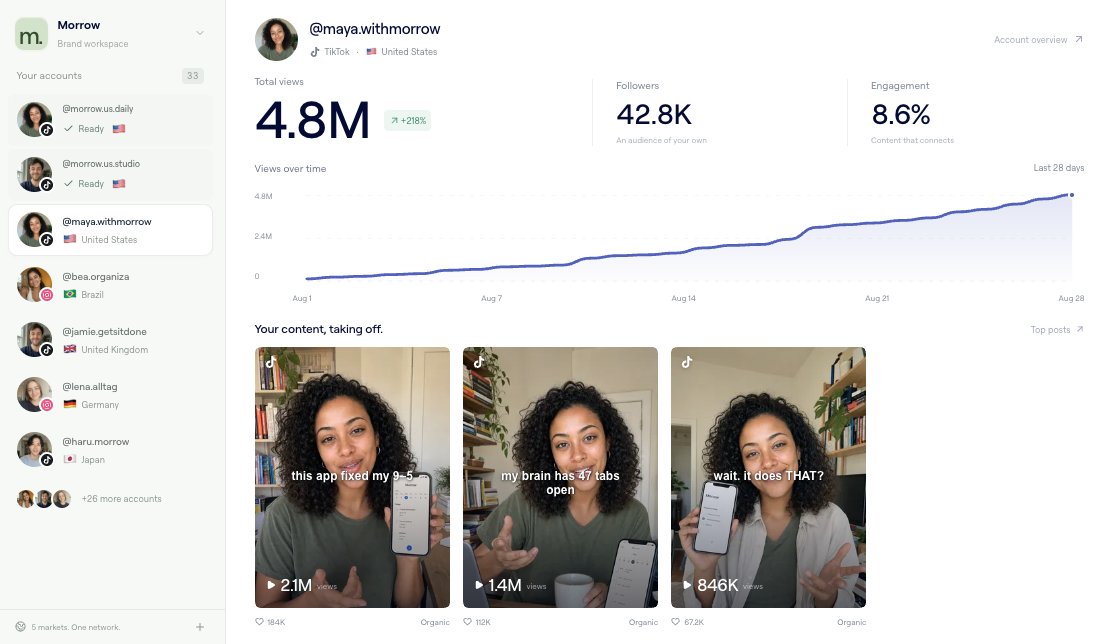 — "Multiple accounts per niche, format and location"
An app can have several ways to reach potential users. An artist can have several accounts distributing their music. A brand can develop different feeds for different audiences. And the accounts can keep working beyond a single campaign.
Traditional influencer agencies have relationships with people who already have an audience. But another kind of team is becoming more valuable: one that can build and operate a customer’s distribution network.
> If you already sell content, selling DISTRIBUTION changes what you can charge for.
A lot of this market is already white-labelled
Today, around 70% of our users resell TokPortal directly or indirectly. You probably have seen a lot of them on X.
Some are agencies. Some are SaaS platforms. Some sell a complete service. Others simply resell accounts and publishing.
We also have businesses buying from suppliers who themselves buy from us. Some of these are even "competitors " that operates with TokPortal API without knowing.
This market already exists and is accelerating. Arguably there will be more people selling and buying distribution in 2027 than 2024+25+26.
We built TokPortal around API access, MCP and white-label because we want those teams to build their own offers.
You can integrate our API in hours depending the size of your project. Fully white-labelled. It handles human, localized, native account creation and posting. It comes with everything your clients will ask for (advanced analytics, comments, running ads campaign, etc.).
You still need good content. You still need to understand the audience.
But you can spend your time on those things.
Stop assuming you have to sell to indie hackers
Someone watches a launch video get a million views on X and decides they’re going to build a similar product for the same audience.
Then another hundred people do the same thing. It's normal, you spend time there. You understand the jokes. Selling to people who look like you feels natural.
And sometimes it works extremely well, look at @wickedguro from Postiz. He found an audience that fits his product: indie hackers / vibecoders, people who spend time on this side of X. The combination of open source and distribution on X makes sense for that audience. They have a specific problem and a specific way of buying and using software.
But watching him or another person here succeed and thinking “I’ll do the same thing” misses the point. His audience fits his offer. That doesn’t mean it fits yours.
You can spend so much time on X that you start thinking the entire economy is micro-SaaS, mobile apps and AI agents. It isn’t. And there are plenty of customers outside that circle who need distribution, have real (often much bigger) budgets and aren’t trying to rebuild your product themselves over the weekend.
A lot of that indie hacker audience wants everything immediately, for almost nothing, and is happy to build a replacement themselves.
That can be a great audience for the right product. It can also be a painful audience to build an agency around.
Getting your first few customers there is one thing. Keeping them and becoming the obvious choice is much harder.
Meanwhile, there are entire industries spending money on distribution that barely appear in your feed.
Sell to niches that needs distribution AND have more money.
Music. Artists, DJs, labels, management companies, release campaigns. The need for reach is obvious, and there are plenty of ways to specialise. Independent electronic artists and a large catalogue owner do not need the same service.
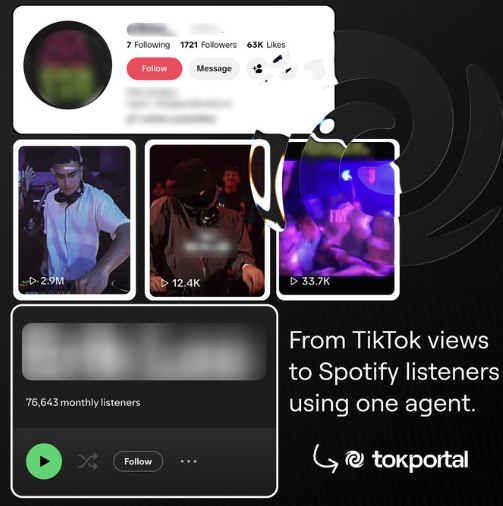 — "Sell 100 TikTok accounts to a record label for one of their artist and watch their Spotify monthly listeners grow"
Video games. Gameplay, characters, updates, challenges, funny moments, community content. There is so much material to work with, and plenty of studios that need help getting it in front of people.
Films and series. Production companies and distributors need attention around releases. There are opportunities around authorised clips, characters, genres and behind-the-scenes content.
Hotels and restaurants. Real places, real experiences, specific destinations. A resort group has a different budget and a different problem from an indie hacker comparing scheduling tools.
Events, concerts and festivals. There’s a date, a location and something to sell. You can build a whole offer around the announcement, the preparation, the event and the next edition.
Established ecommerce and retail brands. Actual products, existing customers, repeat purchases. Not just the dropshipping businesses everyone on your feed is already pitching.
Sports, associations and institutions. Clubs, competitions, cultural organisations and other teams that need to reach people consistently.
And those are just broad categories.
Inside music, you could focus on independent DJs. Inside hospitality, resort hotels. Inside gaming, studios preparing their first release.
You do not need the whole market. You need a group of customers you understand, with a problem they already spend money on.
Upsell distribution services and go from '$29/mo' to '$2,000/mo' pricing model
The simplest version is adding distribution to something you already sell.
You make content for clients. Now you also offer accounts, publishing and reporting.
You don’t need to launch a startup to do that.
Another version is a managed service for a specific industry. You build the account strategy, handle the content and charge a monthly fee to run everything.
Or maybe you already have software that creates videos, edits clips or generates slideshows. Your users still have to figure out what to do with the output.
Adding hosted accounts and publishing gives them a way to use it.
You can also build a network first and sell publishing capacity on it. Some customers want dedicated accounts. Others are happy to buy a campaign, a number of uploads or distribution priced by views.
Those are different offers. Be clear about what the customer controls.
And yes, you can build a self-serve product where someone chooses a country, orders accounts and manages their content through your interface.
The point is that you don’t have to invent a new content-generation tool to have a business here.
You can take a service customers already understand and make it much more complete.
How much should you charge?
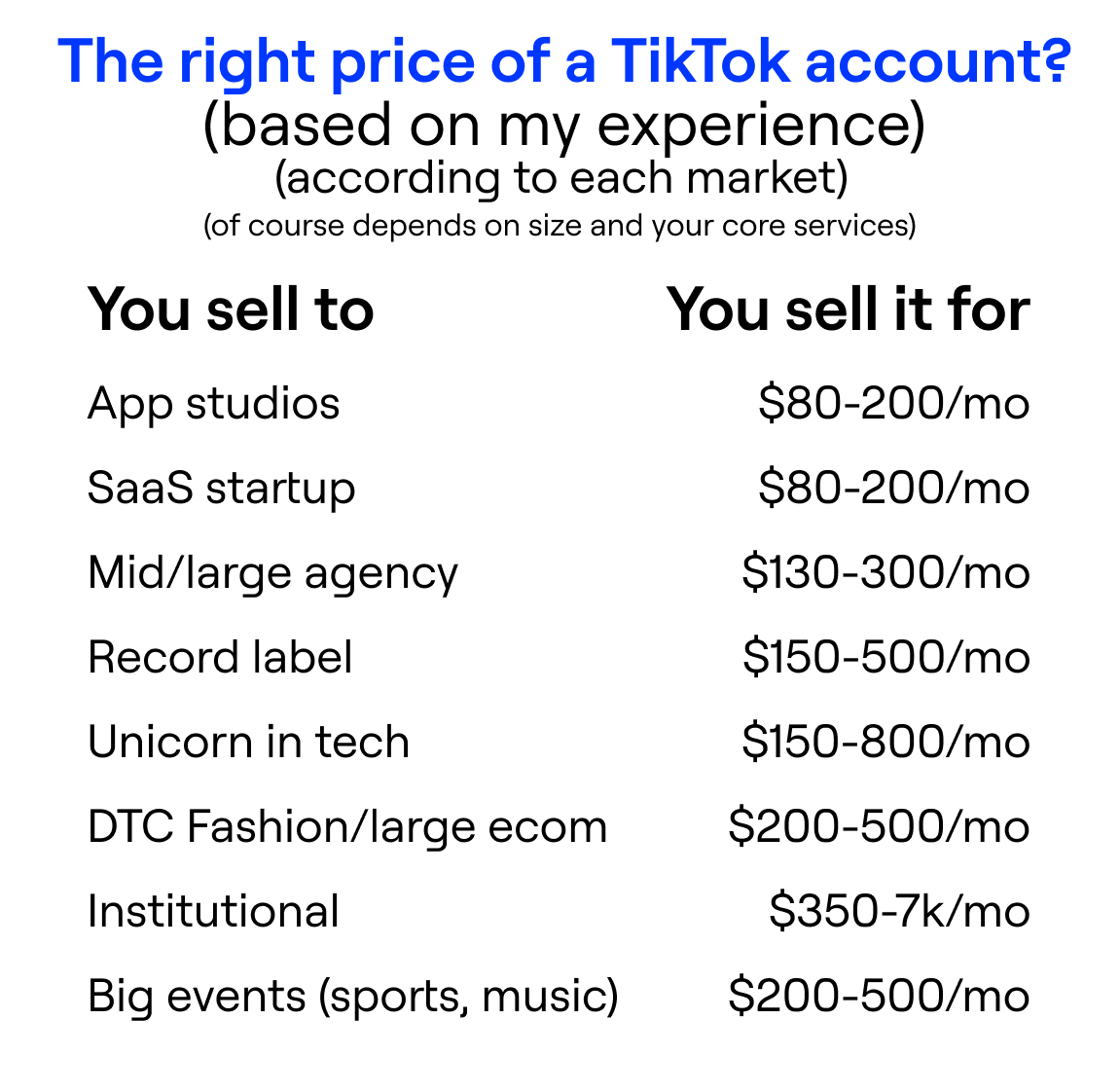 — "Source: i spent the last 2 years talking with people selling this"
I’m going to tell you something that sounds obvious, but people keep ignoring it:
Your price depends on who you sell to.
On X, you see teams constantly trying to undercut each other.
The price pressure often comes from the audience they chose. If your customers are indie hackers arguing over twenty dollars, that shapes your business.
Other customers care much more about whether you can handle the work properly.
Here are some examples from businesses that resell TokPortal. Note they often include other services too, but their distribution prices are:
- Distribution billed at $2.50 CPM, without directly selling the accounts.
- A TikTok account at $350 a month, plus $5 per upload, for customers in music.
- An Instagram and TikTok package at $1,200 a month, with three daily uploads included, for an established ecommerce brand.
- A hundred TikTok accounts at $25,000 a month, with an included publishing allowance, for an institutional customer.
A friend who works with me sells Instagram and YouTube management for around $10,000 a month, covering only 2 accounts. If you doubt it's true, I can get it, but also you need to explore distribution businesses a little bit more.
Same broad category. Completely different customer and service.
You have no idea how much this changes from one market to another until you start talking to people outside your usual circle.
Of course, content quality and the amount of strategy you provide affect the price.
A client paying you to handle everything is buying your judgment, your availability and the fact that they don’t need to manage the operation themselves.
A self-serve customer is buying something else. Don’t price those two businesses the same way. Look at the whole deal, not just the upload price Take the $2.50 CPM model. Ten thousand billable views would generate $25 in revenue. For a reseller paying $1 to $1.20 per human upload under their TokPortal arrangement, that leaves plenty of room for an attractive offer.
But you still have content costs, account costs, management and posts that don’t perform.
You need to understand the economics across the campaign.
The same applies to subscriptions. Decide how many uploads are included, what support you provide and what happens when the client wants more.
> You can make money selling accounts. You can make money selling uploads. You can make money selling a complete managed service.
The mistake is copying someone else’s price without understanding what their customer is actually buying.
So how to integrate tokportal api, white-label it and get rich?
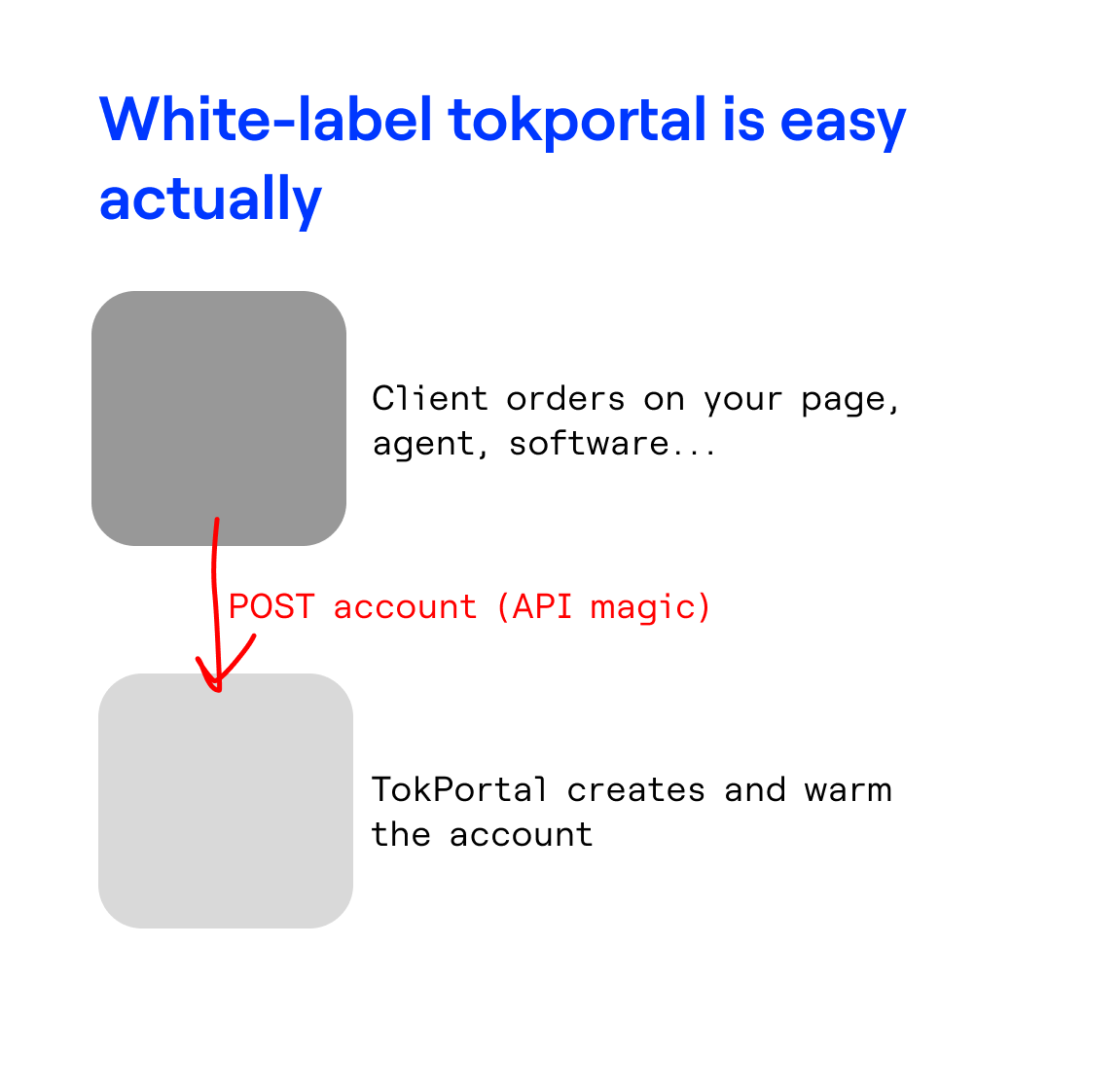 — "Scientific illustration "
A first API test can take minutes. Our documentation includes a free sandbox so you can validate requests and check pricing without placing live orders.
Give it to your AI. Ask it to map the features to your existing product or workflow.
You can get a simple internal setup working quickly. A complete customer-facing product needs more work: billing, delivery status, support, approvals and the details that make it reliable.
But this is a much smaller problem than building the underlying operation yourself.
I also help a lot of customers directly, including on WhatsApp, when they’re putting their offer together.
What I would spend more time thinking about is:
- Who already pays for this problem to be solved?
- What are they unhappy with today?
- What can you do better?
- Why would they stay after the first month?
Your AI can help you build the interface and backend but you still need good answers to those questions.
Yes, I want you to build on TokPortal

Obviously, this article has a commercial purpose. I founded TokPortal. I’m not going to pretend otherwise.
But our interests are aligned. ($)
TokPortal is an infrastructure for organic marketing. Something you can build your own business on, in the way you use Stripe for payments or Twilio for communications. This is the way we're developing this product.
I’m not trying to create one agency that is somehow excellent at music, sports, hotels, gaming, apps, saas, ecommerce and every other market. We can’t be good at everything.
Some of our customers make more money than TokPortal because they know how to sell to a market we don’t address ourselves. That is exactly what I want to happen.
A team working with sports organisations understands things we don’t. A music agency has relationships we don’t. A specialist in hospitality knows what those customers actually need. You should own that expertise and the customer relationship.
The conclusion you're not skipping
Thank you for reading this so far!
I think there are going to be very large businesses built around owning and operating distribution networks. Not all of them will look like SaaS companies. Not all of them will be posting their revenue on X.
A lot will simply find a good market, deliver a useful service and keep growing.
We’ve recently brought in talent across organic operations, strategy and distribution, and we’re expanding what teams can do through the API (more platforms, more control on accounts).
If you already make content for people or understand a market that needs better distribution, let’s talk.
You can start here:
- TokPortal: create your account and explore the platform.
- Developer documentation: give it to your AI and test in the free sandbox.
Build your offer, white-label TokPortal, and sell it to the people you understand. 💙
Related articles

How I Make $20k/Month With Pixar Animations (and how you can too)
Every time I've made the most money in my life it came down to right time, right skill. AI Animations are exactly this to me right now

How to launch a one-person product (without destroying your life)
Over the last 5 years, I’ve helped launch products that went on to make multiple 7 figures in revenue per year.
the whop partner business model explained in 5 minutes...
every online business model is a trade between 3 things.