Why You Waste Your Evenings (The Neuroscience of Post-Work Fatigue)

You're on the sofa. You know you should get up - exercise, read, cook a real meal - but you can't make yourself move. So you sit there, not resting, not working, scrolling through your phone while mentally rehearsing the tasks you're not doing. You tell yourself you're lazy.
You're not. But to understand why this keeps happening, you need to know what a full day of work actually does to your brain.
*I'm a neuroscientist and doctor. Every Tuesday I write about how to think and feel better. Join 95,000 readers on my newsletter.*
Every Decision You Make Has a Chemical Cost
Every time you focus on a difficult email, resist a distraction, or make a judgment call, you activate your prefrontal cortex - the region behind your forehead responsible for planning, decision-making, and self-control. In simple terms, it's the part of your brain that chooses the harder-but-better option.
But every activation has a metabolic cost.
A 2022 study from the Paris Brain Institute put two groups through a simulated workday lasting over six hours. Both groups performed the same types of tasks - but one group got a much harder version.
By the end of the day, the hard-task group showed a clear change in their brain chemistry:
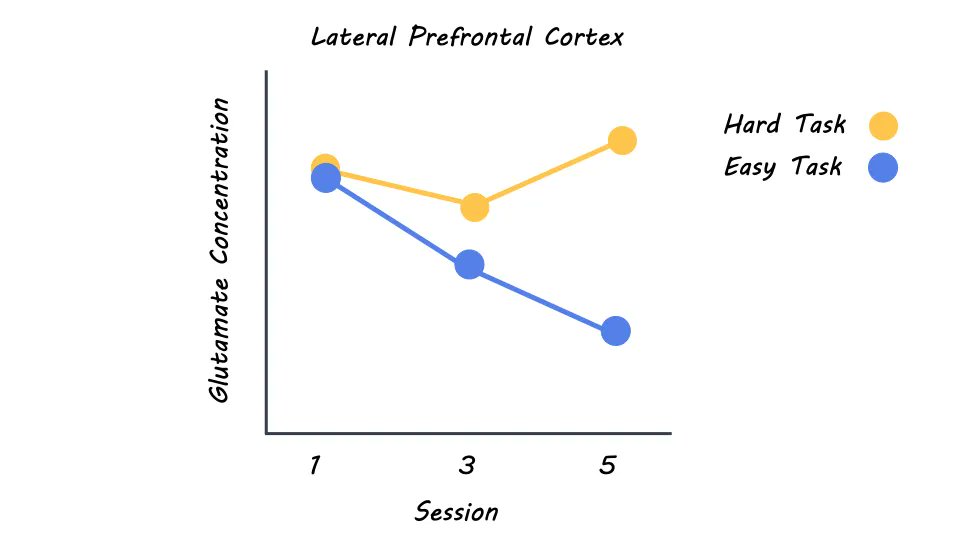 — "Glutamate concentration in the lateral prefrontal cortex across a six-hour workday. Each session is one block of tasks. The hard-task group (who performed cognitively demanding work) showed a steady rise in glutamate over the day. The easy-task group did not. - link"
- Hard cognitive work forced the prefrontal cortex to fire repeatedly. Every activation released a chemical called glutamate - the chemical neurons use to send signals to each other.
- Over a full workday, glutamate built up faster than the brain could clear it. In small amounts, it’s essential. But when it accumulates in one region, it starts to interfere with that region’s ability to function.
- The prefrontal cortex then became harder to activate. Think of it like lactic acid in a muscle - the harder you work, the more builds up, and the harder it becomes to keep going.
The result: the hard-task group participants defaulted to the easiest option available. A depleted prefrontal cortex could no longer override impulses or choose harder-but-better options. They became more impulsive and more likely to pick easy rewards over better ones.
That’s your evening. The phone instead of the running shoes. The infinite scroll instead of the book on your nightstand. Your depleted prefrontal cortex isn’t choosing what’s best - it’s choosing what’s easiest.
Real Recovery Means Taking Your Prefrontal Cortex Offline
If glutamate buildup is the problem, the solution is simple: stop making your prefrontal cortex work.
That means choosing activities that don't require decisions, judgment, or impulse control. Activities where your brain can run on autopilot while the chemical buildup clears.
Some examples:
- Go for a walk without a podcast. Let your mind wander. No choices to make, no input to process.
- Listen to music you already know. Familiar music doesn't demand attention the way new content does.
- Cook a recipe you've made before. Your hands stay busy, but your prefrontal cortex stays quiet.
- Sit outside and do nothing. This feels like wasting time. It's not. It's letting your brain recover so you can be productive later.
The pattern is the same in each case: your body can be active, but your decision-making brain needs to be idle.
If you do this for even 20-30 minutes before your evening starts, you give your prefrontal cortex a window to recover. The glutamate clears. The system comes back online. And the book, the gym, the meal you wanted to cook - they all become genuinely accessible again.
Why "Just Push Through It" Doesn't Work
You might be thinking: "Okay, but sometimes I need to be productive in the evening. Can't I just force myself?"
You can try. But here's why it usually fails.
Willpower is not a personality trait. It is a prefrontal cortex function. The same region that's been working all day - and is now flooded with glutamate - is the exact region you're asking to override your impulse to stay on the sofa.
You are asking the exhausted system to fix itself using the resource it already ran out of.
This is why the standard advice - "just start," "discipline equals freedom," "push through" - works fine at 9 AM and feels impossible at 8 PM. It's not that you had discipline in the morning and lost it. It's that the biological system that produces discipline has been running all day and is now impaired.
The solution isn't to try harder. It's to work around the depletion.
I covered four strategies to do exactly that - to be productive with a depleted brain, rather than fighting against it - for paid subscribers on my Substack. [Link]
Related articles

How I Make $20k/Month With Pixar Animations (and how you can too)
Every time I've made the most money in my life it came down to right time, right skill. AI Animations are exactly this to me right now
How to launch a one-person product (without destroying your life)
Over the last 5 years, I’ve helped launch products that went on to make multiple 7 figures in revenue per year.

the whop partner business model explained in 5 minutes...
every online business model is a trade between 3 things.