You Won't See It for Five Years. Then One Year Outpaces the Previous Ten Combined

Everyone has heard that compound interest is powerful. Almost nobody has been shown the actual mechanism, in real numbers, with the part that explains why the wait feels so much longer than the payoff.

Seven mathematicians, monks, statesmen, and investors spent seven centuries mapping this exact mechanism. None of them wrote it down as motivation. They wrote it as arithmetic. That is what makes it dangerous to ignore and boring to explain, and it is exactly why almost nobody who needs it has actually sat down and worked through the numbers.
Here it is, in seven pieces, with the actual math included.
1. THE MACHINE, EXPLAINED PROPERLY FOR ONCE
Simple interest pays you the same amount every period, calculated only on what you originally put in. Compound interest pays you on what you put in, plus every payment it already made you before this one. That is the entire mechanism. The difference sounds small in a sentence and becomes enormous over years, because in compounding, the thing being multiplied keeps growing.
- THE FORMULA: the value after time equals the starting amount multiplied by one plus the rate, raised to the number of periods, written as A equals P times (1 plus r) to the power of t
- WHY THE EXPONENT MATTERS: it means growth is not added year after year, it is multiplied year after year, and multiplication compounding on itself is a different shape of curve entirely
- THE QUOTE OFTEN MISATTRIBUTED TO EINSTEIN about compound interest being the eighth wonder of the world has never been found in his actual writing, but the myth persists because people sense correctly that something almost unbelievable is buried in ordinary arithmetic
Physicist Albert Bartlett spent decades lecturing on a related failure of intuition. He argued that the greatest shortcoming of the human race is its inability to understand the exponential function. The brain evolved to judge how fast a predator is closing the distance, not how a number doubles quietly in the dark for a decade before anyone notices.
2. THE MONK WHO WROTE YOUR RETIREMENT ACCOUNT BEFORE BANKS EXISTED
In 1202, an Italian mathematician named Leonardo of Pisa, later known as Fibonacci, published a book called Liber Abaci. Most people know him for a sequence of rabbits. Few know that the same book carried Europe's first serious mathematical treatment of interest accumulating on interest, brought back from merchants and scholars in the Arab world who had been working the problem for centuries.
- THE FIRST FRAMEWORK: Fibonacci showed merchants exactly how a loan grows when the interest is left to sit rather than withdrawn
- THE QUIET REVOLUTION: this single idea reshaped European banking, trade, and the very concept of saving for a future self
- THE MODERN ECHO: physicist Richard Hamming spent his career at Bell Labs studying why so few people did great work, and concluded that knowledge itself compounds the same way money does
A loan left untouched and a skill left untouched are the same equation wearing different clothes. Eight hundred years later, almost nobody has noticed they are reading the same book.
3. THE NUMBERS, RUN HONESTLY
Enough theory. Here is what actually happens to one thousand dollars, with five hundred dollars added every month, growing at ten percent a year, which is a conservative long-run number, not an optimistic one.
Read the right-hand column slowly. In year one, the interest earned is ninety five dollars, barely worth mentioning. By year twenty, the amount contributed and the amount earned in interest are close to equal, meaning the account has quietly built a second, invisible income stream the exact size of every dollar deposited so far. By year forty, total contributions are forty nine thousand dollars and the interest earned alone is one hundred sixty one thousand dollars, more than three times everything that was ever paid in.

- THE QUIET CROSSOVER: somewhere around year twenty one, interest starts adding more to the account per year than the person does
- THE PART NOBODY FEELS: every one of those first twenty years looked, month to month, almost identical to the one before it
- THE PART THAT CHANGES EVERYTHING: none of the later years work without every one of the earlier years being left alone
This is not a projection built on a lucky stock pick. It is ordinary monthly saving at an ordinary rate, doing something that feels extraordinary purely because it was never interrupted.
4. THE FOUNDING FATHER WHO BET ON A CENTURY HE WOULD NEVER SEE
In 1789, Benjamin Franklin added a codicil to his will. He left a bequest of roughly one thousand pounds, worth a few thousand dollars at the time, to each of his two home cities, Boston and Philadelphia, with one unusual condition. The money could not be touched for two hundred years.
THE INSTRUCTION: for the first hundred years, both cities could only lend the money out in small amounts to young tradesmen starting a business
- THE MIDPOINT: after a century, each city could spend a portion on public works while the rest kept compounding for another hundred years
- THE RESULT: by 1990, two centuries after Franklin's death, the Boston fund had grown to roughly four and a half million dollars, and the Philadelphia fund to roughly two million
Franklin never saw a cent of it. He was not betting on himself. He was betting on the mechanism, over a stretch of time longer than any single human life, and the mechanism kept its half of the deal without needing him to check in on it once.
5. THE COIN FLIP THAT PREDICTED YOUR PORTFOLIO
In 1738, a mathematician named Daniel Bernoulli was trying to solve a strange gambling puzzle involving a coin flipped until it landed tails, with the payout doubling every flip. The expected payout came out infinite, which made no sense to anyone who actually had to price the bet. Bernoulli's answer created the entire modern field of expected utility, and it planted a second, quieter idea inside economics: what compounds without limit on paper does not behave the way our gut expects it to behave in practice.
- THE PARADOX: a bet with infinite expected value can still feel worthless to a rational person, because psychology does not weigh numbers the way arithmetic does
- THE LESSON THAT SURVIVED: two and a half centuries later, this is still the reason people undervalue long, slow compounding and overvalue a single dramatic win
- ECONOMIST HARRY MARKOWITZ built modern portfolio theory partly on this same insight, earning a Nobel Prize for formalizing why time and patience change what a rational bet even looks like
Bernoulli proved the math could be infinite and still feel like nothing. Nobody has ever disproven the second half of that sentence.
6. THE FLAT PART OF THE CURVE, WHERE EVERYONE GIVES UP
Draw the compound growth curve honestly and it looks almost flat for most of its length. Not slow. Flat. For year after year the number moves so little that a person checking their progress can convince themselves nothing is happening at all.

THE SHAPE OF IT: in this example, roughly eighty percent of the curve's length looks like almost nothing, and the final fifth does almost all of the visible climbing
- WHO SAW THIS FIRST: investor Charlie Munger spent decades warning that the single biggest threat to compounding is a person who interrupts it
- THE COST OF QUITTING EARLY: every dollar pulled out during the flat stretch is pulled out at the exact moment it was closest to bending upward
This is the part of the story most explainers skip, because it is not inspiring. It is the opposite. It is the reason most investment accounts get emptied during the one stretch that mattered most, and the reason almost nobody actually gets to see the payoff, not because the math failed them, but because they left the table one hand before it turned.
7. THE MAN WHO NEVER SOLD, AND THE PAPER THAT REACHES THE MOON
Warren Buffett bought his first share of stock at eleven years old and has spent over eighty years compounding the same portfolio with a philosophy that sounds almost too simple to repeat. Buffett has said that time is the friend of a wonderful business and the enemy of a mediocre one. The overwhelming majority of his net worth was built after his fiftieth birthday, not before it, because compounding needed the decades more than it needed a clever entry point. Investor John Bogle, founder of Vanguard, spent his career showing that simply staying invested through decades outperformed almost every attempt to time the market cleverly.
Here is the same idea in a single physical object. Take an ordinary sheet of paper, about a tenth of a millimeter thick, and imagine folding it in half forty two times. Most people guess the final stack would reach a bookshelf, maybe a building. The actual answer, run through nothing more than repeated doubling, reaches past the Moon.
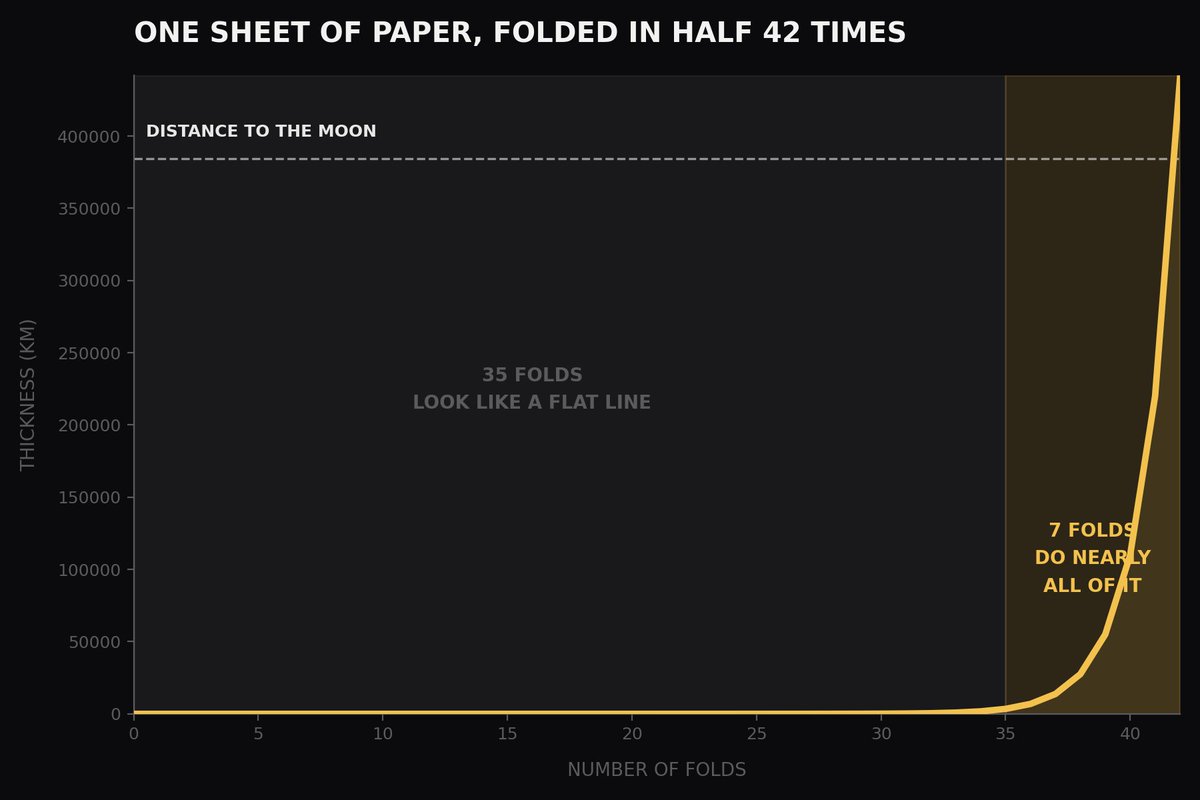
- WHY IT BREAKS INTUITION: forty two doublings sounds small, and each individual fold looks identical to the one before it
- WHERE THE ILLUSION LIVES: the first thirty five folds barely clear a few meters, and then the last seven folds do almost all of the distance
- THE ONLY HONEST TAKEAWAY: growth by doubling is never gradual and dramatic at the same time, it is gradual for a long time and then dramatic all at once, in a stretch most people never stay to see
Buffett is not famous because he picked well once. He is famous because he refused to stop, for eighty years, while everyone around him kept starting over.
THE STACK
Seven pieces, seven centuries of people who never met each other, all describing the same shape from different angles.
The formula multiplies on itself, which is why it does not feel the way addition feels. - the mechanism itself A number left alone compounds, a number withdrawn does not. - Fibonacci, Hamming Even a small amount, left untouched for two centuries, becomes a fortune neither city had to work for. - Franklin What compounds without limit does not behave the way instinct expects. - Bernoulli, Markowitz The curve is flat for most of its length, and that is where people quit. - Munger Time is the asset, not the timing. - Buffett, Bogle Doubling looks small until the final stretch, which is most of the distance. - the paper and the Moon
THE CLOSE
Nobody warns you about the part where nothing seems to be happening, because it is the least exciting sentence in the entire subject, and yet it is the only sentence that matters if you actually want the result instead of just admiring it from a distance.
Five years of a curve that looks flat is not five years of nothing. It is five years of the fold before the one that reaches the Moon. Most people close the book on the exact page before the one that would have shown them why they opened it.
The Moon was always in the math. It just does not show up until near the very last page.

Related articles

Mars men's full meta ads playbook (4,512 ads)
Mars Men has 4,512 ads live on Meta right now, on a Facebook page that only exists since December 2023.
How to Start a 6 Figure Faceless YouTube Channel (Full Breakdown)
I've helped over 400 people start profitable faceless youtube channels. i've ran over 50 channels myself. Generated over $4 MILLION by age 25. Worked with youtubers that have 10 million+ subscribers,…

10 UGC Hooks That Always Work (App Marketing)
your app doesn't need 100 new content ideas.