172M views happened on TikTok this week from just 5 trends. here's how smart apps are hijacking them

most app founders are still creating content from scratch.
meanwhile, the fastest-growing apps are doing something different: they're plugging their product into trends that already have millions of eyeballs.
i tracked this week's biggest trends and broke down how apps are using each one. here's the full playbook.

the 5 trends that generated 172M views this week

these aren't app trends. they're entertainment trends. but the apps that plugged into them got free distribution while everyone else was brainstorming "how to explain my features."
let me show you how each one works and how apps can use them. 🤑🤑
1. The Saxophone Disaster (131M views)
the format: start with a small, manageable problem. then escalate it step by step until the final moment feels completely unavoidable. all set to a dramatic saxophone sound.
one video hit 51M views. two others hit 47M and 33M.
how apps use this:
any app that solves a problem that escalates can plug into this format. screen time apps can show: "I'll just check Instagram for 5 minutes" escalating to 4 hours lost. budgeting apps: "I'll just buy one coffee" escalating to $400 in impulse purchases. fitness apps: "I'll skip one workout" escalating to 6 months on the couch.
the product doesn't appear until the final beat. the punchline IS the solution. the app IS the "what if you'd just used this."
47M views - Saxophone Disaster 💀💀💀
2. Life Is Boring, So I Pretend (23.5M views)
the format: creators reframe mundane daily tasks as high-stakes scenarios. cooking dinner becomes a MasterChef elimination round. cleaning the house becomes a crime scene investigation. studying becomes a CIA intelligence briefing.
the hook: "life is so boring, so I pretend..."
videos hit 10.1M, 8M, and 5.4M views.
how apps use this:
this is perfect for any app tied to a daily routine. a language app can frame studying as "training for a secret diplomatic mission." a habit tracker can frame checking off tasks as "completing missions before the deadline." a meditation app can frame a session as "entering the simulation."
the key insight: you're not explaining features. you're making the routine the content. the app just happens to be the tool inside the fantasy.
one mnemonic app called Keymagine already tested this angle. they framed memorizing vocabulary as "a CIA memory technique" and hit $8K MRR from a single AI slideshow format. the reframe turned a boring task (memorizing words) into something people actually wanted to watch (spy training).
10.1M views - Life Is Boring
8M views - Life Is Boring
5.4M views - Life Is Boring ]
3. Photo Every Hour (10.2M views)
the format: two people exchange one photo every hour throughout an entire day. the photos are shown side by side in chronological order with timestamps.
videos hit 5.3M, 3.1M, and 1.8M views.
the magic is in the comparison. different routines, different moods, different locations. viewers watch to see how two lives unfold in parallel.
how apps use this:
this format is built for any app that tracks behavior over time. a fitness app: "photo every hour" between someone who uses the app and someone who doesn't. the contrast IS the value prop. a productivity app: compare a structured day vs. an unstructured day. a meal planning app: compare what someone eats with the app vs. without it.
you don't need to sell anything. the side-by-side comparison does the selling for you. and the comment section becomes people debating whose routine is better, which drives engagement through the roof.
5.3M views - Photo Every Hour
4. Editing the Questions (6.8M views)
the format: film your partner answering a set of normal questions. then in post-production, replace the original questions with different ones. the answers now sound inappropriate, hilarious, or completely unhinged.
the hook: "editing the questions to make my boyfriend sound crazy."
videos hit 4.2M and 2.7M views.
how apps use this:
relationship apps, dating apps, couples therapy apps. the format is pure rage-bait that drives massive comment engagement. but any app with a social/community angle can adapt it.
the deeper play: apps don't need to create the trend content themselves. they need creators who are already making this content and can naturally integrate the app. "I edited the questions to test if my boyfriend actually knows me" + the app is where you take the quiz.
4.2M views - Editing Questions
[ VIDEO EMBED: 2.7M views - Editing Questions ]
5. Guess Our Zodiac Signs (738K views)
the format: show two or more people and ask the audience to guess their zodiac signs based on appearance, energy, or behavior.
smaller trend, but the engagement rate is insane. every comment is a guess, a debate, or a hot take.
how apps use this:
astrology apps are the obvious play. but any app with a personality/identity angle can use this. "guess which one of us has a 200-day streak on [habit app]." "guess which one of us actually sticks to their budget."
the principle: turn your audience into judges. give them options, let them debate. comments drive distribution. distribution drives downloads.
[ 404K views - Zodiac Signs ]
[ 334K views - Zodiac Signs ]
the real lesson: screen time apps already proved this works
screen time blockers were a dead category until founders started plugging into trends and formats instead of explaining features.

Reload hit 11M views on Instagram Reels with one repeatable format: a "bro hook" paired with a faceless phone demo. one video alone pulled 5.8M views and 55,000 comments, most of them asking "app name?" the format: "Bro: I really need a girl. What bro actually needs:" followed by a screen recording of blocking Instagram.
Second Thought made you play blackjack to unlock blocked apps. one ambassador on Instagram posted 23 videos using the same selfie-mode format and accumulated 826K views. three videos crossed 100K with the hook "BLACKJACK FOR SCREENTIME." the app hit Top 100 in Productivity in six European countries.
Useless hit 1.9M views from a single split-screen skit: one side shows someone using Apple's built-in screen time (tapping "ignore" and still scrolling 10 hours). the other side shows the app user at 1 hour. same problem, two outcomes. the difference is the app.
none of these apps invented a new content category. they each found one format that worked and ran it on repeat.

the trend hijacking playbook
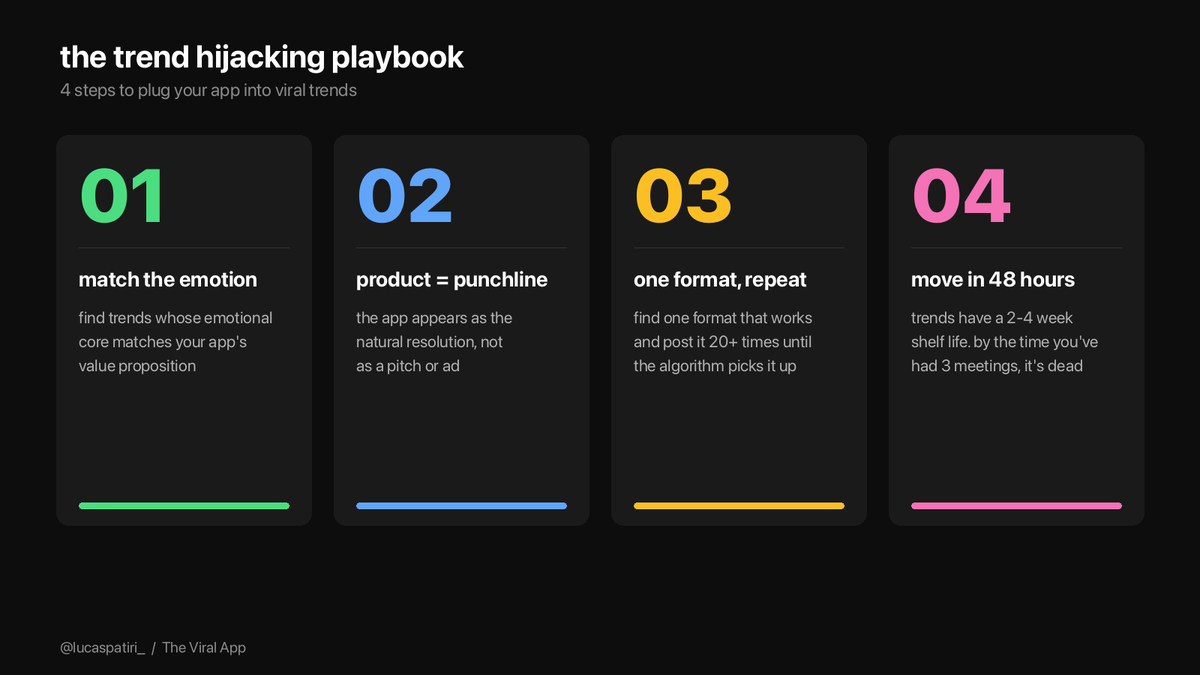
step 1: identify which trends match your product's core tension.
every trend has an emotional engine. the saxophone disaster is about escalation. "life is boring" is about escapism. "photo every hour" is about comparison. find the trend whose emotional core matches your app's value proposition.
step 2: make the product the punchline, not the pitch.
the worst way to use a trend is to slap your app logo on it and call it marketing. the best way is to make the product appear as the natural resolution of the trend's narrative. the viewer should discover your app, not feel sold to.
step 3: one format, one creator, repeat.
Reload proved it with bro hooks. Second Thought proved it with selfie-mode reviews. you don't need 10 formats. you need one that works and the discipline to post it 20+ times until the algorithm picks it up.
step 4: move fast.
trends have a shelf life of 2-4 weeks. the apps that win are the ones that adapt within 48 hours of a trend peaking. by the time you've had three internal meetings about "whether this aligns with our brand," the trend is dead.
the bottom line
172M views were generated this week by 5 trends. that attention is free. it's sitting there, waiting for someone to redirect it.
the apps growing fastest right now aren't the ones with the best features or the biggest budgets. they're the ones that move fast, plug into existing attention, and make their product feel native to the content people are already watching.
you don't need to create demand. you need to redirect attention that already exists.
every week, new trends generate hundreds of millions of views. every week, most app founders ignore them.
stop creating content from scratch. start hijacking trends.
I'm Lucas Patiri, Co-Founder of The Viral App. We've generated 1.5B+ organic views for mobile apps using creator marketing and content strategies. If you're building an app and want to talk growth, DM me.
Related articles

the playbook behind 10 billion views (and why most apps still brick)
i've spent the last 12 months studying 60 apps that collectively generated over 10 billion views on TikTok and Instagram. no paid ads. just short-form content.

how to speedrun your consumer app to $1M+ with organic UGC
i've added $8,500,000+ ARR added to client topline revenue through end-to-end organic UGC marketing.

The ULTIMATE Organic Marketing Guide For App Founders
I’m going into calorie deficit, fat loss, high protein meals, gym meals, restaurant calories, what I eat in a day, meal prep, macro tracking, cutting, bulking, low calorie snacks and whatever else st…