the playbook behind 10 billion views (and why most apps still brick)

i've spent the last 12 months studying 60 apps that collectively generated over 10 billion views on TikTok and Instagram. no paid ads. just short-form content.
some of these apps print money.
others have billions of views and almost nothing to show for it. 1.5 billion views and poor App Store performance. 24.2 million views and only 6,000 downloads per month.
the difference comes down to one question nobody asks before posting their first video.
the one question
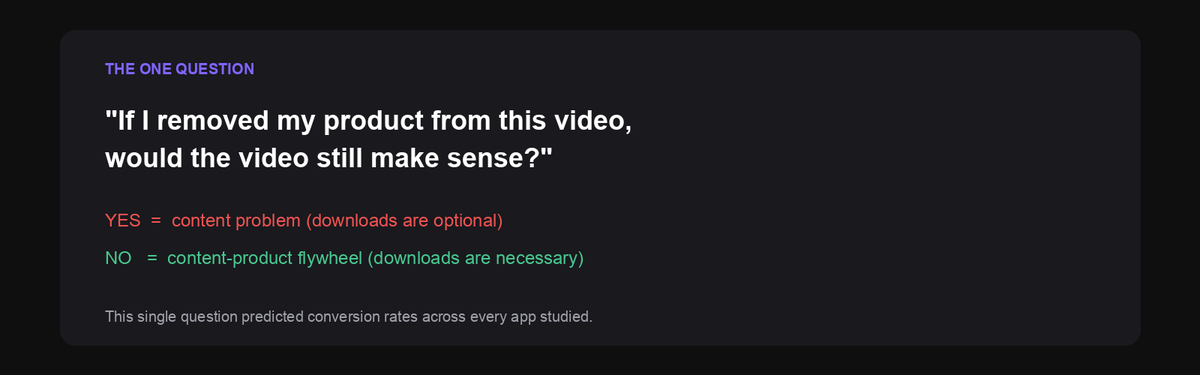
before you post anything, ask this:
"if i removed my product from this video, would the video still make sense?"
if yes, you have a content problem. the video entertains independently of your product. downloads are optional for the viewer.
if no, you have a content-product flywheel. the viewer must engage with your product to get the experience they just watched. downloads become necessary, not optional.
this single question predicted conversion rates across every app i studied. structural dependency between content and product.
let me show you exactly what i mean.
the apps that nailed it :0
themepack: 2.1 billion views, 400K downloads per month

one creator account. @themie_app. the content is simple: show a default boring iPhone home screen, quick transition synced to a music beat drop, reveal a fully themed home screen with matching icons, widgets, and wallpapers.
every single video is a live product demo disguised as satisfying visual content. the transition IS the app in action. you literally cannot replicate what you see without downloading ThemePack.
400,000 downloads per month from a single creator account. the CAC is effectively zero at massive scale.
remove the product from the video and what do you have? nothing. there is no video without the app. that's why it converts.
mob kitchen: 2.3 billion views, $4.5M ARR

ben lebus started posting recipe videos from a small kitchen in the UK in 2016. today: 3.2 million Instagram followers, $350K+ MRR, #15 on the UK App Store, 270K downloads per month.
the stat that matters most: roughly 1 in every 2 videos surpasses 1 million views on Instagram. a 50% hit rate. that's not luck. that's a format so dialed in it's almost unfair.
his top format: "POV: you have 15 minutes to make dinner." 21 million views on the top post. the POV format puts the viewer in the scenario. it's not "watch me cook." it's "this is YOU, rushing to make dinner."
every recipe video is simultaneously entertainment AND a product demo. you watch the recipe, you want it, you open the app, you get the meal plan and shopping list. the content IS the top of a conversion funnel.
ben didn't need a network of accounts. he built a $4.5M ARR business with his own face and voice. founder-led content at its peak.
drawly: 122 million views, $20K MRR, 1 format
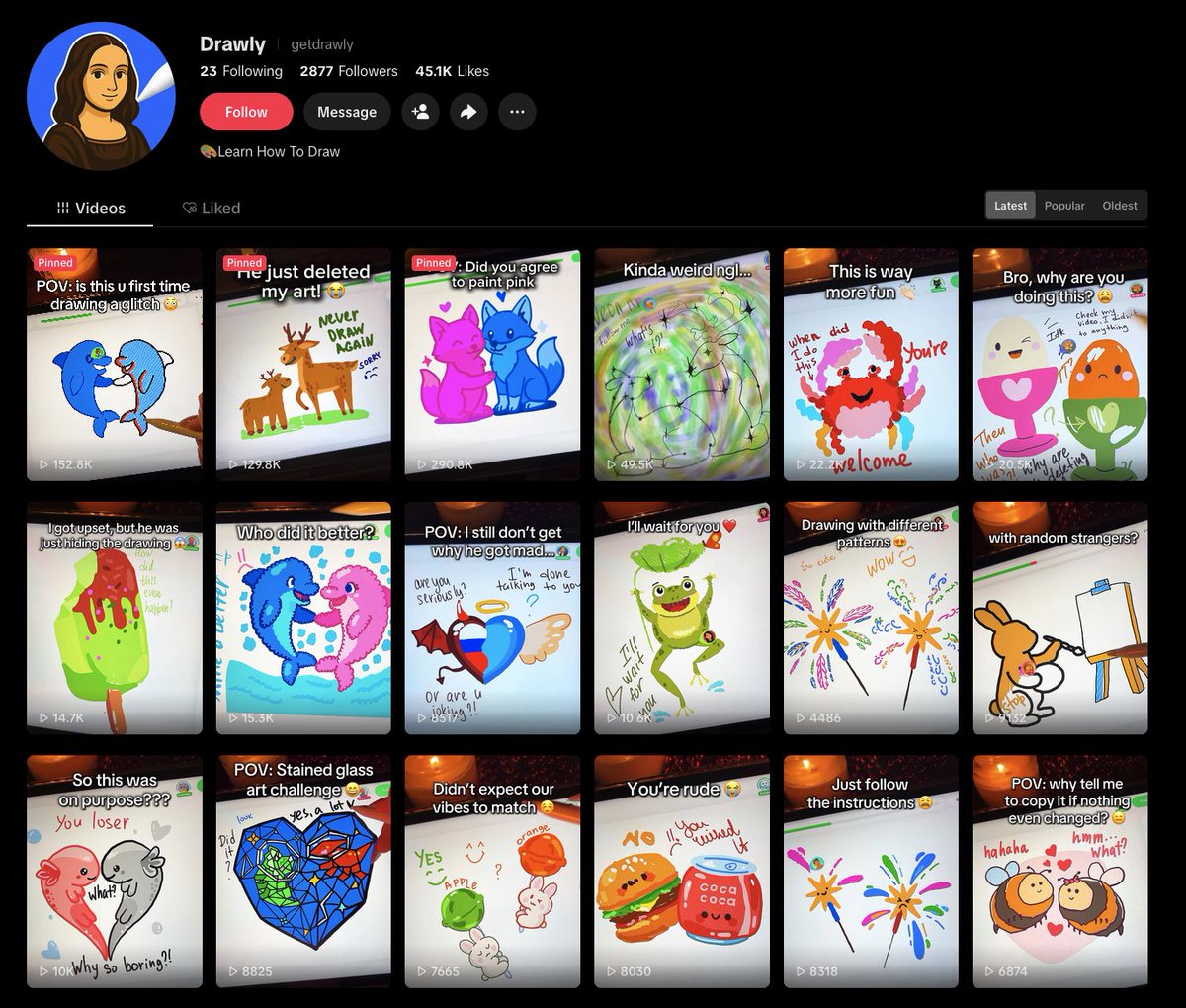
a drawing app with 55 faceless accounts. the entire content strategy: iPad screen recordings of people drawing.just a top-down shot of an iPad with a stylus creating art in real time.
why it works: drawing content requires no language. a viewer in Brazil, Japan, or Germany is equally engaged. visually hypnotic (people watch to see the finished product). and every video IS a product demo because you see the brushes, colors, and tools in action.
the surprising part: YouTube Shorts was their biggest channel (59.4M views), not TikTok (24.3M). the "watch to see the finished drawing" mechanic drives high completion rates, which YouTube's algorithm rewards heavily.
one format. 55 accounts. 122 million views. you don't need 10 content strategies. you need one that works and the discipline to execute it at scale.
stars align: 31 million views, 1 creator, 2 formats
this one is fresh from social growth engineers (march 2026).
stars align is a dating app that uses astrology and birth charts to match people. the app existed since 2021 with almost zero downloads. in may 2025, they created a TikTok account.
instead of building a creator network, they relied on one single creator with two formats.
format 1: "zodiac couples." same hook, same audio every time. she pairs zodiac signs together and reacts to each couple. one video hit 4.1 million views.
format 2: compatibility score reveals using the app's interface.
31.1 million views from one creator and two formats. the app's compatibility scores are visible in every video. remove the product, and the content doesn't work. the scores ARE the content.
this is the thesis in action: product-inseparable content, minimal resources, massive reach.
the apps that didn't convert : (
funimate: 1.5 billion views, poor conversion
@sindexzs. 3.3 million followers. 14.1% engagement rate. 2,000+ videos posted. 1.5 BILLION views.

and the app didn't see proportional App Store performance.
the content is flashy video edits, transitions, visual magic. viewers follow @sindexzs because the edits are cool, not because they associate those edits with Funimate. the creator IS the brand. the app is invisible.
remove the product from the video. does it still work? absolutely. it's a talented person doing impressive edits. could be any editing app. could be no app at all.
1.5 billion views with unclear product attribution means you've built a massive audience for a creator, not for your app. if @sindexzs left for a competitor, the audience would follow the creator, not the tool.
manifest daily journal: 24.2 million views, 6K downloads per month
the creator talks about journaling, manifestation, mindset, personal growth. the content performs reasonably well. but only 6K downloads per month on 24.2 million views.
that's a 0.025% conversion rate.
the audience gets 95% of the value (inspiration, motivation, mindset shifts) without ever downloading the app. the journaling app is mentioned, but it's peripheral to why people watch.
compare that to ThemePack: 2.1 billion views, 400K downloads per month. the product is structurally necessary for the viewer to get what they saw. Manifest's product is structurally optional.
the spectrum
after studying all 60 apps, i mapped them on a spectrum. on one end: product-inseparable content (ThemePack). on the other: creator-dependent content (Manifest).
conversion correlates directly with how inseparable the product is from the content. every time.
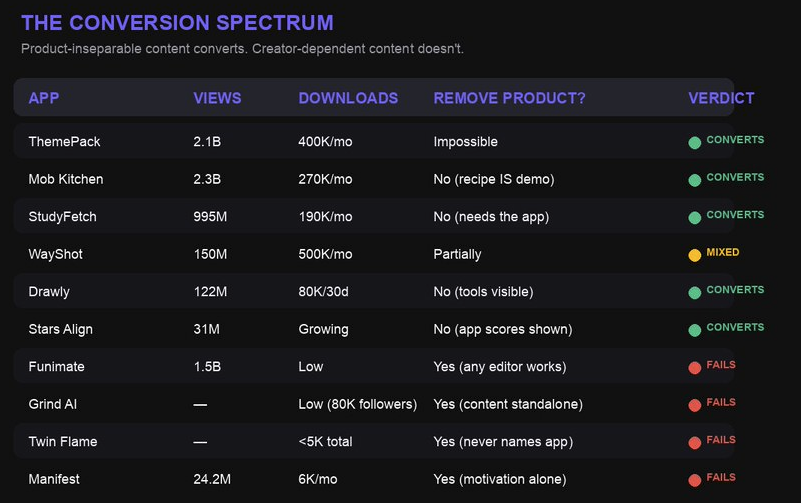
5 other patterns that showed up everywhere

1. one format is enough
drawly used one format across 55 accounts for 122 million views. wayshot used three. mob kitchen uses one dominant format ("POV: you have 15 minutes"). stars align used two formats for 31 million views.
the temptation is to test 10 content strategies. the data says: find one that works and run it 1,000 times. testing many formats is how you FIND the winner. but once you find it, discipline is what scales it.
2. founder-as-creator is underrated
mob kitchen ($4.5M ARR) is built entirely on ben's face and voice. kaml abdel-kader markets 9 apps solo with no team, hitting $10K MRR on his best app (sum puff, 150M+ views) using faceless and face-cam formats he reuses across all 9 apps.
eleven percent (sge, april 2026): devin huynh built an AI video editor and leads TikTok with founder-driven content showing real editing workflows, not polished ads. the founder IS the proof that the tool works.
the advantage: zero coordination cost, instant iteration, cross-app learning. the trade-off: you can't produce as much volume as a team. but if your face IS the brand, competitors can't copy that.
3. instagram can be the primary channel
mob kitchen: 2B+ views on Instagram (vs 324M on TikTok). drawly: 59.4M on YouTube, 38.2M on Instagram, 24.3M on TikTok despite having the most TikTok accounts. kaml's apps perform primarily on Instagram, not TikTok.
most app marketers assume TikTok is the default. the data says platform fit matters more than platform popularity. test both. go where your format performs (recently we've seen better results on ig)
4. volume is a real strategy (when you have the ops)
studyfetch: 225 accounts, 150 videos/day, 995M views. truthseek: 18 accounts, 30+ videos per day per account, $100K MRR in 22 days. the AI companion app category runs 30+ faceless accounts per app as standard.
but volume only works with operational infrastructure. scattered comms, slow approvals, and inconsistent quality kill volume campaigns. centralize everything: one channel per creator, one master sheet, one approvals inbox, one performance dashboard.
we run this at the viral app across 62 campaigns and 590 creators. the ops infrastructure is harder to build than the content.
5. 20 posts can beat 22,504 posts (with the right audience)
focus friend (hank green's pomodoro timer): 20 pieces of content. $300K MRR. #1 on the App Store in 72 hours. 1 million downloads.
compare to studyfetch's 150 daily posts. both worked. the difference: hank had 12 million followers and years of trust built up. studyfetch had zero audience and compensated with volume.
if you have an existing audience, you don't need volume. if you don't, volume is how you build one.
the conversion test (use this before posting)
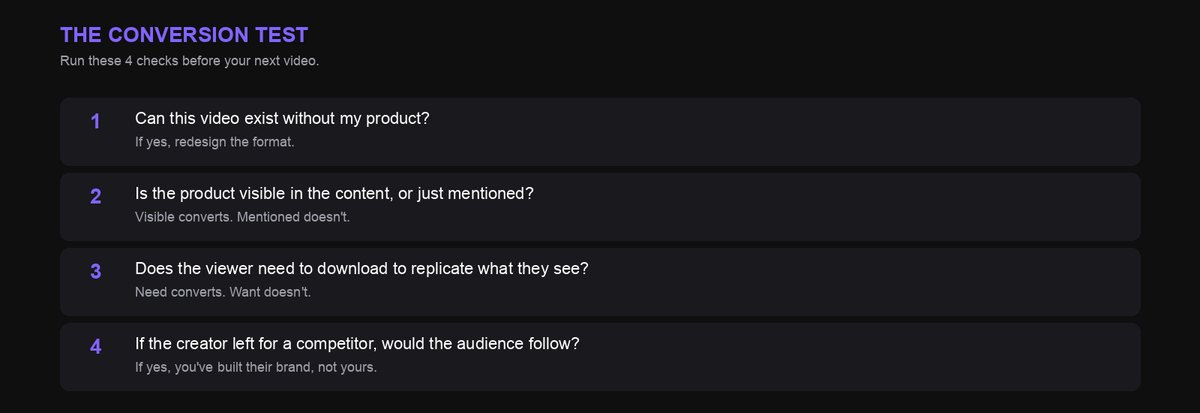
before your next video, run through these 4 checks:
-
can this video exist without my product? if yes, redesign the format.
-
is the product visible in the content, or just mentioned? visible converts. mentioned doesn't.
-
does the viewer need to download to replicate what they see? need converts. want doesn't.
-
if the creator left for a competitor, would the audience follow the creator or stay with the product? if they follow the creator, you've built their brand, not yours.
if your content fails checks 1 and 4, more views won't fix conversion. it just means more people watching content that doesn't drive downloads.
what this means for your UGC strategy
we've generated 2 billion organic views across 62 campaigns, managed 590 creators, and produced 22,504 videos. the pattern from our own data matches what i found studying these 60 apps.
our worst performers are the ones where you could remove the app and the video still works.
the brief, the creator selection, the format, the feedback loop. every operational decision should be filtered through one question: does this make the product more necessary to the content, or less?
60 apps. 10 billion views. the answer is always the same.
make the product the content. not the other way around.

Related articles

172M views happened on TikTok this week from just 5 trends. here's how smart apps are hijacking them
most app founders are still creating content from scratch.

how to speedrun your consumer app to $1M+ with organic UGC
i've added $8,500,000+ ARR added to client topline revenue through end-to-end organic UGC marketing.

The ULTIMATE Organic Marketing Guide For App Founders
I’m going into calorie deficit, fat loss, high protein meals, gym meals, restaurant calories, what I eat in a day, meal prep, macro tracking, cutting, bulking, low calorie snacks and whatever else st…