get rich with native ads
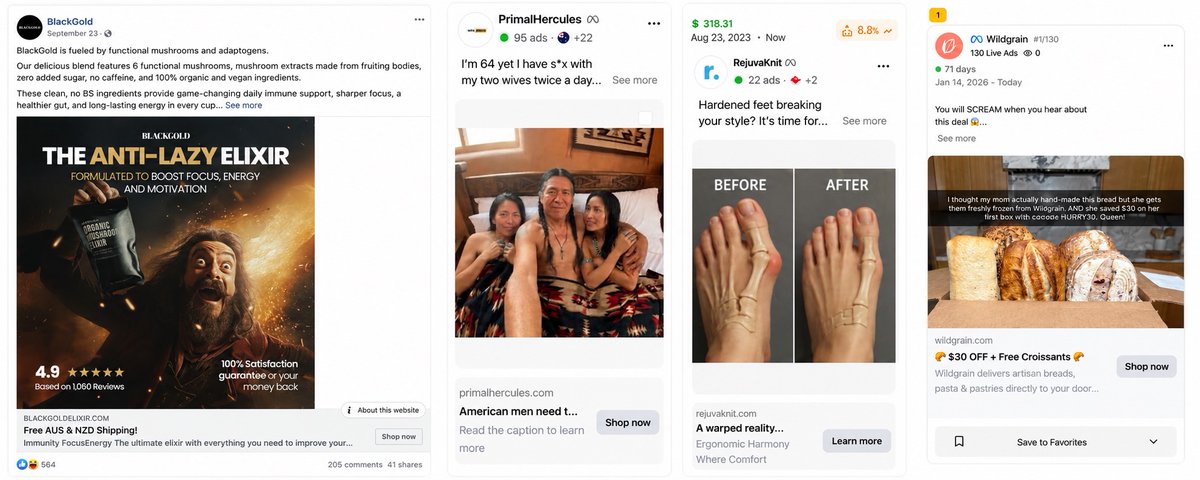
native ads are the format working best right now.
they're also the format that forces you to learn your customer.
when you scrape a competitor's cartoon concept, you get an ad that 'may' go viral but dies with no explanation.
when you write a native you get an ad, VSL, UGC script, POV script, with the reason behind why it worked.
here's my native playbook:
1. what are native ads?
1.1 - format
a long form text placed in the primary text field. it's not 10 sentences, it's closer to writing a 10-page book. it's meant to be long, dense, and full of value. the length is why it works because you have room to describe the problem in the language customers use.
1.2 - test
how organic does it feel? buyers decide within a second whether they're reading a post or an ad. natives should read as organic as it boosts engagement and holds a low CPM. this is the single most important thing to judge in your process.
1.3 - feed
in the feed it looks like the profile picture belongs to a person rather than a brand. the body is a long block of story driven copy with one image at the bottom. the comment section floods with people agreeing the story resonates which carries the illusion.
1.4 - concept
cartoons, 3D speaking items, and AI videos are working right now, but the issue is how those concepts get made... scraping ads from competitors, adapting concepts to your product, and launching without knowing which problem you solved or why each ad works so well.
1.5 - mechanism
people saying writing your objectives down is more powerful than holding them in your head. ads work the same way. if you steal competitors ads, you won't understand the avatar because you never wrote it down or reflected on it. the native forces you to write the whole thing which forces the research.
2. how do i research the avatar?
2.1 - reddit
nobody knows who is speaking. people describe everything in full detail there without holding back. use this platform to your advantage because it's gold.
2.2 - amazon
these compile on top of reddit. it gives you the same language attached to a purchase so run both together and you'll get the voice of the customer.
2.3 - fb/ig/tt
your name and face is attached to posts there so people will not speak as freely about how they feel day-to-day when all their friends are gonna see what they said.
3. how do i source the structure?
3.1 - separate structure from content
research gives you WHAT to say. proven native concepts give you the order to say it in. take a winning architecture and fill it with your own research. still not copying.
3.2 - filter for what's scaled
pull natives that are running as image ads with long primary text in your language and your market. filter for ads that've live for at least 30 days and rank in the top % of spend.
3.3 - study 3-5 and map
pick a small number that sit close to your niche and read through them properly. check where conflict happens, where the story pivots, where specific numbers appear, which line lands the hardest... this is your skeleton.
3.4 - build the habit
read winning natives across niches every day. expose yourself to the type of formats that scale so you can replicate them.
4. how do i write the native?
4.1 - open on the pain
the native starts on the problem and describes it in detail. make the reader see their own life on the page or nothing will happen.
4.2 - negligence structure
this is the structure we use most and the one i consider the most powerful. you write the body so the reader concludes that the cause of their problem is their own negligence. they did not take any initiative. they did not buy anything. they watched their life run and did not act. the reader arrives at the end holding responsibility for the problem, which is what makes them act on the solution.
4.3 - hook rules
hook rules the hook needs a bold statement. it needs tension that pulls on emotion. the product should be visible or clear enough from the problem framing that the reader can imagine it. the messaging has to be specific. the reader should know you are speaking about an ankle problem or a foot problem within seconds. keep sales language out of the top of funnel. that belongs in the call to action and in bottom of funnel ads.
4.4 - holds beats, change the words
write your version of each beat in the order you mapped it. the emotional flow is what carries the reader to the bottom of a long text. copy that follows the source too closely gets flagged as duplicate content and pulled after it starts spending. the beats are yours to reuse. the sentences are not.
4.5 - use your brain
AI will write you a native brief in seconds. you can tell when it did. the text does not read like a person speaking. people produce concepts an AI will not reach. time in ecom gives you a twisted mind that invents angles a model will not. use it.
5. how do i match image to copy?
5.1 - image carries illusion
the copy can be a 2500 word story and the image can undo it. a polished product shot on a white background tells the buyer this is an advertisement before they read a word. the brain flags it in under a second and the story goes unread.
5.2 - what an organic image looks like
it looks like a photograph a person would post. a drawer with half used products in it. a shot taken in a car. a photo with bad lighting. the image has to belong to the story you just told.
5.3 - how to produce them
give the copy to an image model and ask for a native ad image that matches the story. iterate until it stops looking produced. this improves through volume. generate and test until you know what your buyer reads as real.
6. how do i keep the ad compliant?
6.1 - the risk
a native that claims authority you do not hold moves from aggressive marketing into false advertising. the outcomes are refunds, chargebacks, a restricted ad account and the loss of your pixel data. the ad that scaled for 60 days takes the account with it when it goes.
6.2 - rules to follow
do not claim a medical credential the brand does not have. do not promise a result the product has not demonstrated. do not use endorsements that do not exist.
6.3 - apply this test
read every claim in the copy and ask whether you would defend that line in front of a regulator. if the answer is no, rewrite it before meta rewrites it for you. a doctor voice becomes a person who tried the product and describes what happened. an unprovable promise becomes the mechanism explained.
6.4 - scaling decisions
a clean native runs for months and scales with budget. a native carrying a false claim scales until it is caught and you don't want to lose everything over something avoidable.
7. how should i test?
7.1 - multiple texts
write several natives in several formats and run them against different avatars. you are testing which avatar responds, and the text is the instrument.
7.2 - decompose
list the parameters of the ad before the video editor touches it:
-
the main avatar
-
the sub avatar
-
the funnel stage
-
the framework, whether that is VSL, problem solution or authority figure
-
the character, including age and role if it is an AI character
-
the text font and the background
-
the music
this sets the editor inside a frame before the brief instructions arrive. it also means a winner can be explained, which is the only way it gets repeated.
7.3 - volume and rhythm
we push around 20 concepts per brand per week, which lands at about 60 ads including variations. launch on a fixed day so the team works to a flow instead of batches. run a feedback loop every week over the winners and the losers so the same errors stop repeating.
7.4 - read the text first
the format stays the same across natives, so the check is on the text. read it and feel whether the emotion lands. confirm the opening matches how you start a native. confirm the body carries the pain and the negligence. i still run these checks on creatives myself.
7.5 - score the ad
a native fails on the weakest of its parts. score the structure, the writing, the image and the compliance on the last three natives you ran. the lowest score is the thing to work on. that is more useful than telling yourself to write better ads.
8. how do i turn this into a funnel?
8.1 - the native hands you the VSL script once one avatar is performing you already have the story, the pain points, the hook and the full structure. that plugs into a VSL without starting over.
8.2 - iterate off the VSL run variations from the VSL and you get new winning concepts out of it. each new concept traces back to the research, so you know where it came from.
8.3 - scripting is the puzzle all the information sits on the table and the job is finishing the puzzle. material that belongs in the body ends up in the hook, the ad stops taking off, and the concept gets blamed. the concept was fine. the placement was wrong.
8.4 - one native feeds many formats a winning native holds enough data to produce a VSL, an AI authority figure reading the pain, a UGC piece and a POV piece. the emotion and the pain are already written. the format is the wrapper.
8.5 - build a bible of formats keep every format documented by funnel stage.
QT this and follow me @ChelalaPierre1 for more content like this
Namaste
Related articles
The 5 AI UGC Formats We Run and When to Use Each
picking the wrong format is one of the best ways to waste good content.

How to create a winning-ad machine (for 7-figure brands)
Right now there's a supplement brand running roughly 8,000 active ads on Meta.

FAKE 24-YEAR-OLD MAKES $18K/MO SELLING SKINCARE ON INSTAGRAM—NO THIRST TRAPS.
She doesn’t exist. She’s 5 text files, 1 LoRA, and about 3 hours of work a day.