How to create a winning-ad machine (for 7-figure brands)

Right now there's a supplement brand running roughly 8,000 active ads on Meta.
One product. A single oregano oil softgel. From what I've heard they're doing at least $10-15M a month off it.
Your first instinct is to look for the trick.
The product, the offer, some media-buying secret.
There isn't one.
What they've actually built is a machine that manufactures winning ads on repeat, so that no single creative, format, or trend can make or break them.
That's the real line between brands that scale and stay scaled and brands that spike and then collapse.
You're not buying ads. You're running a machine.
Most brands treat creative hand to mouth.
Make a few ads, hope one hits, ride it while it lasts, then scramble when it dies.
A machine is different. It has four parts, and they feed each other in a loop:
- The Map tells it what to build and who for.
- The Assembly Line produces winning candidates at volume.
- The Scoreboard tells it, objectively, what actually worked.
- The Loop feeds that lesson back into the Map so the next round is sharper.
Resilia has all four running. That's why 8,000 ads isn't chaos for them, it's throughput. Let me walk through each part, because once you see the machine you can't unsee it, and you can start building your own.

Part 1 — The Map
The Map is where scale is won or lost, and it's where most brands are thinnest.
We call it the Creative Strategy Map, and it does one thing: it turns a vague product into a clear grid of exactly who you're talking to, what they already know, and what to say to them.
First, the main buyer personas, each with a core pain point or reason to buy.
Across the top, the awareness levels, from people who don't yet know they have the problem to people ready to buy. In the boxes, the specific angles for each persona at each stage.
Every ad the machine produces traces back to one box.
But remember, personas HAVE TO BE SPECIFIC:
- The chronic gut sufferer, targeted through symptoms rather than the named problem. Bloating, that crawling feeling at night, jaw clenching. Symptoms are a far bigger door than the diagnosis, because people are aware of the symptom long before they'll accept the cause.
- The weight loss seeker, hit with a root-cause reframe. It isn't your fault, you've been doing everything right, the real blocker is a parasite or a cortisol response nobody told you about.
- The natural remedy believer, sold on speed and transformation. Here's what oregano oil does inside your body in the first seven days.
The engine under all three is the same move: remove the blame, name a hidden enemy, position the product as the one thing that removes it.
That's not a lucky creative. That's a map being executed.
The Map also shows you your white space, which is what is missing from your creative strate
Part 2 — The Assembly Line
Once the Map tells you what to build, you have to build it at volume. This is where the machine metaphor gets literal, and where AI has changed everything.

Volume only works with real diversity
Here's the part almost everyone gets wrong. Raw volume is a trap on its own.
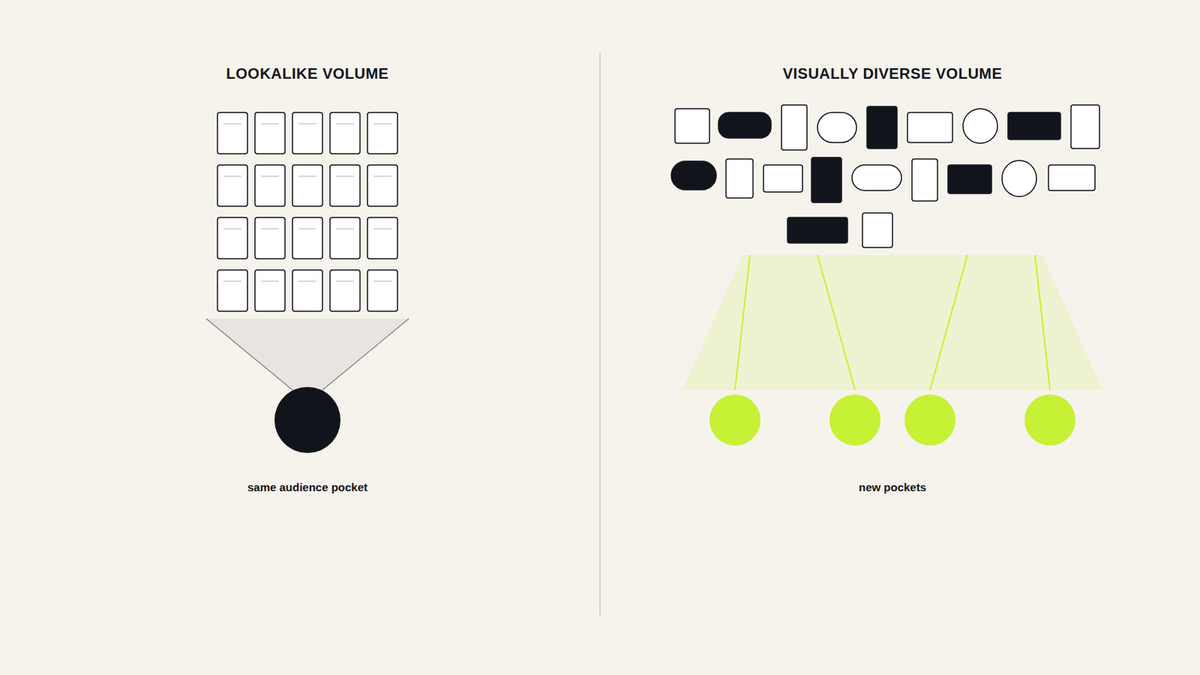
With Meta's current delivery, ads that look alike get served to the same pocket of people, so you can launch 100 near-identical ads and the system effectively treats them as two or three.
You paid for a hundred and got the reach of a handful.
The fix is diversity, and I need to be precise about that word, because this is the single most misunderstood thing in the game right now.
Diversity does not mean the same ad with a new hook line or a swapped voiceover. It means creatives that are visually and structurally different. Different formats, different openings, different visual worlds, different people, different pacing. If two ads would look the same to someone scrolling with the sound off, Meta reads them as the same, no matter how different the script is on paper.
So the target is never just more ads. It's more ads that are genuinely, visibly different from each other. Resilia does this well: thousands of ads, spread across many pages, in pixel animation, claymation, AI characters, first-person skits, timelines. High volume, real visual range. That's what keeps their reach expanding instead of recycling the same audience.
AI runs the line. Humans hold the wheel.
This is how we actually produce at that volume, and it's the opposite of what most brands do with AI.
The common failure is hiring a cheap VA to spit out hundreds of generic AI images, skipping research and strategy entirely, and flooding Meta with lifeless creative that all looks the same. That's just lookalike volume with extra steps, and Meta's delivery eats it alive.
Our line looks different.
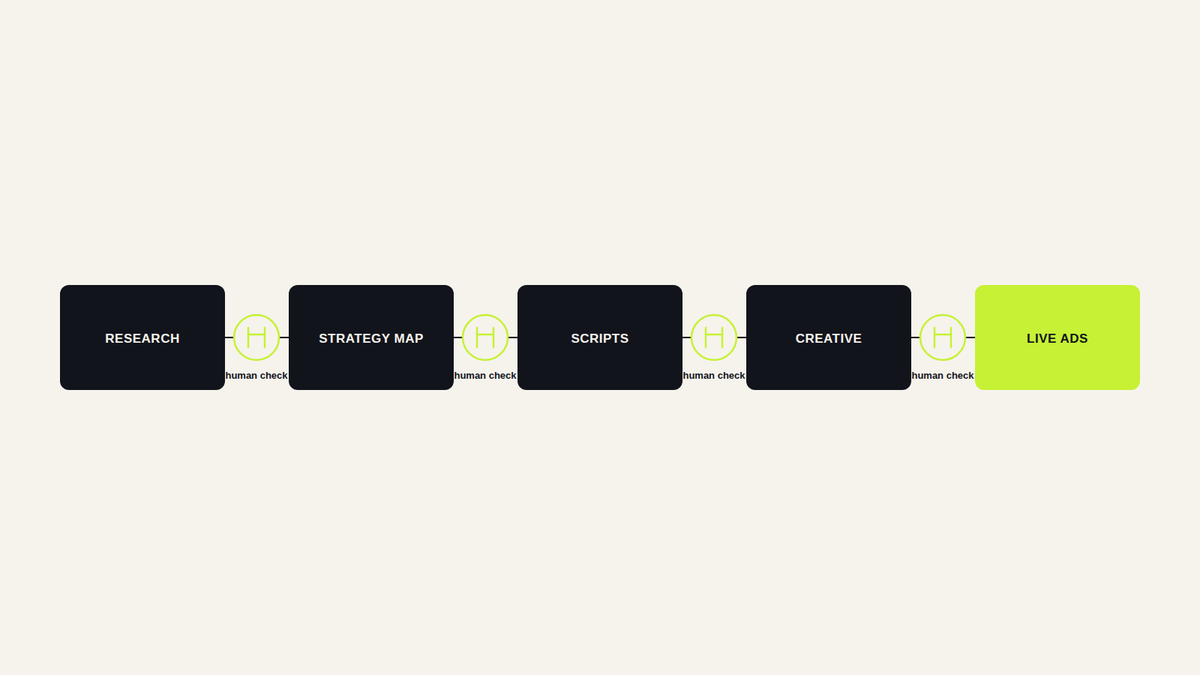
The moment a brand onboards, AI does the heavy research: brand, product, market, competitor, and customer analysis assembled fast. It helps build the Map, write and iterate scripts and headlines, and generate image and video creative at a volume no human team could match by hand. But nothing ships straight off the machine.
There are human checkpoints at every stage: a human validates the research is true to the market, a human approves the angles on the Map, a human reviews the scripts before production, and a human signs off on the creative before it goes live. AI gives you throughput. The checkpoints keep the throughput honest. That combination is the line, and it's why our output is diverse and on-strategy instead of diverse and random.
Formats are the fastest unlock
Once an angle wins, you've proven there's a real audience for that message. You will never reach all of that audience with two or three formats, so the quickest win for a brand already spending is to rebuild the winning angle across many formats: a spokesperson in a clean studio, a FaceTime-style piece to camera, a podcast clip, a straight interview, a founder story, a UGC testimonial, a claymation piece, a longer VSL.
Brands leaning hard on AI creative usually have a huge gap here, because they scaled one or two AI formats and never rebuilt their winners with real people. Real people in a professional setup still routinely outperform, and it's often sitting there untapped. The same goes for going more unaware with longer scripts. There are levels to unaware, and the biggest audiences live at the top, the buyers you can't convince in 30 seconds. The 9 to 10 minute VSL structures brands like Miami MD run exist to reach exactly those people.

Part 3 — The Scoreboard
At some point more volume stops paying off. The win rate flattens, or a fresh batch stops earning its keep. That's the machine telling you the bottleneck has moved from quantity to quality, and now you need an objective way to measure it. That measure is win rate, and it has to be read correctly.
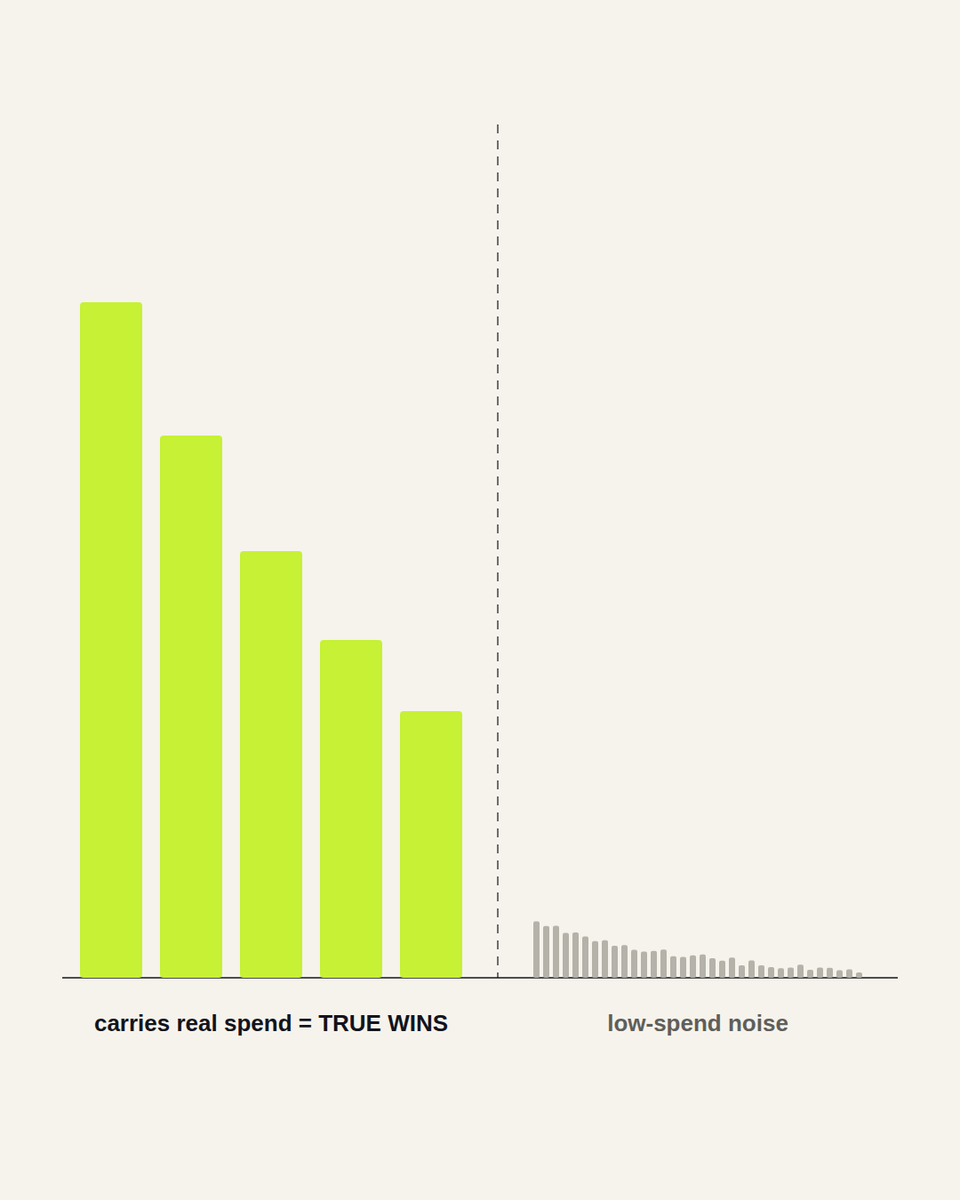
Here's where brands fool themselves. They count every ad that was ever mildly profitable, including tiny low-spend ones, and convince themselves the account is healthy. That's noise. What matters is the ads that actually carry spend, the creatives Meta is willing to push real budget into, and the share of total spend each new batch earns. If a fresh batch can't pull real spend away from the current winners, that batch didn't work, however many small "profitable" ads are hiding inside it.
The Scoreboard is also what keeps you honest about your own taste. I personally don't love a lot of the AI-avatar ads out there. But when they scale and hold a strong win rate, they work, and my opinion is irrelevant. The machine doesn't care what you like. It cares what carries spend.
Part 4 — The Loop
The last part is the one almost nobody has the patience for, and it's why the machine compounds instead of plateauing.
Every ad you ship, win or lose, is data. Once a month we go back through what scaled and what died, pull out the pattern, and feed it into the Map: new personas, new angles, awareness levels we haven't covered, formats we haven't tested. The next round starts smarter than the last. Do that for a year and your win rate climbs, your intuition sharpens, and you start seeing openings your competitors walk straight past. There's no shortcut for it and no month where it's finished. That's exactly why it's an edge.
Which part of your machine is jammed?
When we look at an account, ours or a client's, we're really asking which of the four parts is the constraint:
- If you can't produce enough genuinely different creative, your Assembly Line is the bottleneck.
- If you're producing volume but it all looks alike, your line is running but your diversity is broken, and Meta is collapsing your reach.
- If you can't tell which ads are actually carrying the account, your Scoreboard is off.
- If you're not feeding last month's lessons back in, your Loop is open and you're relearning the same things every cycle.
Fix the part that's actually jammed, not the part that's easiest to touch. That single diagnosis is usually worth more than any new hook or format.
Where to start
Build the Map first. Then feed the line with real visual diversity, not re-scripts. Let the Scoreboard decide what lives and dies. Close the Loop every month. Do those four things in that order and you stop depending on lucky creatives, because you're producing winners on purpose.
If you're running a brand spending more than $30-50k a month, you already have a few winning angles, and you want a second set of eyes on which part of your machine is holding you back, that's exactly the work we do. The link is in my bio and I'm happy to take a look.
Related articles

The 5 AI UGC Formats We Run and When to Use Each
picking the wrong format is one of the best ways to waste good content.

FAKE 24-YEAR-OLD MAKES $18K/MO SELLING SKINCARE ON INSTAGRAM—NO THIRST TRAPS.
She doesn’t exist. She’s 5 text files, 1 LoRA, and about 3 hours of work a day.