How to scale a mobile app using AI UGC from Zero to 1B+ views

+30 billion organic views across mobile app campaigns. +500,000 videos. +200,000 creators. zero ad spend. that was the human-creator playbook.

the AI UGC version of that same playbook produces the same numbers with 1/10th the production cost and none of the creator recruitment overhead.
this article is the operational how-to. not theory. the exact systems, briefs, workflows, and decisions that make AI UGC campaigns work or die.
if you're a founder building a mobile app right now, this saves you the $50k+ in mistakes most operators make figuring this out the first time.
I. prerequisites. is your app ready for AI UGC?
before you run a single campaign, two things need to be true.
your app has to have a visual "aha" moment. the result needs to look good on a screen. Cal AI works because the calorie count is one screenshot. Rizz works because the reply is one screenshot. Cantina works because the character's line is one screen. if opening your app doesn't produce something that reads in a single frame, AI UGC won't fix that.
you have to have product-market fit already. AI UGC amplifies what's working. it doesn't manufacture demand where there isn't any. if your organic retention is broken, scaling to 1M views produces 1M downloads and then 1M churned users.
skip AI UGC if either of those isn't true. run founder-led organic content on your own accounts instead until they are.
two program models:
volume-first (regular): 20-100 AI creators, high-volume posting, format testing at scale. this is the model that produces the billion-view numbers. the goal is finding which format prints, then running it 1,000 times.
quality-first (focused): under 10 established AI creator personas with dialed audiences, longer-form content, higher CPM campaigns. this is the model for founders with smaller budgets who want to test before scaling.
start with volume-first if the app is proven. start with quality-first if you're still learning what converts.
II. the creative brief. the single most important document in the operation
a bad brief produces bad content at scale. a good brief produces one format you can run 1,000 times.
the five required components. if one is missing, the AI creator (or the human directing it) guesses wrong every time.
campaign objective in one sentence. "after watching this video, the viewer should believe ___." if you can't fill in that blank, the campaign has no direction.
key product messaging in 2-4 points max. not features. benefits. "rizz gives you the perfect reply in dating conversations" is a benefit. "rizz uses GPT-4 to analyze text" is a feature. features die. benefits convert.
target audience insights. age, interests, behaviors, apps they already use. AI creators generate content that fits an audience, but only if you tell them which audience.
content requirements. platform, length, aspect ratio, branding moments. for AI UGC, also specify: character consistency requirements, voice model, motion style, aesthetic direction (iphone camera aesthetic vs cinematic, film grain level, color grade).
creative inspiration. 3-5 links to high-performing reference videos. this is the single highest-leverage element in the brief. AI creators generating without reference produce averaged, generic content. AI creators generating against 5 specific reference videos produce content that fits a proven format.
the golden rule: guide, don't script.
when most founders start, their briefs are 3-4 pages of detailed scripts. the content comes out polished and performs terribly.
the brief that scales is one page. what the app does in 2 sentences. who it's for in 1 sentence. 2-4 benefits that matter as bullets. 3-5 reference videos. one general script direction. done.
what NOT to do:
- don't leave usage rights ambiguous
- don't use corporate language
- don't list every feature, pick the 2-4 that matter and let the rest die
- don't specify camera angles that fight what the reference videos show
III. AI creator setup. the character workflow
human creators used to be the bottleneck. that's gone.
the AI creator stack in 2026: Fable 5 for character generation, Seedance 1.5 Pro for animation and lip sync, ElevenLabs for voice, capcut for post.
the character workflow that produces content at scale:
step 1: lock the character before anything else. generate one strong character reference in Fable 5 on a pure white background. save the seed. save the exact prompt. save the reference image. this file is now the anchor for every video that character appears in.
for volume campaigns, lock 3-5 different characters. each one targets a different sub-audience within your niche. one character for the 18-24 female audience. one for the 25-32 male. one for the "insider" tone. one for the "just-discovered-this" tone. rotate across accounts.
step 2: generate the first frame for each scene, not the full video first. upload the locked character reference. describe the scene setting. specify the pose, expression, camera angle. this frame is what Seedance will animate from. if the frame is off, the motion will be off. spend time here.
step 3: run motion transfer in Seedance with an explicit motion-lock prompt. vague motion prompts produce warped output. specific prompts produce clean output. include biomechanics instructions: preserve character identity, no morphing, no foot sliding, maintain silhouette, realistic inertia.
step 4: bake voice into the video output rather than layering it after. Seedance handles dialogue if you write it inline with the scene description. embed spoken lines with "says [exact line]" attribution. tie the line to a visible speaker beat so lip sync enforces pronunciation.
step 5: post-process in capcut with film grain and 1080p export. 2-3% film grain to remove the clean digital look that signals AI. export at 1080p, not 4k. 4k reads as production. 1080p blends with organic content.
for founders who want to scale beyond one character workflow: this stack costs under $200 a month at operating volume. the equivalent human creator infrastructure, 40+ creators under management, editing, briefing, revision cycles, costs $15k-$30k a month at the same output volume. that's the 100x cost delta.
IV. the 8 proven content formats
not every format works for every app. the format has to match the app's aha moment.
testimonial. personal experience. AI creator says
"i've been using [app] for X weeks and here's what happened."
best for: trust, conversion. works for: fitness, health, finance, dating.
tutorial / walkthrough/ step-by-step demonstration of the app. AI creator opens the app, shows the flow, reveals the output.
best for: apps where the aha moment requires context.
before / after. transformation content.
best for: fitness, weight loss, looksmaxxing, language learning, any app with a visible outcome over time.
day in my life. AI character's day, with the app appearing naturally in the routine.
best for: lifestyle apps, productivity apps, dating apps. Rizz ran variants of this format thousands of times.
reaction. AI creator discovers the app for the first time on camera.
best for: virality, apps with a "wtf" moment. works when the reaction feels genuine, over-scripted reactions kill this format instantly.
challenge. trend or hashtag-based. AI creator participates in a viral trend with the app as part of the setup.
best for: reach, breaking into new niches.
comparison. app vs alternative. AI creator shows why the app beats what they were using before.
best for: differentiation in crowded categories.
story time. personal narrative that ends with the app as the resolution.
best for: emotional engagement. this is the format that produced Rizz's texting-story hijack.
V. the 15-second formula
every high-performing UGC video hits the same beats regardless of format:
0-2 seconds. the hook. stops the scroll. on-screen text, movement, a surprising stat, a direct question.
no "hey guys."
no slow pan.
no logo intro.
no dead silence.
the first 0.5 seconds determines 90% of the performance.
2-4 seconds. the problem or context. the "that's me" moment where the target audience recognizes themselves in the situation.
3-7 seconds. the product enters naturally.
not as a pitch.
as the resolution to the setup from seconds 2-4.
7-12 seconds. the payoff with visual proof. the app produces the aha moment. one frame. viewers understand instantly.
final 2-3 seconds. the CTA. clear, single action.
design the AI creator generation prompts around this timing. Seedance clips cap at 15 seconds. build every scene to fit that arc exactly.
VI. the daily operations
the campaign runs whether you're online or not, but there's still a daily rhythm that separates campaigns that compound from ones that stall.
morning (30 minutes): review every video posted in the last 24 hours.
flag the top performers (>50k views inside 24 hours) as format leads to test more of. flag the bottom performers (<1k views inside 24 hours) as formats to kill. update the brief before the next batch.
midday (batch production window, 2-3 hours): produce the next batch of AI UGC. use the winning formats from the morning review. generate 10-20 clips per session across the active characters. don't produce clips manually one at a time, batch the generation, then batch the editing.
evening (15 minutes): schedule the next 24 hours of posts across accounts. stagger timing so no two accounts post the same character within the same window.
the compounding rule: every session's output should be informed by the previous session's data. a system that generates 100 clips without reading the data on the first 20 is not a system. it's guessing at scale.
VII. quality control. the scoring system
not every AI-generated clip is post-ready. the scoring system catches the underperformers before they burn distribution.
score each clip 1-5 across five categories:
hook strength. does the first 1-2 seconds grab attention?
clarity. is the audio clean, framing right, composition working?
brand alignment. does the tone match your app's positioning?
engagement style. is the energy right for the product?
conversion potential. would you download after watching this?
if any category scores 2 or below, kill the clip. regenerate.
for AI UGC specifically, add one more check: the AI reflex test. watch the first 2 seconds without sound. do you immediately recognize it as AI-generated? if yes, adjust the film grain, color grade, and compression before posting. the goal is content that blends with organic, not content that announces itself as synthetic.
the one-round rule: one round of revisions per clip. if a clip needs three rounds, the brief is broken and no amount of individual clip revision will fix it. update the brief instead.
VIII. scaling. the tiering system
review character performance monthly. tier characters based on the same criteria you'd use for human creators.
tier S (elite): consistently viral. autonomous, the character can run new formats without extensive briefing because it's dialed. highest priority in production queue, biggest scene budget allocation.
tier A (top performers): consistent hitters. strong hook game. push them into higher-difficulty formats to see if they can carry S-tier campaigns.
tier B (reliable): steady output. give them S-tier format tests to see if the character can stretch.
tier C (underperformers): one more cycle with adjusted formats and characters. if still underperforming, retire the character and reallocate the production capacity.
for AI UGC, characters don't get demotivated by getting retired. that's the operational advantage over human creators, you can rotate characters based purely on data without losing them from the ecosystem.
IX. 2026 benchmarks
what "working" actually looks like:
hook rate (first second):
TikTok >60%,
Reels >50% view-through (3 seconds):
TikTok >40%,
Reels >35% engagement:
TikTok >5%,
Reels >3% organic CPV:
TikTok $0.005-$0.02,
Reels $0.01-$0.03
if your numbers are below these, the fix is almost always the hook. update the first 2 seconds before you touch anything else.
X. the pattern behind every campaign that hit
after 22,504 videos and 2 billion views across the human-creator playbook, and the AI UGC scaling that followed, the pattern is the same.
one-page brief.
one character workflow, locked down, run at volume.
daily operations. watch every clip. update the brief with the data.
pay attention to hooks over everything else.
find one format that works, then run it 1,000 times.
track downloads and revenue per 1M views, not raw views.
the human-creator version of this hit 1B+ views. the AI UGC version hits the same numbers at 1/10th the cost, with no recruitment overhead, and no ceiling on production capacity.
this is the playbook. run it on affiliatenetwork.com
the campaign infrastructure, the verification layer, the payout system, and the 200,000+ creator network are already there. plug your app in, run the AI UGC layer on top, and let the machine work.
the graveyard is full of better products. it has never once been full of better distribution.
launch your campaign at affiliatenetwork.com.
Related articles
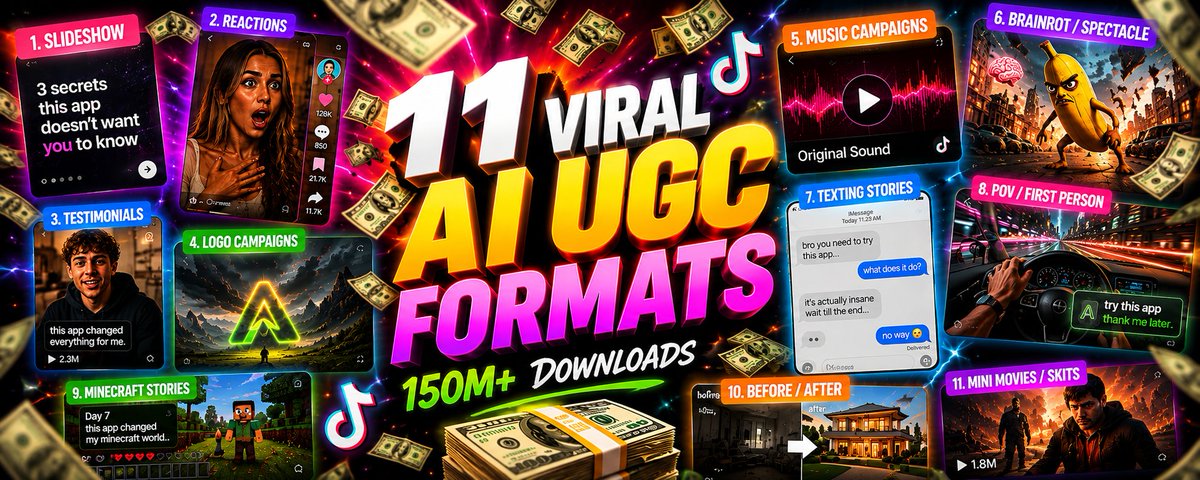
11 VIRAL AI UGC formats we abused to engineer 150M+ app downloads
9 out of 10 people think AI UGC is 1 thing: a fake person talking to a camera about a product.
how to RAGEBAIT your way into a $100k+/mo app (with viral ai ugc)
a soda company ran an AI-generated ad last year and the internet lost its mind.

The Cal AI Distribution and Scaling Blueprint
But because we out-distributed every major competitor, we shot to the #1 app in Health & Fitness in 18 months and eventually were acquired by MyFitnessPal.