Meta Ads Guide: How To Leverage Market Awareness & Sophistication To Scale

Most eCom brands are advertising to about 10% of their total addressable market without realizing it.
Not because they lack budget or creative.
But because they only know how to write ads for people who are already shopping for their type of product or know the brand.
The other 70%+ of potential customers?
Stay unaddressed.
Because talking to someone who doesn't even know they have a problem requires a fundamentally different message than talking to someone who's comparing products on Amazon right now.
And that's just one dimension. Even if you get the message right for the person, the market itself might have heard it all before.
These are the two things that awareness levels and sophistication levels solve.
They come from Eugene Schwartz's Breakthrough Advertising (written in the 1960s, still the most relevant advertising book out there), and they're the foundation of how I think about creative strategy for every brand I work with.
Awareness levels tell you what to say based on how much the person already knows. Sophistication levels tell you how to say it based on how much the market has already heard.
Most marketers either confuse them or don't apply them at all.
Let's go through both and see how to apply them to your brand to scale.
1. Awareness Levels
Awareness is about the individual person.
How much do they know about their problem, the solutions out there, and your product specifically?
Schwartz identified five stages.
A headline or hook that works perfectly for one stage will fall flat at another.
I'll walk through each one with example hooks for a fictional skincare brand to make it concrete.
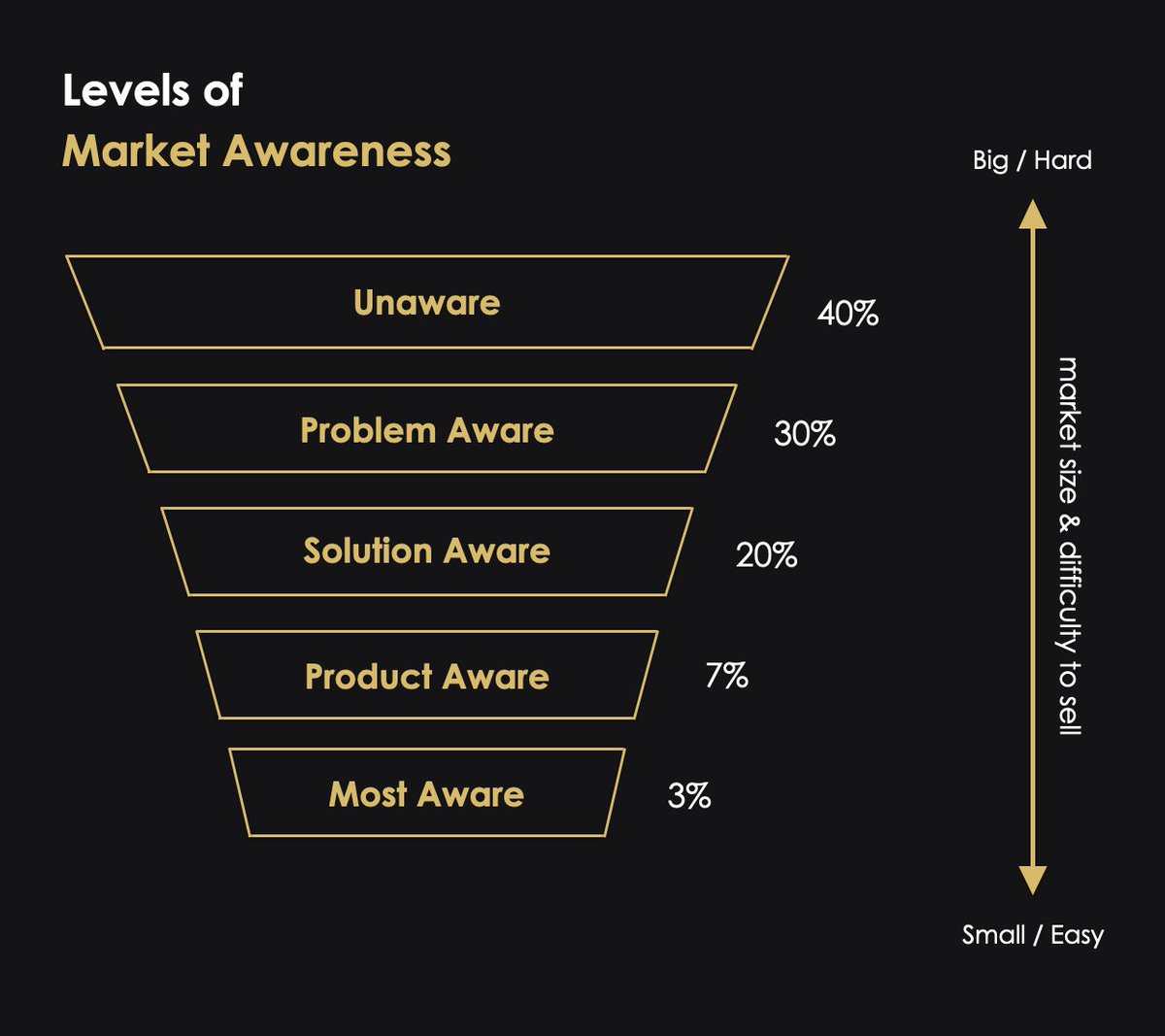 — "The 5 Market Awareness Levels & Their Approximate Market Size (exact numbers vary depending on the industry)"
1.1 Most Aware
The easiest market to advertise to. And the least scalable.
They know your product and brand. They want it. They just haven't bought yet.
No need to re-educate them. Don't re-sell them. Just give them a reason to act now.
Example hooks:
- "AcneClear Serum - 25% off this weekend only"
- "Your AcneClear is waiting. Free shipping ends tonight."
- "Back in stock - the serum that sold out in 72 hours"
This is retargeting, email flows, loyalty offers.
The heavy lifting is already done.
You just need to close.
1.2 Product Aware
They know your product category exists, but not your product specifically.
Your message should highlight what makes you different or better.
Example hooks:
- "Why AcneClear works in 14 days when most serums take 90"
- "The only acne serum that clears AND repairs the moisture barrier"
- "AcneClear vs. the 3 top-selling serums - what the ingredient list doesn't tell you"
This is where you sell your mechanism, your proof, your edge over competitors.
You're not educating them on the problem anymore - you're showing why your solution is the best one.
Most brands stop here.
Most ads don't go beyond the product aware level simply because they don't know how.
If you want to scale, you need to address less aware markets too.
1.3 Solution Aware
They know a type of solution exists for their problem, but don't necessarily know your product category as a solution.
They might be googling "best acne treatments" or scrolling through progress videos.
Your message should position the right approach first, then make your product the obvious answer.
Example hooks:
- "The ingredient dermatologists are calling the retinol replacement"
- "You've tried everything for your skin and nothing sticks. Here's what everyone misses."
- "3 things to look for in an acne serum (most brands fail on #2)"
None of these lead with the brand name. You're selling the approach. The product comes after.
1.4 Problem Aware
They have a problem and know it.
But they don't know a solution exists.
Your message needs to name their problem so accurately that they feel understood, and then introduce the solution path.
Example hooks:
- "Your acne isn't a skin problem. It's an inflammation problem."
- "If you're having breakouts every few weeks, watch this"
- "Why acne happens & how to get rid of it for good"
This is where a huge portion of the money is.
Problem-aware people make up roughly 30-40% of any market.
Massive audience.
And most brands completely skip them because writing problem-aware ads requires actual education before the pitch.
It's harder to write, so creative teams default to product-aware messaging instead.
That's the trap.
It's easier to write, so everyone writes it, and now you're fighting over a tiny slice of the market with every competitor in your category.
1.5 Unaware
They don't even know they have the problem.
Or they've accepted it as just how things are.
They're not searching for a problem or solution, let alone a product because they think that "this is just how it is".
You can only reach them through identity, emotion, or story - then bridge them into problem awareness.
Example hooks:
- "I spent $4,000 on skincare in 2 years. 90% of it was making things worse."
- "My dermatologist told me to stop everything I was doing. Here's what happened."
- "The 'healthy' morning routine that was destroying my skin barrier"
None of these mention a product.
None of them even mention acne directly.
You're meeting people with stories and emotions, not pitches.
That's the only way in at this level.
This is also the hardest stage to write for.
But unaware + problem aware combined represent 70%+ of the total market.
The brands scaling to 100k+ days are doing it because they've built an awareness funnel - a system of ads designed for each level that moves people from not knowing to wanting to buy.
If your creative team only writes product-aware and most-aware ads, you're fighting over about 10% of the people you could be reaching.
Your CPAs keep climbing because that audience is tiny and saturated.
A mass market product becomes niche when you only target the bottom of the awareness pyramid.
2. Sophistication Levels
Now the second dimension.
Awareness is a property of the persona.
Sophistication is a property of the market.
It measures how many similar claims, promises, and products the market has already been exposed to.
Think of it as the collective scar tissue of an entire audience.
 — "The 5 Market Sophistication Stages"
This matters because even if you match your message perfectly to the right awareness level, the market's sophistication determines how you're allowed to deliver that message.
A claim that would've crushed five years ago might be completely invisible today - not because it's wrong, but because everyone has heard it already.
Schwartz laid out five stages here too.
2.1 Stage 1: Simple Claim
You're first in the market.
Just state what you do.
"Lose ugly fat."
"Clear your acne."
"Sleep better tonight."
No proof stack proof stack, mechanism, or storytelling needed.
The claim is new enough to carry the ad on its own.
Schwartz's words: "Nothing more - because nothing more is needed."
This rarely ever exists in eCom anymore.
But when it does happen - when you're genuinely first with something new - don't overcomplicate it.
Say what it does and let the novelty work.
2.2 Stage 2: Bigger Claim
Competitors showed up.
The direct claim still works, but now you need to make it bigger, faster, more specific.
"Lose ugly fat" becomes "Lose up to 47 lbs in 4 weeks."
"Clear your acne" becomes "Clear skin in 14 days or your money back."
"Sleep better" becomes "Fall asleep in under 8 minutes. Every night."
This is the arms race.
Everyone outbids each other with louder promises.
It works until every competitor is screaming the same thing and the audience just tunes it all out.
Most brands stay here way too long.
They keep making the claim bigger without realizing the market stopped believing the claims long ago.
2.3 Stage 3: New Mechanism
This is where the real separation happens.
The market has heard every version of the promise.
"Clear skin fast" doesn't register anymore because 30 brands said it and most didn't deliver.
The claim is dead. Making it bigger won't help.
So you stop leading with WHAT your product does and start leading with HOW it does it.
"Lose weight" becomes "This hormone shuts off your appetite at the source" (GLP-1s).
"Clear skin" becomes "This peptide reprograms your skin's oil production at the cellular level."
"Sleep better" becomes "This compound mimics your brain's natural shutdown sequence."
The mechanism makes the old promise believable again.
You're not just saying "this works" - you're explaining WHY it works in a way that nobody has heard before.
GLP-1s are the perfect example.
Weight loss is probably the most burned-out market on the planet.
Every claim has been made a thousand times over.
But GLP-1s still exploded because they brought a genuinely new mechanism with real clinical proof.
New mechanism, same desire.
2.4 Stage 4: Expanded Mechanism
A competitor (or you) introduced a mechanism that resonated, and many brands followed.
Just as from stage 1 to stage 2, at some point everyone is claiming the same.
Now you improve on it.
Make it easier, faster, fewer side effects, solves more of the problem.
"The only GLP-1 that works without the nausea."
"Same peptide technology, but it also repairs your moisture barrier."
"8-hour deep sleep formula that won't leave you groggy."
Same arms race pattern as Stage 2, except now you're expanding the mechanism instead of the claim.
Works until the mechanisms themselves get commoditized.
2.5 Stage 5: Identity
The market is exhausted.
Nobody believes claims.
Nobody believes mechanisms.
Everything has been said.
At this point, you stop talking about the product entirely.
You sell identity.
The ad becomes about who the customer wants to be, not what the product does.
The cigarette industry is the textbook case.
Schwartz traced the full evolution:
Stage 1 - "I'd walk a mile for a Camel" (simple pleasure claim)
Stage 2 - "Light up a Lucky, and you'll never miss the sweets that make you fat" (bigger claim)
Stage 3 - "Luckies - they're toasted!" (new mechanism)
Stage 4 - "Philip Morris - all the harshness baked out" (expanded mechanism)
Stage 5 - Marlboro puts a cowboy on a horse. No claims. No mechanisms. Just identity.
Marlboro didn't win by talking about tobacco quality.
They won by selling masculinity.
The cigarette became a prop in an identity story.
In eCom today, this looks like lifestyle content where the product is secondary to the feeling.
Community-driven messaging.
Brand worlds where owning the product says something about who you are.
Apple is the obvious modern example.
They don't sell phone specs anymore.
They sell what it means to be someone who uses Apple products.
3. Putting It Together
Before you write your next ad, ask yourself two things:
- How aware is this persona? That tells you how much education comes before the pitch.
- How sophisticated is this market? That tells you whether a simple claim works, whether you need a new mechanism, or whether you need to go full identity.
Once you can place any customer on both dimensions, you know exactly what your ad needs to say and how it needs to say it.
You unlock the bigger, less competitive market and write ads that can spend 10x of what your current ads spend.
Related articles

Mars men's full meta ads playbook (4,512 ads)
Mars Men has 4,512 ads live on Meta right now, on a Facebook page that only exists since December 2023.

How I scaled two apps to $240,000/yr with paid ads
My first app made $20,000 in a single month after I did this one thing: