The 10-Minute Protocol That Clears Mental Fog Forever

You know that foggy, nagging sense that there's stuff you need to do, need to remember, need to respond to, but you can't quite pin down what it is?
Maybe right now, you're vaguely aware of emails that need responding to. Calls that need making. Tasks that need completing. But you can't hold it all at once.
> "Did I respond to that client email? What time was that meeting moved to? I need to call the dentist. Wait, was there something else urgent I'm forgetting?"
Part of your mind is constantly scanning, searching, trying to remember what else needs attention while you're trying to focus on the task in front of you.
This is the felt-sense of cognitive load.

Think of it as the equivalent of RAM on a computer. Like a laptop with too many tabs open, the more you have, the slower it all gets.
What follows is how to clear your mental RAM in under 10 minutes, and how to keep it clear permanently so you can access flow state - a state in which productivity increases 5x, creativity 7x, and learning speeds accelerate nearly 4x.
I. What Is Cognitive Load?
In the late 1970s, John Sweller was a lecturer at the University of New South Wales, studying how people solve problems.

He'd give students math problems and watch them work. What he saw puzzled him.
The students who tried the hardest, who pushed themselves to juggle all the steps in their heads, learned the least.
Students who were given a clear step-by-step map of the problem-solving process? They learned faster.
At the time, this made no sense.
It contradicted everything educators believed about learning through struggle.
Shouldn't the mental effort lead to better learning?
Sweller realized something was happening beneath the surface. The struggling students weren't learning poorly because they lacked intelligence.
Rather, they were learning poorly because their minds were overloaded. Like a computer trying to run a program while simultaneously downloading updates, scanning for viruses, and rendering video. The system was maxed out.

Think of it like trying to learn a new dance while juggling. The juggling takes so much mental effort that you can't actually learn the dance steps. All your mental resources go toward keeping the balls in the air.
In 1988, Sweller published his findings and gave this phenomenon a name: Cognitive Load.
He showed that the human brain has a hard limit.
We can only hold about four to seven distinct pieces of information in our working memory at once. When we exceed this limit, our mental performance doesn't just slow down; it crashes.
(I post one breakdown like this each week - the neuroscience behind why you feel and perform at your best, and how to access it on command. Follow @RianSweetDoris for the next one.)
II. The Neural Traffic Jam
Your brain has two major networks that need to take turns.
There's the Default Mode Network, active when you're reflecting, planning, or mind-wandering.

And there's the Task-Positive Network, engaged when you're focused on external work.

Under normal conditions, these networks trade the spotlight like dancers.
When one steps forward, the other steps back. This anti-correlated relationship, discovered by Michael Fox and colleagues at the University of British Columbia, is what allows you to shift smoothly between internal reflection and external focus.

But under high cognitive load, this clean handoff breaks down.
When your working memory is overloaded with tasks, worries, and obligations, your brain can't cleanly switch between networks.
It's trying to plan (Default Mode) while also trying to focus (Task-Positive).
Every unfinished task keeps pulling your Default Mode Network online: "remember to call the dentist," "that report is due Friday."
Meanwhile, you're trying to engage your Task-Positive Network to focus on the spreadsheet in front of you.
Both networks firing at once. Like trying to have a phone conversation while listening to a podcast.

This creates neural congestion.
When Yale researcher Amy Arnsten studied what happens next, she found something alarming: this congestion triggers a stress response.
Cortisol floods your system.
The very part of your brain you need for executive control, planning, decision-making, and complex analysis becomes impaired.
An engine redlining but producing no power.
III. Two Types of Performers
This neural traffic jam creates two radically different types of performers.
Which one you become depends on what you do about your cognitive load.
The Overburdened Brain
These performers live in perpetual chaos. Brain scans would show sustained beta waves, the high-frequency electrical pattern of stress and overthinking.

They never get back to you when they said they would. When they finally do the work, it's sloppy. They're exhausting to work with because their frantic energy rubs off on everyone around them.
Why? Their brain is caught in that neural traffic jam. Both networks trying to be active at once. Every unfinished task pulling the Default Mode Network online while they struggle to focus on current work.
High cognitive load locks their brain in beta. The neural traffic jam generates so much beta-wave noise that the calm alpha-theta patterns of flow can't emerge. They're biologically locked out of peak performance.
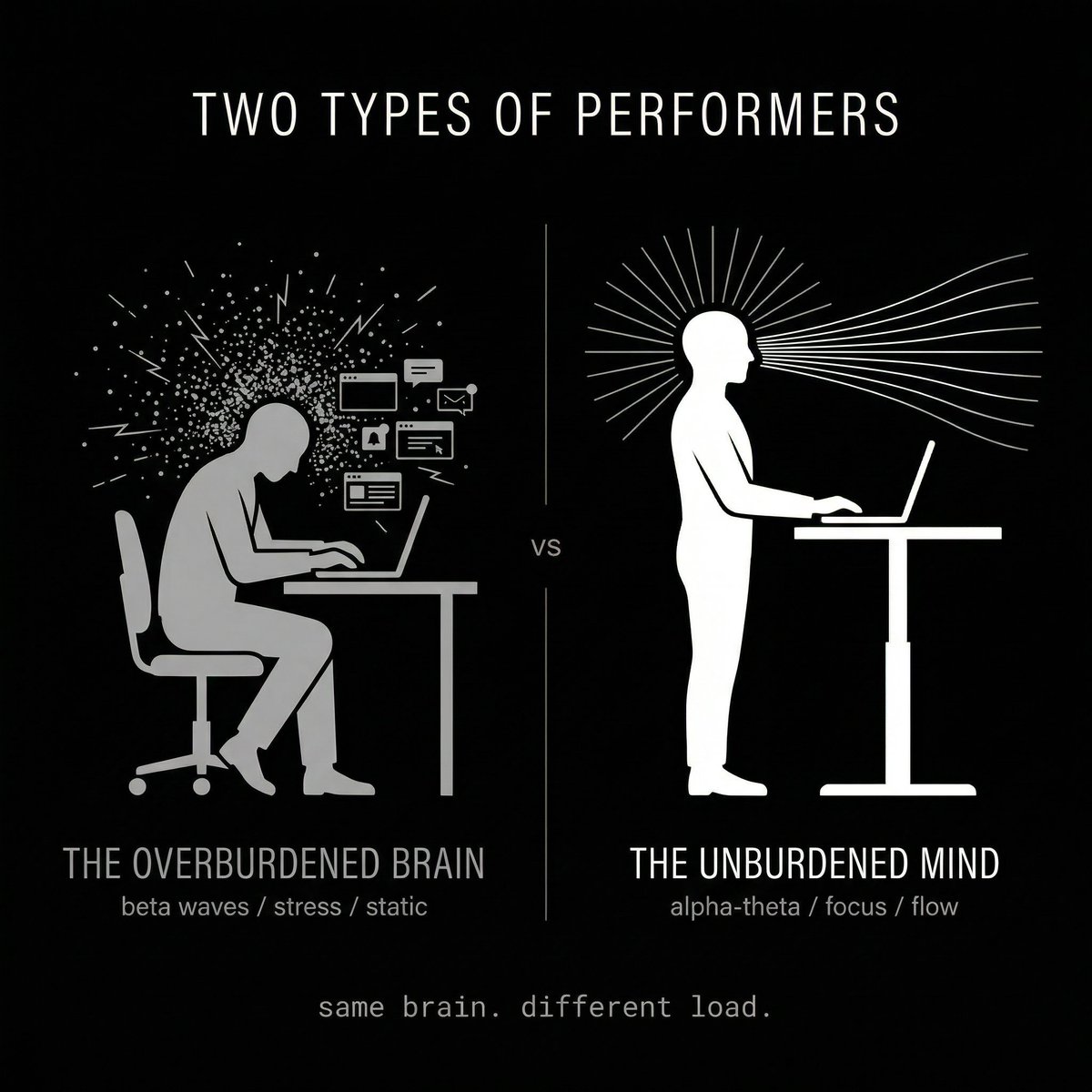
The Unburdened Mind
These performers operate completely differently.
They keep their mental RAM clear. Not by holding fewer responsibilities, but by capturing them externally instead of carrying them in working memory.
Brain scans would show alpha-theta activity, the smooth hum of relaxed focus. These are the frequencies where flow state happens.

With low cognitive load, their networks can cleanly trade places. When they need to plan, the Default Mode Network takes over. When they need to focus, the Task Positive Network engages fully.
They maintain such low cognitive load that their brain can fully commit to whatever's in front of them. They produce breakthrough work at 2 PM on a Tuesday, then leave at 5 with energy to spare.
The difference between these two types isn't intelligence. It's understanding that your mental RAM must be actively cleared and kept clear.
Why This Is THE Flow Blocker
As my prior co-founder Steven Kotler says, when you analyze all the flow triggers, they work through two primary mechanisms: increasing focus-enhancing neurochemicals or decreasing cognitive load.

When flow triggers increase dopamine and norepinephrine, they sharpen your mental signal. When they reduce cognitive load, they make one thing so important that your brain naturally filters out everything else. Your prefrontal cortex stops juggling thirty things because your brain only sees one.
Both create conditions for transient hypofrontality, where your inner critic quiets and self-consciousness fades.
It's like turning off a loud air conditioner you didn't realize was running.
Suddenly, there's quiet. In this quiet, flow emerges naturally.

But you cannot achieve transient hypofrontality when your cognitive load is high.
Your prefrontal cortex cannot simultaneously juggle thirty open loops AND downregulate itself.
Cognitive load isn't just a flow blocker; rather, it's THE flow blocker.
Until you clear it, that peak performance state remains locked behind a door your brain physically cannot open.
So, how do you lower your cognitive load to clear the pathway to flow?
Two steps: an acute protocol to dump your current load and daily/weekly practices to keep it low.
(I post weekly about the neuroscience of flow state. Follow @RianSweetDoris and grab the full protocol library at the link in my bio.)
IV. The Cognitive Load Dump

Several years ago, I was up at midnight working on a slide deck that was due in a few hours.
I'd spent three hours staring at a blank title slide while Slack pinged and my inbox piled up.
Out of options, I called my business partner.
He asked one line. "How many tabs are open in your head?"
I started listing. Curriculum outlines. Ad copy. Partner calls. Payroll. Twenty seconds in, he cut me off.
"Grab a page. Write down everything that's taking up space in your head."
I filled a legal pad, front and back, in ten frantic minutes.
Client deliverables. Unpaid invoices. That tense conversation with our lead developer. My mom's birthday gift. The presentation slides. Strategic planning for Q4. Even random worries about whether I'd locked my car.
As I wrote, something shifted. Each item I captured on paper was one less thing my brain had to hold. My breathing slowed. The mental static cleared. For the first time in hours, I could think in complete sentences.
That messy brain dump became the foundation of a protocol that's now helped thousands clear their mental RAM.
We call it the Cognitive Load Dump.
Step 1: Brain Dump
Grab a sheet of paper and pen. Physical, not digital. When you write by hand, your visual and motor cortex work together to create "cognitive offloading." You're literally transferring the burden from brain to page.
Write down everything on your mind. Tasks, worries, random thoughts, that thing your spouse mentioned, the weird noise your car is making. Everything. Don't organize. Just dump.
Once you think you're finished, keep writing until more surfaces. There's always another layer to offload.
Step 2: Organize Your RAM

When you've gotten everything out, quickly scan what you wrote. For each item, make a decision:
-
Do it now (if under 2 minutes)
-
Schedule it (add to calendar with specific time)
-
Delete it (cross it out. It's not actually important.)
-
Delegate it (note who to hand it off to)
Just writing things down leaves loose ends. Deciding their fate lets your brain truly release them. Until every item is assigned and timed, it keeps pulling at your attention.
Step 3: Release and Reset
Take the paper, fold it in half, and put it somewhere out of sight. In a drawer. In a folder. Just away.
This physical act of putting it away creates a psychological boundary. You're telling your brain: "This is captured. You can stop holding it."
Then take three deep breaths. In for three, hold for two, out for ten. This activates your parasympathetic nervous system, clearing the stress hormones cognitive load creates.
Now go directly to your most important task. Don't check email. Don't look at your phone. Use this cleared state immediately.
The fastest way to speed up your brain is to slow down and get everything out of it.
(I post weekly about the neuroscience of flow state. Follow @RianSweetDoris and grab the full protocol library at the link in my bio.)
V. Keeping Your Mental RAM Clear

The Cognitive Load Dump is a deep clean for your mind. Powerful and acute.
But you wouldn't deep-clean your kitchen once and expect it to stay spotless forever. Same with cognitive load. You can't dump it once and expect mental clarity to last.
You need both the occasional deep clean AND daily maintenance.
The Cognitive Load Dump drops your mental burden from 100% to 20% instantly.
What you need next is a system that keeps you hovering around 20-30% capacity by default. That way, when important work arrives, you have the mental bandwidth to engage fully.

Elite performers don't just clear cognitive load when overwhelmed. They maintain practices that prevent the overwhelm from occurring.
Three rules make this possible:
Rule 1: Never hold information in working memory.
Your brain is for processing, not storage. Every thought you try to hold internally steals processing power from your current task.
Rule 2: Close open loops immediately.
Unfinished tasks create mental tension until resolved. Either complete them, schedule them, or capture them externally. Never leave them floating.
Rule 3: Eliminate the need to remember.
The most productive people have the emptiest minds. Not because they're thinking less, but because they're thinking more efficiently. Build systems that remember for you.
To support these rules, you need two cornerstone habits. One weekly, one daily.
The Weekly Goal Flywheel
Every Sunday, spend 90 minutes realigning your week to prevent strategic ambiguity from creeping into your cognitive load.
When your brain doesn't know how today's work connects to your long-term goals, it generates constant background processing: "Is this the right thing? Should I be doing something else?" This uncertainty accumulates into cognitive overload.
The Goal Flywheel eliminates this through three steps:
Step 1: Review Your Goal Stack (15 minutes)
Pull up your goals across all timeframes: yearly, quarterly, monthly. This is a reminder of what you're aiming at.
Ask three questions:
-
How did last week's work move me toward these goals?
-
What's the gap between where I am and where I'm going?
-
What specific actions would close that gap?
This review prevents your brain from wasting cycles trying to remember why you're doing what you're doing.
Step 2: Identify Next Week's Goal-Directed Actions (30 minutes)
Ask: "Which three actions this week would most directly advance my goals?" Not twenty. Not ten. Three maximum.
This constraint forces clarity and prevents your brain from juggling too many priorities. Write these in your calendar, not a separate list.
Step 3: Allocate Your Peak Hours (45 minutes)
Block your highest-energy hours for these goal-directed actions. Pre-deciding when you'll work on what eliminates hundreds of micro-decisions throughout the week. Your brain can relax knowing the important work has protected time.
By connecting daily actions to long-term goals once per week, you prevent the constant low-level anxiety of "Am I working on the right thing?" Your cognitive load stays low because your brain trusts the plan.
The Daily Power-Down Ritual
Each day, 30 minutes before you stop work, run this 15-minute ritual to achieve mental closure and prevent today's open loops from becoming tomorrow's cognitive burden.
Unfinished tasks create what psychologists call the Zeigarnik Effect. Your brain treats every unfinished task like an unpaid bill. It keeps a background process running, checking and rechecking, draining mental resources even while you sleep.
The Power-Down Ritual closes these loops:

Step 1: Tomorrow's Big Three (5 minutes)
Open tomorrow's calendar.
Identify 1-3 goal-directed actions: the tasks that directly advance your main goals. Just one is fine. More than three is too many.
Write them directly in your calendar with specific time blocks. This eliminates morning decision fatigue and the anxiety of "What should I work on?"
Step 2: Clear Goals Breakdown (5 minutes)
For each action, write 3-5 ultra-specific sub-steps in the calendar event itself. These are your clear goals, the quintessential flow trigger.
Instead of "Write report," you'd have:
-
Open Q3 data spreadsheet
-
Create three charts showing growth trends
-
Draft executive summary bullets
This specificity eliminates startup friction. Tomorrow, you won't waste 20 minutes figuring out how to begin. You'll read step one and start typing.
Step 3: Clear the Decks (5 minutes)
The cleanup that lets your brain actually rest tonight.
Email triage. Open your inbox. For each message, make a decision:
-
Takes under 2 minutes? Do it now.
-
Takes longer? Schedule specific time tomorrow.
-
Not important? Archive immediately.
Don't aim for inbox zero. Aim for "nothing urgent lurking."
Capture open loops. This is a miniature daily Cognitive Load Dump.
Grab paper or open a notes app. Write down everything bouncing around your head: that vendor you need to call, that idea for the product, that concern about the budget. Get it out of your brain and onto a page.
Clean your workspace. Close all browser tabs. File loose papers. Wipe down your desk. This physical reset signals your brain that work is complete.
The result: your brain gets the "all clear" signal.
It can stop scanning for threats and forgotten tasks. You leave work actually at work, instead of carrying mental weight home.
These two habits work synergistically. The weekly Goal Flywheel ensures you're pointed at the right target. The daily Power-Down Ritual keeps mental inventory clean.
Together, they maintain the low cognitive load state that the Cognitive Load Dump initially creates.
VI. What Changes Now
When you clear cognitive load properly, your brain undergoes a measurable shift.
Those noisy, high-frequency beta waves, the signature of an overloaded mind, give way to the calm, focused alpha-theta state where your best work happens.
World-class performers across every domain unconsciously develop rituals to clear cognitive load before their most important work.
Concert pianists have pre-performance routines.

Elite athletes have pre-game protocols.

Nobel laureates have thinking rituals.

They've discovered through experience what neuroscience now confirms: a cluttered mind is an inefficient mind.
When you commit to keeping your cognitive load minimal as a way of life, something foundational shifts.
You become one of the Unburdened Minds.
The performers who produce breakthrough work while others are still warming up. The ones who solve complex problems at 2 PM on a Tuesday with the same clarity others only find at 5 AM after three coffees.
You stop being the frantic, Overburdened Brain who's always behind, always apologizing, always scrambling.
You become the calm center others rely on. The one who delivers when it matters.
Peak performers aren't those who successfully juggle the most. They're those who refuse to juggle at all.
(I post weekly about the neuroscience of flow state. Follow @RianSweetDoris and grab the full protocol library at the link in my bio.)
Related articles

Mars men's full meta ads playbook (4,512 ads)
Mars Men has 4,512 ads live on Meta right now, on a Facebook page that only exists since December 2023.
How to Start a 6 Figure Faceless YouTube Channel (Full Breakdown)
I've helped over 400 people start profitable faceless youtube channels. i've ran over 50 channels myself. Generated over $4 MILLION by age 25. Worked with youtubers that have 10 million+ subscribers,…

Build a Marketing Intelligence System With Grok Bot
I want one Grok Bot whose entire job is to know what's happening in my market before I do.