the 5-minute ai song ads taking over meta

Over the dozen of formats we test every year, I did NOT expect this one to work. Now I'm breaking down why it does:
We produce over 500 ads a month across accounts, so I see most formats before they get named. Long-form song ads built in Suno are the first thing in a while where the format itself is the unlock, not the script or the offer.
Go look at Quasi's ad library, or Ryze's. Five to ten minute story songs, running at real scale, in categories where everyone else is shipping thirty second UGC.
In this article I'll cover how the format works, the script blocks that have to be in every one, how to test something this long without burning budget, and the three angles we're running with where to send the traffic for each.
Everything you need to actually run it. Let's get into it.

i - how the format works
A long-form song ad is a story delivered as music, usually three to ten minutes, with the product arriving somewhere in the last third.
Three things carry it: the song, the visual, and the bridge into the product.
The song does the emotional work. It is not a jingle over product shots, and that distinction is the whole thing. There's a character with a name and a situation, the situation gets worse, and then it turns.
The visual is usually simple. Animation, or stills, or loose b-roll. It exists to keep someone watching while the audio does the selling, which is why it can be cheap.
The bridge is where most attempts die. The product has to arrive as the reason the story turned, not as an interruption.
What surprised me is that people watch. Five minutes, on Meta, cold. Once someone is inside a story they stay for the ending, and the ending is where your offer sits.
One thing worth knowing before you commit budget: animation-based ads get rejected noticeably less often than live footage in restricted categories.
ii - script structure
The brands winning with this don't write a new ad each time. They've identified the blocks that have to appear, and they sequence them.
Same blocks, different stories. That's how they find new winners monthly instead of hoping.
The blocks we're using:
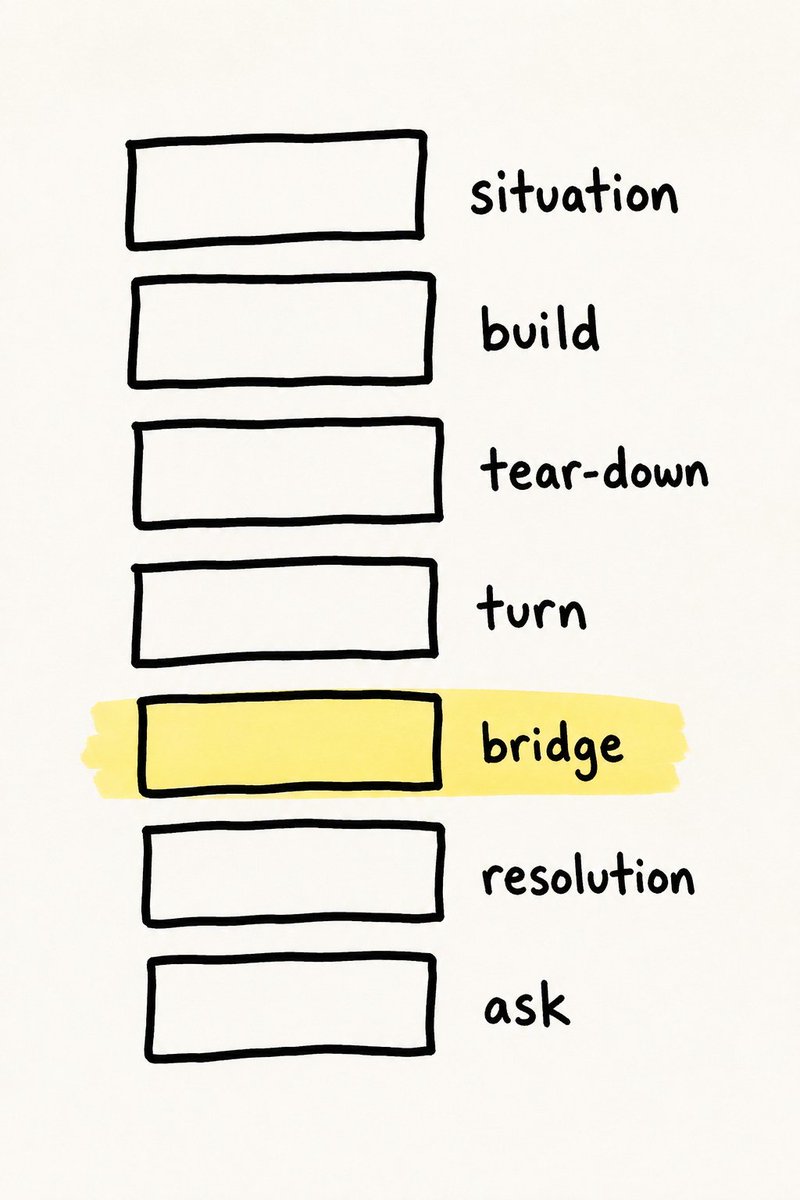
- The situation, named specifically. A person, a place, a moment. Not "she was struggling." Her name, her kitchen, a Tuesday.
- The build. Two or three verses where it gets worse. This is the part everyone cuts too short. The audience has to actually feel the weight before relief means anything.
- The tear-down. The lowest point, stated plainly. The brands running this go dark here, and their read is that the drama is doing real work. Worth testing both intensities in your category.
- The turn. Something changes. Not the product yet.
- The soft-sell bridge. Now the product, woven in as the explanation for the turn. One or two lines. The narrative has already sold; this just names the thing.
- The resolution. Where she is now. Short.
- The ask. Quiet. After five minutes of story, a hard close breaks the spell.
Write the blocks once as a template, then run different stories through them. That's the system, and it's why this scales instead of being a one-off lucky ad.
Embedded post:
Author: Lorenzo | Meta Ads & Performance Creatives 📈 (@lorenzo_pravata) Post ID: 2089304539232866347 Source: https://x.com/lorenzo_pravata/status/2089304539232866347 Posted: 2026-08-17T10:53:14.000Z Reply to: none
Text:
> 1 minute of this "ad" and no product. > > That's why our AI ads are just better. > > We have been good at scriptwriting for a long time. > > New formats or not, we know how to flow between being entertaining and then selling without losing attention. > > So instead of focusing on how cool or not this AI ad looks. > > Focus on learning how to become a brand that: > > - uses storytelling > > - can relate to your actual real customers > > - makes AI become a tool that amplifies your internal skills as a team > > Want ads like these for your brand? > > Link in bio.
Media:
- video:
iii - how to test something this long
You cannot test a five minute ad the way you test a thirty second one, and this is where brands waste money.
Test the first 30 seconds before you build the whole thing. Cut the situation and the first verse, run it as a standalone, and look at hook rate and 25% retention. If people don't stay for thirty seconds they will never stay for five minutes. This costs almost nothing and kills bad concepts early.
Length does not excuse a weak open. The three second rule still applies. A long ad with a slow first line just fails slower.
Every song is a genuinely different ad, and that matters more than it used to. Different character, different melody, different visual treatment reads as structurally distinct, which is how you get more than one ticket into the auction. Five re-cuts of the same song do not. If you take one thing from this article, take that one.

Give it room. These need real spend and real time before the data means anything. Judging a five minute ad on a day of spend at a low daily budget tells you nothing.
Run one song per ad set, not five. You want to know which story worked, not which combination.
iv - the three angles, and where to send the traffic

- The confession
First person. The character admits something they're ashamed of, and the shame is the hook.
This is the highest-performing register we've seen and also the riskiest. It works because nobody scrolls past a person admitting something real.
Opening lines that work: something that would be uncomfortable to say out loud. "I stopped answering when my daughter called." "I told everyone I was fine for two years."
Visual: simple animation, or a single character in one room. Keep it claustrophobic while the story is dark, then open it up at the turn.
Where to send it: an advertorial or a VSL. Someone who just sat through a confession is in a story mindset, and a product page breaks it immediately.
- The transformation ballad
The full arc, before and after, with the benefit carried by the chorus rather than stated.
Less risky than the confession and easier to write, which makes it the right place to start if you're new to the format.
Opening lines: the before state, concretely. Not "she felt tired." What she stopped doing because of it.
Visual: transformation cues. The same room, the same routine, the same person, visibly different by the end. This is the one angle where the visual carries real weight.
Where to send it: a quiz. The arc has already made them identify with the character, and a quiz lets them find their own version of her.
- The third-party story
The singer is not the customer. They're telling someone else's story. A daughter about her mother, a husband about his wife, a friend about a friend.
This one is underrated. Defences drop when nobody is being sold to directly, and it lets you go emotionally harder than a first-person version could without feeling manipulative.
It also solves a real targeting problem, because the buyer and the user are often different people.
Opening lines: the observer noticing something. "I saw my mum's shopping list and it broke my heart."
Visual: two characters. The relationship is the whole appeal.
Where to send it: an advertorial that speaks to the buyer, not the user. If a daughter is buying for her mother, the page needs to reassure the daughter.
Whether any of these work in your category depends on your product, your margins and your audience. The 40+ audience is where the clearest wins are right now, and I suspect that's about attention rather than demographics.
You find out by running it.
What I'd say is that the brands already scaling on this format did not have a better product than their competitors. They had a format nobody else was running.
That window is open right now and it will not stay open. Most brands will look at a five minute song ad, decide it's ridiculous, and keep shipping thirty second UGC into a feed that's saturated with it.
Talk soon
Lorenzo
Spending over $100k/mo on Meta and want us to build these for you? DM me "Audit" or click the link in my bio.
Related articles

how to crack the meta ads andromeda algorithm in 7 steps
if your meta ads suddenly stopped converting over the past year, got more expensive, and your proven system no longer works, nobody hacked your account.
the $100,000,000 AI UGC ad opportunity (that'll disappear soon)
there is a window open right now in meta ads that will produce more millionaires in the next 18 months than any advertising format shift in the last decade.

How to Create Massive AI Influencer Content at Scale (Step by step - P2 simplest way)
Hey guys, I’m back. I was honestly shocked to see HER 75 achieve such massive success using AI UGC. They grew from $60K/month to $200K/month using only AI influencers. That’s crazy.