the dark psychology behind winning meta ad creatives

"if you know the enemy and know yourself, you need not fear the result of a hundred battles."
sun tzu wrote that 2,500 years ago about warfare. he was describing meta ads in 2026.
most operators build creatives by asking "what sounds good?" the operators printing money at scale build creatives by asking "what psychological mechanism will stop this specific person from scrolling, hold their attention through the argument, and make inaction feel more dangerous than action?"
the difference between those two questions is the difference between a $50 cost per lead and a $12 cost per lead running the same offer to the same audience.
this is not about being deceptive. nothing here is unethical or non-compliant. this is about understanding why certain creatives perform and others don't at the psychological level, so you stop guessing and start engineering.
i've been spending $1M+ a month on meta ads for 7 years. the creative decisions generating the highest returns are rooted in behavioral science, not in design aesthetics. here's the psychology behind every one of them.
law 1: make inaction feel dangerous, not action feel attractive
"men are driven by two principal impulses, either by love or by fear." - Machiavelli
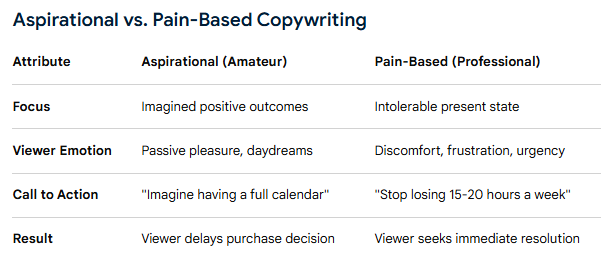
the amateur advertiser sells the positive outcome. "imagine having a full calendar." "picture yourself with a 30% close rate." "what would your life look like with 50 new leads a month?"
the professional advertiser makes the current state feel intolerable.
aspiration-based messaging creates a pleasant daydream. the viewer enjoys imagining the outcome and keeps scrolling. they'll get to it eventually. there's no urgency because the positive future will still be there tomorrow.
pain-based messaging creates discomfort with the present. the viewer recognizes their current situation in the ad, and the recognition surfaces frustration, embarrassment, or anxiety they've been suppressing. the discomfort creates a desire to resolve it. the offer becomes the resolution.
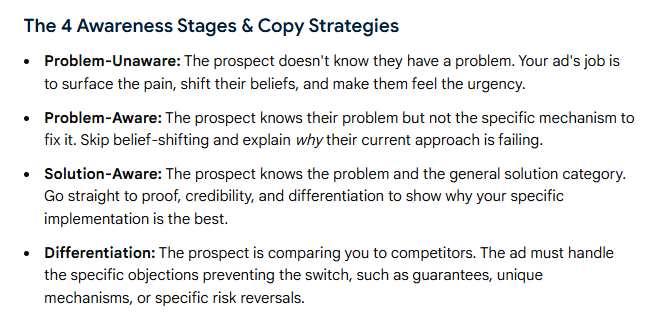
this is not about being cruel. it's about being honest about the cost of inaction, which is something the viewer is actively avoiding thinking about.
the compliance line: describe the real pain your ICP experiences. never fabricate, exaggerate, or manufacture fear about something that isn't real. "you're losing 15-20 hours a week managing your ads manually" is compliant if it's true for your ICP. "your business will fail without this" is non-compliant fear-mongering.
the distinction is between illuminating a real problem they're ignoring and fabricating a threat that doesn't exist.
law 2: the pattern interrupt is the gatekeeper
"the best of opportunities will be missed unless taken at the flood." - Baltasar Gracian
in a meta feed, every piece of content competes for a 0.3-second pattern-matching decision. the brain sees the format before it reads the words. the format triggers either "content i want to engage with" or "ad trying to sell me something."
this is why format selection is a psychological decision, not a production decision.
native formats (iMessage threads, apple notes, google search results, email inboxes) trigger the "organic content" pattern. the brain doesn't classify them as ads in the first 0.3 seconds. they get past the scroll filter.
claymation and stop-motion trigger the "novel visual experience" pattern. the brain has never filed this aesthetic as an ad format before, so the pattern-matching system doesn't have a shortcut for "skip." the novelty creates a pause.
balloon and pixar-style trigger the "entertainment" pattern. colorful, stylized, emotionally warm. the brain categorizes it as content worth watching before realizing the commercial intent.
product showcase triggers the "what is that" pattern when the product is visually distinctive. works for physical products with interesting aesthetics. fails for services that don't have a tangible object to show.
founder talking head triggers the "person talking to me" pattern. the most direct format for authority positioning. works because the brain responds to face-to-face communication even through a screen.
each format exploits a different psychological entry point. the buying trigger is the payload. the format is the delivery mechanism that gets the payload past the brain's defenses.

law 3: the hook must create a cognitive open loop
"a man who knows how to keep his own counsel is stronger than he who forces his secret on others." - Robert Greene, 48 Laws of Power
a cognitive open loop is an unresolved question or tension in the viewer's mind. the brain is wired to seek closure. an open loop creates discomfort that can only be resolved by continuing to consume the content.
FOMO angle hooks create the loop through exclusion fear. "by [timeframe], [bad thing] will be the default in [niche]." the viewer needs to know what the bad thing is and whether it affects them. the loop stays open until they watch/read through the mechanism reveal.
problem agitation hooks create the loop through recognition. "there's a specific reason your cost per lead keeps climbing and it has nothing to do with your creative." the viewer who's experiencing climbing CPLs needs to know what the real reason is.
great offer hooks create the loop through value anticipation. "$37,444 in one day. zero paid ads. zero outbound." the viewer needs to know how.
promo angle hooks (BFCM, seasonal, limited time) create the loop through scarcity. the window is closing. the viewer needs to act or lose.
the hook doesn't sell the product. the hook sells the next 5 seconds. every line in the ad sells the line after it. this is the cascading commitment principle: small yeses (keep watching, keep reading) accumulate into the big yes (take action).
law 4: speak to the awareness stage or be ignored
"the wise man does at once what the fool does finally." - Baltasar Gracian
the same product requires completely different psychological entry points depending on how much the viewer already knows.
problem-unaware ads must shift a belief before anything else. the viewer doesn't know they have a problem. the ad's job is to surface the problem and make them feel it. "most service business owners are losing $5,000-$10,000/mo in wasted ad spend and have no idea it's happening." the viewer who isn't tracking their ad efficiency now feels compelled to check.
problem-aware ads skip the belief shift and go straight to the mechanism. the viewer already knows the problem. they need to understand why their current approach is failing and what the alternative is. "your winning ads keep dying because the algorithm exhausted the audience pocket, not because the creative got worse."
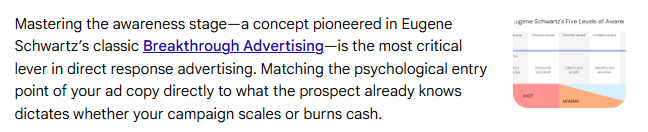
solution-aware ads skip both and go straight to proof and differentiation. the viewer knows the problem and the type of solution. they need to be convinced that your specific implementation is the best. "$10M+ generated across 100+ service businesses through meta ads funnels, fully done-for-you."
differentiation ads target the viewer who's comparing you against alternatives. the ad handles the specific objection that's preventing the switch. "you've seen 50 agencies promise results. here's why we're the only one backing it with a guarantee."
running a problem-unaware ad to a solution-aware audience wastes their time. running a solution-aware ad to a problem-unaware audience confuses them. the awareness stage determines the psychological entry point, and getting it wrong kills performance regardless of how good the creative is.
law 5: specificity is the weapon, not superlatives
"never outshine the master." - Robert Greene, 48 Laws of Power. the corollary: never outshine the truth.
"we generated amazing results for our clients" is invisible.
"we generated $55k in 90 days for a service business spending $3k/mo on ads through an advertorial funnel converting cold traffic at 11.2%" stops a scroll.
specificity creates credibility without requiring trust. the reader doesn't need to believe you're good. the detail itself is the proof. a specific number implies measurement. measurement implies a system. a system implies competence. the chain of inference happens automatically in the reader's brain.
the psychological mechanism: vague claims trigger the brain's bullshit filter. "we get great results" sounds like every other ad. there's nothing to process, nothing to evaluate, nothing to anchor. the brain dismisses it.
specific claims bypass the bullshit filter because they give the brain something to evaluate. "11.2% conversion rate from cold traffic" triggers evaluation: "is that good? that seems high. how did they do that?" the evaluation creates engagement. engagement creates attention. attention creates the opportunity to sell.
every claim in your creative should be specific enough to be falsifiable. if you state it so precisely that someone could prove you wrong, the audience reads it as confidence. confidence converts.
law 6: the close is earned, never demanded
"do not die for someone who does not know you." - Sun Tzu. the advertising translation: do not ask for action before you have given reason to act.
the CTA in a winning creative is not "buy now." the CTA is the logical next step after the argument has been made.
the psychological sequence:
discomfort with the current state (the pain they're ignoring)
understanding of why their current approach fails (the mechanism gap)
introduction of the new approach (the mechanism)
proof that the new approach works (the result)
the CTA as the obvious next step (the resolution)
skip any step and the CTA feels forced. hit every step and the CTA feels inevitable.
the best performing CTAs in our account are the least aggressive. "DM me META and we'll build the plan" converts better than "BOOK NOW before spots run out." urgency without earned trust repels. a calm, confident next step after a fully built argument closes.
the format-psychology matrix (what to run and when)
format selection by angle type:
FOMO angle + calendar invite or lock screen format = urgency meets native trust
problem agitation + iMessage thread or apple notes = intimate pain recognition
great offer + breaking news or google search = authority amplification on a result
promo angle (seasonal) + typography headline or billboard = bold statement meets visual scale
differentiation + before/after comparison or checklist = scannable proof of the gap
format selection by awareness stage:
problem unaware: native formats (notes, iMessage, search results) or novelty formats (claymation, balloon) to get past the scroll filter before the belief shift
problem aware: founder talking head or UGC for mechanism explanation with human credibility
solution aware: proof-heavy formats (breaking news, before/after, data visualization) for result anchoring
the creative is the weapon. the psychology is the aim. and the format is the delivery system that determines whether the weapon reaches the target or gets intercepted by the scroll reflex before it ever fires.
if you want us to audit your service business and show you how we'd apply this psychological framework to your meta ad creative strategy, DM me "META" and we'll build the plan.
($10M+ generated for service-based businesses through meta ads funnels, fully done-for-you)
zack
Related articles

the 48 laws of winning meta ads funnels
robert greene published the 48 laws of power in 1998. every law was drawn from the same source: thousands of years of strategic thinking by people who understood that human nature is the operating sy…
how to write hooks that consistently hit above 45% hook rate (full guide)
Here’s what TRUE creative diversity looks like:

Mars men's full meta ads playbook (4,512 ads)
Mars Men has 4,512 ads live on Meta right now, on a Facebook page that only exists since December 2023.