The Two-App Stack: $6,850 a Month from Midjourney and Pinterest
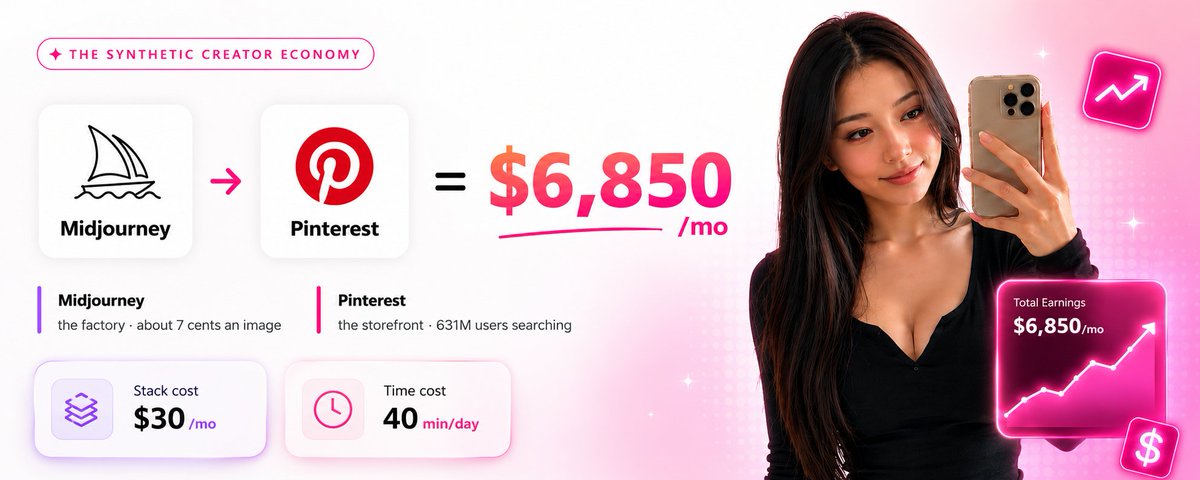
She produces high-performing posts every single day. Her apartment gets photographed from every angle, warm light through the blinds, plants in the corner, a coffee bar that home-decor boards can't stop saving. She has 214,000 monthly viewers and she was never born. The person behind her is a 26-year-old nurse in Phoenix who works night shifts, touches the operation for about 40 minutes a day, and cleared $6,850 last month. Her entire business is two apps: one manufactures a life, the other ranks it in front of people holding a shopping list.

I've spent this year decoding how synthetic creators get paid, and most of the plays share a weakness: they live or die by a feed algorithm's mood. This one doesn't, and that's exactly why almost nobody in the AI crowd runs it. It's built on search, it compounds instead of resetting every morning, and the whole stack costs $30 a month. This is the full system, including the part where it pays $118 and feels like a scam.
1 · The stack: a factory and a storefront
Every money system on the internet is some version of the same sentence: make something cheap, put it where demand already exists, take a cut of what moves. The two-app stack is that sentence with no decoration left on it.

Midjourney is the factory. The $30 Standard plan includes unlimited generation in relax mode, which means the marginal image costs nothing but queue time. Willow's operator batches 100-plus images in a sitting; across a month her effective cost lands around 7 cents per generated image, and the keepers become content. No shoots, no studio, no model who moved to LA.

Pinterest is the storefront. 631 million people use it every month, an all-time high, and they use it differently than any other platform: they type what they want into a search bar, save what they plan to buy, and click out to buy it. A pin that ranks for a search keeps collecting traffic for months. That single property changes the whole business model from performing to publishing.
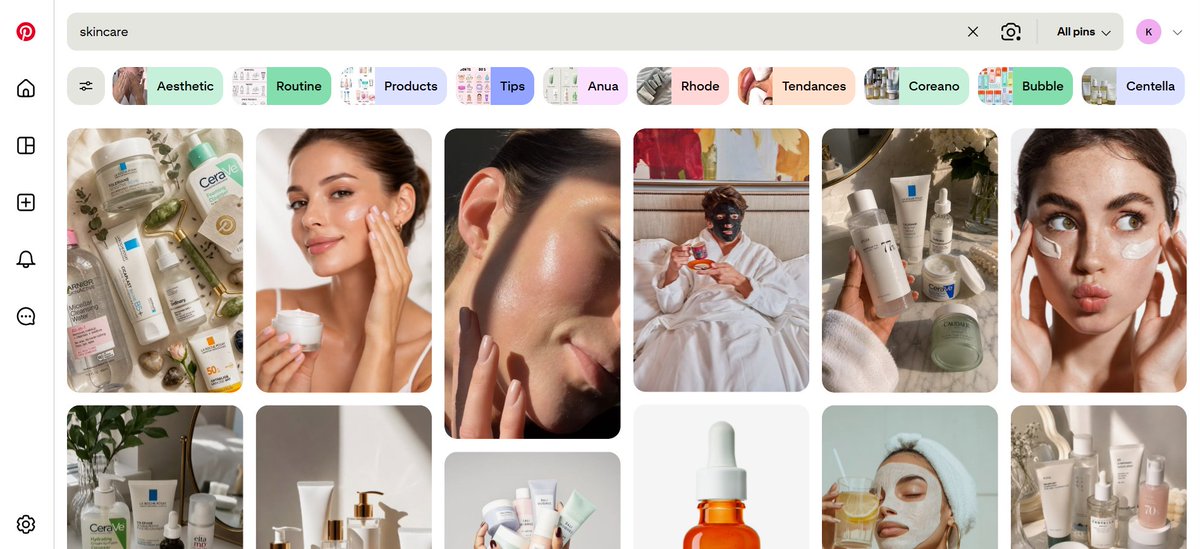
Everything else, the persona, the boards, the affiliate links, is plumbing between those two machines.
The full stack and what it costs
| Job | App | Plan that matters | Cost |
|---|---|---|---|
| Image production | Midjourney | Standard: unlimited relax-mode generation | $30/mo |
| Distribution + ranking | Free business account with analytics and scheduling | $0 | |
| The money | Amazon Associates (or LTK / ShopMy) | Affiliate links in pins, 2.5 to 4.5% on home categories | $0 |
| Keyword research | Pinterest Trends | Free, first-party search data | $0 |
 — "Five stages, one loop. The reinvest arrow is where the compounding lives: analytics on winners feeds keyword choice for the next batch."
2 · Why Pinterest is the arbitrage
The AI-creator crowd is packed onto TikTok and Instagram, fighting a feed that forgets them in 48 hours. Meanwhile, the platform that behaves like a search engine, where content is an asset instead of a performance, has almost no serious AI operators on it. That gap is the trade.
Three properties make Pinterest structurally different for this play. First, intent: people arrive planning purchases, which is why the platform can charge advertisers a billion dollars a quarter. You are not interrupting entertainment, you are answering a query someone typed with a credit card within reach. Second, lifespan: a pin that ranks keeps surfacing in search and related-pin feeds for months, so every day of posting adds inventory instead of replacing yesterday's. Third, the follower irrelevance: distribution comes from the query, not the follow graph, so pin number one competes on the same field as an account with a million followers.
Pinterest vs the feed platforms, for an AI image operator
| Dimension | TikTok / Instagram | |
|---|---|---|
| Content lifespan | Months (search asset) | 24 to 48 hours (feed moment) |
| Traffic source | Queries + related pins | Algorithmic feed mood |
| Followers needed to start | Zero | Reach scales with account weight |
| Visitor intent | Planning and shopping | Entertainment |
| Outbound links | Native on every pin | Bio only, or penalized |
| Format for still images | First-class citizen | Second-class next to video |
> Every TikTok is a performance that ends. Every pin is a billboard that stays up. The operator who understands that difference stops chasing virality and starts accumulating real estate.
3 · Step 1: pick keywords, not aesthetics
Here is the mistake that kills 9 in 10 attempts at this: people open Midjourney first. They generate whatever looks gorgeous, post it, and wonder why 40 beautiful images produced 12 visits. Pretty is not a query. Nobody types "vibes" into a search bar.
Willow's operator works backwards. She starts in Pinterest Trends, the platform's free first-party search data, and only generates what people are already looking for. "Coffee bar ideas." "Cozy studio apartment." "Small kitchen organization." Every image in the batch exists to answer one specific query, which means every image has a ranking target before it's ever generated. She isn't generating pictures, she's generating answers to searches.
Embedded post:
Author: Asher Crowe 🪺 (@ashercrw) Post ID: 2066882168828153883 Source: https://x.com/ashercrw/status/2066882168828153883 Reply to: none
Text:
> http://x.com/i/article/2066852248563453952
Two selection rules matter.
Stay faceless. Rooms, flatlays, outfits arranged on a bed, a hand around a mug. Faceless niches sidestep the uncanny valley entirely, dodge the "this is AI" pile-on in comments, and conveniently cover the highest-commission product categories.
Stay purchasable. A niche only works if the image is full of things a viewer can buy: the lamp, the rug, the espresso machine. Landscape photography is beautiful and monetizes like a screensaver.
Faceless niches that print, and what they sell
| Niche | Example queries | What the pin sells | Affiliate rate (Amazon) |
|---|---|---|---|
| Home decor / small spaces | "coffee bar ideas", "cozy studio apartment" | Furniture, lamps, shelving | ~4% |
| Kitchen + coffee setups | "small kitchen organization", "home espresso corner" | Appliances, organizers | ~4.5% |
| Outfit flatlays | "fall capsule wardrobe", "old money outfits" | Clothing, accessories | ~4% |
| Desk / WFH setups | "minimal desk setup", "home office ideas" | Monitors, chairs, desk gear | 2.5 to 4% |
| Seasonal decor | "christmas apartment decor", "fall porch ideas" | Seasonal everything, huge spikes | ~4% |
4 · Step 2: the Midjourney production line
The difference between an account that looks like a brand and an account that looks like an AI dump is consistency. Willow's apartment is the same apartment in every frame. Same palette, same wood tones, same morning light. Viewers follow because the world feels real enough to want to live in, and that feeling is one parameter deep.
The tool for it is Midjourney's style reference. Generate one anchor image that nails the aesthetic, then pass it as --sref on everything after, with --sw tuning how hard the style locks. One good anchor makes every future image on-brand by default. From there the workflow is industrial: two batch sittings a week in relax mode, 60 to 80 generations per sitting, keep the best third. Relax mode is slower per image and completely free past the subscription, which is what makes the 7-cent math work.
Prompts are an assembly, not an art project. Willow's operator fills five slots and ships:
The five-slot prompt formula
| Slot | What goes in | Example |
|---|---|---|
| 1 · The query | The keyword, almost verbatim | "small apartment coffee bar" |
| 2 · The scene | Room, surface, arrangement details | "floating oak shelf, ceramic mugs, espresso machine" |
| 3 · The light | One signature lighting setup, reused | "soft morning window light, warm tones" |
| 4 · The camera | Keeps outputs photographic, not painterly | "shot on 35mm, f/2.8, editorial interior photography" |
| 5 · The lock | Style reference + aspect ratio | --sref [anchor] --sw 200 --ar 2:3 |
> Quality gate, non-negotiable: AI hands, warped text, impossible furniture joints, and melted appliance dials are what get an account mentally filed as slop. The keep-rate is a third of the batch precisely because two thirds get killed. The bar is "could be a real editorial photo at first glance." Below that bar, don't post it.
5 · Step 3: the Pinterest machine
The account setup is done once and then it's pure cadence. A free business account for analytics. Eight to twelve boards named after real queries ("Coffee Bar Ideas", "Small Apartment Living"), because board names are ranking signals too. Then the machine: Pinterest's built-in scheduler holds a queue of 10 pins up to 30 days out, and Willow's operator refills it every evening after shift. Call it 10 fresh pins a day, each one a new image, because Pinterest's distribution favors fresh pins over recycled ones.
Each pin is a tiny SEO exercise: the query up front in the title, a description that uses the phrase naturally plus two neighbors ("coffee station", "apartment kitchen ideas"), the affiliate link as the pin's destination, and the pin filed to the matching board. Sixty to ninety seconds per pin once the images exist.

And the disclosure question, answered plainly: Pinterest detects AI generation from image metadata and applies an "AI modified" label on the pin closeup, with classifiers catching unmarked content too. Do not fight it. Stripping metadata to dodge the label is the kind of move that works until it costs you the account, and the label barely matters for this play anyway. A person searching "coffee bar ideas" wants the shelf and the layout; the idea works the same whether the photo came from a camera or a diffusion model. Run it labeled. Boring compliance is what lets the thing compound for years.
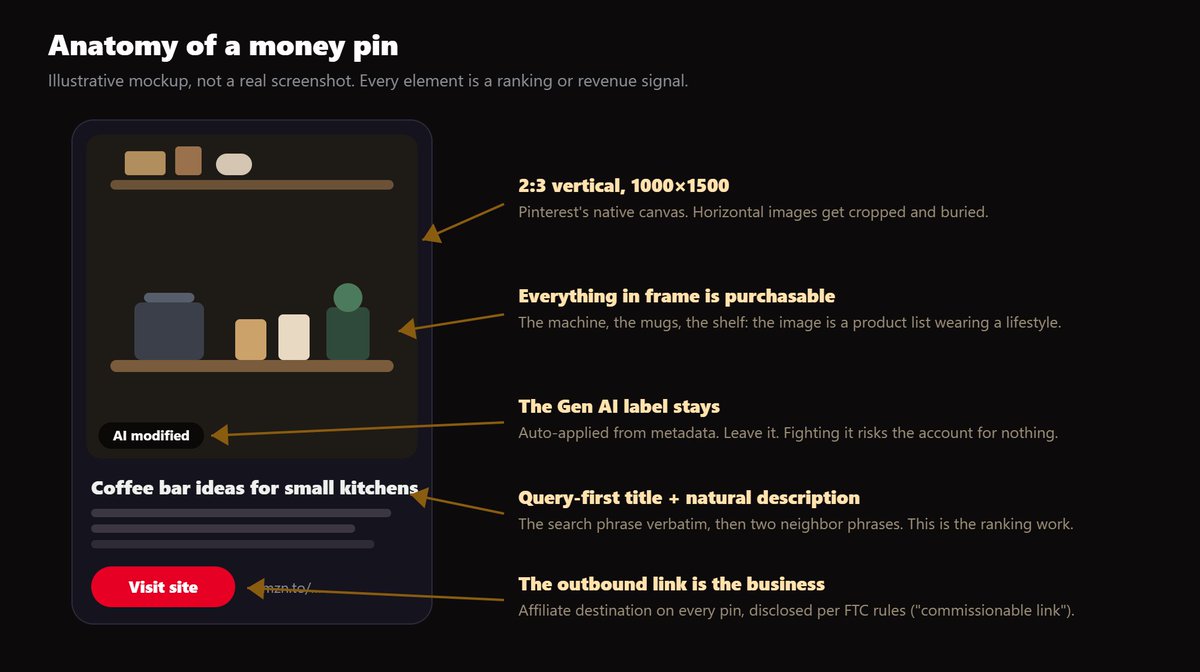 — "Illustrative mockup of the pin template that did 2.1 million impressions in the case study. Five signals, sixty seconds of work per pin."
The 40 minutes a day, itemized
| Cadence | Task | Time |
|---|---|---|
| Nightly | Refill the 10-slot native queue: titles, descriptions, links, boards | ~25 min |
| Twice a week | Batch sitting: 60 to 80 relax-mode generations against next week's keywords | ~45 min |
| Weekly | Analytics pass: kill losing formats, clone winning ones onto neighbor keywords | ~20 min |
| Monthly | Keyword refresh in Pinterest Trends; plan seasonal boards 60 days early | ~30 min |
I decode one money system like this every week.
AI personas, synthetic creators, and the machinery behind the screenshots. Free to follow. https://x.com/ashercrw
Embedded post:
Author: Asher Crowe 🪺 (@ashercrw) Post ID: 2071579673604100381 Source: https://x.com/ashercrw/status/2071579673604100381 Reply to: none
Text:
> http://x.com/i/article/2071569276310339584
6 · Step 4: the money layer
The pin's destination link is where traffic becomes income, and the entry-level answer is Amazon Associates: free to join, everything in a home-decor frame is on Amazon, and the cookie credits you for what the visitor buys within the session window. Rates run 2.5 to 4.5 percent on the relevant categories, kitchen at the top of that band. The numbers on Willow's best pin: 2.1 million impressions, about 19,000 outbound clicks, $48,250 in attributed purchases, and a $1,930 slice of it so far. One image. Seven cents of compute.

Two upgrades stack on top once traffic is real. Creator platforms like LTK and ShopMy replace raw Amazon links with branded storefronts and often better rates from individual brands. And digital products are the margin play: the same pin traffic that buys a $40 lamp will pay $9 for a bundle of printable wall art, which the same Midjourney subscription produces for pennies and an Etsy or Gumroad page delivers automatically. Physical affiliate pays 4 percent of someone else's product; a printable pays roughly 90 percent of your own.

One rule keeps all of it durable: disclose. "Commissionable links" in the profile and pin descriptions. It costs zero clicks and it keeps the FTC, the platforms, and the affiliate programs off your back permanently.
The monetization layers, in the order you add them
| Layer | What it is | Your cut | When to add |
|---|---|---|---|
| Amazon Associates | Affiliate links as pin destinations | 2.5 to 4.5% of attributed sales | Day one |
| LTK / ShopMy | Creator storefronts, brand-direct rates | Varies by brand, often 10%+ | ~50k monthly views |
| Digital printables | Wall-art bundles made in the same Midjourney account, sold via Etsy or Gumroad | ~90% after fees | Month 3+ |
| A simple blog | Pins link to your roundup posts; display ads + affiliate both pay | Ad RPM + affiliate stacked | When pins prove the niche |
7 · The honest math and the risks
Now the part the screenshot bros leave out. Search compounding has a brutal front end: pins need weeks to index, rank, and propagate through related-pin feeds. Willow's first month paid $118, which is under a dollar an hour for the work involved. Month two paid $486 and this is where almost everyone quits, standing three feet from the inflection. Month three, two pins broke into the category feed and dragged the whole account's distribution up with them: $2,610. By month six the account held roughly 1,700 live pins and paid $6,850, most of it from inventory published months earlier.
The distribution behind that curve is savagely top-heavy: about 5 percent of her pins produce 90 percent of the money. You cannot predict which ones in advance, which is exactly why the system is volume plus analytics instead of taste. You publish wide, the search data votes, and you reinforce the winners.
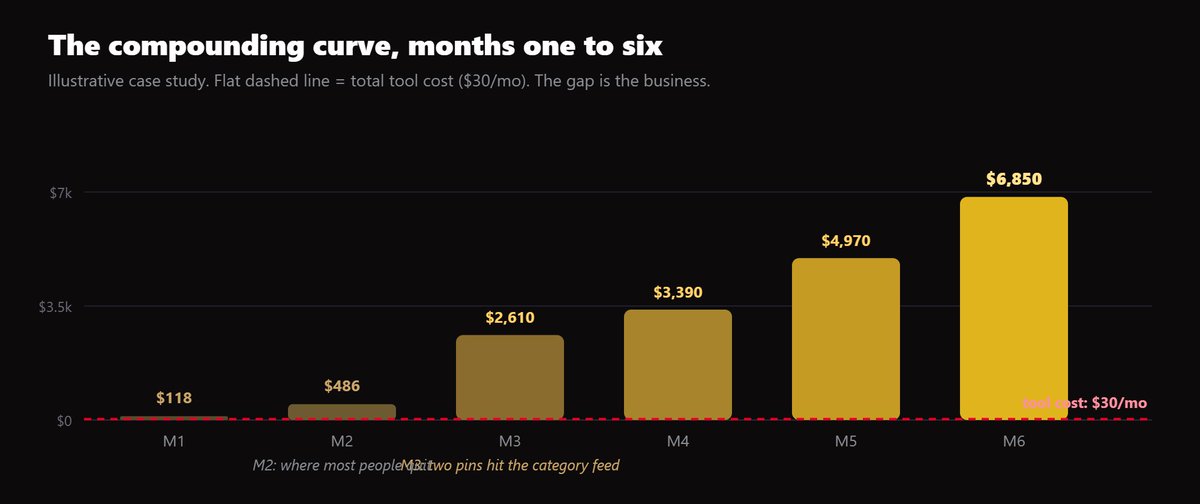 — "One operator's curve, not a median. Typical outcomes are materially lower; a large share of attempts never clear $200 a month. The shape, slow then compounding, is the honest part."
Month by month, with the part that hurts
| Month | Pins live | Paid | What was true |
|---|---|---|---|
| 1 | ~290 | $118 | Indexing. Under a dollar an hour for the effort. |
| 2 | ~580 | $486 | The quitting month. Growth is happening, invisibly. |
| 3 | ~860 | $2,610 | Two pins break into the category feed; account distribution lifts. |
| 4 | ~1,130 | $3,390 | Winners identified; batches now target proven formats. |
| 5 | ~1,420 | $4,970 | Printables layer added; margin jumps. |
| 6 | ~1,700 | $6,850 | Old pins do most of the work. 5% of pins = 90% of revenue. |
The three real risks
The Gen AI headwind. Pinterest labels AI content and gives users a "limit Gen AI in my feed" toggle. If a meaningful slice of your niche flips it, your ceiling drops. The counter is the same as the strategy: compete on usefulness, not on passing as human. A good coffee-bar layout survives its label; slop doesn't survive anything.
Spam enforcement. Pinterest suspends aggressive affiliate spammers in waves. The line that keeps you on the right side: original images, honest descriptions, disclosed links, one account, no link-shortener games, volume that looks like a brand rather than a bot. This playbook already lives inside those lines.
Platform drift. Rates change, programs change, algorithms change. The asset that survives all three is the niche account itself: an audience-and-rankings position you can point at any monetization that exists next year. That's the actual thing being built here. The commissions are just this year's exhaust.
More from @ashercrw
This is one system in a series decoding how synthetic creators and AI operators get paid. The complete run lives at x.com/ashercrw/articles.
Embedded post:
Author: Asher Crowe 🪺 (@ashercrw) Post ID: 2063961121803866288 Source: https://x.com/ashercrw/status/2063961121803866288 Reply to: none
Text:
> http://x.com/i/article/2063945770416398336
FAQ
Does Pinterest allow AI-generated images?
Yes. Pinterest detects AI generation from image metadata and its own classifiers, and applies an "AI modified" label on the pin closeup. Labeled AI content distributes normally in search. Users do have a setting to see less Gen AI content in some feeds, which is a headwind you price in, not a wall. The move that gets accounts in trouble is stripping metadata to dodge the label, so don't.

Do I need a website for Amazon Associates?
No. You can register a social account, including Pinterest, as your traffic channel, and you must list it in your Associates profile. Adding a simple blog later is an upgrade (display ads stack with affiliate), not a requirement. Check the program's current policy pages when you apply, and disclose commissionable links wherever you post them. This is not legal advice.

How many pins a day, and do they have to be new images?
The case in this article runs about 10 a day using Pinterest's free native scheduler, which holds 10 queued pins up to 30 days out. Fresh pins (new images) earn better distribution than repins of old content, which is exactly why the unlimited-generation Midjourney plan matters: fresh supply costs pennies.

How fast until the first payout?
Slow. Pins take weeks to index and rank, Amazon pays roughly 60 days after the month ends, and month one in the illustrative case was $118. Treat the first 90 days as planting season. If you need income this month, this is the wrong system; if you can feed it 40 minutes a day for a season, the curve bends.

What if my niche has no Pinterest search volume?
Then it isn't a niche for this system, and you find out in ten minutes instead of ten weeks: check Pinterest Trends before generating anything. If related queries show steady or seasonal volume, proceed. If the graph is a flatline, pick the neighboring niche that isn't.
Is this really passive income?
It's front-loaded income. The first months are real work for embarrassing money, then old pins keep paying while you maintain cadence in about 40 minutes a day. "Passive" is the marketing word; "compounding" is the accurate one.
> The influencer was never the product. The traffic was. One app manufactures a life for 7 cents an image, the other ranks it where 631 million people shop, and the operator collects the toll between those two numbers.
I break down a system like this every week, with the math the screenshots leave out. Follow @ashercrw.
Embedded post:
Author: Asher Crowe 🪺 (@ashercrw) Post ID: 2069092830048371042 Source: https://x.com/ashercrw/status/2069092830048371042 Reply to: none
Text:
Related articles

The ULTIMATE Organic Marketing Guide For App Founders
I’m going into calorie deficit, fat loss, high protein meals, gym meals, restaurant calories, what I eat in a day, meal prep, macro tracking, cutting, bulking, low calorie snacks and whatever else st…

34 Truths Nobody Tells You About Scaling a Consumer App
I ran marketing and day-to-day operations for Cal AI as we scaled from nothing to $50M ARR in roughly 18 months.

A Reels blocker hit $90k mrr with 70 videos (and why your app will never do that)
[video](https://video.twimg.com/amplify_video/2095254647896174592/vid/avc1/320x568/t94KQkXnW6X-CMfE.mp4?tag=29)