I went from $0 to $10K+ without spending a cent on ads (full guide)

I’m going to break down the exact process that took one of my apps from $0 to $10K+ using organic marketing.
No paid ads.
No huge audience.
No “secret algorithm hack.”
Just a repeatable system.
But before getting into the process, let me introduce myself.
My name is Pedro. I’m a mechanical engineer and I’ve been doing organic content since 2020, originally through ecommerce.
When I started building apps, I had no budget to spend on acquisition.
So organic wasn’t just an option.
It was the only option.
And honestly, I’m glad it was.
Because learning how to acquire users without paying for them completely changed the way I approach app development.
Here’s exactly how I do it:
1. Why organic is the best way to start
There are many reasons I believe organic is one of the best acquisition channels when launching an app.
The biggest one is obvious:
You don’t need money.
If you have $0 to spend on ads, you can still start today.
Your main investment is time.
And unlike paid acquisition, your results are not completely dependent on your budget.
The more content you can produce, the more opportunities you create for something to take off.
One video can generate:
10K views.
100K views.
1M+ views.
And potentially thousands of downloads.
The key is understanding that you shouldn't be looking for ONE viral video.
You need a system that gives you hundreds of chances to find one.
2. How I find content ideas
People massively overcomplicate organic marketing.
There is no secret formula.
You don't need to be a genius at content.
You need to become really good at identifying what is already working.
Here's my process.
Step 1: Create a TikTok research account
I create a burner account and start looking for app-related content.
Fitness apps.
Calorie trackers.
Looksmaxing apps.
Productivity apps.
Dating apps.
Mental health apps.
Anything related to apps.
I then spend around 20–30 minutes liking, watching and interacting with the videos that catch my attention.
The goal is simple:
Train the FYP.
If you've done it correctly, your feed should eventually become almost entirely app-related content.
Why don't I immediately focus on my exact niche?
Because most successful content formats are transferable.
A format that works for a fitness app can often work for a dating app.
A format that works for a calorie tracker can work for a productivity app.
Examples:
- Phone notification slideshows
- Single-image slideshows with long text
- UGC reactions
- Screen recordings
- Before/after formats
- Storytelling formats
The niche changes.
The underlying format often doesn't.

3. Copy what already works
This is probably the most underrated skill in organic marketing.
You don't need to reinvent the wheel.
You need to recognize a wheel that is already working and build your own version of it.
Once my account is properly trained, I start collecting around 12–15 different video/slideshow formats that I believe can be adapted to my app.
Ideally, I take inspiration from apps in the same niche.
But sometimes your niche simply doesn't have enough content.
That's why I prefer looking at the broader app ecosystem.
The objective isn't to copy someone's exact video.
It's to identify the FORMAT and adapt it to your product.
And there is one rule I follow especially when starting:
Prioritize formats that take less than 10–15 minutes to replicate.
This is extremely important.
One of the most frustrating things about organic is spending 2 hours making a video...
...just for it to get 300 views.
You want to avoid that as much as possible in the beginning.
Fast content = more tests.
More tests = more data.
More data = better content.

4. Test multiple formats
Once I have my 12–15 formats, I start testing.
My rule:
3 different formats per account, per day.
If I'm running 2 accounts:
6 different content formats every day.
This is important because you don't want to spend 5 days posting essentially the same type of content and hoping it suddenly starts working.
You need to constantly test.
Maybe:
Format A gets 500 views.
Format B gets 5K.
Format C gets 100K.
Now you have information.
You know where to focus.
Organic isn't about guessing.
It's about testing enough variables until the data starts giving you answers.

5. Analyze the results
This is the step almost everyone ignores.
Creating content is only half the job.
Analyzing it is the other half.
A video can perform badly for completely different reasons.
For example:
A slideshow gets 100K views and thousands of likes...
…but almost no comments.
That tells me something.
The content is interesting enough to consume, but it's not generating enough interaction.
So instead of abandoning the format, I would replicate it while changing the engagement mechanism.
Your analytics should tell you:
What to repeat.
What to change.
What to stop doing.
That's how you turn organic into a system instead of gambling on every post.
6. How to force engagement
There are hundreds of ways to increase engagement.
Here are three that consistently work for me.
- Ask a question
For a fitness app:
“Which friend would you challenge to a bench press competition?”
Simple.
But it gives people a reason to comment.
- Ask people to comment a specific word
For a weight-loss app:
“Comment ‘I COMMIT’ if you're actually going to lose weight before summer.”
You're giving the viewer an extremely easy action to take.
- Create controversy
This is probably the hardest one to execute properly.
But when done correctly, it's extremely powerful.
The key:
Create debate around the topic without making people distrust your app.
For example, for a couples app:
A notification shows a boyfriend making a questionable comment about his girlfriend.
Now people start debating:
“That's toxic.”
“He's right.”
“She should leave him.”
“He obviously didn't mean it like that.”
The app becomes the vehicle for the conversation.
Compare that to a calorie-tracking app showing a salad and claiming:
“This has 1,000 calories.”
People will still comment.
But now they're commenting because your app is wrong.
That's not the kind of engagement you want.
The objective isn't just comments.
It's the RIGHT comments.
I explain this entire process in much more depth, along with many other techniques, inside my Spanish Skool community with @AlbertoAIcode.
Link: https://www.skool.com/academia-apps-9175
7. Slideshows vs. videos
The million-dollar question.
Which one is better?
The answer:
Both.
But they have different advantages.
In my experience, slideshows generally convert worse than videos.
However, they're MUCH faster to produce.
And when you're testing dozens of ideas, production speed matters.
The biggest disadvantage?
A slideshow is basically locked to TikTok.
A good video can be repurposed across:
TikTok.
Instagram Reels.
YouTube Shorts.
Facebook Reels.
So my advice is simple:
Don't choose one.
Test both.
Let the data decide what works best for your app.

8. How many TikTok accounts can you have on one phone?
This is another thing I see people massively overcomplicate.
You can have up to 8 TikTok accounts on one device.
Personally, I've always preferred running 6–7 because that has worked better for me.
But there is something important:
Create your accounts using email rather than a phone number.
I use Outlook for creating multiple emails.
Gmail tends to become restrictive when you're creating several accounts.
And here's another rule I follow:
DO NOT create multiple TikTok accounts on the same day.
I leave at least 24–48 hours between creating accounts.
So don't try to create 8 accounts in one afternoon.
Build them gradually.
The goal isn't to have 8 accounts.
The goal is to have 8 accounts that actually distribute your content normally.
9. The setup I use for US TikTok
I also use a separate US setup when I want to specifically target the US market.
And honestly, it's much simpler than many “gurus” make it sound.
The setup I personally use:
- Factory-reset phone
- No SIM
- Location set to United States
- English as the system language
- VPN
- Create the social accounts from that environment
I personally use NordVPN and connect to New York.
Once connected, I keep the VPN on consistently.
Then I install TikTok, Instagram, YouTube, etc. and create the accounts.
For TikTok, I personally prefer creating the account 2–3 days before posting the first video.
It's not something I consider mandatory, but it's what has worked best for me.
I'll scroll for around 15–20 minutes and interact normally before posting.
And one important point:
You don't need a separate phone for every TikTok account.
You can run multiple accounts from the same device.
10. Common TikTok problems
One of the most common things I've seen:
You post your first video...
0 views.
Don't panic.
I've had accounts where the first few posts barely moved.
I usually keep using the account normally and continue posting.
Sometimes the first 2–3 videos don't get distribution and then everything starts working normally.
Another scenario:
The first video gets views.
The second gets 0.
Again:
Don't immediately assume the account is dead.
Keep posting.
In my experience, distribution can normalize after several posts.
If you're consistently getting 0 views across 7–8 posts, then I'd stop wasting time on that account and move on.
Remember:
You're building a system.
Don't emotionally attach yourself to individual accounts.
11. The tools I use
These are the tools that make the entire process significantly easier.
Probably the most important editing tool for organic content.
It's incredibly intuitive and you can do almost everything directly from your phone.
You don't need a computer to start creating.
There are free options, and the first month of Pro is usually very cheap depending on the offer available.
I use Higgsfield because it makes creating AI content much easier.
Instead of jumping between different platforms for images, videos and different AI models, I can keep everything in one place.
The cost per image is also very competitive, and having access to multiple models in the same platform makes the workflow much faster.
One of the things I like most is that you can connect Higgsfield to Claude through MCP.
That opens up a completely different workflow where you can go from an idea to generated content extremely quickly.
I'm currently paying $50/month and it's more than enough for what I do.
If you want me to make a complete guide showing how I connect Claude + Higgsfield through MCP and use it to generate content in minutes, comment “MCP” and I'll make it.
Very few people talk about this one.
But if you're serious about organic, I think it's incredibly useful.
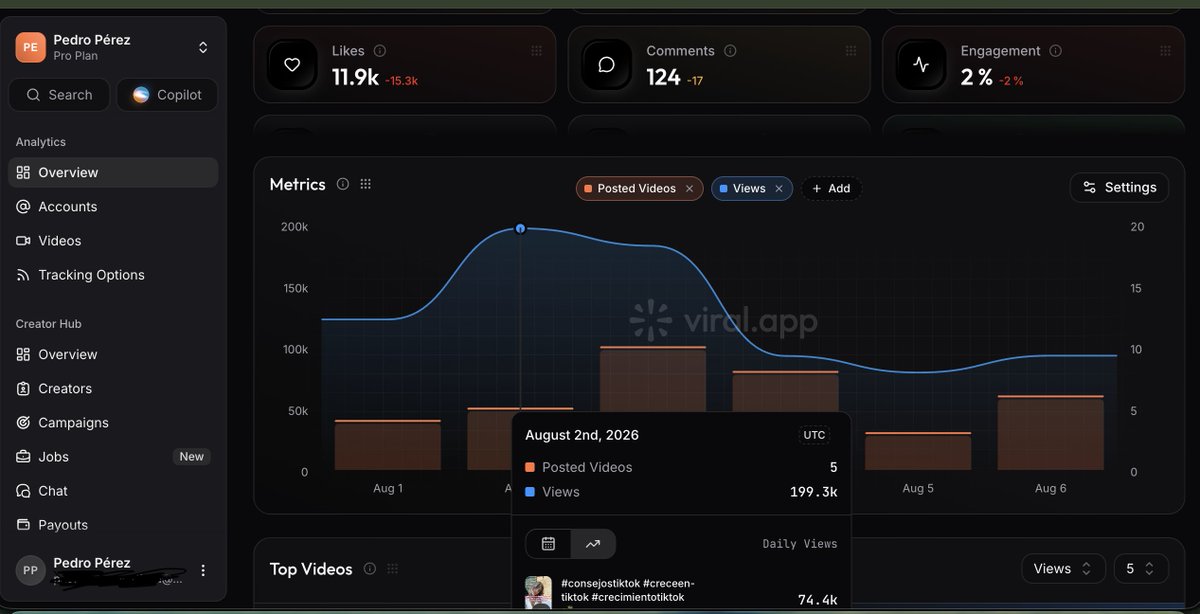
One of the biggest problems with organic marketing is knowing which content is actually driving results.
You can see views.
Likes.
Comments.
Shares.
But understanding which content is consistently performing across multiple accounts becomes much harder once you're posting at scale.
Viral App gives me a centralized dashboard where I can track the performance of my content and compare accounts.
That makes it much easier to identify:
Which formats are working.
Which accounts are performing best.
Which content deserves to be replicated.
And which content should probably be abandoned.
For me, it's become one of those tools that I didn't realize I needed until I started using it.
If you want to test it out: viral.app
The tool I use to build my apps.
I've been using Rork since I started building apps and I've tried several alternatives along the way.
For me, it's still the most complete option.
The fact that you can build and ship apps without having to become a traditional developer completely changes the game.
And the 24/7 technical support is incredibly useful when something inevitably breaks.
Wanna try? rork.com
12. Is organic actually scalable?
Yes.
This is probably one of the biggest misconceptions about organic marketing.
People think:
“Organic only works when I'm the one making every video.”
That's where the real scaling opportunity starts.
Once you've identified your winning formats, you don't necessarily need to make every video yourself.
You can start outsourcing production.
One of my favorite ways to do this early on:
Find 4–5 friends or family members.
Pay them a fixed amount to create X videos per week.
Then teach them your winning formats.
Now instead of producing 10 videos yourself...
You could potentially have 50+ pieces of content being produced every week.
And you're not necessarily spending thousands of dollars on an agency.
You're creating a small content team.
Even better:
You're paying people close to you instead of giving all that money to some random creator.

13. What happens when you want to scale even further?
At some point, your circle of friends and family will probably run out.
Then you have two options:
Option 1: Expand your network
Find 10–15 people who can consistently produce content for you.
This can work extremely well.
But finding that many reliable people can become difficult.
Option 2: Work with creators
You can start using creator marketplaces or directly hiring creators to produce content.
It will be more expensive.
But you'll also have access to people who already know how to create content.
And if you've already figured out your winning formats, you can give them a proven system instead of asking them to “make something viral.”
That's a HUGE difference.
The entire system
If I had to simplify everything I've explained into one framework, it would be:
Research → Identify winning formats → Copy what works → Test → Analyze → Improve → Repeat → Outsource → Scale.
That's it.
No secret hack.
No magic button.
Just a system that gets better every time you run it.
And that's exactly why I believe organic marketing is such a powerful acquisition channel for app founders.
You don't need a massive budget.
You don't need millions of followers.
You don't even need to be particularly good at creating content when you start.
You need to be willing to test more than everyone else.
Because eventually, the numbers start working in your favor.
One format works.
Then another.
Then you find a winning hook.
Then a winning account.
Then you replicate it.
And suddenly you're not “trying to go viral” anymore.
You're building a distribution machine.
That's how I went from $0 to $10K+ organically.
And I'm still learning every single day.
Want the full playbook?
I break down all of this in much more detail — including the exact systems, tools and strategies I use to grow apps organically — inside my Skool Community with @albertoaicode.
If you're serious about growing an app with organic marketing, that's where I'd start.
Related articles

i analyzed 27 apps that went from zero to millions of views without spending a dollar on ads. they a
$0 to $80K MRR in 70 days. $0 to $200K MRR in 9 months

how to steal viral formats and make them work for your app
every viral format you saw on TikTok this week is a copy of something that worked last month.
