the 48 laws of winning meta ads funnels
robert greene published the 48 laws of power in 1998. every law was drawn from the same source: thousands of years of strategic thinking by people who understood that human nature is the operating system underneath every system of influence.
meta ads is a system of influence. the principles that determined which generals won wars, which courtiers accumulated power, and which strategists outlasted their rivals are the same principles that determine which creatives stop a scroll, which funnels convert cold traffic, and which accounts scale past $100k/mo while others stall at $5k.
i've been spending $1M+ a month on meta ads for 7 years. here are the laws that separate the accounts printing from the ones burning money.
the laws of creative psychology
law 1: never outshine the prospect's self-image.
"never outshine the master." - Greene
the prospect's self-image is the master. every ad that makes the prospect feel stupid, inadequate, or talked down to triggers a defensive response. the scroll reflex fires as a self-protection mechanism, not a disinterest signal.
the winning creative makes the prospect feel seen, not lectured. it describes their situation with enough precision that they feel understood, not criticized. "you're losing $5,000/mo in wasted ad spend and you don't know where it's going" is recognition. "you don't know what you're doing with meta ads" is an attack. the first one converts. the second one gets scrolled.
law 2: conceal your intentions until the mechanism is earned.
"conceal your intentions." - Greene
don't reveal the offer in the first 5 seconds. the creative that opens with "hire us to run your meta ads" fails because the intention is visible before the authority is established. the creative that opens with a pain point, builds the mechanism, proves it works, and then reveals the offer converts because the intention only becomes visible after it's been earned.
the advertorial funnel is the architectural expression of this law. 70% education, 30% offer. the product doesn't get named until section 4 at the earliest. by the time the prospect sees the offer, the intention feels like a recommendation, not a pitch.
law 3: use selective honesty to disarm.
"use selective honesty and generosity to disarm your victim." - Greene
the ad that admits a limitation ("this takes 6-9 months, not 30 days") creates more trust than the ad that promises everything. radical honesty on one dimension (timeline, effort required, who this isn't for) makes every other claim in the creative more credible.
we tested this with a client in credit repair. the ad that opened with "honest truth: this takes 6-9 months minimum" outperformed the "fix your credit fast" ad by 2.4x on CTR and produced prospects who closed at nearly double the rate because their expectations were calibrated before the call.
law 4: make the prospect feel the cost of inaction, not the benefit of action.
"men are driven by two principal impulses, either by love or by fear." - Machiavelli
aspiration sells daydreams. "picture yourself with 50 new leads a month" creates a pleasant image the viewer files away for later. there's no urgency.
loss aversion is 2x stronger than gain anticipation in behavioral economics. the creative that surfaces the cost of the current state ("you're spending $3,000/mo on ads producing $0 in qualified pipeline") creates a discomfort the viewer wants to resolve now, not tomorrow.
the laws of algorithm manipulation
law 5: the creative is the weapon. the format is the disguise.
"appear weak when you are strong." - Sun Tzu
andromeda's retrieval engine pattern-matches creative format before it processes creative content. a polished studio ad triggers the "advertisement" classification in 0.1 seconds. a native format (iMessage thread, apple notes, google search results) triggers the "organic content" classification.
the strongest weapon (the sales message) performs best when disguised as something the viewer already trusts (the format of organic content they engage with daily). the format is the trojan horse. the buying trigger inside it is the payload.
law 6: never fight the algorithm. redirect it.
"appear to work for the interests of others while furthering your own." - Greene
the algorithm wants three things: engagement, retention, and conversion signal. give it all three and it will reward you with lower CPMs and broader reach.
fighting the algorithm means restricting targeting, ignoring creative diversity, and optimizing for surface metrics (clicks, impressions) instead of deep events (booked calls, qualified applications). redirecting the algorithm means running broad, feeding it 25 genuinely different creative signals, and optimizing for the deepest conversion event you have enough volume to support.
law 7: consolidation is power.
"concentrate your forces." - Greene
one campaign with one objective concentrates all of meta's learning data into a single optimization loop. five campaigns with split budgets dilute the learning across five pools, none of which accumulate the 50+ weekly conversion events needed to exit the learning phase.
account simplification is not laziness. it's the mathematical condition required for the algorithm to form behavioral patterns from the conversion data.
law 8: feed the machine clean data, and it becomes your strategist.
"the wise man does at once what the fool does finally." - Gracian
the pixel is the algorithm's memory. feed it every lead and it learns to find more of whatever comes through, including the garbage. feed it only qualified leads and it learns to find the behavioral pattern behind high-quality prospects.
conversion API with deduplication, restricted to qualified leads only. event match quality above 7.0. the data discipline is tedious. the compound return on optimization quality is worth more than any creative test.
the laws of offer positioning
law 9: make the offer feel inevitable, not persuasive.
"win through your actions, never through argument." - Greene
the best-performing offers we've built never feel like they're being sold. they feel like the logical conclusion of everything the prospect learned in the advertorial. the 6-section advertorial framework exists to make the offer feel inevitable by the time it appears in section 6.
if the prospect reaches the offer and feels "sold to," the advertorial failed. if the prospect reaches the offer and thinks "this is obviously the next step," the advertorial succeeded.
law 10: price on outcome value, not delivery cost.
"despise the free lunch." - Greene
an offer priced based on delivery cost ($3,000/mo because that's what covers payroll) competes on price against every other agency in the market. an offer priced based on outcome value ($3,000/mo against a $50,000 outcome) competes on ROI, and the ROI conversation is one you win.
law 11: the guarantee is the mechanism for belief transfer.
"be royal in your own fashion." - Greene
a guarantee is not a discount or a safety net. it's a mechanism for transferring the risk from the prospect to the operator. "we work for free until you see results" transfers 100% of the risk. the prospect's objection ("what if this doesn't work?") is resolved before it's raised.
the guarantee needs to be specific. "satisfaction guaranteed" is meaningless. "$15k-$50k added to your MRR in 90 days, or we work for free until you hit it" is a specific, falsifiable commitment that builds mechanism belief and vehicle belief simultaneously.
the laws of scaling
law 12: do not scale spend. scale creative.
"the best of opportunities will be missed unless taken at the flood." - Gracian
the instinct when a campaign is performing is to increase the budget. the budget is the second lever. the first lever is creative volume. more creative concepts means more audience pockets discovered means more room for the budget to scale without saturating any single pocket.
scale creative first. scale budget second. the order matters.
law 13: creative diversity is not creative variation.
andromeda groups visually similar ads into containers. 10 variations of the same talking head with different hooks are one container. 10 genuinely different creative formats (talking head, static, UGC, native, claymation) are 10 containers. more containers means more signals to the algorithm means more audience segments reached.
variation is cosmetic. diversity is structural. the algorithm sees the structure, not the cosmetics.
law 14: fatigue is not failure. it's a signal to rotate.
"do not build fortresses to protect yourself. isolation is dangerous." - Greene
when a creative fatigues, the buying trigger behind it is still valid. the audience pocket it was reaching has been saturated. the fix is the same trigger delivered through a different format (format rotation matrix), not a new trigger or a new campaign.
the laws of the funnel
law 15: the funnel is a belief-building sequence, not a page sequence.
every page in the funnel has one job: move one specific belief from "i don't hold this" to "i hold this." the advertorial builds mechanism belief. the application builds commitment and qualification. the confirmation sequence builds urgency and preparation. the call closes on a prospect who already holds all three beliefs.
skip a belief and the call has to build it from scratch. the close rate drops proportionally to the number of beliefs the closer has to build in real time.
law 16: the application is a qualifying mechanism disguised as a commitment device.
the application doesn't exist to collect data. it exists to create investment. a prospect who spends 3-5 minutes answering 6 questions about their business has made a micro-commitment that makes booking the call feel like the natural next step. the data collected is a side benefit. the commitment created is the primary function.
law 17: the confirmation sequence is where show rate lives or dies.
show rate is not a function of how interested the prospect was when they booked. it's a function of what happened between booking and the call. pre-call homework (pulling reports, answering a prep question, watching a pre-call video) creates additional investment that makes missing the call feel wasteful.
the meta-law
law 18: master the psychology, not the platform.
platforms change. features update. algorithms shift. the psychological principles underneath are permanent.
the reason a native format beats a polished ad is neurological, not algorithmic. the reason pain-based messaging outperforms aspiration-based messaging is behavioral, not creative. the reason specific claims convert better than vague claims is cognitive, not strategic.
master the psychology and every platform shift becomes a new surface to apply the same principles. chase the platform features and every update resets your advantage to zero.
if you want us to audit your service business and show you how we'd apply these laws to your meta ads account, funnel architecture, and offer positioning, DM me "META" and we'll build the plan.
($10M+ generated for service-based businesses through meta ads funnels, fully done-for-you)
zack
Related articles

the dark psychology behind winning meta ad creatives
"if you know the enemy and know yourself, you need not fear the result of a hundred battles."
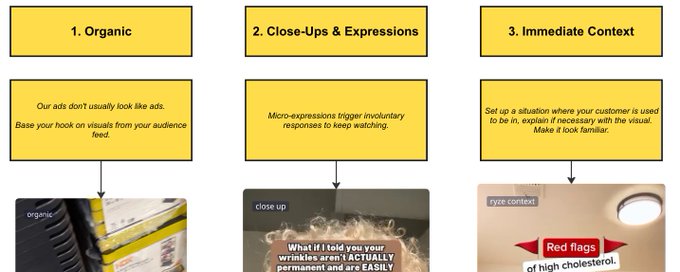
how to write hooks that consistently hit above 45% hook rate (full guide)
Here’s what TRUE creative diversity looks like:

Mars men's full meta ads playbook (4,512 ads)
Mars Men has 4,512 ads live on Meta right now, on a Facebook page that only exists since December 2023.